IRRBB Outlier Test: The 15% of Tier 1 Rule Explained

Some regulatory thresholds are quiet. This one is not. If a bank fails the IRRBB outlier test, it is formally flagged as carrying undue interest rate risk in its banking book, and a supervisory conversation follows that no treasury head enjoys. The rule itself fits in a single sentence, which is exactly why it is such a reliable CAIIB BFM question.
Ashish Sir's short frames the update. Watch it, then let us build the calculation underneath it, because the sentence only makes sense once you can see where the number comes from.
Outlier test banks update 2026 · Watch on YouTube
The rule, stated exactly
The governing circular is the Reserve Bank's "Governance, measurement and management of Interest Rate Risk in Banking Book", RBI/2022-23/180, dated 17 February 2023. Clause 7.5 is the one to memorise. A bank that generates a decline in Economic Value of Equity of more than 15 per cent of its Tier 1 capital under any one of the six prescribed interest rate shock scenarios is identified as an outlier, potentially carrying undue IRRBB exposure.
Four words in that sentence carry all the weight, and each is a place candidates lose marks:
- Decline in EVE, not net interest income. The IRRBB outlier test is an economic-value test, not an earnings test.
- 15 per cent, the threshold. Not 10, not 20.
- Tier 1 capital, the denominator. Not total capital, not CET1, not net worth.
- Any one of six scenarios. The worst single scenario decides it. Five comfortable results do not rescue a sixth bad one.
An older Basel formulation used 20 per cent of total capital. The current Indian rule is 15 per cent of Tier 1. If a stale question bank hands you the old pair, that question is out of date.
EVE and NII: two lenses on the same risk
Interest rate risk in the banking book damages a bank in two distinct ways, and the framework insists you measure both.
The economic value lens asks what the present value of the whole book is worth if the yield curve shifts. Every rate-sensitive asset, liability and off-balance-sheet item is discounted, and Economic Value of Equity is the residual. Because a longer-duration asset loses more present value for a given rate rise, a bank funding a thirty-year home loan book with three-month deposits carries a large negative sensitivity, and EVE exposes it immediately.
The earnings lens asks what happens to net interest income over the next twelve months or so. This is nearer-term and more visible to the market, but it misses the long-dated damage that has already been done to value.
The split is deliberate. EVE catches slow, structural mismatch. NII catches the immediate profit hit. A bank can look fine on one and fail badly on the other, which is precisely why the outlier threshold is attached to EVE, where the structural risk hides.
The six shock scenarios and the INR numbers
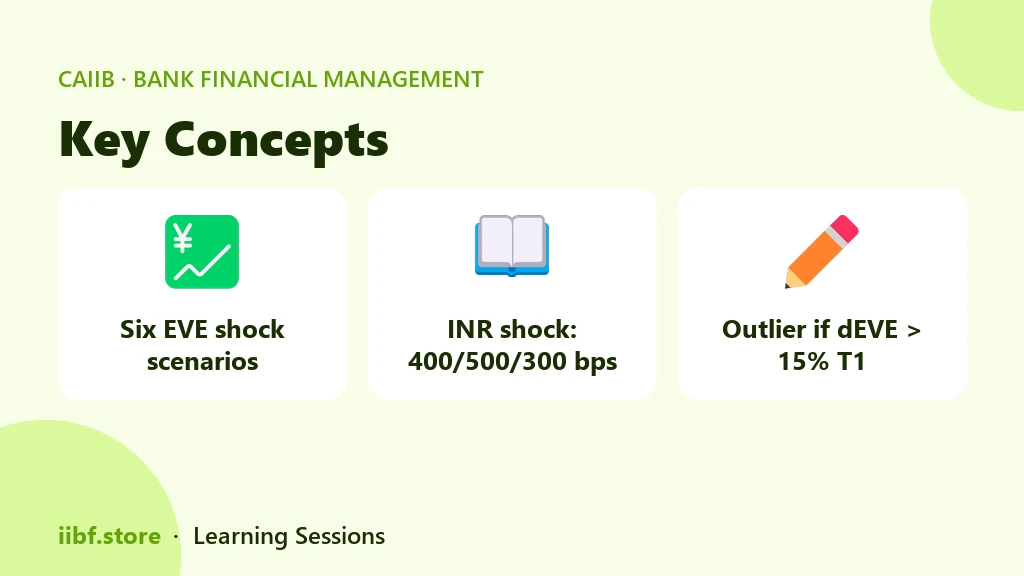
The six prescribed scenarios for EVE are parallel shock up, parallel shock down, steepener shock (short rates down and long rates up), flattener shock (short rates up and long rates down), short rates shock up, and short rates shock down. For NII, only the two parallel scenarios are applied.
Appendix 1 of the circular prescribes currency-specific shock sizes. For INR they are:
| Shock type | INR size | Where it applies |
|---|---|---|
| Parallel | 400 basis points | Parallel up and parallel down scenarios |
| Short | 500 basis points | Short-rate shocks; short end of steepener and flattener |
| Long | 300 basis points | Long end of steepener and flattener |
Two observations examiners like. The short shock at 500 bps is larger than the parallel at 400 bps, because short rates are empirically more volatile, and the shock decays as you move out along the curve. And the INR shocks sit among the larger ones in the Basel table, reflecting the historical volatility of Indian rates against, say, the euro or the yen.
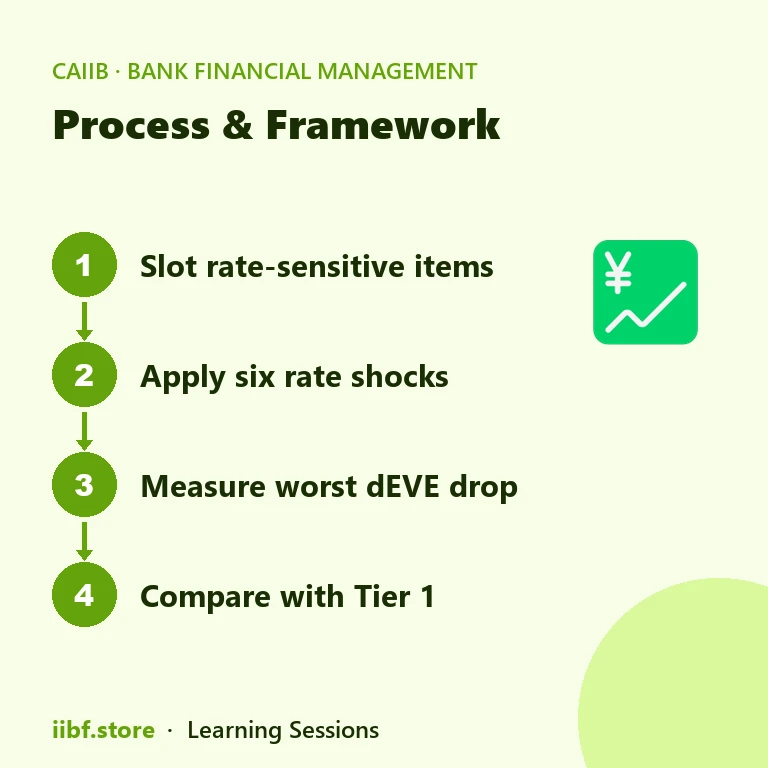
The reported result is the maximum of the worst aggregated reductions to EVE across the six scenarios. You do not average them, and you do not net a gain in one scenario against a loss in another.
A worked example
Take a bank with Tier 1 capital of Rs 12,000 crore. Its treasury runs the six scenarios and records the following declines in EVE: parallel up Rs 1,450 crore; parallel down Rs 260 crore; steepener Rs 900 crore; flattener Rs 1,910 crore; short up Rs 1,760 crore; short down Rs 310 crore.
The threshold is 15% of Rs 12,000 crore, which is Rs 1,800 crore. The worst single decline is the flattener at Rs 1,910 crore. Since Rs 1,910 crore exceeds Rs 1,800 crore, the bank is an outlier, even though five of the six scenarios sit comfortably inside the limit. Expressed as a ratio, the flattener decline is 15.9% of Tier 1.
Now watch the trap. If a candidate averages the six declines they get roughly Rs 1,098 crore, about 9.2% of Tier 1, and concludes the bank passes. If a candidate uses total capital of, say, Rs 15,000 crore as the denominator, the threshold becomes Rs 2,250 crore and the bank again appears to pass. Both are wrong, and both are the distractor options sitting on your paper.
What happens to an outlier
Being flagged is not an automatic capital penalty. IRRBB is a Pillar 2 risk, not a Pillar 1 charge, so there is no formula that converts the breach into a fixed add-on. What follows is supervisory: the Reserve Bank may require the bank to explain the exposure, to reduce it, to hold additional capital under the supervisory review process, or to constrain the mismatch that produced it. The internal consequence is usually faster than the external one, since a board risk committee tends to react to the word "outlier" well before the regulator writes.
Exam angle
Three question shapes recur. Straight recall of the 15% of Tier 1 threshold. A computation like the one above, where the trap is averaging or the wrong denominator. And a listing question on the six scenarios or the INR shock sizes. Learn 400, 500 and 300 as a trio; they are quick marks. Practise the variants in our CAIIB test series, revise the chapter inside CAIIB Bank Financial Management, and pick up the related ALM material in Advanced Bank Management. Slot a revision pass into your study planner, and read the circular itself on rbi.org.in. More rate-risk explainers sit on the blog.
What exactly is the threshold in this test?
A decline in Economic Value of Equity of more than 15 per cent of Tier 1 capital under any one of the six prescribed interest rate shock scenarios, per clause 7.5 of RBI/2022-23/180 dated 17 February 2023.
Is the threshold measured against Tier 1 or total capital?
Tier 1 capital. Using total capital or CET1 as the denominator is the most common error in computation questions on this topic.
What are the prescribed INR shock sizes?
Parallel 400 basis points, short 500 basis points and long 300 basis points, as set out in Appendix 1 of the circular.
Does failing the test mean an automatic capital charge?
No. IRRBB sits under Pillar 2, so there is no automatic Pillar 1 charge. The bank is flagged for supervisory review and may be required to reduce the exposure or hold additional capital under the supervisory review process.
Quick quiz on this topic
5 exam-style questions from our free test bank — check yourself before you move on.
Practice this topic
Take a free mock test, download chapter PDFs, or watch a video class — all included on iibf.store.
Keep reading