Forex Exchange Arithmetic: A Complete CAIIB BFM 2026 Guide
Every CAIIB BFM candidate eventually runs into forex exchange arithmetic — the numbers side of foreign exchange business that trips up otherwise strong students. Banks don't quote "one rate" for a currency; they quote a spread of TT and bill rates, buying and selling, each built off an interbank rate plus a margin. This article walks through forex exchange arithmetic exactly as it shows up in the CAIIB BFM paper: merchant rate construction, TT/bill logic, cross rates, and how it plugs into letters of credit and import-export bills.
📊 Understanding Forex Exchange Arithmetic in Bank Treasury
In India, foreign currencies are quoted against the rupee on a direct basis — rupees per unit of USD, GBP, EUR or JPY (per 100 JPY, by convention). The starting point is the interbank rate (also called the card rate), which the treasury desk picks up from the market. Branches never deal at this raw rate — they apply an exchange margin on top to arrive at the merchant rate quoted at the counter.
The margin direction depends on whether the bank is buying or selling. Buying deducts a margin from the interbank rate; selling adds one — a buy-low, sell-high spread that compensates for exchange risk, funding cost and handling. The chapter on Exchange Rates and Forex Business works through this mechanism in detail — worth reading first, since CAIIB rarely hands you the merchant rate directly.
💱 TT Buying, TT Selling, Bill Buying and Bill Selling — The Four Merchant Rates
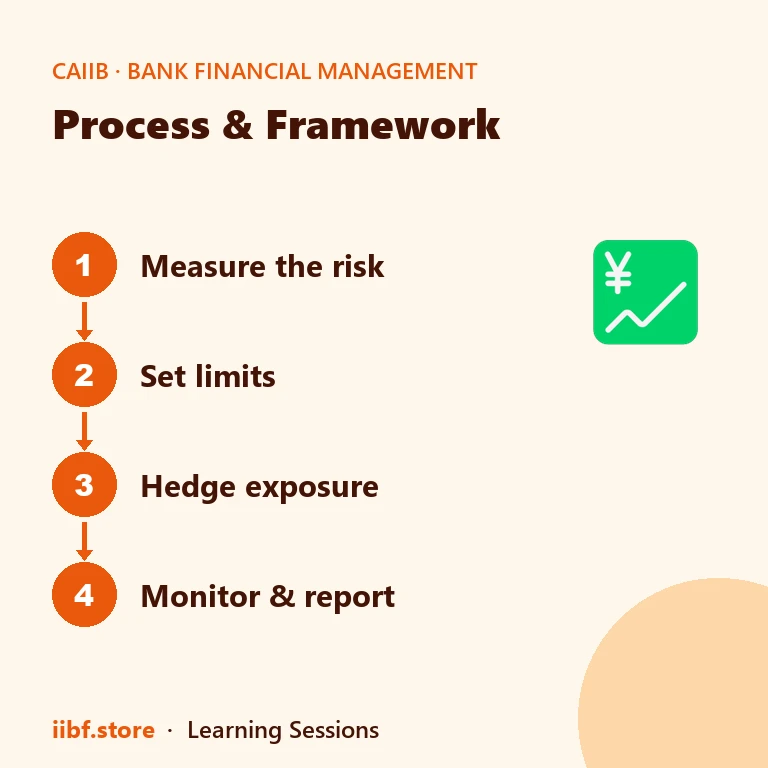
Once a margin sits on top of the interbank rate, the real BFM skill is knowing which of the four merchant rates applies, and in which direction the margin moves.
- TT Buying Rate = Interbank Buying Rate − Margin. Applied on a clean inward remittance, no documents involved.
- TT Selling Rate = Interbank Selling Rate + Margin. Applied on a clean outward remittance.
- Bill Buying Rate = Interbank Buying Rate − (Margin + notional transit-period interest). Applied when purchasing a foreign bill — the bank loses interest for the transit/collection period.
- Bill Selling Rate = TT Selling Rate + a small document-handling margin, typically used when retiring an import bill under an LC.
Example: interbank USD/INR is ₹83.20 (buying) / ₹83.24 (selling), margin 0.20%. TT buying ≈ ₹83.03; TT selling ≈ ₹83.41. Bill buying shaves off a little more for a notional 20-25 day transit period.
💡 Exam Tip: One rule covers all four rates — the bank always protects itself. Buying rates sit below the interbank mid-rate, selling rates sit above it, and bill rates always carry an extra adjustment against the customer versus TT rates.
🧮 Cross Rates and the Chain Rule for Third-Currency Deals
Not every pair is quoted directly against the rupee. If a customer wants euros converted to rupees and the bank only has USD/INR and USD/EUR on screen, it computes a cross rate via the chain rule — routing through a common vehicle currency, almost always the US dollar.
Example: USD/INR = 83.20, USD/EUR = 0.92 (one dollar buys 0.92 euro). EUR/INR = 83.20 ÷ 0.92 ≈ ₹90.43. Had the quotes been stated the other way round, you would multiply instead of divide — the chain rule simply cancels the common currency out.
⚠️ Common Mistake: Forgetting whether a quote is "units of X per Y" or the reverse, and inverting the final answer. Write the currency pair explicitly above every rate before calculating — it prevents almost every chain-rule error.
CAIIB chain-rule questions are usually two-step: derive the merchant rate first, then run the cross-rate calculation — treat it as one combined problem, since setters like testing both together.
📄 Forex Arithmetic in Letters of Credit and Import-Export Bills
This arithmetic decides how much an exporter is credited or an importer is debited. When an export bill is negotiated under an LC, the bank applies the bill buying rate, crediting the exporter net of the notional transit-period discount. The chapter on Documentary Letters of Credit covers how usance period and reimbursement terms interact with this arithmetic.
On the import side, retiring a bill under an LC uses the bill selling rate. If a forward contract hedges the payment, the forward rate (spot adjusted for the annualised premium/discount over the tenor) replaces the spot rate. The chapter on Facilities for Importers and Exporters ties packing credit, bill discounting and forward cover back to the same mechanics.
📌 Remember: Export bill negotiation always uses a buying rate; import bill retirement always uses a selling rate. Getting the direction right is half the battle in any trade-finance numerical.
🌍 Where This Arithmetic Shows Up: LRS, ECB and GIFT City IFSC
The same buy/sell and cross-rate logic recurs elsewhere in BFM. A resident remitting abroad under the Liberalised Remittance Scheme is still converted at a TT selling rate — see LRS and Other Remittance Facilities for Residents. A corporate servicing an External Commercial Borrowing sees its rupee cost move with this same arithmetic at each payment date — covered in External Commercial Borrowings and Foreign Investments in India.
Units in GIFT City IFSC deal predominantly in foreign currency, so this arithmetic drives valuation even without a rupee leg — see International Financial Service Centre (IFSC), GIFT City. ITDB candidates will recognise the same buy/sell logic underneath API banking in India settlement rails. For the regulatory framework governing authorised dealers, see the RBI's Master Directions on Foreign Exchange Management.
| Rate Type | When Bank Uses It | Margin Direction | Involves Documents ✅/❌ |
|---|---|---|---|
| TT Buying Rate | Clean inward remittance | Deducted from interbank buying rate | ❌ |
| TT Selling Rate | Clean outward remittance | Added to interbank selling rate | ❌ |
| Bill Buying Rate | Negotiation of export bill | Deducted, plus transit-period interest | ✅ |
| Bill Selling Rate | Retirement of import bill under LC | Added, plus document-handling margin | ✅ |
If you've already covered Asset Liability Management in Banks, bond duration and convexity and IRRBB in banking book, this forex module rounds out BFM — heavily scored in the numerical section since most candidates under-practise it relative to balance-sheet topics.
🧠 Practice MCQs: Forex Exchange Arithmetic
Q1. If the USD/INR interbank rate is ₹83.00 and GBP/USD is 1.25, what is the GBP/INR cross rate using the chain rule? (a) ₹66.40 (b) ₹103.75 (c) ₹84.25 (d) ₹92.00
Answer: (b) — Multiply the two legs through the common USD currency: 83.00 × 1.25 = 103.75.
Q2. A bank receives a clean inward telegraphic transfer with no underlying trade document. Which rate does it apply to convert the foreign currency? (a) Bill Buying Rate (b) Bill Selling Rate (c) TT Buying Rate (d) TT Selling Rate
Answer: (c) — TT rates apply whenever there is no document to handle; since the bank is buying foreign currency, it is the TT Buying Rate.
Q3. Compared to the TT buying rate, the bill buying rate for the same currency is normally: (a) Higher, because of document handling charges (b) Lower, because of notional transit-period interest cost (c) Identical in all cases (d) Not comparable, since they apply to different currencies
Answer: (b) — Bill buying involves a notional transit/collection period during which the bank loses interest, so the rate is adjusted lower.
Q4. When an export bill is negotiated under a letter of credit, the exporter's rupee proceeds are most directly affected by: (a) The bank's TT selling rate (b) The bill buying rate applied on negotiation (c) The RBI's repo rate on that date (d) The importer's local bank charges
Answer: (b) — The bill buying rate converts the invoice value into rupees credited to the exporter, net of the notional transit-period discount.
Q5. When a currency pair is not directly quoted against the rupee, a bank computes the rate by: (a) Estimating it from historical averages (b) Applying only the exchange margin twice (c) Using the chain rule through a common vehicle currency (d) Waiting for the interbank market to quote it directly
Answer: (c) — The chain rule derives the missing cross rate by routing through a currency quoted against both, almost always the US dollar.
Want chapter-wise mock tests with 100+ MCQs? Start practising free →
Frequently Asked Questions
What is the difference between a TT rate and a bill rate in forex arithmetic?
TT rates apply to clean remittances with no document involved; bill rates apply when a bill of exchange is bought or sold, adding a document-handling adjustment and, on the buying side, notional transit-period interest.
Why do banks always buy foreign currency low and sell it high?
The buy-low, sell-high spread compensates the bank for exchange risk, funding cost, and the operational cost of the transaction — it is the bank's margin on every forex deal.
How is a cross rate calculated when a currency isn't quoted directly against the rupee?
The bank applies the chain rule, computing the rate through a common vehicle currency — typically the US dollar — so that currency cancels out of the calculation.
Does forward cover change the exchange rate used in trade finance arithmetic?
Yes — once a forward contract is booked, the forward rate (spot adjusted for the annualised premium or discount) replaces the spot merchant rate in the calculation.
Ready to put this into practice? Work through timed numericals on iibf.store's CAIIB course and pair this article with the rest of the Bank Financial Management tag hub to cover the syllabus systematically.
Quick quiz on this topic
5 exam-style questions from our free test bank — check yourself before you move on.
Practice this topic
Take a free mock test, download chapter PDFs, or watch a video class — all included on iibf.store.
Keep reading