Deferred Tax Assets in Banks: AS 22 Timing Differences (JAIIB AFM)
Deferred tax assets in banks are one of the least understood lines on a bank's balance sheet, yet they appear in almost every JAIIB AFM paper. They arise because the profit a bank reports to shareholders under accounting rules is almost never the same figure on which it pays income tax. Accounting Standard 22 bridges that gap by recognising the tax effect of differences that will reverse in later years.
This guide explains how the asset is created, which bank-specific items generate it, how RBI's capital rules treat it, and the traps examiners love to set around it.
📘 Why Deferred Tax Exists in a Bank's Books
A bank prepares its profit and loss account under the Banking Regulation Act, 1949 and applicable accounting standards, but computes taxable income under the Income-tax Act, 1961. The two sets of rules disagree on when an item is allowed, so the tax actually payable for a year rarely matches the tax expense that the matching concept demands.
AS 22, Accounting for Taxes on Income, resolves this by splitting the difference between book profit and taxable income into two categories. Timing differences originate in one period and reverse in one or more subsequent periods. Permanent differences never reverse at all.
Only timing differences attract deferred tax. If a bank charges a provision to its profit and loss account today that the Assessing Officer will allow only when the loan is actually written off three years later, the bank has effectively prepaid tax. That prepayment is carried forward as a deferred tax asset, and it unwinds when the deduction is finally claimed.
The reverse situation creates a deferred tax liability. When the Income-tax Act allows a deduction earlier than the books do, the bank enjoys a temporary tax holiday that it must eventually pay back. Recognising both sides keeps reported tax expense proportionate to reported profit, which is exactly what a user of financial statements expects when reading the Preparation of final accounts of a banking company.
💡 Exam Tip: Deferred tax is never computed on the difference between book profit and taxable income as a whole. Isolate each item first, classify it as timing or permanent, and only then apply the tax rate.
⚖️ Timing Differences That Create DTA and DTL in Banks
Banks have a distinctive set of timing differences that other companies simply do not face, and these are the ones that carry marks in the exam.
The largest driver is loan loss provisioning. Section 36(1)(viia) caps the deduction for provision for bad and doubtful debts at 8.5% of total income plus 10% of the aggregate average advances made by rural branches of a scheduled bank. Prudential provisioning under RBI's IRAC norms is usually far higher, so the excess is disallowed today and allowed later under Section 36(1)(vii) when the account is written off. That excess is the single biggest source of deferred tax assets in banks.
Depreciation works in the opposite direction. Written down value rates under the Income-tax Act are generally front-loaded compared with the straight line charge many banks use in their books, so the early years throw up a deferred tax liability. The mechanics of the two systems are covered in detail in our note on depreciation accounting methods.
Section 43B items such as gratuity, leave encashment and bonus are deductible only on actual payment, so any unpaid provision creates a further asset. The Special Reserve under Section 36(1)(viii) creates a liability, because RBI has directed banks to provide for the tax that would fall due if the reserve were ever withdrawn.
| Item | Treatment in books | Treatment under Income-tax Act | Deferred tax created | Creates DTA? |
|---|---|---|---|---|
| Provision above the 36(1)(viia) ceiling | Charged to P&L now | Allowed on write-off later | DTA | ✅ |
| Depreciation on premises and equipment | Lower charge (SLM) | Higher charge (WDV) | DTL | ❌ |
| Special Reserve u/s 36(1)(viii) | Appropriation of profit | Deducted now, taxed on withdrawal | DTL | ❌ |
| Provision for leave encashment / gratuity | Charged to P&L now | Allowed on payment u/s 43B | DTA | ✅ |
| Penalty for infraction of law | Charged to P&L | Permanently disallowed u/s 37 | None | ❌ |
🧮 Computing and Recording Deferred Tax Step by Step
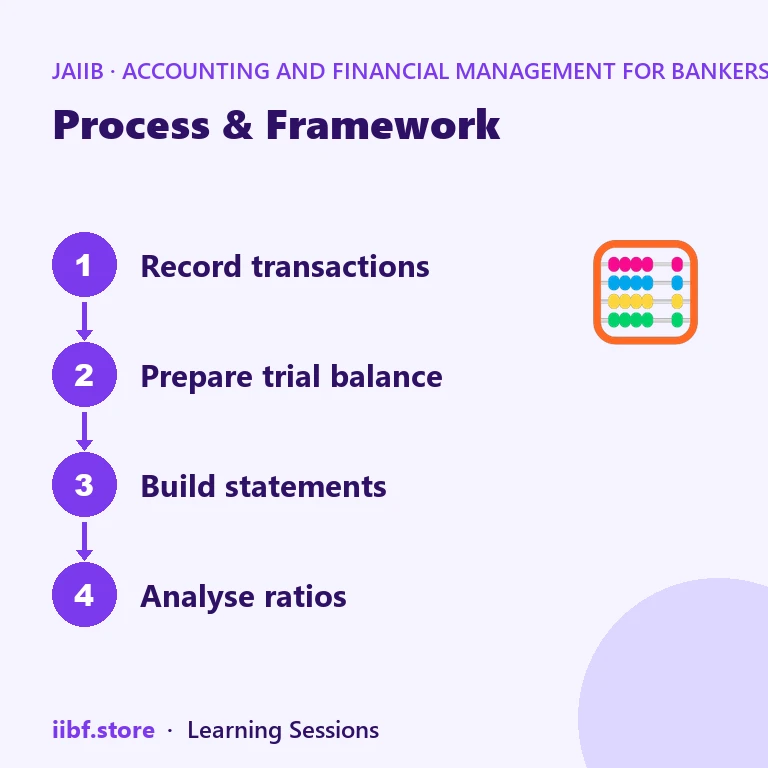
The computation follows a fixed sequence, and marks are usually lost at step two rather than step four.
- List every difference between the book charge and the tax deduction for the year.
- Discard permanent differences such as penalties, disallowed expenditure and exempt income.
- Apply the tax rate enacted or substantively enacted on the balance sheet date to each remaining item.
- Aggregate the debits and credits and present a single net figure, since a bank's assets and liabilities relate to the same taxing authority.
Take a bank with an excess loan loss provision of ₹40 crore, an unpaid leave encashment provision of ₹5 crore, and tax depreciation exceeding book depreciation by ₹15 crore. Under the concessional regime of Section 115BAA the effective rate is 25.168%. The deferred tax asset is ₹45 crore × 25.168% = ₹11.33 crore and the deferred tax liability is ₹15 crore × 25.168% = ₹3.78 crore, giving a net asset of ₹7.55 crore.
The entries are straightforward. A net asset is recorded as Deferred Tax Asset A/c Dr. with a corresponding credit to the profit and loss account, reducing total tax expense for the year. A net liability reverses that entry. Deferred tax is never discounted to present value, a point that separates it from the discounting logic used elsewhere in financial management and from the entries drilled in Operational Aspects of Accounting Entries.
⚠️ Common Mistake: Candidates apply the rate at which tax was actually paid last year. AS 22 requires the rate expected to apply when the difference reverses, measured by the law enacted or substantively enacted on the balance sheet date.
🛡️ Prudence, Virtual Certainty and the Basel III Capital Hit
An asset that depends entirely on earning future profits deserves scepticism, and both the accounting standard and the regulator apply it.
Under AS 22, a deferred tax asset arising from ordinary timing differences may be recognised only when there is reasonable certainty that sufficient future taxable income will be available. Where the asset arises from unabsorbed depreciation or carry-forward business losses, the far tougher test of virtual certainty supported by convincing evidence applies. A profitable order book or binding contracts may qualify; optimistic internal projections do not. The carrying amount must be reviewed and written down at every balance sheet date.
RBI goes further in its Basel III Capital Regulations. Deferred tax assets that rely on future profitability and arise from accumulated losses are deducted in full from Common Equity Tier 1 capital. Those arising from temporary differences are treated more leniently and are subject to a threshold, with amounts above the prescribed proportion of CET1 also deducted. The practical effect is that a large DTA flatters reported net worth while doing nothing for regulatory capital.
This is why capital planning teams track the asset separately from other receivables, alongside the ratios and rate movements published on our RBI policy rates page. The same discipline of testing an estimate against evidence rather than hope also underpins budgetary control in banks.
📋 Presentation, Disclosure and the Exam Traps
In the Form A balance sheet prescribed by the Third Schedule to the Banking Regulation Act, 1949, a net deferred tax asset appears within Other Assets and a net liability within Other Liabilities and Provisions. RBI's Master Direction on Financial Statements — Presentation and Disclosures, available on the RBI Master Directions portal, requires the net position to be shown distinctly rather than buried in a residual head.
Notes to accounts must disclose the major components of the balance, the basis on which recognition was considered appropriate, and the effect of any change in the tax rate. Deferred tax is charged to the profit and loss account as part of tax expense, except where the underlying item was itself taken directly to reserves, as RBI required for the Special Reserve.
Three traps recur in the paper. First, candidates treat exempt income as a timing difference; it is permanent. Second, they net a DTA of one group entity against a DTL of another; netting is permitted only within the same taxable entity and taxing authority. Third, they forget that tax deducted at source is an advance payment of current tax and has nothing to do with deferred tax, a distinction worth revising alongside TDS - Tax Deducted at Source and the depositor-facing rules on tds on bank fixed deposits.
📌 Remember: Indian banks still follow AS 22. RBI has deferred Ind AS implementation for banks until further notice, so the balance-sheet approach of Ind AS 12 is background reading, not the examinable rule.
Because banking profitability tracks the wider economy, the reversal assumptions behind these assets are ultimately macro judgements, a link explored in our piece on the services sector in the Indian economy.

🧠 Practice MCQs: Deferred Tax Assets in Banks
Q1. Which of the following is a permanent difference under AS 22? (a) Provision for leave encashment (b) Provision for bad debts above the 36(1)(viia) ceiling (c) Penalty paid for infraction of law (d) Excess of tax depreciation over book depreciation
Answer: (c) — A penalty disallowed under Section 37 is never allowed in any future year, so it never reverses.
Q2. A bank's provision for bad and doubtful debts is ₹120 crore, of which only ₹80 crore is allowable under Section 36(1)(viia). At a tax rate of 25%, the deferred tax effect is: (a) DTA of ₹30 crore (b) DTA of ₹10 crore (c) DTL of ₹10 crore (d) No deferred tax, as it is a permanent difference
Answer: (b) — The disallowed ₹40 crore reverses on write-off; ₹40 crore × 25% = ₹10 crore deferred tax asset.
Q3. RBI requires banks to create a deferred tax liability on the Special Reserve created under which section of the Income-tax Act, 1961? (a) Section 36(1)(vii) (b) Section 36(1)(viia) (c) Section 43B (d) Section 36(1)(viii)
Answer: (d) — The Special Reserve for eligible long-term finance under Section 36(1)(viii) becomes taxable on withdrawal, so a liability must be provided.
Q4. A deferred tax asset on unabsorbed depreciation and carry-forward losses may be recognised only when there is: (a) Reasonable certainty of future taxable income (b) Virtual certainty supported by convincing evidence (c) Written approval of the statutory auditors (d) Certainty that tax rates will not change
Answer: (b) — AS 22 imposes the stricter virtual certainty test precisely because past losses weaken the evidence of future profits.
Q5. Under RBI's Basel III capital rules, a deferred tax asset that relies on future profitability and arises from accumulated losses is: (a) Deducted in full from Common Equity Tier 1 capital (b) Risk weighted at 100% (c) Retained fully within Tier 1 capital (d) Included in Tier 2 capital
Answer: (a) — Such an asset has no loss-absorbing value in a stress scenario, so it is deducted entirely from CET1.
Want chapter-wise mock tests with 100+ MCQs? Start practising free →
❓ Frequently Asked Questions
Are deferred tax assets in banks real, realisable assets?
No. They are notional book entries representing future tax savings, not cash or a claim on any counterparty. They are realised only if the bank earns enough taxable income for the underlying difference to reverse, which is why regulators discount them for capital purposes.
How much loan loss provision can a scheduled bank actually deduct?
Section 36(1)(viia) permits a deduction of up to 8.5% of total income computed before this deduction, plus 10% of the aggregate average advances made by rural branches. Provisioning beyond this limit is disallowed for the year and creates a deferred tax asset.
Do Indian banks apply AS 22 or Ind AS 12?
Indian banks continue to apply AS 22, since RBI deferred the implementation of Ind AS for banks until further notice. Ind AS 12 uses a balance-sheet approach based on temporary differences rather than the income-statement approach of timing differences.
What happens to the balance when the corporate tax rate changes?
The entire deferred tax balance is remeasured at the new enacted rate, and the resulting gain or loss is recognised in the profit and loss account in the year the change is enacted. Many banks recorded a one-time hit when they migrated to the concessional regime under Section 115BAA.
Master this before exam day
Deferred tax rewards candidates who can classify an item correctly in ten seconds and then apply one multiplication. Work through the numericals in the JAIIB course, revise the wider tax and accounting set on the AFM article hub, and treat every provision in a bank's books as a question about timing.
Quick quiz on this topic
5 exam-style questions from our free test bank — check yourself before you move on.
Practice this topic
Take a free mock test, download chapter PDFs, or watch a video class — all included on iibf.store.
Keep reading