Last 5 Days Revision Plan for JAIIB and CAIIB That Works
The reel below is blunt: five days left, stop reading theory, start attempting questions. It is framed as a warning, and it deserves unpacking, because a last 5 days revision block behaves nothing like the eight weeks that came before it. What worked then — reading, highlighting, building notes — is exactly what fails now.
Warning for bankers · Watch on YouTube
Here is a plan built around the actual shape of the paper rather than around motivation. The examination is objective, roughly 100 questions for 100 marks, two hours, online, with no negative marking for wrong answers. Every decision below follows from those four facts.
Why the last week must be practice, not reading
Two hours for a hundred questions is about seventy-two seconds each — and that average has to absorb the three or four numerical items that will eat three minutes apiece. Reading a chapter improves recognition. It does very little for retrieval speed, and speed is what the final week is short of. A candidate who has read every module but never sat a timed full-length paper will discover the deficit at question sixty, which is the worst possible moment to discover anything.
No negative marking changes the arithmetic completely. There is no rational reason to leave a question blank. A blind guess on a four-option question has an expected value of 0.25 marks; a blank has an expected value of zero. Twenty unattempted questions therefore give away roughly five marks for nothing — and in an examination where the pass mark is 50 out of 100, five marks decide outcomes.
The five-day schedule
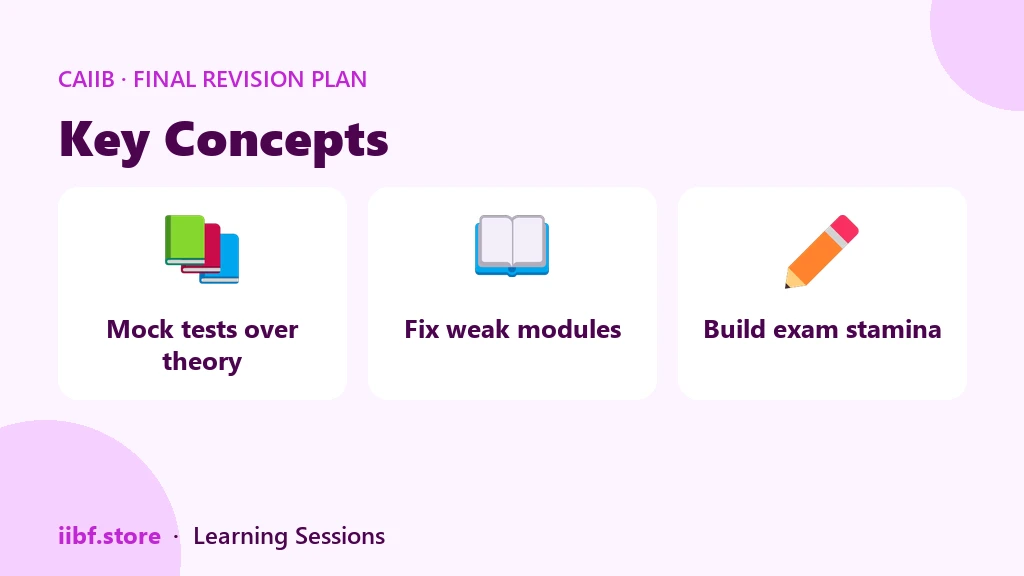
The structure alternates diagnosis and repair. You are not trying to learn new material; you are trying to convert what you half-know into what you can retrieve under a clock.
| Day | Main block | Purpose |
|---|---|---|
| Day 5 | One full-length 100-question mock, strictly timed | Establish a baseline and expose weak modules honestly |
| Day 4 | Error analysis, then targeted revision of the two worst modules | Repair the largest gaps while there is still room |
| Day 3 | Sectional tests on the weak modules plus a formula and definition sweep | Convert repaired topics into scoring topics |
| Day 2 | Second full-length mock at the exact exam time slot | Rehearse pacing and stamina, not knowledge |
| Day 1 | Light review of the error log and the one-page formula sheet; early night | Consolidate; protect sleep and working memory |
The error log is the part people skip and the part that carries the plan. After every mock, sort the wrong answers into three buckets: did not know, knew but misread, and knew but ran out of time. Those need three different fixes — study, slow down, and practise faster respectively. Treating all three as "revise more" is why scores stall between mocks.
Practical rules for the final week
- Attempt at the same hour as your slot. Concentration is trainable and time-of-day specific. A 10 a.m. exam deserves 10 a.m. mocks.
- Never leave a blank. With no negative marking, mark your best guess, flag it, and move. Come back only if time remains.
- Two passes, not one. First pass takes everything you can answer inside about a minute; second pass handles the flagged ones. This alone rescues candidates who otherwise stall on question forty.
- One page of formulas, not twenty. Ratios, capital and liquidity figures, statistical formulas — whatever your paper needs, on a single sheet you re-read daily.
- Stop new material at Day 3. A topic opened for the first time on Day 2 costs more in confidence than it can return in marks.
- Protect sleep. Recall accuracy falls faster with sleep debt than with a missed chapter. This is the cheapest score improvement available.
What "one mega test" actually buys you
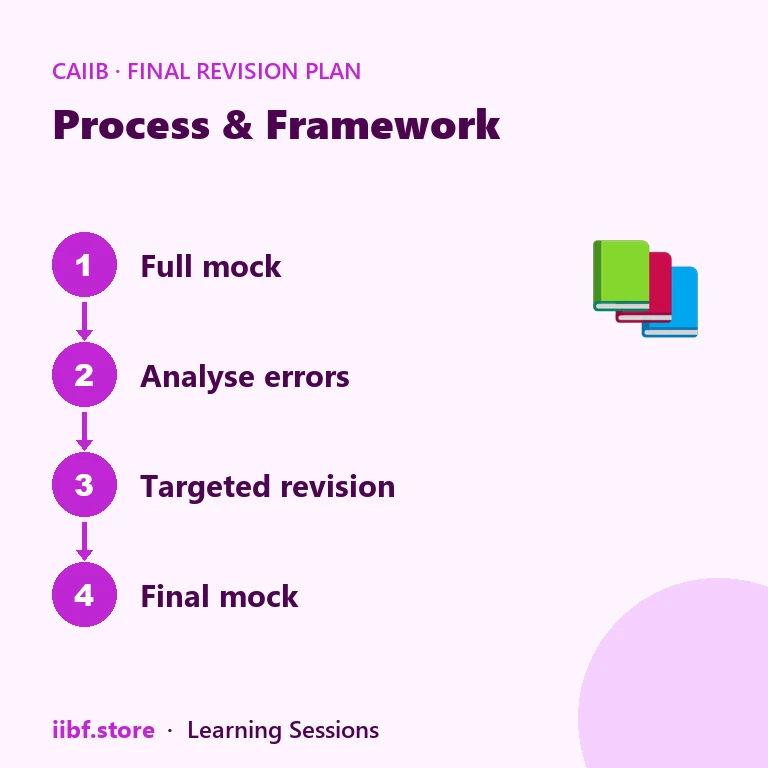
The reel pushes a hundred-question mock, and the recommendation is sound for a reason that is easy to miss. A full-length paper is the only instrument that tests all three failure modes at once — knowledge, pacing and stamina. Sectional tests measure knowledge cleanly but hide the other two, which is why a candidate can score well on twenty-question sets all month and still finish short in the hall.
Do it twice, not five times. Two full mocks with serious analysis between them beat five mocks skimmed for the score. The score is diagnostic output, not the goal; what you do with the wrong answers is the goal.
Set the plan up on the CAIIB course or the JAIIB course, run the timed papers from the test series, block the five days in the planner, and confirm your examination date and reporting instructions on the IIBF website rather than from any forwarded message.
What to do if you have three days, not five
Plans meet reality. If a busy branch week has left you with three days, compress rather than abandon: one full mock on day three, a hard error-analysis session on day two, and a short sectional plus the formula sheet on day one. The sequence matters more than the length. Diagnose, repair, rehearse — a compressed last 5 days revision cycle still beats three days of unstructured reading by a wide margin.
If you have only one evening, do exactly two things. Attempt fifty questions under a strict clock to reset your pacing instinct, then read your own error log rather than any book. Fresh material at that stage adds noise, not marks.
One more caution. Avoid comparing mock scores with anyone else in the final week. The only comparison carrying real information is your own second mock against your first, on the same pattern, at the same hour. Everything else is a distraction dressed up as motivation, and a last 5 days revision window is far too short to spend on it.
Frequently asked questions
Should I read new chapters in the last five days?
Only until Day 3, and only if a module is completely untouched and carries meaningful weight. After that, new material competes for the retrieval capacity you need for topics you already half-know, and it usually loses.
Is guessing worth it in JAIIB and CAIIB papers?
Yes. There is no negative marking for wrong answers, so an unattempted question is strictly worse than a guess. Mark something for every question before the paper ends.
How many mock tests should I attempt in the final week?
Two full-length papers with thorough error analysis between them, supported by sectional tests on weak modules. More mocks without analysis produce scores, not improvement.
What if my mock score is still below 50 on Day 2?
Stop adding topics and concentrate entirely on the modules where your error log shows the highest count of "knew but misread" and "ran out of time" mistakes. Those convert to marks fastest, and with no negative marking, completing every question often adds several marks on its own.
Prefer revising from a printed book?
Chapter-wise books with MCQs after every chapter — minimal pages, complete coverage, delivered anywhere in India. Every book has a free sample to read first.
148 pages · 478 MCQs
Learning Sessions · Ashish Sir
151 pages · 465 MCQs
Learning Sessions · Ashish Sir
148 pages · 375 MCQs
Learning Sessions · Ashish Sir
216 pages · 895 MCQs
Learning Sessions · Ashish Sir
109 pages · 300 MCQs
Learning Sessions · Ashish Sir
104 pages · 360 MCQs
Learning Sessions · Ashish Sir
82 pages · 297 MCQs
Learning Sessions · Ashish Sir
151 pages · 600 MCQs
Learning Sessions · Ashish Sir
98 pages · 282 MCQs
Learning Sessions · Ashish Sir
131 pages · 672 MCQs
Learning Sessions · Ashish Sir
221 pages · 831 MCQs
Learning Sessions · Ashish Sir
128 pages · 524 MCQs
Learning Sessions · Ashish Sir
107 pages · 445 MCQs
Learning Sessions · Ashish Sir
132 pages · 225 MCQs
Learning Sessions · Ashish Sir
188 pages · 435 MCQs
Learning Sessions · Ashish Sir
117 pages · 236 MCQs
Learning Sessions · Ashish Sir
Learning Sessions · Ashish Sir
118 pages · 299 MCQs
Learning Sessions · Ashish Sir
Learning Sessions · Ashish Sir
Learning Sessions · Ashish Sir
Learning Sessions · Ashish Sir
115 pages · 255 MCQs
Learning Sessions · Ashish Sir
Learning Sessions · Ashish Sir
334 pages · 936 MCQs
Learning Sessions · Ashish Sir
Learning Sessions · Ashish Sir
115 pages · 344 MCQs
Learning Sessions · Ashish Sir
107 pages · 240 MCQs
Learning Sessions · Ashish Sir
90 pages · 150 MCQs
Learning Sessions · Ashish Sir
Learning Sessions · Ashish Sir
Quick quiz on this topic
5 exam-style questions from our free test bank — check yourself before you move on.
Practice this topic
Take a free mock test, download chapter PDFs, or watch a video class — all included on iibf.store.