Lender of Last Resort Function of RBI: CAIIB Central Banking Guide (2026)
The lender of last resort function of RBI is one of the oldest and most tested ideas in the CAIIB Central Banking elective, yet candidates routinely confuse it with a bailout or with routine liquidity injection. In plain terms, a central bank acts as the lender of last resort (LOLR) when it stands ready to supply emergency funds to solvent banks that are temporarily unable to meet their obligations, so that a localised cash crunch does not snowball into a full-blown banking panic. Understanding the lender of last resort function of RBI means understanding when the Reserve Bank steps in, through which windows it lends, and crucially where it draws the line. This guide walks through the theory, the legal backing under the RBI Act, the operational plumbing, and the moral-hazard debate, with a comparison table, exam callouts and practice MCQs to lock it in.
🏦 What "Lender of Last Resort" Actually Means
A commercial bank funds long-term, illiquid loans with short-term, callable deposits. This maturity mismatch is profitable but fragile: if enough depositors demand cash at once, even a fundamentally sound bank can run out of liquid assets. The lender of last resort exists precisely for this moment. By promising to lend against good collateral, the central bank breaks the self-fulfilling logic of a bank run — depositors who know the bank can always raise cash have no reason to rush the counter.
The key distinction the examiner wants you to make is illiquidity versus insolvency. LOLR support is meant for institutions that are solvent (assets exceed liabilities) but illiquid (cannot convert those assets to cash quickly enough). A bank whose capital has already been wiped out is not a candidate for last-resort lending; it belongs in a resolution or Prompt Corrective Action framework track. Blurring this line is the single most common error in the topic.
The LOLR role sits alongside the RBI's other classic functions — issuer of currency, banker to government, and regulator — and you can revise how these fit together in the chapter on the functions of the Reserve Bank of India. LOLR is the ultimate expression of the RBI being the "bankers' bank": the one balance sheet in the system that cannot itself run out of rupees.
💡 Exam Tip: If a question describes a bank that is "solvent but facing a temporary cash shortfall", the correct policy response is last-resort lending — not deposit insurance payout and not capital infusion. Match the symptom to the tool.
📜 Bagehot's Principles and the Legal Basis in the RBI Act
The intellectual foundation comes from Walter Bagehot's 1873 classic Lombard Street. His dictum is usually compressed into three rules: in a crisis the central bank should lend freely, at a penalty (high) rate, against good collateral. Lending freely stops the panic; the penalty rate ensures banks only come to the window in genuine distress and return to markets once calm returns; the good-collateral requirement protects the central bank's balance sheet from taking losses on a truly bust institution. Every modern LOLR framework, including India's, is a variation on these three principles.
In India the statutory backing sits in the Reserve Bank of India Act, 1934. Section 17 lists the banking business the RBI may transact, including making loans and advances to banks and rediscounting eligible bills, while Section 18 gives the RBI a discretionary emergency power to provide loans and advances to banks in special circumstances to preserve financial stability. This emergency clause is the legal engine of the lender of last resort function of RBI. Because the power is discretionary, the RBI is never obliged to lend to a particular bank — a deliberate design choice that keeps "constructive ambiguity" alive and discourages banks from treating rescue as guaranteed.
These provisions interlock with the RBI's day-to-day monetary policy operations, because the same instruments that manage systemic liquidity can be widened in a crisis to become last-resort support.
📌 Remember: Bagehot's penalty rate is the reason the Marginal Standing Facility sits above the policy repo rate. The pricing is a feature, not an accident — it nudges banks back to the market.
🔧 How the RBI Delivers the Function: Standing Facilities and Special Windows
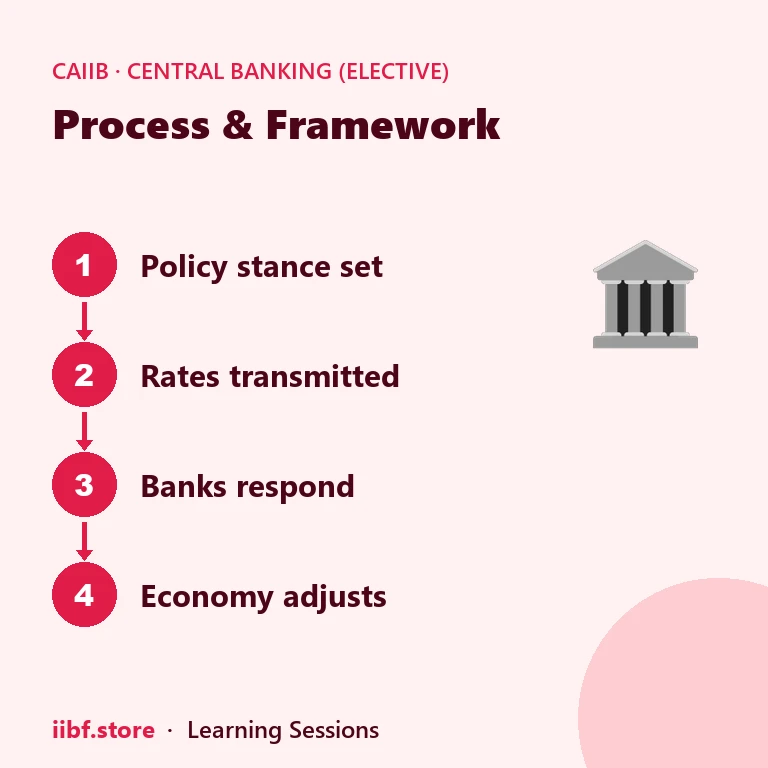
The RBI does not have a single button marked "LOLR". Instead the function is delivered through a graduated set of windows. In normal times banks manage liquidity through the Liquidity Adjustment Facility corridor. The upper bound of that corridor, the Marginal Standing Facility (MSF), is the closest thing to a routine last-resort window: any scheduled commercial bank can borrow overnight funds against government securities (including, within limits, a slice of its own SLR holdings) at a rate set above the repo rate. Because it is penal and always available, MSF embodies Bagehot's logic in the ordinary operating framework.
When a shock is broader — a system-wide freeze rather than one bank's bad day — the RBI opens bespoke facilities: special liquidity windows, targeted long-term repo operations, and dedicated lines routed through institutions to reach stressed segments such as NBFCs and mutual funds. These were used during the 2008 global crisis and again in 2020. Understanding how these windows price and collateralise liquidity connects directly to treasury operations in banks, since it is the treasury desk that actually taps them.
| Facility | Rate vs repo | Tenor | Collateral | Classic LOLR tool? |
|---|---|---|---|---|
| Standing Deposit Facility (SDF) | Below repo (floor) | Overnight | None (deposit) | ❌ (absorbs liquidity) |
| Repo (LAF) | Policy rate | Overnight/term | G-Sec | ❌ (routine) |
| Marginal Standing Facility (MSF) | Above repo (ceiling) | Overnight | G-Sec incl. SLR slice | ✔️ (penal, always open) |
| Section 18 emergency loans | Discretionary/penal | Case-specific | Eligible assets | ✔️ (true last resort) |
| Special crisis windows | Concessional/penal | Weeks–years | Widened pool | ✔️ (systemic) |
Note that the collateral pool tends to widen as the crisis deepens — the reverse of the SDF, which is a liquidity-absorbing floor and never a lending tool at all.
⚠️ Moral Hazard, Solvency and Systemic Risk
The gravest objection to any LOLR regime is moral hazard: if bankers believe the RBI will always rescue them, they take on excessive risk, knowing the downside is socialised. Central banks manage this in three ways. First, the penalty rate makes rescue expensive. Second, discretion (Section 18 is a "may", not a "shall") keeps banks guessing — the doctrine of constructive ambiguity. Third, LOLR is paired with tough supervision so that risk-taking is caught before it needs rescuing. A bank that repeatedly needs the window is flagged for corrective action rather than indulged.
Examiners also probe the boundary between the LOLR and fiscal support. Classic last-resort lending is a liquidity operation against collateral, temporary and self-liquidating; a bailout is a solvency operation involving taxpayer capital, and in India that is a government call, not a central-bank one. Keeping the two separate protects the RBI's balance sheet and its credibility, which is why the collateral test in Bagehot's rule matters so much. This debate links to the wider study of fiscal-monetary relations and to how the G-Sec market supplies the high-quality collateral that makes safe LOLR lending possible.
🚫 Common Mistake: Treating LOLR support as "free money" for a failing bank. Last-resort lending is collateralised and penal — it buys time for a solvent bank, it does not rescue an insolvent one.
🌍 Why the Function Still Matters in 2026
Post-2008 reforms, and India's own experience with the 2018 NBFC liquidity squeeze and the 2020 pandemic shock, reshaped how the RBI thinks about last-resort lending. Two lessons stand out. First, liquidity stress now travels through non-bank channels — mutual funds, NBFCs, primary dealers — so the RBI has learned to route support beyond the banking book, though its formal Section 18 power still targets banks. Second, speed matters: in a digital-deposit era a run can happen in hours, so pre-committed, rules-based windows like the MSF are more valuable than slow, case-by-case decisions.
The function also has to be reconciled with price stability. Flooding the system with liquidity to save a bank can undercut the inflation objective steered by the Monetary Policy Committee structure. The modern RBI therefore sterilises — it drains the extra liquidity elsewhere so that a targeted rescue does not become an unintended monetary easing. For a broader map of how these central-banking themes connect, browse the full Central Banking topic hub, and reinforce the fundamentals through the CAIIB course. Getting these nuances right — collateral, pricing, discretion and sterilisation — is what separates a rote answer from a scoring one in the elective paper.
🧠 Practice MCQs: Lender of Last Resort Function of RBI
Q1. Bagehot's classic rule for a lender of last resort is to: (a) lend nothing and let banks fail (b) lend freely, at a penalty rate, against good collateral (c) lend only to the government (d) lend at a zero rate to all applicants
Answer: (b) — Bagehot's Lombard Street prescribes free lending, at a high/penalty rate, against sound collateral.
Q2. Which facility forms the upper bound of the LAF corridor and acts as the routine last-resort overnight window? (a) Standing Deposit Facility (b) Reverse repo (c) Marginal Standing Facility (d) Cash Reserve Ratio
Answer: (c) — The MSF is priced above the repo rate and is always available, embodying the penal, ever-open logic of last-resort lending.
Q3. Which section of the RBI Act, 1934 provides the discretionary emergency power to make loans and advances to banks? (a) Section 7 (b) Section 42 (c) Section 18 (d) Section 21
Answer: (c) — Section 18 is the emergency lending clause; Section 42 deals with CRR and Section 21 with government business.
Q4. Last-resort lending is intended primarily for a bank that is: (a) insolvent and illiquid (b) illiquid but solvent (c) profitable and highly liquid (d) undercapitalised beyond recovery
Answer: (b) — LOLR support buys time for a solvent-but-illiquid bank; an insolvent bank belongs in resolution.
Q5. The risk that banks take on excessive risk because they expect a central-bank rescue is called: (a) adverse selection (b) moral hazard (c) crowding out (d) fiscal dominance
Answer: (b) — This is moral hazard, managed through penalty pricing, discretion and strong supervision.
Want chapter-wise mock tests with 100+ MCQs? Start practising free
❓ Frequently Asked Questions
Authoritative reference: see the latest guidelines on the Reserve Bank of India website and the IIBF syllabus portal.
Is the lender of last resort the same as a bailout?
No. Last-resort lending is a temporary, collateralised loan to a solvent bank at a penalty rate. A bailout is a solvency rescue using taxpayer capital, which in India is a government decision, not a routine RBI operation.
Which RBI window is closest to a day-to-day last-resort facility?
The Marginal Standing Facility (MSF). It sits above the repo rate, is available overnight against government securities, and follows Bagehot's penalty-rate principle.
Why does the RBI keep its emergency power discretionary?
Section 18 is a "may", not a "shall". This constructive ambiguity discourages banks from assuming rescue is guaranteed, which limits moral hazard and excessive risk-taking.
Can the RBI act as lender of last resort to NBFCs directly?
Its statutory Section 18 power targets banks, but during systemic stress the RBI has used special windows routed through banks and other channels to reach NBFCs and mutual funds indirectly.
Master the lender of last resort function of RBI alongside the rest of the Central Banking elective, then test yourself under exam conditions — take a free CAIIB Central Banking mock test and turn these concepts into marks.
Prefer revising from a printed book?
Chapter-wise books with MCQs after every chapter — minimal pages, complete coverage, delivered anywhere in India. Every book has a free sample to read first.











Quick quiz on this topic
5 exam-style questions from our free test bank — check yourself before you move on.
Practice this topic
Take a free mock test, download chapter PDFs, or watch a video class — all included on iibf.store.