Liquidation Waterfall Under Section 53 of IBC Explained
When a corporate debtor cannot be rescued and the National Company Law Tribunal orders liquidation, the question every banker, resolution professional, and creditor asks is simple: who gets paid first? The answer lives in the liquidation waterfall under Section 53 of the Insolvency and Bankruptcy Code, 2016 — the single most tested distribution mechanism in the IBC syllabus. Unlike the negotiated resolution plan approved during CIRP, Section 53 is a rigid, non-negotiable statutory order. Every rupee realised from the sale of a corporate debtor's assets must cascade down this ladder, and no liquidator, committee, or court can reshuffle it. For JAIIB and CAIIB candidates, and for working bankers assessing recovery prospects on stressed accounts, mastering this hierarchy is non-negotiable exam and career material.
📊 What the Section 53 Waterfall Actually Covers
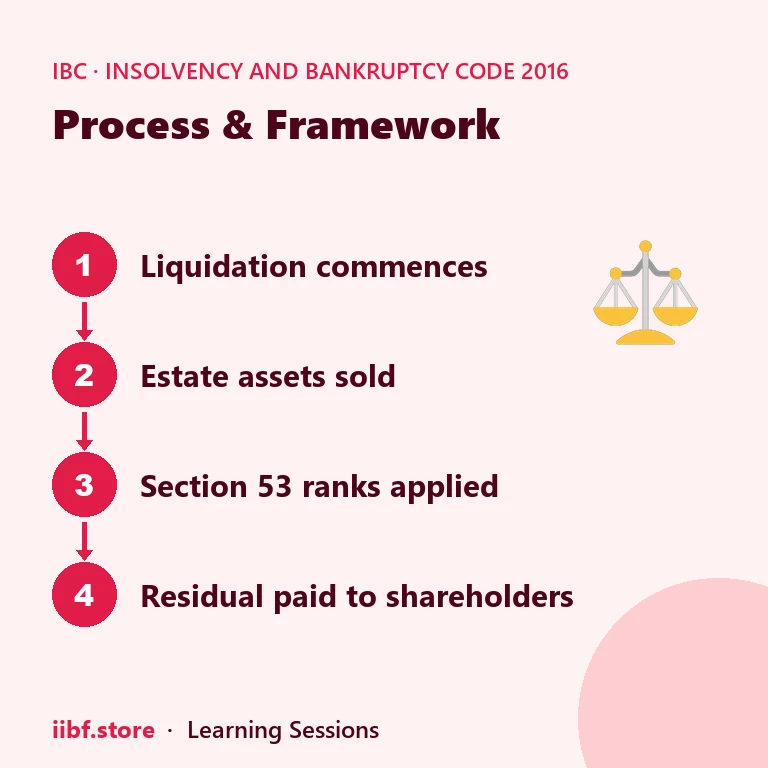
Section 53(1) of the Code applies only after liquidation has commenced — it has no role during a live Corporate Insolvency Resolution Process, where distribution instead follows the resolution plan and the fairness test under Section 30(2)(b). Once liquidation begins, the liquidator converts the corporate debtor's assets into a liquidation estate, sells them (piecemeal or as a going concern), and must distribute the proceeds strictly in the order Section 53 lays down, with each class ranked and equitably treated within itself. Understanding this transition point is easiest when you first study how a resolution attempt actually fails — the chapter on failure of CIRP and the move into liquidation walks through exactly when and why a company slides from resolution into the waterfall regime. The waterfall is also distinct from voluntary liquidation, which follows the same Section 53 order but is triggered by solvent shareholders rather than a failed CIRP.
The ranking exists because unsecured creditors, workmen, and government dues would otherwise be wiped out by secured lenders racing to enforce security individually. Section 53 forces a common pool and a common queue, and it explicitly overrides anything inconsistent in any other law for the time being in force — a non-obstante clause that gives it primacy even over tax and revenue statutes.
⚖️ The Order of Priority, Rank by Rank
The waterfall runs in five broad ranks, with sub-ranks inside each:
Rank 1 (highest): Insolvency resolution process costs and liquidation costs, paid in full first — this includes the resolution professional's and liquidator's fees, valuer costs, and expenses of running the debtor as a going concern during the process.
Rank 2: Workmen's dues for the 24 months preceding the liquidation commencement date, ranking pari passu (equally, pro rata) with debts owed to secured creditors who have relinquished their security interest into the liquidation estate.
Rank 3: Wages and unpaid dues owed to employees other than workmen, for the 12 months preceding the liquidation commencement date.
Rank 4: Financial debts owed to unsecured creditors.
Rank 5: A combined class of (a) government dues for the two years preceding liquidation commencement and (b) amounts due to a secured creditor for any unpaid debt after enforcing security — again ranking pari passu.
Rank 6: Any remaining debts and dues.
Rank 7: Preference shareholders, if any.
Rank 8 (lowest): Equity shareholders or partners, who absorb the residual risk and are paid only if every prior class is satisfied in full.
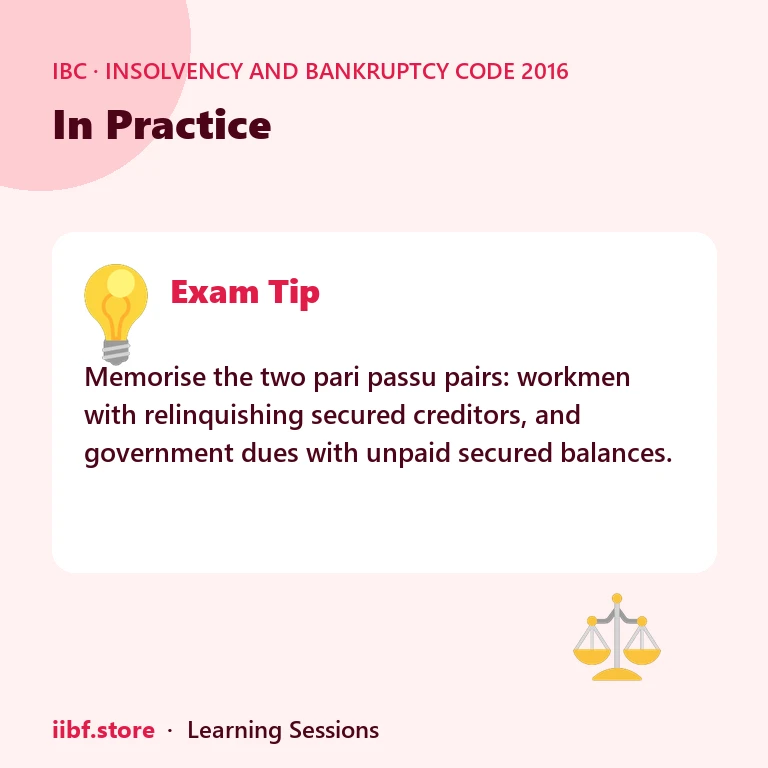
💡 Exam Tip: Memorise the pari passu pairs — workmen's 24-month dues with relinquishing secured creditors at Rank 2, and government dues with the secured creditor's unpaid balance at Rank 5. Examiners love testing this exact pairing.
💰 Workmen's Dues and the 24-Month Test
Workmen occupy a privileged position precisely because they cannot diversify their risk the way a lender can — their wages are their only claim on the enterprise. Section 53 protects only dues accrued in the 24 months immediately before the liquidation commencement date; older dues fall to a lower rank alongside general unsecured claims. This time-boxing prevents workmen's claims from ballooning indefinitely and keeps the waterfall administrable. A liquidator must verify each workman's claim through Form D (or the relevant liquidation claim form) and compute the eligible 24-month window precisely — a single miscalculation here can trigger appeals before the NCLT and delay the entire distribution.
It is worth revisiting how the Code itself evolved to reach this workmen-protective structure. The chapter on the evolution of the Insolvency and Bankruptcy Code traces how India moved from a fragmented, creditor-unfriendly recovery regime — SICA, RDDBFI, SARFAESI in isolation — toward the unified, time-bound waterfall we have today.
🏦 Where Banks and Secured Creditors Stand
Banks holding security interests face a strategic choice at the start of liquidation: relinquish the security into the common liquidation estate, or enforce it separately outside the waterfall under Section 52. A secured creditor that relinquishes moves into Rank 2, sharing pari passu with workmen — often a faster and more certain recovery path when the underlying asset is hard to realise individually. A secured creditor that instead enforces its security independently must still account to the liquidator for any surplus and contributes towards insolvency resolution process costs, workmen's dues, and liquidation costs before keeping the balance; any shortfall after enforcement ranks at Rank 5, well below unsecured financial debt.
This is precisely why credit officers assessing a stressed account need to model both scenarios before recommending a resolution strategy. The chapter on credit recovery laws for banks lays out how Section 53 interacts with SARFAESI enforcement and the DRT route, and why banks increasingly prefer the collective IBC process for larger exposures.
⚠️ Common Mistake: Candidates often assume secured creditors are always paid first in liquidation. They are not — an unpaid secured creditor's residual claim after independent enforcement actually falls to Rank 5, below unsecured financial debt at Rank 4.
🧾 Liquidation Costs, Government Dues, and What's Left for Shareholders
Liquidation costs at Rank 1 are deliberately paid ahead of everyone else because without funding the process itself — the liquidator's fee, legal costs, valuation, and asset-preservation expenses — no recovery would happen for anyone. Government dues sit far lower than most candidates expect: only two years of central and state government dues rank at Rank 5, and only pari passu with the secured creditor's unpaid balance, not ahead of workmen or financial creditors. This reflects a deliberate policy shift away from the old "Crown debt" doctrine that once gave tax authorities automatic priority.
In practice, equity and preference shareholders almost never see a distribution in liquidation — by the time a company reaches this stage, asset realisation rarely covers even the higher-ranked classes in full. Section 53(3) also clarifies that any contractual arrangement between creditors that would disrupt this order is disregarded unless it improves the position of dissenting or under-ranked creditors, protecting the statutory hierarchy from side agreements.
📌 Remember: The Section 53 order is a floor, not a menu — no committee, contract, or resolution can reorder it once liquidation has commenced.
🔍 Section 53 in Context: Related Provisions to Cross-Check
Section 53 does not operate alone. The liquidator's authority to run the process, verify claims, and prepare the asset memorandum flows from the same structural chapter of the Code — see the structure of the IBC for how Parts II and III of the Code fit together. Candidates should also be comfortable distinguishing the liquidation waterfall from two frequently confused topics: the moratorium under Section 14 of IBC, which freezes creditor action only during CIRP and lapses once liquidation begins, and avoidance transactions under IBC, where amounts clawed back from preferential, undervalued, or fraudulent transactions are added back into the liquidation estate before the Section 53 order is even applied. It also pays to know who cannot bid for the debtor's assets in liquidation — the same ineligibility test used in resolution, covered in the piece on Section 29A of IBC, extends to liquidation sales as well.
Beyond the IBC syllabus itself, examiners occasionally test candidates on how insolvency outcomes connect to the wider economy a bank operates in — for instance, how a younger, larger workforce shapes credit demand and default patterns, a theme explored in the JAIIB IE&IFS piece on demographic dividend in India.
For a browser view of how ranks compare side by side, the table below is the fastest revision tool before an exam attempt.
| Rank | Claimant Class | Time-Bound? | Pari Passu With | Typically Recovers in Full? |
|---|---|---|---|---|
| 1 | Insolvency resolution/liquidation process costs | ❌ No cap | — | ✅ Yes |
| 2 | Workmen's dues (24 months) + relinquishing secured creditors | ✅ 24 months | Each other | ⚠️ Often partial |
| 3 | Other employees' wages | ✅ 12 months | — | ⚠️ Often partial |
| 4 | Unsecured financial creditors | ❌ No cap | — | ❌ Rarely |
| 5 | Government dues (2 years) + unpaid secured creditor balance | ✅ 2 years | Each other | ❌ Rarely |
| 6 | Any remaining debts | ❌ No cap | — | ❌ Rarely |
| 7 | Preference shareholders | ❌ No cap | — | ❌ Almost never |
| 8 | Equity shareholders/partners | ❌ No cap | — | ❌ Almost never |
The Insolvency and Bankruptcy Board of India's regulations on liquidation process further detail how the liquidator must maintain a Liquidation Case Progress Report and disclose distributions rank-by-rank, keeping the process auditable; the primary text is available on ibbi.gov.in. Every distribution the liquidator makes must trace back to this statutory order, and any deviation is grounds for an application before the NCLT under its residuary powers.
🧠 Practice MCQs: Liquidation Waterfall Under Section 53
Q1. Under Section 53 of the IBC, workmen's dues for which preceding period rank pari passu with relinquishing secured creditors? (a) 12 months (b) 18 months (c) 24 months (d) 36 months
Answer: (c) — Workmen's dues for the 24 months before the liquidation commencement date rank at the second tier, pari passu with debts of secured creditors who relinquish their security.
Q2. Where do insolvency resolution process costs and liquidation costs rank in the Section 53 waterfall? (a) Second (b) Third (c) Highest priority, paid first (d) Along with government dues
Answer: (c) — Process and liquidation costs are paid in full before any other class, since they fund the liquidation itself.
Q3. A secured creditor enforces its security independently under Section 52 and remains partly unpaid. Where does the unpaid balance rank? (a) Rank 2 with workmen (b) Rank 4 with unsecured financial creditors (c) Rank 5, pari passu with government dues (d) It is extinguished automatically
Answer: (c) — An unpaid balance after independent enforcement of security ranks at the fifth tier, alongside government dues for the preceding two years.
Q4. Which statement about government dues under Section 53 is correct? (a) They rank first, ahead of liquidation costs (b) They rank pari passu with workmen's dues (c) Only dues for the two years preceding liquidation commencement are included, at the fifth tier (d) Government dues are excluded from the waterfall entirely
Answer: (c) — Only the preceding two years of government dues are captured, and they sit at Rank 5 with the secured creditor's unpaid shortfall, not at the top.
Q5. Can the committee of creditors or a private inter-creditor agreement alter the Section 53 priority order during liquidation? (a) Yes, with NCLT's prior approval only (b) Yes, if all financial creditors consent (c) No, contractual arrangements disrupting the statutory order are disregarded (d) Yes, but only for secured creditors
Answer: (c) — Section 53(3) disregards any contract between creditors that would disturb the statutory priority, unless it benefits an under-ranked or dissenting creditor.
Want chapter-wise mock tests with 100+ MCQs? Start practising free →
❓ Frequently Asked Questions
Does Section 53 apply during CIRP or only after liquidation begins?
Section 53 applies only after the NCLT has ordered liquidation. During an ongoing CIRP, distribution follows the resolution plan and the priority rules under Section 30(2)(b), not the Section 53 waterfall.
Can a secured creditor choose whether to relinquish security into the liquidation estate?
Yes. A secured creditor may either relinquish security and join the common pool at Rank 2 pari passu with workmen, or enforce it independently under Section 52, accounting to the liquidator for costs and any surplus.
What happens if the sale proceeds are insufficient to fully pay even Rank 1 costs?
Insolvency resolution process and liquidation costs must be paid in full before moving to any lower rank; if proceeds fall short even here, remaining costs are settled first from whatever is realised, and lower ranks may receive nothing.
Are dues older than the specified time window (24 or 12 months) simply lost?
No, they are not lost outright — they fall out of the protected higher rank and are clubbed with the general unsecured or remaining-debt class at a lower rank, where recovery is far less certain.
🎯 Conclusion: Lock In the Ranking Before Exam Day
The liquidation waterfall under Section 53 rewards precise memorisation more than conceptual debate — examiners test the exact order, the exact time windows, and the exact pari passu pairings. Pair this chapter with the linked material on CIRP failure, the Code's structure, and recovery law to build a complete liquidation-to-recovery picture, then drill the ranking until it is automatic. For more practice on this and every other IBC topic tested in JAIIB and CAIIB, browse the full Insolvency and Bankruptcy Code 2016 topic hub and take a timed mock test to check your recall under exam conditions.
Quick quiz on this topic
5 exam-style questions from our free test bank — check yourself before you move on.
Practice this topic
Take a free mock test, download chapter PDFs, or watch a video class — all included on iibf.store.