Resolution Professional under IBC: Role and Duties Explained
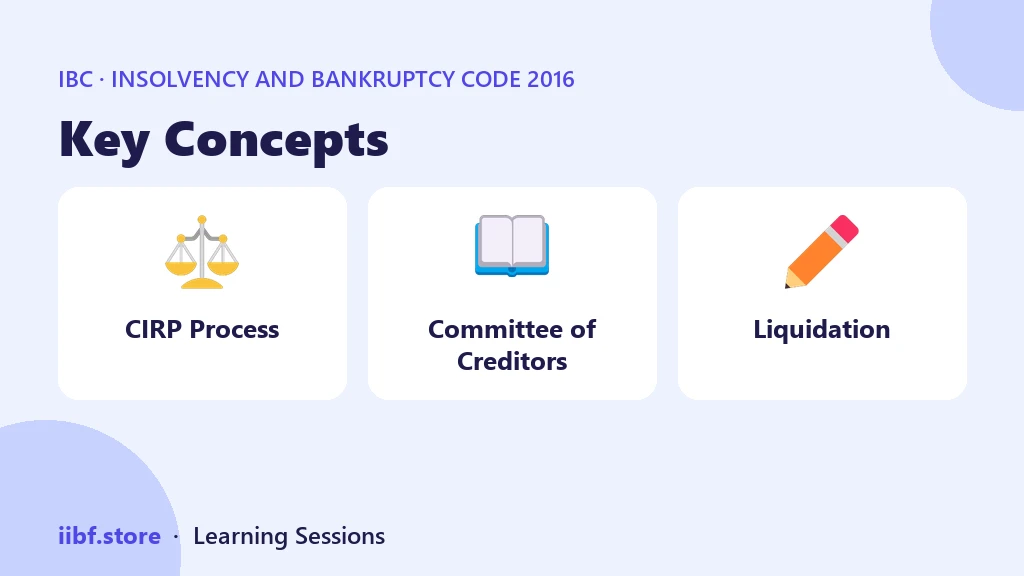
When a corporate insolvency resolution process begins, one person ends up carrying the entire file: the resolution professional under IBC. The moment the Adjudicating Authority admits an application under Section 7, 9 or 10 of the Insolvency and Bankruptcy Code, 2016, the promoters lose the steering wheel and an interim resolution professional takes over. Within weeks the committee of creditors either confirms that person or replaces him. For IIBF candidates, this appointment chain — and the long duty list that follows — is one of the most reliably examined areas of the whole Code.
This guide walks the role end to end: appointment, eligibility, powers, statutory duties, plan scrutiny, avoidance applications, fees, conduct and the endgame. Every point is tied to the section or regulation an examiner can quote back at you.
🧑⚖️ Appointment in Two Stages: IRP First, RP by 66% Vote
The appointment of the resolution professional under IBC happens in two clean stages, and the exam loves the join between them.
Stage one — the interim resolution professional. Under Section 16(1), the Adjudicating Authority must appoint an IRP within fourteen days of the insolvency commencement date. Where a financial creditor or the corporate debtor itself files, the insolvency professional proposed in the application is appointed. Where an operational creditor files without proposing a name, the Adjudicating Authority makes a reference to the Insolvency and Bankruptcy Board of India, which recommends an insolvency professional against whom no disciplinary proceedings are pending, ordinarily within ten days.
Since the 2018 amendment, the IRP does not have a fixed thirty-day tenure. He holds office until the resolution professional is appointed under Section 22 — a small change that has quietly become a favourite one-liner in question papers.
Stage two — confirmation or replacement. The first meeting of the committee of creditors must be held within seven days of its constitution. At that meeting, by a majority vote of not less than 66% of the voting share of financial creditors, the committee either resolves to appoint the IRP as the resolution professional, or resolves to replace him. If it replaces him, it files an application before the Adjudicating Authority with the proposed professional's written consent, and the Authority forwards the name to the Board for confirmation before appointing.
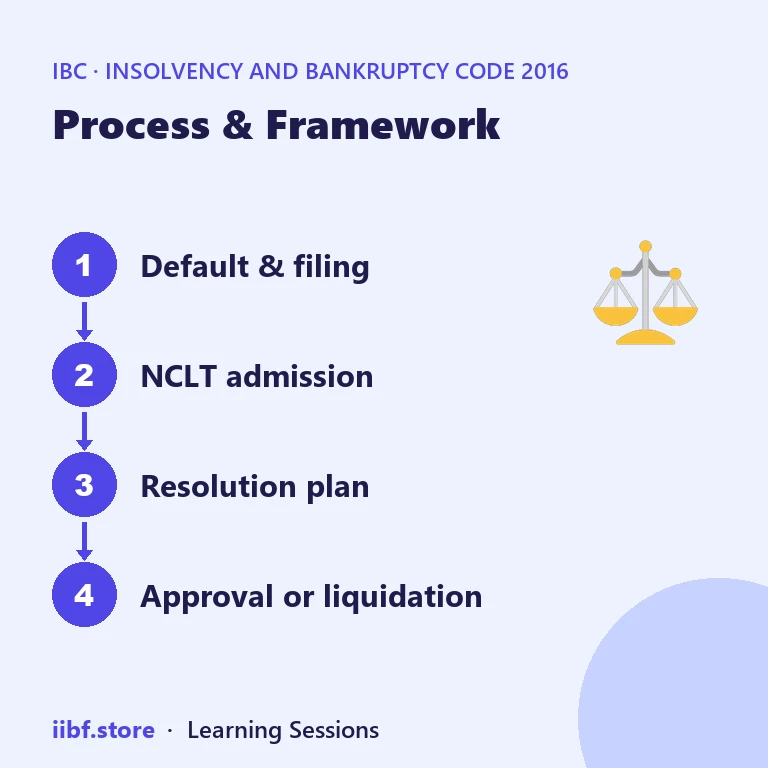
The leash never comes off. Section 27 lets the committee replace the resolution professional at any time during the process by the same 66% vote, again routed through the Board and the Adjudicating Authority. Build the sequence carefully alongside the chapter on Commencement of CIRP.
💡 Exam Tip: 66% is the number for appointing, replacing and approving. 51% is the ordinary decision threshold for routine committee business. Do not swap them.
🎓 Eligibility: IBBI Registration, IPA Enrolment and a Valid AFA
Not every chartered accountant, company secretary, cost accountant or advocate can walk into this role. Three conditions must hold together before anyone can act as a resolution professional under IBC.
First, the individual must be registered with the Board as an insolvency professional under Section 206 read with Section 207, after clearing the Limited Insolvency Examination and meeting the qualification and experience norms in the IBBI (Insolvency Professionals) Regulations, 2016.
Second, he must be enrolled as a member of an insolvency professional agency registered with the Board. The agency is the first line of self-regulation — it enrols, monitors and disciplines its members under its own bye-laws.
Third, and most often missed, he must hold a valid Authorisation for Assignment (AFA) issued by that agency. Regulation 7A of the Insolvency Professionals Regulations bars an insolvency professional from accepting or undertaking an assignment unless a valid AFA subsists on the date of acceptance or commencement. The AFA is issued for a limited validity period and must be renewed before it lapses; if it expires mid-assignment, the professional cannot take on fresh assignments, and the lapse itself invites regulatory attention.
A partnership or company of insolvency professionals may be recognised, but the assignment is always personal — an individual signs, and an individual answers for it. Read this alongside Chapter 4 - Structure of the IBC, which maps how the Board, the agencies and the professionals sit in one regulatory pyramid. The Board publishes the current register of insolvency professionals and all circulars on its official site, ibbi.gov.in.
🏢 Management Vests, the Board Stands Suspended
Section 17 is the provision that makes insolvency in India a genuinely creditor-in-control regime. From the date of appointment of the IRP, the management of the affairs of the corporate debtor vests in him, the powers of the board of directors or the partners stand suspended and are exercised by him, and the officers and managers report to him. Financial institutions holding the debtor's accounts must act on his instructions.
Section 20 then imposes the balancing obligation: manage the operations of the corporate debtor as a going concern and make every endeavour to protect and preserve the value of its property. To do that he may appoint accountants, legal professionals and other advisers, enter into contracts on the debtor's behalf, and raise interim finance — though he cannot create a security interest over already encumbered property without the consent of the creditors secured on it.
Once the committee of creditors exists, Section 28 tightens the belt. Prior approval of the committee by 66% of voting share is mandatory before the resolution professional raises interim finance, creates a security interest, changes the capital structure or ownership interest, undertakes related-party transactions, amends constitutional documents, changes management, or alters the appointment or terms of the statutory auditors. An action taken without that approval is void, and the committee may report the professional to the Board.
| Aspect | Interim Resolution Professional | Confirmed Resolution Professional |
|---|---|---|
| Appointed by | Adjudicating Authority, Section 16 | Committee of creditors by 66%, Section 22 |
| Tenure | Until the RP is appointed under Section 22 | Until plan approval or liquidation order, Section 23 |
| Runs the debtor as a going concern | ✅ Section 20 | ✅ Section 23 |
| Needs 66% committee nod for interim finance | ❌ Committee not yet constituted | ✅ Section 28(1) |
| Prepares the information memorandum | ❌ | ✅ Section 29, Regulation 36 |
| Examines plans against Section 30(2) | ❌ | ✅ Section 30(2) |
| Files avoidance applications | ❌ | ✅ Section 25(2), Regulation 35A |
📋 Core Duties: Claims, Valuers, Committee and the Memorandum
Sections 18 and 25 together give you the working checklist, and the CIRP Regulations attach the clocks.
Public announcement. The IRP issues it in Form A within three days of his appointment, calling for claims. Claims are ordinarily to be submitted by the fourteenth day from the insolvency commencement date, and the professional then collates and verifies them rather than adjudicating them like a court.
Constituting the committee. After verification he determines the financial position, constitutes the committee of creditors under Section 21 and files a report certifying its constitution with the Adjudicating Authority. He convenes and chairs its meetings under Section 24, giving notice also to suspended directors and to operational creditors holding at least ten per cent of the debt, who may attend but cannot vote.
Valuation. Under Regulation 27 he appoints two registered valuers within seven days of his appointment and in any case by the forty-seventh day from the insolvency commencement date, to determine fair value and liquidation value. Those figures stay confidential until resolution plans are received.
Information memorandum and market outreach. Section 29 read with Regulation 36 requires the memorandum to reach every committee member within two weeks of his appointment and not later than the fifty-fourth day from commencement, against a confidentiality undertaking. The invitation for expression of interest in Form G follows, and from the responses he draws up a provisional and then a final list of prospective resolution applicants before issuing the request for resolution plans.
⚠️ Common Mistake: Candidates write that the resolution professional "admits or rejects" claims. He collates and verifies; disputed claims and questions of law go to the Adjudicating Authority.
📑 Testing Resolution Plans Against Section 30(2)
This is where the gatekeeping happens. A resolution applicant submits its plan with an affidavit confirming eligibility, which is why section 29a of ibc is the natural companion topic. Under Section 30(2) the resolution professional must examine every plan received and confirm that it provides for payment of insolvency resolution process costs in priority, pays operational creditors and dissenting financial creditors at least what Section 53 would have given them, provides for the management of the corporate debtor's affairs after approval and for implementation and supervision of the plan, does not contravene any provision of law for the time being in force, and meets such other requirements as the Board specifies.
Note the division of labour the examiner is testing. The professional certifies compliance; he does not sit in judgment on commercial wisdom. Only plans that clear Section 30(2) go to the committee, which approves by 66% of voting share under Section 30(4). The Adjudicating Authority then approves under Section 31, and the approved plan binds the corporate debtor, its employees, members, creditors, guarantors and every statutory authority.
During all of this the clock in Section 12 runs: 180 days, extendable by 90, with an outer limit of 330 days including time taken in legal proceedings. Delay is the single biggest criticism of the framework, and the chapter on Roles and Duties of IRP and RP sets out how the professional is expected to keep the process moving. Where a moratorium question is layered on top, revise moratorium under Section 14 of IBC as well.
⚖️ Avoidance Applications, Conduct, Fees and the Endgame
Section 25(2) obliges the professional to file applications for avoidance of transactions under Chapter III — preferential transactions under Section 43, undervalued transactions under Section 45, extortionate credit transactions under Section 50, and fraudulent or wrongful trading under Section 66. Regulation 35A gives him the discipline: form an opinion by the seventy-fifth day from commencement, make a determination by the one hundred and fifteenth day, and apply to the Adjudicating Authority by the one hundred and thirty-fifth day. The detail sits in avoidance transactions under ibc.
Conduct and discipline. The Code of Conduct in the First Schedule to the Insolvency Professionals Regulations governs independence, disclosure of relationships, confidentiality, timeliness and record-keeping. Complaints under Section 217 can lead to investigation under Section 218, a show-cause notice under Section 219 and action by the Board's Disciplinary Committee under Section 220, which may suspend or cancel registration or impose a penalty. The agency runs a parallel disciplinary track under its bye-laws.
Fees and expenses. The IRP's expenses are fixed by the applicant and ratified by the committee; thereafter the committee fixes the professional's fee and the expenses to be incurred, and both form part of the insolvency resolution process cost payable in priority. The CIRP Regulations also permit a performance-linked incentive structure tied to timely resolution and value realisation, subject to the committee's approval, and require the fee to be disclosed.
📌 Remember: The mandate does not stop at plan approval. The professional continues to manage the corporate debtor until the Adjudicating Authority approves a plan or orders liquidation, and on a liquidation order he acts as the liquidator subject to filing his written consent, unless the Authority replaces him.
Anti-money-laundering diligence often surfaces in the same audit trail during a resolution, so bankers preparing for the wider syllabus should also revise PMLA reporting obligations for bankers. For the liquidation route in detail, see Failure of CIRP or Business: Liquidation & Voluntary Liquidation.
🧠 Practice MCQs: Resolution Professional under IBC
Q1. At its first meeting, the committee of creditors may resolve to appoint the interim resolution professional as the resolution professional by a vote of not less than — (a) 51% of voting share (b) 66% of voting share (c) 75% of voting share (d) a simple majority of members present
Answer: (b) — Section 22(2) requires a majority vote of not less than 66% of the voting share of financial creditors, and the same threshold applies to replacement.
Q2. An insolvency professional cannot accept a CIRP assignment unless he holds — (a) a certificate of practice from any professional body (b) a registered valuer certificate (c) a valid Authorisation for Assignment from his insolvency professional agency (d) a licence issued by the NCLT
Answer: (c) — Regulation 7A of the IBBI (Insolvency Professionals) Regulations, 2016 bars acceptance of an assignment without a subsisting AFA, in addition to Board registration and agency enrolment.
Q3. Raising interim finance after the committee of creditors is constituted requires — (a) no approval at all (b) approval of the Adjudicating Authority (c) a simple majority of the committee (d) prior approval of the committee by 66% of voting share
Answer: (d) — Section 28(1) lists interim finance among the actions needing prior committee approval by 66% of voting share; an action taken without it is void.
Q4. Which provision requires the resolution professional to examine each resolution plan for conformity before it is placed before the committee of creditors? (a) Section 25 (b) Section 29 (c) Section 30(2) (d) Section 31
Answer: (c) — Section 30(2) sets the compliance checklist; the professional certifies conformity, while commercial wisdom rests with the committee under Section 30(4).
Q5. When the Adjudicating Authority passes a liquidation order under Section 33, who acts as the liquidator? (a) an officer nominated by the Adjudicating Authority (b) the resolution professional appointed for the CIRP, subject to his written consent (c) a fresh professional appointed by the Board in every case (d) the nominee of the largest financial creditor
Answer: (b) — Section 34 provides that the resolution professional appointed for the CIRP shall act as liquidator, subject to submission of written consent, unless replaced by the Adjudicating Authority.
Want chapter-wise mock tests with 100+ MCQs? Start practising free →
❓ Frequently Asked Questions
Who appoints the interim resolution professional?
The Adjudicating Authority appoints the IRP within fourteen days of the insolvency commencement date under Section 16. Where a financial creditor or the corporate debtor applies, the professional named in the application is appointed; where an operational creditor does not propose a name, the Board recommends one.
Can the committee of creditors replace the resolution professional mid-process?
Yes. Section 27 allows the committee to replace him at any time during the process by a vote of 66% of voting share. The proposed name goes to the Adjudicating Authority, which forwards it to the Board for confirmation before appointment.
How many registered valuers must be appointed, and by when?
Two registered valuers, under Regulation 27 of the CIRP Regulations, within seven days of the professional's appointment and in any case by the forty-seventh day from the insolvency commencement date, to determine fair value and liquidation value.
Does the role end once a resolution plan is approved?
No. He manages the corporate debtor until the Adjudicating Authority approves a plan or orders liquidation, assists implementation as the approved plan provides, and on a liquidation order acts as liquidator subject to his written consent.
🎯 Conclusion: Study the Role as a Timeline, Not a List
Almost every question on the resolution professional under IBC is really a question about when something must happen and who must approve it. Fix the spine first: appointment within fourteen days, public announcement within three days, claims by day fourteen, valuers by day forty-seven, information memorandum by day fifty-four, expression of interest by day sixty, avoidance application by day one hundred and thirty-five, and the whole process inside 330 days. Then hang the powers of Sections 17, 20, 23, 25, 28 and 30 on that spine.
Get that structure right and the rest — eligibility, conduct, fees, replacement thresholds — falls into place. Revise the foundation with Credit Recovery Laws for Banks, browse everything else in this paper on the Insolvency and Bankruptcy Code 2016 tag hub, and then test yourself under time pressure with free chapter-wise mock tests on iibf.store. Ten minutes of timed practice today beats an hour of passive reading tomorrow.
Quick quiz on this topic
5 exam-style questions from our free test bank — check yourself before you move on.
Practice this topic
Take a free mock test, download chapter PDFs, or watch a video class — all included on iibf.store.