Loan Against Property in Retail Banking: LTV, Appraisal and Risks (JAIIB RBWM)

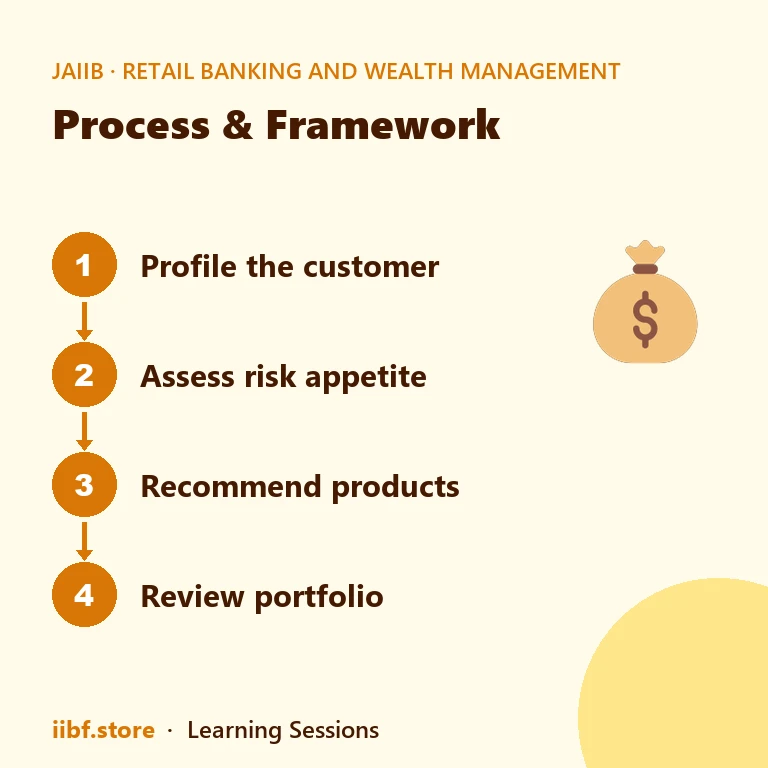
For most branch and credit officers, loan against property in retail banking is the product that sits between a plain-vanilla home loan and a working-capital facility — the borrower already owns the asset, and the bank is being asked to lend against it rather than to fund its purchase. Because the money can be used for almost anything, from business expansion to a daughter's wedding, appraisal discipline matters more here than in most retail products. This article walks through eligible property types, LTV and margin practice, income assessment for salaried and self-employed applicants, valuation and legal search, mortgage creation with CERSAI registration, end-use monitoring, and why a LAP file carries more inherent risk than a home loan file of the same size.
🏠 Eligible Property Types and Purpose of the Loan
Banks generally accept self-occupied or rented residential property, and commercial/office property, as security for a loan against property. Some lenders extend LAP against industrial premises held by the borrower, subject to a stricter valuation and legal check. Agricultural land is almost universally excluded, both because of state-level restrictions on transfer of agricultural holdings to non-agriculturists on default, and because RBI's priority-sector and land-use classifications treat it differently from urban immovable property.
The loan itself is purpose-neutral within reasonable limits: business expansion, working capital, medical or education expenses, debt consolidation, or other personal needs are all acceptable end uses, but pure speculation — buying shares or a second property purely to flip it — is not a sanctioned purpose in a prudent credit policy. Candidates preparing the RBWM paper should revisit how this differs from a home loan, where the property being financed and the property being mortgaged are the same asset; in LAP they are decoupled, which is exactly what raises the risk profile discussed later. For grounding in the base retail framework before layering on LAP specifics, the chapter on introduction of retail banking is a useful starting point.

📊 LTV, Margin and Why LAP Caps Are Tighter Than Home Loans
RBI's loan-to-value guidance for housing loans sets tiered LTV ceilings (higher for smaller-ticket home loans, lower as the loan amount rises), because the funded asset is the same property being purchased and occupied. LAP does not fall under that same housing-loan LTV framework — the property is not being purchased with the loan — so banks apply their own board-approved, more conservative LTV caps, typically well below what is allowed on a comparable home loan. The gap exists because a LAP borrower has already extracted value from the property once and is now leveraging it a second time for a purpose the bank cannot always fully verify.
Margin is simply 1 minus LTV, funded by the borrower upfront and never financed by the bank or a top-up facility. A lower LTV on LAP means a proportionately higher margin than the same borrower would need to arrange for a home purchase, which is a common exam trap: candidates assume "property loan" means "same LTV as home loan," and it does not.
| Feature | Home Loan | Loan Against Property |
|---|---|---|
| Asset funded vs asset mortgaged | Same property | Different — property already owned |
| RBI housing-loan LTV slabs apply | ✅ Yes | ❌ No — bank's internal policy |
| Typical LTV band | Higher, tiered by loan size | Lower, single conservative cap |
| End-use monitoring intensity | Low — purchase is self-evident | High — purpose can drift |
| Relative credit risk | Lower | Higher |
💡 Exam Tip: If a question asks why LAP margin requirements are higher than home loan margin requirements for a similar ticket size, the answer is risk-based internal policy, not a uniform RBI LTV slab — LAP sits outside the housing-loan LTV directive.
💼 Income Assessment: Salaried and Self-Employed Borrowers
For a salaried applicant, the credit officer relies on salary slips (usually the last three months), Form 16 or the latest income tax return, and bank statements showing salary credits, to arrive at net monthly income and an acceptable fixed obligation to income ratio (FOIR). Employer category, length of service, and continuity of employment feed into the risk grading alongside the income figure itself.
Self-employed borrowers — professionals and businesspeople — are assessed very differently, because a single payslip does not exist. The bank examines two to three years of income tax returns, audited financials or GST returns where applicable, bank statement turnover, and the stability of the business itself. Income averaging or income smoothing across years is common practice to avoid overstating repayment capacity from one unusually good year. This is also where LAP appraisal diverges sharply from an unsecured personal loan: even a well-collateralised file must clear an independent income and repayment-capacity test, not just a valuation test. Branch teams handling both segments benefit from revisiting branch profitability fundamentals, since LAP income misassessment directly erodes branch-level asset quality and profitability. The underlying income checks also feed the same processes covered in KYC and customer due diligence in retail banking, and the appraisal output is often cross-checked against credit scoring models in retail banking before final sanction.
Where the self-employed borrower operates as a partnership firm, the LAP file must also track changes in the firm's constitution — a partner joining or exiting alters both the mortgagor's authority and the income base being assessed, a linkage worth revisiting through admission and retirement of partners from the AFM syllabus.
⚠️ Common Mistake: Treating a self-employed applicant's gross business turnover as disposable income. Only the assessed net income after averaging, tax, and existing obligations should feed the FOIR calculation.
📝 Valuation, Legal Search Report, Mortgage Creation and CERSAI
Before sanction, the property must be valued by an empanelled valuer, and for higher-value properties banks typically insist on two independent valuations to guard against a single valuer's error or bias. Alongside valuation, an empanelled advocate conducts a legal search — usually covering 13 to 30 years of title depending on bank policy — and issues a legal search report along with a non-encumbrance certificate confirming the property is free of prior charges, litigation, or defective title.
Once sanctioned, the bank creates a mortgage — either a registered mortgage or an equitable mortgage by deposit of title deeds, depending on the state and product policy — and the security interest must be registered with the Central Registry (CERSAI) under the SARFAESI Act, 2002 framework. CERSAI registration is what prevents the same property from being fraudulently mortgaged to a second lender, since any subsequent lender's search will reveal the existing charge. Skipping or delaying CERSAI filing is a documented operational-risk gap that examiners specifically look for during retail asset audits.

You can read more on RBI's published guidance on prudent retail lending and security documentation practices at rbi.org.in for the current regulatory framework governing secured retail credit.
⚠️ End-Use Monitoring and Why LAP Carries Higher Risk Than a Home Loan
Because LAP proceeds can be used for almost any legitimate purpose, banks are expected to monitor end-use more actively than they would for a home loan, where the disbursement flows directly to the seller or builder and the purpose is self-evident. End-use checks may include post-disbursement site visits, verification of stated business investment, or scrutiny of large withdrawals inconsistent with the declared purpose, since diversion of LAP funds into speculative markets increases both credit and reputational risk for the lender.
Several factors together make LAP structurally riskier than a home loan of comparable size: the borrower has no fresh emotional or financial stake in the property being acquired (it is already owned, so default pressure is lower than on a home the family is living in and just bought); income verification for the often self-employed borrower base is harder to pin down than a salaried home-loan applicant; valuation and title risk is borne entirely on an existing asset rather than a freshly registered purchase; and the funds are fungible, making diversion and end-use slippage far easier to conceal than a builder-linked home loan disbursement. This combination is precisely why prudent banks apply a lower LTV, a tighter FOIR, and closer post-disbursement monitoring on every loan against property in retail banking file, even when the collateral cover looks comfortable on paper.
📌 Remember: Collateral comfort is not a substitute for income verification and end-use discipline — LAP defaults are driven far more often by cash-flow stress than by a shortfall in property value.
For a structured refresher on how these appraisal habits connect back to core retail concepts, revisit retail banking concepts and the related note on branch profitability and customer requirements, both of which set up the risk-and-return logic that LAP appraisal builds on.
🧠 Practice MCQs: Loan Against Property
Q1. Under RBI's housing-loan LTV framework, which statement about loan against property (LAP) is correct? (a) LAP follows the same tiered LTV slabs as home loans (b) LAP LTV is set by the bank's own board-approved policy, outside the housing-loan LTV slabs (c) LAP has no LTV limit at all (d) LAP LTV is always higher than home loan LTV
Answer: (b) — LAP is not a property-purchase loan, so RBI's tiered housing-loan LTV directive does not apply; banks set their own, generally more conservative, LTV cap.
Q2. For a self-employed applicant's income assessment on a LAP file, which document set is primarily relied upon? (a) Salary slips and Form 16 only (b) Income tax returns, GST/financials, and bank statement turnover, usually averaged over two to three years (c) A single year's provisional balance sheet (d) Only the property valuation report
Answer: (b) — Self-employed income is assessed over multiple years using ITRs, financials/GST data and bank turnover, with averaging to smooth volatility.
Q3. What is the primary purpose of registering the mortgage with CERSAI? (a) To fix the property's market value (b) To calculate stamp duty (c) To prevent the same property being fraudulently mortgaged to multiple lenders (d) To approve the borrower's income
Answer: (c) — CERSAI is a central registry of security interests under the SARFAESI Act framework; it lets subsequent lenders discover an existing charge and blocks multi-financing fraud on the same asset.
Q4. Which of these is generally NOT accepted as eligible security for a standard loan against property? (a) Self-occupied residential property (b) Rented commercial property (c) Agricultural land (d) Office premises owned by the borrower
Answer: (c) — Agricultural land is typically excluded from LAP security due to transfer restrictions and its distinct land-use classification.
Q5. Why is a loan against property considered structurally riskier than a comparable home loan? (a) LAP borrowers always have lower credit scores (b) The mortgaged property is already owned, funds are fungible, and end-use is harder to verify than a direct purchase-linked disbursement (c) LAP interest rates are always lower (d) Home loans never require a legal search report
Answer: (b) — Decoupled asset ownership, fungible fund use, and weaker end-use visibility make LAP inherently higher risk than a home loan disbursed directly against a fresh purchase.
Want chapter-wise mock tests with 100+ MCQs? Start practising free →
Is agricultural land accepted as security for a loan against property?
No, most banks exclude agricultural land from LAP security because of state-level transfer restrictions and its separate land-use classification; only residential and commercial/industrial property is generally accepted.
Why is the LTV on a loan against property lower than on a home loan?
RBI's tiered LTV slabs apply specifically to home loans where the funded and mortgaged property are the same asset. LAP falls outside that framework, so banks set their own, more conservative LTV through internal policy to offset the higher risk.
What is CERSAI and why does it matter for LAP?
CERSAI is the Central Registry where security interests over property are recorded under the SARFAESI Act framework. Registering the mortgage there prevents the same property from being fraudulently mortgaged to more than one lender.
How is income assessed differently for salaried versus self-employed LAP applicants?
Salaried applicants are assessed on salary slips, Form 16 and salary-credit bank statements. Self-employed applicants are assessed on two to three years of income tax returns, financials or GST data and bank turnover, usually averaged to smooth year-on-year volatility.
🎯 Conclusion: Appraise the Property, Verify the Income, Monitor the End Use
A loan against property in retail banking file is only as strong as its weakest leg — property, income, or end use. Get any one of them wrong and the collateral comfort on paper will not save the asset quality. For JAIIB RBWM candidates, the recurring theme across LTV, valuation, CERSAI, and monitoring is that LAP is judged on the same rigour as an unsecured facility, with security as a backstop rather than a substitute for underwriting discipline. Practise the appraisal sequence with full-length mock tests on the JAIIB course, and browse more retail banking topics on the Retail Banking and Wealth Management blog hub to round out your RBWM preparation.
Quick quiz on this topic
5 exam-style questions from our free test bank — check yourself before you move on.
Practice this topic
Take a free mock test, download chapter PDFs, or watch a video class — all included on iibf.store.
Keep reading