Look-Back Period Under IBC: Avoidance Transactions Explained
Not every transaction a corporate debtor entered into before insolvency is fair game for the resolution professional to challenge. The IBC draws a hard boundary in time — the look-back period under IBC — before which a transaction is presumed untouchable and after which it can be unwound if it falls into one of four categories: preferential, undervalued, extortionate credit, or fraudulent trading. Sections 43, 45, 50 and 66 each set their own rules for how far back the resolution professional can reach, and getting these windows right is one of the more heavily tested corners of the IBC syllabus.
⏳ What Is the Look-Back Period Under IBC
The "relevant time" is the outer boundary, counted backward from the insolvency commencement date, within which a transaction can be scrutinised as an avoidance transaction. Anything the corporate debtor did before that window opened is out of reach, no matter how suspicious it looks in hindsight. The idea is to stop promoters and directors from quietly moving value out of the company, or favouring one lender over the rest, once they see insolvency approaching.
Each of the four avoidance provisions defines its own relevant time rather than sharing one common clock. Sections 43 and 45 use the same related-party-linked window; Section 50 fixes a flat period; Section 66 sets no window at all. That distinction alone accounts for a good share of the confusion students run into, and it is the anchor for everything below.
🤝 Preferential Transactions Under Section 43
A preferential transaction is one that puts a particular creditor, surety, or guarantor in a better position than it would otherwise have been in an insolvency — for instance, paying one lender's dues in full just before filing while every other creditor is left to recover only a fraction. Section 43(4) sets the relevant time at two years before the insolvency commencement date if the beneficiary is a related party of the corporate debtor, and one year for any other person.
Transactions made in the ordinary course of business, or ones that create new value for the corporate debtor at the same time, are generally excluded from being treated as preferential — the section is aimed at deliberate favouritism, not routine commercial dealing. This anchoring to the insolvency commencement date is the same reference point used across the commencement of CIRP, which is worth revisiting alongside this topic since every look-back window is measured from that single date.
💡 Exam Tip: Related party = 2 years, everyone else = 1 year, for both Section 43 and Section 45. Section 50 breaks this pattern with a flat 2 years regardless of relationship — that's the exception the paper likes to test.
💸 Undervalued Transactions Under Section 45
Where Section 43 asks "did one creditor get an unfair edge," Section 45 asks a different question: "did the corporate debtor give away more value than it received?" An undervalued transaction is one where the corporate debtor made a gift, sold an asset at a throwaway price, or waived a debt without adequate consideration — draining value out of the company rather than tilting it toward one creditor.
The look-back window mirrors Section 43: two years for related parties, one year for everyone else, again measured back from the insolvency commencement date. The resolution professional's job is essentially a valuation exercise — comparing what the corporate debtor actually received against the fair value of what it gave up, and flagging the gap.
⚠️ Common Mistake: Students often merge preferential and undervalued transactions into one idea. Preferential is about unfair ranking among creditors; undervalued is about value leaving the company for too little in return. They can overlap in a single deal, but the tests under Sections 43 and 45 are distinct.
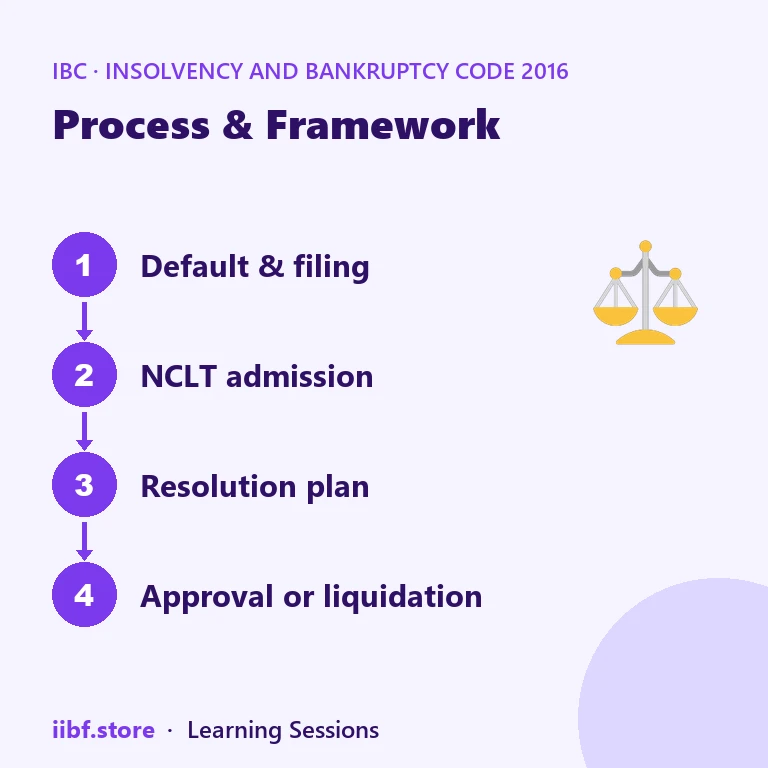
| Provision | Transaction Type | Look-Back Period | Related-Party Distinction? |
|---|---|---|---|
| Section 43 | Preferential transactions | 1 year (others) / 2 years (related party) | ✅ Yes |
| Section 45 | Undervalued transactions | 1 year (others) / 2 years (related party) | ✅ Yes |
| Section 50 | Extortionate credit transactions | 2 years (flat) | No |
| Section 66 | Fraudulent / wrongful trading | No fixed statutory window | ❌ No |
⚠️ Extortionate Credit and Fraudulent Trading — Sections 50 & 66
Section 50 targets extortionate credit transactions — credit arrangements that required grossly exorbitant payments or were otherwise unconscionable to the corporate debtor. Unlike Sections 43 and 45, this provision does not distinguish between related and unrelated parties; the relevant period is a flat two years before the insolvency commencement date for every counterparty alike.
Section 66 stands apart from the other three. Fraudulent and wrongful trading lets the NCLT direct any person — typically a director or promoter — who knowingly carried on the corporate debtor's business with intent to defraud creditors, or who continued trading despite knowing there was no reasonable prospect of avoiding insolvency, to personally contribute to the assets of the corporate debtor. Critically, Section 66 carries no fixed statutory look-back window. It can reach conduct at any point before the insolvency commencement date once the required intent or knowledge is established — the constraint here is evidentiary, not a ticking clock.
📌 Remember: If a question describes conduct going back further than two years and still asks whether it can be challenged, check whether it fits Section 66 — that is the one provision the fixed look-back periods do not apply to.
👤 The Resolution Professional's Duty to Identify and Apply
Spotting these transactions is squarely the job of the resolution professional under IBC, who reviews the corporate debtor's books, transaction history, and related-party dealings as part of the process. Under the IBBI CIRP Regulations, the resolution professional is expected to form an opinion on whether any avoidance transaction exists by around the 75th day from the insolvency commencement date, arrive at a determination by around the 115th day, and file the application before the NCLT by around the 135th day.
Missing this window does not automatically kill a genuine claim, but tribunals have taken a dim view of resolution professionals who sit on obvious red flags without explanation. This duty sits alongside the broader responsibilities covered in the chapter on roles and duties of IRP and RP, and it continues even though the general protection of the moratorium under Section 14 of IBC is a separate, parallel safeguard operating during the same period rather than a substitute for chasing these transactions down.
⚖️ What Relief the NCLT Can Grant — Why Lenders on the CoC Should Care
Once an application succeeds, the NCLT — acting as the Adjudicating Authority — can order a range of remedies depending on the provision invoked: reversing the transaction, directing the return of the property or its equivalent value, releasing security interests created in the beneficiary's favour, or, under Section 66, ordering a director or promoter to personally contribute funds to the corporate debtor's assets.
Whatever is recovered goes back into the common pool available to creditors, so financial creditors on the Committee of Creditors have a direct stake in these applications being pursued diligently rather than treated as a formality. The same discipline banks apply when structuring security — the sort of scrutiny reflected in how lenders work out the debt equity ratio for project finance loans before disbursement — is worth applying again here, on the back end, when reviewing whether a resolution professional's avoidance filings are being pursued with the same rigour. For the full picture of how these provisions fit within the Code, browse the IBC 2016 blog tag.
🧠 Practice MCQs: Look-Back Period Under IBC
Q1. Under Section 43, the look-back period for a preferential transaction with a related party is: (a) 1 year (b) 2 years (c) 3 years (d) 6 months
Answer: (b) — Section 43(4) fixes the relevant time at two years before the insolvency commencement date for related-party beneficiaries.
Q2. Which provision governs extortionate credit transactions and fixes a flat two-year window regardless of the relationship between the parties? (a) Section 43 (b) Section 45 (c) Section 50 (d) Section 66
Answer: (c) — Section 50 applies a uniform two-year relevant period without a related-party distinction.
Q3. Which avoidance provision under the IBC has no fixed statutory look-back period? (a) Section 43 (b) Section 45 (c) Section 50 (d) Section 66
Answer: (d) — Section 66 on fraudulent and wrongful trading can reach conduct at any point before the insolvency commencement date once intent or knowledge is proved.
Q4. After forming an opinion on a possible avoidance transaction, the resolution professional applies to: (a) IBBI (b) the NCLT (Adjudicating Authority) (c) the RBI (d) the Committee of Creditors alone
Answer: (b) — The application to unwind an avoidance transaction is filed before the NCLT, acting as Adjudicating Authority.
Q5. Undervalued transactions under Section 45 primarily test whether: (a) one creditor received an unfair edge over others (b) the corporate debtor received significantly less value than it gave away (c) directors traded with fraudulent intent (d) the transaction was reported to the IBBI
Answer: (b) — Section 45 focuses on the gap between the value the corporate debtor gave up and the consideration it actually received.
Want chapter-wise mock tests with 100+ MCQs? Start practising free →
FAQs
What is the look-back period under IBC?
It is the "relevant time" fixed by Sections 43, 45 and 50 of the IBC — the window before the insolvency commencement date within which a transaction can be examined and potentially unwound as an avoidance transaction.
How long is the look-back period for preferential and undervalued transactions?
Two years before the insolvency commencement date if the counterparty is a related party of the corporate debtor, and one year for any other person, under Sections 43 and 45 respectively.
Does Section 66 fraudulent trading have a fixed look-back period?
No. Section 66 carries no statutory time limit — it can reach conduct at any point before the insolvency commencement date once fraudulent intent or knowledge of inevitable insolvency is established.
Who is responsible for identifying avoidance transactions during CIRP?
The resolution professional is responsible for reviewing the corporate debtor's transactions, forming an opinion on possible avoidance transactions, and filing the application before the NCLT.
The look-back period is what decides whether a suspicious transaction can be clawed back at all, so knowing which of Sections 43, 45, 50 and 66 applies — and which window governs it — is worth mastering before exam day. Sharpen this and the rest of the IBC syllabus with chapter-wise mock tests on iibf.store's CAIIB course.
Quick quiz on this topic
5 exam-style questions from our free test bank — check yourself before you move on.
Practice this topic
Take a free mock test, download chapter PDFs, or watch a video class — all included on iibf.store.