New Product Approval Compliance in Banks: The IIBF BCP Sign-Off Process
Every product a bank launches — a co-branded card, a floating-rate deposit, a bancassurance bundle, a fully digital personal loan — must pass through a formal gate before it reaches a single customer. That gate is new product approval compliance in banks, and it is one of the most reliably examined areas in the IIBF Certificate in Banking Compliance Professional (BCP) paper. Examiners like it because it forces you to connect four things at once: regulatory permissibility, customer suitability, operational readiness and documented accountability.
The idea is simple. A product that is commercially attractive is not automatically a product the bank is permitted to sell, capable of servicing, or able to defend before a supervisor. The New Product Approval Committee (NPAC) exists to test all three before the launch date, not after the first complaint.
🧭 Why the Approval Gate Exists at All
Compliance risk in a bank is rarely created at the point of a mis-sale. It is created much earlier — at the moment a product is designed with a fee structure that cannot be disclosed cleanly, a target segment that cannot be assessed for suitability, or a delivery channel the bank does not actually control. By the time the mis-sale happens, the defect is already embedded in ten thousand contracts.
This is why the Reserve Bank of India expects new product approval compliance in banks to run through a documented, board-approved process rather than an informal business sign-off. The process is an application of the wider compliance function's mandate: identify the regulation, map it to the proposed feature, and record the conclusion. If you are shaky on that mandate, revise compliance culture and the GRC framework first — the product gate is simply GRC applied to a launch calendar.
Three risks the gate is designed to catch:
- Permissibility risk — the bank is not authorised to undertake the activity, or can only do so as an agent, or needs prior regulatory approval.
- Conduct risk — the product is permissible but unsuitable for the segment being targeted, or its pricing cannot be disclosed in a way a retail customer would understand.
- Execution risk — the product is permissible and suitable, but the core system, the accounting treatment, the grievance workflow or the vendor cannot actually support it on day one.
💡 Exam Tip: A frequent BCP question asks which risk category a scenario belongs to. Read the failure point: unauthorised activity = permissibility, wrong customer = conduct, right customer but broken process = execution.
🏛️ Who Sits on the New Product Approval Committee
Ownership is the single most examinable feature of new product approval compliance in banks, because ambiguous ownership is the most common real-world failure. A well-constituted NPAC is cross-functional and its membership is fixed by policy, not by whoever is available that week.
Typical composition
- Business / product head — sponsors the proposal and owns the revenue case.
- Compliance — issues the permissibility and conduct opinion. This is an opinion the business cannot overrule; it can only be escalated.
- Risk management — credit, market, operational and reputational risk assessment.
- Legal — contract enforceability, documentation, jurisdiction, consumer-protection exposure.
- Finance and accounts — revenue recognition, capital treatment, transfer pricing, tax.
- Technology and operations — system readiness, controls, MIS and reconciliation.
- Internal audit — usually as a permanent invitee or observer, never as an approver, so independence is preserved.
That last point matters. Internal audit cannot approve a product and then audit it — that destroys the third line of defence. In exam questions, an option that puts audit in the approving chair is almost always the distractor.
The escalation rule
Where compliance records an adverse opinion, the proposal does not die silently and it does not proceed quietly either. It escalates — typically to the risk management committee of the board or the board itself, with the compliance note attached in full. The value of the process lies in the paper trail: a supervisor reading the file two years later must be able to see who objected, on what ground, and who overrode it.
📌 Remember: The compliance officer's role at the NPAC is to opine and record, not to sell. A sign-off that reads "no objection subject to conditions" is worthless unless the conditions are tracked to closure before launch.
📋 The Eight Checks Every Proposal Must Clear
Most banks operationalise new product approval compliance in banks as a structured checklist, so that no reviewer can quietly skip a domain. The table below sets out the standard eight checks, the owning function and whether the check can block a launch outright.
| # | Check | Primary owner | Can block launch? |
|---|---|---|---|
| 1 | Regulatory permissibility — is the activity allowed, and on what basis (principal, agent, referral)? | Compliance | ✅ |
| 2 | Customer suitability and fair-practice review — target segment, mis-sale risk, vulnerable customers | Compliance + Business | ✅ |
| 3 | Pricing, fees and disclosure sign-off — all-in cost, key facts statement, no hidden charges | Finance + Compliance | ✅ |
| 4 | AML/KYC and sanctions assessment — onboarding mode, risk categorisation, monitoring scenarios | Principal Officer / AML | ✅ |
| 5 | Data privacy and consent architecture — what is collected, purpose limitation, retention, sharing | Legal + Technology | ✅ |
| 6 | Operational readiness — process notes, maker-checker, reconciliation, grievance workflow, staff training | Operations | ✅ |
| 7 | Model and vendor dependency — outsourced activity, material vendor, exit and continuity plan | Risk + Vendor Governance | ✅ |
| 8 | Accounting, capital and regulatory reporting treatment | Finance | ❌ (conditions usually permitted) |
Checks 4, 5 and 7 are where most modern launches stumble. A digitally onboarded product changes the AML risk profile because the customer is never physically seen, which is why the enterprise wide AML risk assessment must be refreshed whenever a materially new delivery channel is introduced. Where the product is delivered through a lending service provider or a technology partner, the proposal must satisfy the bank's outsourcing governance in banks standards, including a workable exit plan — not a plan that exists only on paper.
Products that carry extra scrutiny
Non-deposit, non-credit offerings attract a heavier permissibility test because they touch other regulators. Distribution of insurance, mutual funds and pension products brings IRDAI, SEBI and PFRDA conduct expectations into the file — the ground covered in other financial services by banks. Similarly, structures involving guarantees, acceptances or exposure to NBFCs carry prudential limits that a product designer will not know by instinct; see guarantees, acceptances and finance to NBFCs before assuming a structure is clean.
⚠️ How the Process Fails in Practice
The BCP syllabus expects you to recognise how new product approval compliance in banks breaks down in practice, not just recite the ideal flow. Four failure patterns recur across supervisory findings.
1. Launching ahead of sign-off. The campaign date is fixed by marketing, the NPAC meets after the soft launch, and compliance is asked to ratify a live product. This is the most serious failure because it converts a preventable defect into a remediation exercise with a customer population already attached.
2. Ambiguous ownership. Every function assumes another function covered a domain. Data-privacy consent is the classic orphan: technology assumes legal drafted it, legal assumes the vendor supplied it, and nobody tested what the customer actually sees on screen.
3. Conditions never closed. Approval is granted "subject to" training completion, a monitoring scenario, or an updated grievance script. Nobody tracks closure, and the conditions quietly lapse.
4. No post-implementation review. The product goes live and is never revisited, so early complaint clusters never feed back into design.
⚠️ Common Mistake: Candidates treat "product approved by the board" as the end of the compliance obligation. It is the start. The obligation continues through pilot, post-implementation review and periodic re-validation.
Supervisory consequences
Where the gate has failed, the consequences escalate in a predictable order: supervisory observation in the inspection report, a specific compliance direction, a monetary penalty under the Banking Regulation Act, and in serious cases a business restriction — a direction to stop onboarding new customers on that product until remediation is verified. Customer-level consequences run in parallel: complaints that are not redressed within the bank's own timeline become maintainable under the RBI Ombudsman framework, now the RB-IOS 2026 scheme effective 1 July 2026, with a 90-day complaint window, an award ceiling of Rs 30 lakh and a consequential-loss cap of Rs 3 lakh. Regulatory reporting and compounding aspects of such lapses are covered in reporting, compounding and miscellaneous.
🔁 Pilot, Post-Implementation Review and the Written Sign-Off
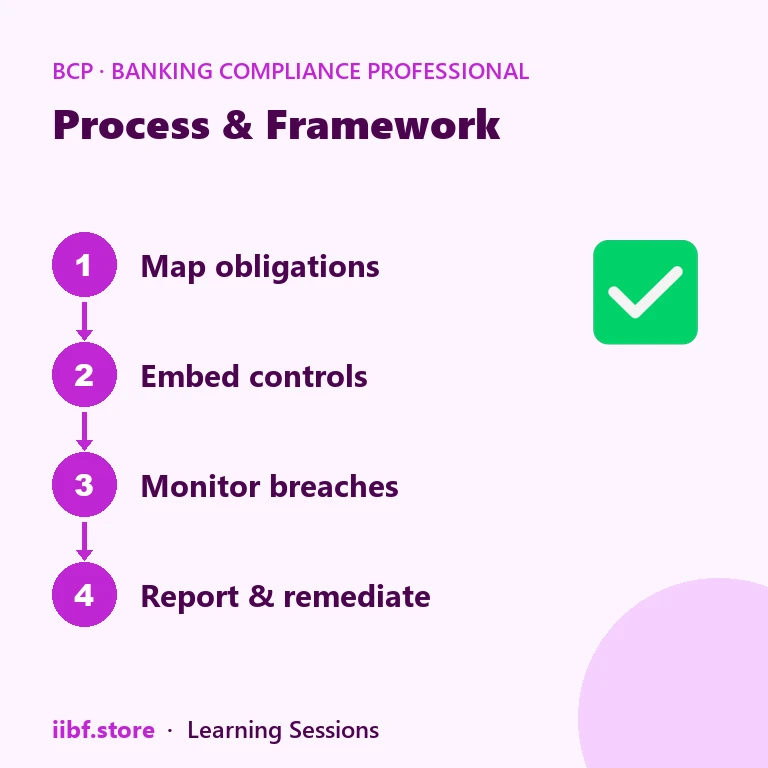
A mature bank does not treat new product approval compliance in banks as a binary event that ends when the minutes are signed. It stages the launch.
Pilot. The product runs on a capped population — a limited number of branches, a bounded ticket size, or a single geography — with heightened monitoring. The pilot's purpose is not marketing; it is to see whether the controls behave as designed under real volume. Exit criteria are defined before the pilot starts, and failing them means rollback, not renegotiation.
Post-implementation review (PIR). Conducted typically within three to six months of full launch, the PIR compares actual outcomes against the approval assumptions: complaint volumes and root causes, mis-sale indicators such as early surrender or early closure, delinquency against projections, vendor service levels, and whether the disclosed pricing matched what customers were actually charged. Adverse findings feed back into product design or, where severe, into withdrawal.
Documented sign-off. The file must be reconstructable. At minimum it holds the product note, the compliance opinion with the regulation mapped feature-by-feature, risk and legal opinions, the pricing and disclosure approval, the AML and privacy assessments, the operational-readiness certificate, minutes recording dissent, the conditions register with closure evidence, and the PIR report.
This discipline matters most in fast-moving channels. Digitally delivered credit compresses the design-to-launch cycle to weeks, which is exactly when the gate gets skipped — revise the compliance obligations in digital lending alongside this topic. The same applies where the product is manufactured by a third party and merely distributed by the bank, covered in third party product distribution in banks.
🧠 Practice MCQs: New Product Approval
Q1. In a well-constituted New Product Approval Committee, what is the appropriate role of Internal Audit? (a) Chair the committee (b) Approve the product jointly with Compliance (c) Attend as a permanent invitee or observer without approving (d) Draft the product note
Answer: (c) — Audit is the third line of defence; approving a product it must later audit would destroy its independence.
Q2. A bank's marketing team soft-launches a co-branded card two weeks before the NPAC meets. The most accurate characterisation of this lapse is: (a) A minor sequencing issue with no compliance impact (b) A breach of the product approval process that converts a preventable defect into a customer-affecting remediation (c) Acceptable if the board later ratifies it (d) Acceptable because the card is a low-value product
Answer: (b) — Launching ahead of sign-off attaches a live customer population to an untested product, turning a design question into remediation.
Q3. Under the RBI Ombudsman framework applicable from 1 July 2026 (RB-IOS 2026), the overall ceiling on an award that an Ombudsman may pass against a bank is: (a) Rs 1 lakh (b) Rs 3 lakh (c) Rs 20 lakh (d) Rs 30 lakh
Answer: (d) — RB-IOS 2026 raised the award ceiling to Rs 30 lakh; the separate consequential-loss cap is Rs 3 lakh.
Q4. Which of the following is NOT a legitimate output of a post-implementation review? (a) Withdrawal of the product (b) Redesign of the disclosure document (c) Retrospective removal of the compliance officer's recorded dissent from the file (d) Tightening of an AML monitoring scenario
Answer: (c) — Recorded dissent is part of the audit trail; removing it defeats the entire purpose of documented sign-off.
Q5. A bank proposes to deliver a personal loan entirely through a technology partner's app, with the partner handling onboarding and collections. Which check most clearly acquires heightened importance? (a) Vendor dependency and outsourcing governance, including the exit plan (b) Accounting and capital treatment (c) Branch signage requirements (d) Transfer pricing between business units
Answer: (a) — A material outsourced arrangement demands due diligence, service levels, audit rights and a workable exit plan before approval.
Want chapter-wise mock tests with 100+ MCQs? Start practising free →
❓ Frequently Asked Questions
Is a new product approval process required for every change, or only for genuinely new products?
Policy normally defines a materiality threshold. A genuinely new product always goes through the full gate; material variants — a new customer segment, a new delivery channel, a new pricing structure or a new vendor — go through an abridged but documented review. Cosmetic changes such as a campaign name do not.
Can the business proceed if Compliance records an adverse opinion?
Not by overruling it. The proposal must escalate to the designated authority — typically the risk management committee of the board or the board itself — with the compliance note attached in full, and the override must be recorded with reasons.
How soon should the post-implementation review be conducted?
Most banks schedule the first PIR within three to six months of full launch, once enough volume exists for complaint and delinquency patterns to be meaningful, with periodic re-validation thereafter as set out in the product policy.
What single document do supervisors ask for first when they examine a product?
The approval file — specifically the compliance opinion mapping each product feature to the governing regulation, and the conditions register showing that pre-launch conditions were actually closed. An approval without closure evidence reads as no approval at all.
New product approval compliance in banks is ultimately a test of whether the bank can prove, in writing and after the fact, that it asked the right questions before a customer was exposed. Learn the eight checks, the ownership map and the four failure patterns, and most BCP scenario questions on this topic answer themselves. Browse more on the Banking Compliance Professional tag hub, then lock the concepts in with the CAIIB and certificate course material and a timed attempt at chapter-wise mock tests.
Practice this topic
Take a free mock test, download chapter PDFs, or watch a video class — all included on iibf.store.
Keep reading