RBI Circular to Board Report: regulatory change management in banks
Regulatory change management in banks is the discipline that turns a newly issued RBI circular into a changed product, a changed system field, a changed process note and a documented audit trail — within the deadline the regulator set. For the IIBF Banking Compliance Professional (BCP) paper, regulatory change management in banks is one of the most examinable areas because it cuts across every module: a single Master Direction amendment can touch loans, exposure norms, customer service and reporting at the same time. Candidates who treat it as an administrative chore lose marks; examiners expect you to describe it as a controlled lifecycle with named owners, dated milestones and evidence at every stage.
🔍 What Regulatory Change Management in Banks Actually Covers
At its simplest, the lifecycle has six links: identify, assess, allocate, implement, validate, report. Identification means someone in the bank is formally responsible for spotting every new circular, Master Direction, amendment, FAQ, notification and press release the moment it is published. Assessment means translating regulatory language into a list of affected policies, products, processes, systems and reports. Allocation means giving each affected item a single accountable owner in business, operations, IT or risk — not a committee. Implementation means the actual change: a rewritten policy, a new field in core banking, a fresh customer disclosure. Validation means independently checking that the change works as intended in the live environment. Reporting means the board and its audit or risk committee can see, on one page, what is due, what is done and what is late.
The reason this matters so much in Indian banking is volume. The regulator issues instructions continuously and consolidates them into Master Directions that are updated in place, so a bank cannot rely on a one-time reading. Instructions also arrive from more than one source — the RBI for prudential and conduct matters, SEBI and IRDAI where the bank distributes third-party products, the government for sponsored schemes, and FIU-IND for reporting obligations. A mature framework routes all of these through one register rather than letting each department keep a private list.
💡 Exam Tip: If a BCP question asks you to "outline the process", answer in lifecycle order — identify, assess, allocate, implement, validate, report — and name the evidence produced at each stage. Marks are awarded for the evidence trail, not just the stage names.
📡 Horizon Scanning of RBI Circulars and Master Directions
Horizon scanning is the front end of the framework, and it fails more often than any other stage. The control objective is simple: nothing published should reach the bank late, and nothing should reach it only informally. In practice this means a designated cell checks the regulator's website on every working day, captures each instruction in a regulatory inventory with a unique reference, and records the date of issue, the effective date, the applicability (all banks, scheduled commercial banks, a specific licence category) and the transition period, if any.
Good horizon scanning goes further than the published circular. It also tracks draft directions and discussion papers put out for public comment, because these give the bank several months of warning about a change that is likely to come. It watches statements made in the bi-monthly monetary policy announcements, since developmental and regulatory policy statements are usually followed by a detailed circular within weeks. And it monitors industry association communications and the regulator's own FAQ pages, which frequently change the practical interpretation of a rule without changing its text.
The output is a live regulatory inventory mapped to the bank's own universe of obligations. Each obligation should point to the internal policy that implements it and the function that owns it — so when the rule changes, the affected policy is known in seconds rather than reconstructed from memory. Banks that have built this mapping find that credit-side changes cluster in a few predictable areas: loans and advances regulatory restrictions, large exposures and exposure norms, and priority sector definitions. Mapping those chapters to owners in advance shortens every subsequent change cycle.
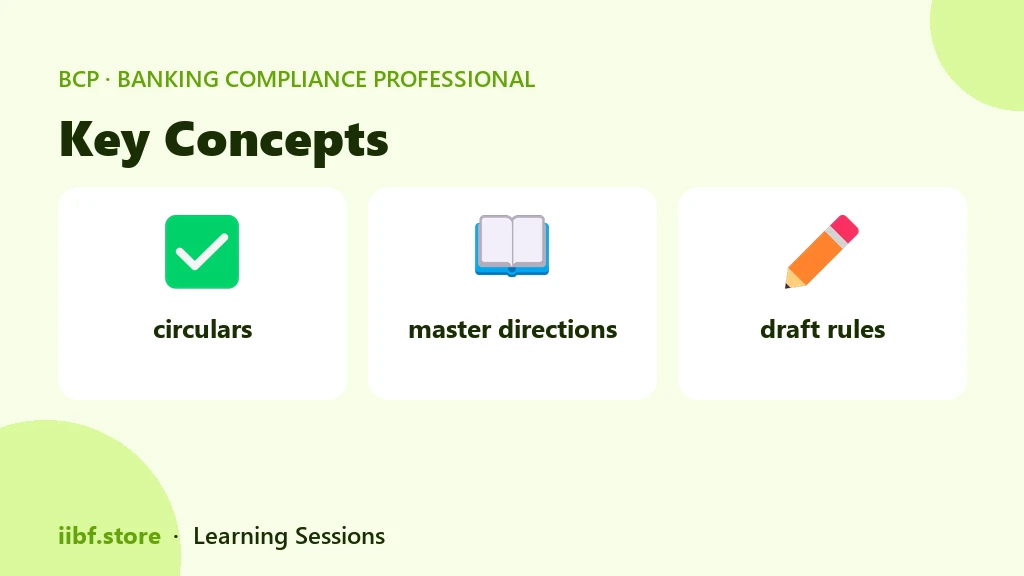
🧭 Impact Assessment, Gap Analysis and Ownership Allocation
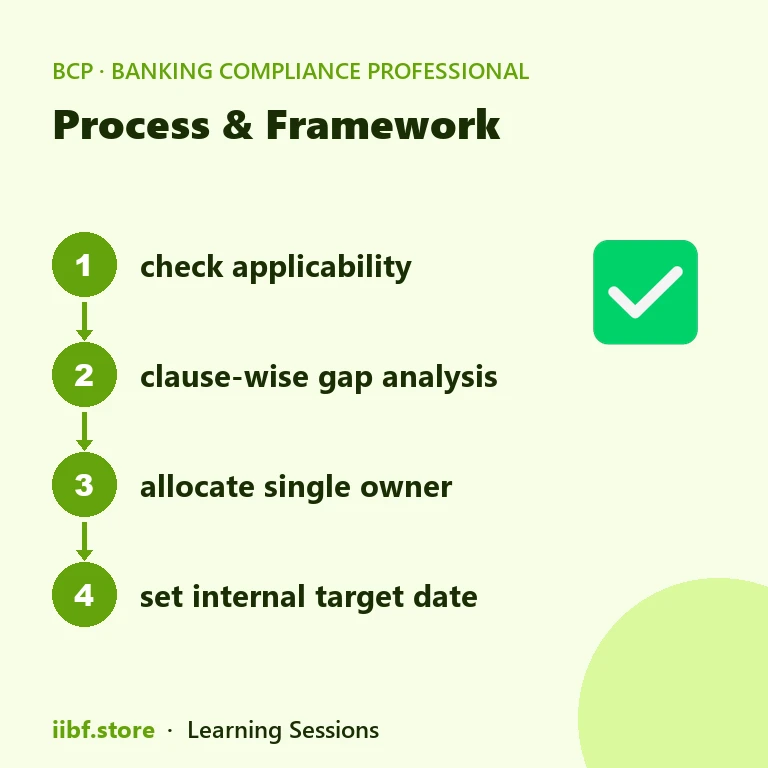
Once an instruction is captured, the impact assessment answers four questions: does this apply to us, what must change, who must change it, and by when. Applicability is not always obvious — an instruction may apply only to a category of lenders, only above a stated size, or only to a specific product. Recording a reasoned "not applicable" conclusion, signed off by compliance, is itself a control, because supervisors routinely ask why a bank did nothing.
The gap analysis then compares the requirement against current practice, clause by clause. Each clause is marked compliant, partially compliant or non-compliant, and every gap becomes a task with an owner and a target date. The most common analytical error is to stop at policy text. A rule change usually has four layers of impact: policy and process notes, system configuration and reports, customer-facing documentation such as sanction letters and key fact statements, and staff training. A change that is written into the policy but never configured in the core system is a gap that will surface in inspection.
Ownership allocation must be single-point. Business owns product and pricing decisions, operations owns process execution and turnaround, IT owns system builds and data fields, finance owns disclosure, and compliance owns the framework rather than the delivery. Where a change touches government-sponsored lending or district-level obligations, the branch banking vertical must be looped in early — the practical detail sits in chapters such as lead bank scheme and government schemes and priority sector, MSME and microfinance. The same discipline governs adjacent processes: new product approval compliance in banks depends on the change register being current, and outsourcing governance in banks fails immediately if vendors are not told that a rule has changed.
🗓️ Implementation Tracking, Validation and Board Reporting
Implementation tracking is where the framework becomes visible. Every gap task should carry a unique ID, an owner, a regulatory due date, an internal target date set earlier than the regulatory date, a status and an evidence link. Status should be evidence-based, not self-declared: "done" means the policy note is approved, the screenshot of the configured system is attached, or the amended report has been filed. Deadline discipline matters because regulatory effective dates are rarely negotiable, and an internal buffer is the only protection against a build that slips.
Validation is an independent check after go-live, usually sample-based: pull a set of accounts opened or loans sanctioned after the effective date and confirm the new rule actually bites. Independent assurance from internal audit then confirms that the change register itself is complete — that no circular was missed and no task was closed without evidence.
| Lifecycle stage | Primary owner | Key output | Typical timing | Board-visible? |
|---|---|---|---|---|
| Horizon scanning | Compliance / regulatory cell | Regulatory inventory entry | Same or next working day | ❌ |
| Applicability and impact assessment | Compliance with business input | Signed impact note | Within days of issue | ❌ |
| Gap analysis | Process and IT owners | Clause-wise gap sheet | Before build starts | ❌ |
| Implementation | Business / operations / IT | Amended policy, system change, disclosure | Before effective date | ✅ |
| Post-implementation validation | Compliance, independent of build | Sample test results | Shortly after go-live | ✅ |
| Assurance and reporting | Internal audit / compliance | Dashboard with overdue items | Each committee cycle | ✅ |
Board reporting should be short and honest. A useful dashboard shows instructions received in the period, those assessed as applicable, those implemented on time, those implemented late, those still open with revised dates, and any instance where the bank has taken an interpretation that differs from the plain reading of the rule. Ageing of overdue items matters more than the raw count.
⚠️ Common Mistake: Reporting a change as "implemented" when only the policy has been amended. Until the system field, the report format and the staff training are all done, the change is partially implemented — and describing it otherwise is itself a reporting failure.
🚫 Failure Patterns That Turn Into Supervisory Findings
Most adverse findings in this area trace back to a small set of failures. The first is a missed instruction — usually because scanning depended on one individual's inbox rather than a documented daily process. The second is wrong applicability: the bank concluded a rule did not apply, without recording why. The third is partial implementation, where the policy is updated but the underlying system continues to behave the old way, so exception reports keep producing pre-change output.
The fourth pattern is orphaned ownership. When a change spans three departments and no single owner is named, each assumes another has delivered it. The fifth is the silent deadline slip, where the due date is extended repeatedly without escalation. The sixth is documentation failure: the change was genuinely made, but the bank cannot demonstrate when, by whom and on what authority, so during inspection it is treated as if it never happened. Related conduct issues — for example a conflict of interest in banking between the team that builds a change and the team that certifies it — make the validation step unreliable and should be avoided by keeping the two separate.
Newer and fast-moving areas amplify all six patterns, because instructions there change more often and system dependencies are heavier; the compliance obligations in digital lending are a standing example. Whenever you are unsure of a current threshold or timeline, go to the latest Master Direction on the regulator's site rather than an internal note — figures such as exposure limits and rate benchmarks are revised from time to time, and consolidated directions are updated in place. Keep a watch on current RBI rates for the same reason.
📌 Remember: A regulatory change is only closed when four things exist together — amended policy, configured system, trained staff and documented evidence. Any one missing means the item stays open on the dashboard.

🎯 Exam Takeaways and Where to Practise
For the BCP paper, hold on to three points. First, regulatory change management in banks is a lifecycle with defined outputs, and questions usually test whether you can sequence it correctly and name the right owner. Second, compliance designs and monitors the framework but does not implement the change — implementation sits with business, operations and IT, and confusing the two is a classic wrong answer. Third, evidence is the deliverable: a change that cannot be demonstrated has not, for supervisory purposes, happened.
Build your revision around real instruction types — an IRAC classification change, an exposure limit revision, a pricing benchmark change — and walk each one through the six stages until the sequence is automatic. You can browse the full set of study notes through the Banking Compliance Professional article hub and then test yourself. Take a free BCP mock test on iibf.store →
🧠 Practice MCQs: Regulatory Change Management in Banks
Q1. In a bank's regulatory change management framework, which stage produces the regulatory inventory entry with issue date, effective date and applicability? (a) Gap analysis (b) Horizon scanning (c) Post-implementation validation (d) Board reporting
Answer: (b) — Horizon scanning captures each new instruction and records its key dates and applicability in the regulatory inventory.
Q2. A circular is assessed as not applicable to the bank. What is the minimum expected control? (a) No action is needed at all (b) Inform the regulator of non-applicability (c) Delete the entry from the register (d) Record a reasoned, signed-off non-applicability conclusion
Answer: (d) — Supervisors ask why a bank took no action, so the reasoning must be documented and signed off rather than left implicit.
Q3. Which of the following best describes compliance's role in implementing a regulatory change? (a) Design and monitor the framework, while business, operations and IT deliver the change (b) Build the system configuration itself (c) Approve the product pricing arising from the change (d) Own the customer communication rollout
Answer: (a) — Compliance owns the framework and independent validation; delivery accountability rests with the line functions.
Q4. A policy has been amended for a new rule but the core banking system still applies the old logic. How should the item be shown on the change dashboard? (a) Closed, since policy is the governing document (b) Deferred to the next cycle without status (c) Open or partially implemented, with the system gap flagged (d) Closed with a note to review annually
Answer: (c) — Implementation is complete only when policy, systems, disclosures and training are all aligned; until then the item remains open.
Q5. Why do banks set an internal target date earlier than the regulatory effective date? (a) To report the change to the regulator ahead of time (b) To create buffer for build slippage, testing and training before the rule bites (c) Because the effective date is usually advisory (d) To reduce the number of items on the board dashboard
Answer: (b) — The internal buffer absorbs delays in development and testing so the bank is compliant on the regulatory effective date.
Want chapter-wise mock tests with 100+ MCQs? Start practising free →
❓ Frequently Asked Questions
Who owns regulatory change management in a bank?
The compliance function owns and monitors the framework — the register, the assessment standard and the reporting. Delivery of each individual change is owned by the business, operations or IT unit whose process or system must change, with a single named accountable person per task.
What is the difference between horizon scanning and impact assessment?
Horizon scanning identifies and records what has been issued, including drafts and FAQs. Impact assessment interprets it — deciding whether it applies to the bank, which policies, systems, disclosures and training are affected, and what must change by when.
How should a regulatory change be evidenced for inspection?
Keep the instruction reference, the signed impact note, the clause-wise gap sheet, approvals for the amended policy, dated proof of system configuration, training records and the post-implementation test results. Evidence that shows when a change went live is as important as the change itself.
Is this topic important for the IIBF BCP exam?
Yes. It is a cross-cutting theme that supports questions across credit, customer service and reporting modules, and it also underpins related topics such as third party product distribution in banks. Learn the lifecycle sequence, the owner of each stage and the evidence each stage produces.
Source and further reading: Reserve Bank of India and the Indian Institute of Banking & Finance.
Practice this topic
Take a free mock test, download chapter PDFs, or watch a video class — all included on iibf.store.
Keep reading