Obligor Risk Rating in Banks: A Complete CAIIB RFS Guide (2026)
Every corporate loan file at an Indian bank carries a number that quietly decides pricing, capital charge and provisioning long before disbursement — the obligor risk rating. Under the Basel internal ratings-based (IRB) framework that RBI has extended to Indian banks, the obligor risk rating measures a borrower's stand-alone probability of default, kept separate from the security-backed facility rating attached to each loan. For CAIIB Risk in Financial Services (RFS) candidates, knowing how banks build, validate and migrate obligor ratings is core Module B territory — and a frequent source of tricky exam questions.
🎯 What Is Obligor Risk Rating?
Obligor risk rating is the grade a bank assigns to a borrower — not to a specific loan — reflecting the probability that the borrower will default on any obligation over a defined horizon, typically one year. It is the first leg of the two-dimensional credit rating architecture prescribed under Basel II/III: the obligor (borrower) rating drives Probability of Default (PD), while a separate facility (transaction) rating captures Loss Given Default (LGD) and Exposure at Default (EAD) based on collateral, seniority and structure. A single borrower therefore gets one obligor grade but can carry several facility grades if it holds multiple loans with different security cover.
This distinction matters because two loans to the same company can carry very different risk once security is factored in — a fully secured term loan and an unsecured working-capital line will never share a facility grade even though the obligor grade behind both is identical. The IIBF syllabus treats this as a dedicated topic; see the detailed treatment in Obligor and Borrower Risk, which should be read alongside the broader Credit Rating System chapter that maps out how internal grades feed capital computation.
💡 Exam Tip: If a question asks "which rating changes when collateral is added but the borrower is unchanged," the answer is always the facility rating, never the obligor rating.
🧮 The Risk Drivers Behind Every Obligor Grade
Banks build the obligor rating from a mix of quantitative and qualitative inputs, usually organised under four broad heads. Financial risk covers leverage, liquidity ratios, profitability trends and cash-flow adequacy pulled from audited financials. Business risk captures industry outlook, competitive position, revenue concentration and operating efficiency. Management risk assesses promoter track record, succession planning and corporate governance quality — often the hardest to quantify but heavily weighted for mid-size borrowers. Conduct of account looks at actual repayment behaviour, account irregularities, and utilisation of sanctioned limits versus drawing power.
Each head is scored against a weighted template — the underlying scorecards and statistical techniques used to build these templates are covered in Credit Risk Models. Qualitative overlays also matter: a bank may notch a rating up or down for group support, external credit enhancement, or country/sovereign risk exposure. Industry cyclicality itself is a live input — a borrower in a sector facing demand pressure from a high inflation cycle typically sees its business-risk score deteriorate even if its balance sheet is unchanged, which is why relationship managers track macro indicators such as types of inflation in India alongside firm-specific financials when reviewing large exposures.
Weightages are not uniform across borrower segments — a large corporate template leans more heavily on financial ratios and rating-agency cross-checks, while an SME template gives more weight to conduct of account and collateral quality because audited data is thinner and less reliable.
📊 Obligor Rating vs Facility Rating vs External Agency Rating
Candidates frequently confuse three distinct rating concepts that appear together in exam scenarios. The table below separates them by what each one measures, who assigns it, and how it is used inside the bank.
| Parameter | Obligor (Internal) Rating | Facility Rating | External Agency Rating |
|---|---|---|---|
| What it measures | Borrower-level Probability of Default (PD) | Loss Given Default (LGD) / Exposure at Default (EAD) per loan | Independent creditworthiness opinion (CRISIL, ICRA, CARE, etc.) |
| Assigned by | Bank's internal credit team / model | Bank's internal credit team / model | SEBI-registered credit rating agency |
| Varies with collateral? | ❌ No | ✅ Yes | ❌ No |
| Used for regulatory risk weights (Standardised Approach) | No | No | Yes |
| Core input for IRB capital models | Yes | Yes | No (reference/benchmark only) |
The exam frequently tests whether a student can identify that a bank's internal obligor grade and an external agency's rating on the same company can legitimately differ, because the internal model weighs the specific banking relationship and conduct-of-account history that an agency rating does not see. Banks that wish to move from the Standardised Approach to the Foundation or Advanced IRB approach for capital computation must demonstrate that their internal rating systems, including obligor and facility grades, meet RBI's validation standards — see the fuller comparison across systems in credit rating systems in banking.
🔁 Master Scale, Migration Matrix & Validation
Every obligor rating maps onto a bank-wide master scale — commonly ten to twelve grades running from the safest (near AAA-equivalent) to default — with each grade calibrated to a specific PD band using pooled historical default data. This lets a bank compare a large corporate borrower and an SME borrower on the same scale even though they were scored on different templates. The mapping and calibration methodology is detailed further in Measurement of Credit Risk.
Ratings are not static. Banks track a rating migration matrix — the probability that a borrower currently in grade X moves to grade Y over one year — built from years of historical transitions. A portfolio with heavy downgrade migration during a stress period signals rising portfolio-level risk well before actual defaults show up, and this migration data feeds directly into stress-testing and economic-capital work. Model validation teams independently back-test predicted PDs against actual default rates at least annually, recalibrating the scorecard whenever predicted and observed defaults diverge materially.
⚠️ Common Mistake: Students often assume obligor ratings are reviewed only at renewal. In practice, banks trigger an off-cycle review on covenant breaches, restructuring, delayed payments, or a sharp rating-agency downgrade — waiting for the annual cycle is a control gap, not standard practice.
Review frequency itself is risk-based: investment-grade obligors may be reviewed annually, while sub-investment-grade or watch-list accounts are typically reviewed quarterly or half-yearly until the stress resolves.
🏦 RBI Norms, Pricing & Provisioning Impact
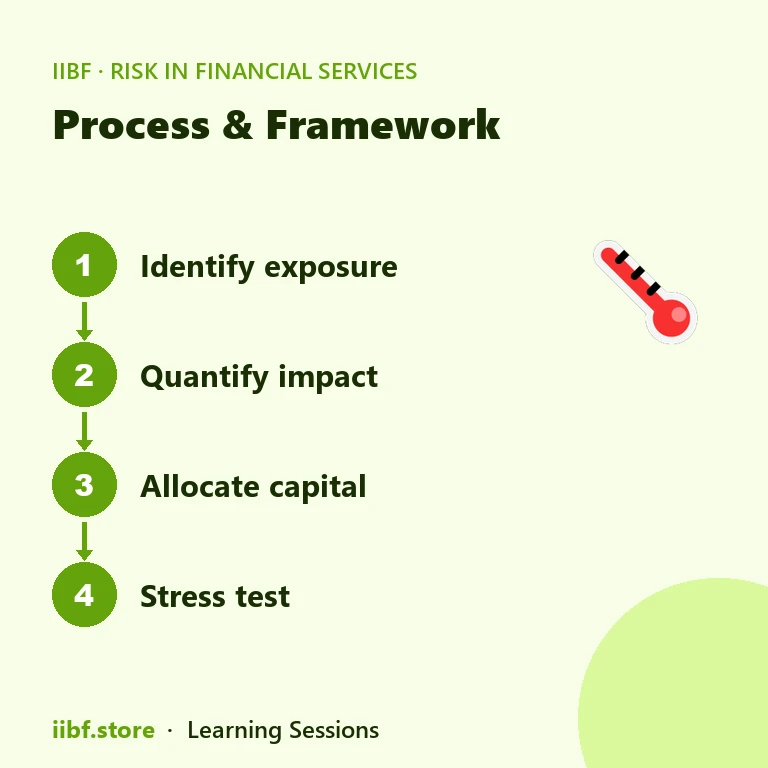
RBI permits Indian banks to migrate from the Standardised Approach to Foundation or Advanced IRB approaches for regulatory capital only after their internal obligor and facility rating systems clear a rigorous supervisory validation process — data history, model discrimination power, and independent oversight of the rating function are all examined. Details sit within RBI's Master Directions on Basel III Capital Regulations, which every serious RFS candidate should skim at least once before the exam.
The obligor rating feeds three commercial outcomes directly. First, risk-based pricing: a lower-rated obligor is charged a higher spread over the benchmark rate to compensate for higher expected loss. Second, capital allocation: under IRB, obligor PD is a direct input into the regulatory capital formula, so a ratings deterioration raises the capital a bank must hold against that exposure. Third, provisioning: Expected Loss is computed as PD × LGD × EAD, and this expected-loss logic underpins the Expected Credit Loss (ECL) framework banks are moving toward under Ind AS 109, replacing the older incurred-loss provisioning model.
Because obligor rating sits upstream of both pricing and capital decisions, it is also tightly linked to how much risk a bank is willing to carry in the first place — a topic covered separately under risk appetite framework, and to how a bank manages funding mismatches once large exposures are booked, discussed in liquidity risk in financial services.
📌 Remember: PD comes from the obligor rating, LGD and EAD come from the facility rating — Expected Loss needs all three multiplied together, never PD alone.

🧠 Practice MCQs: Obligor Risk Rating
Q1. Obligor risk rating primarily reflects which of the following? (a) Loss Given Default (b) Probability of Default of the borrower (c) Exposure at Default (d) Collateral coverage ratio
Answer: (b) — Obligor rating is borrower-specific and measures Probability of Default; LGD and EAD belong to the facility rating.
Q2. Two loans to the same borrower, one fully secured and one unsecured, will typically show: (a) Same obligor rating, same facility rating (b) Same obligor rating, different facility ratings (c) Different obligor ratings, same facility rating (d) Different obligor and facility ratings
Answer: (b) — The obligor is unchanged so the obligor rating stays the same; facility ratings differ because collateral cover differs.
Q3. Which of these is NOT typically a core input into a bank's obligor rating template? (a) Financial risk (leverage, liquidity) (b) Business/industry risk (c) Conduct of account (d) External agency's fee structure
Answer: (d) — A rating agency's commercial fee structure has no bearing on a bank's internal obligor scorecard.
Q4. A rating migration matrix is primarily used to: (a) Fix the interest rate on a loan (b) Track probability of obligors moving between rating grades over time (c) Compute KYC risk category (d) Calculate statutory liquidity ratio
Answer: (b) — Migration matrices capture historical grade-to-grade transition probabilities, key to stress testing and portfolio risk.
Q5. Expected Loss under the IRB approach is computed as: (a) PD + LGD + EAD (b) PD × LGD × EAD (c) LGD ÷ EAD (d) PD × EAD ÷ LGD
Answer: (b) — Expected Loss is the product of Probability of Default, Loss Given Default and Exposure at Default.
Want chapter-wise mock tests with 100+ MCQs? Start practising free →
What is the difference between obligor rating and facility rating?
Obligor rating measures the borrower's overall probability of default and stays constant across all its loans. Facility rating measures the loss the bank would face on a specific loan after accounting for collateral, seniority and structure, so it can vary loan by loan for the same borrower.
Who assigns the obligor risk rating in a bank?
The bank's own credit risk / credit appraisal team assigns it using an internal rating model or scorecard, distinct from ratings issued by external SEBI-registered credit rating agencies such as CRISIL, ICRA or CARE.
How often is an obligor rating reviewed?
Investment-grade borrowers are typically reviewed annually at renewal, while sub-investment-grade, restructured or watch-list accounts are reviewed more frequently — often quarterly or half-yearly — and any account can trigger an off-cycle review on covenant breach or repayment stress.
Why does obligor risk rating matter for CAIIB RFS?
It sits at the core of Module B's credit risk syllabus and links directly to Basel IRB capital computation, risk-based pricing and provisioning — concepts that repeatedly appear together in scenario-based CAIIB RFS questions.
Obligor risk rating is the quiet engine behind pricing, capital and provisioning decisions on every corporate loan book, and CAIIB RFS candidates who can cleanly separate it from facility rating and external agency ratings avoid the exam's most common trap questions. Build that clarity with structured chapter tests on iibf.store's CAIIB course, or browse more Risk in Financial Services exam guides to round out the rest of Module B before test day.
Prefer revising from a printed book?
Chapter-wise books with MCQs after every chapter — minimal pages, complete coverage, delivered anywhere in India. Every book has a free sample to read first.
Learning Sessions · Ashish Sir
132 pages · 225 MCQs
Learning Sessions · Ashish Sir
188 pages · 435 MCQs
Learning Sessions · Ashish Sir
117 pages · 236 MCQs
Learning Sessions · Ashish Sir
Learning Sessions · Ashish Sir
118 pages · 299 MCQs
Learning Sessions · Ashish Sir
Learning Sessions · Ashish Sir
Learning Sessions · Ashish Sir
115 pages · 255 MCQs
Learning Sessions · Ashish Sir
Learning Sessions · Ashish Sir
334 pages · 936 MCQs
Learning Sessions · Ashish Sir
Learning Sessions · Ashish Sir
115 pages · 344 MCQs
Learning Sessions · Ashish Sir
107 pages · 240 MCQs
Learning Sessions · Ashish Sir
90 pages · 150 MCQs
Learning Sessions · Ashish Sir
Learning Sessions · Ashish Sir
131 pages · 672 MCQs
Learning Sessions · Ashish Sir
221 pages · 831 MCQs
Learning Sessions · Ashish Sir
128 pages · 524 MCQs
Learning Sessions · Ashish Sir
107 pages · 445 MCQs
Learning Sessions · Ashish Sir
148 pages · 478 MCQs
Learning Sessions · Ashish Sir
151 pages · 465 MCQs
Learning Sessions · Ashish Sir
148 pages · 375 MCQs
Learning Sessions · Ashish Sir
216 pages · 895 MCQs
Learning Sessions · Ashish Sir
109 pages · 300 MCQs
Learning Sessions · Ashish Sir
104 pages · 360 MCQs
Learning Sessions · Ashish Sir
82 pages · 297 MCQs
Learning Sessions · Ashish Sir
151 pages · 600 MCQs
Learning Sessions · Ashish Sir
98 pages · 282 MCQs
Learning Sessions · Ashish Sir
Practice this topic
Take a free mock test, download chapter PDFs, or watch a video class — all included on iibf.store.
Keep reading