ONDC Banking Integration Guide for IIBF Digital Banking 2026
India's Open Network for Digital Commerce is reshaping retail payments, and ONDC banking integration is now a scoring topic in the IIBF Digital Banking paper. Candidates are expected to know how banks plug into the ONDC protocol as buyer-side and seller-side network participants, how settlement flows differently from a closed-loop app, and what RBI expects from participating entities on security and grievance redressal. This article breaks the concept into exam-ready pieces, compares it with adjacent digital rails, and gives you practice questions before test day.
🛒 What Is ONDC and Why Banks Care
ONDC is not an app or a company — it is an open, interoperable protocol that separates buyer apps, seller apps, and logistics providers so that any compliant participant can transact with any other. A bank's role is rarely to run its own storefront; instead, banks and their fintech partners plug in as Buyer Network Participants (BNPs) or Seller Network Participants (SNPs), offering catalogue discovery, order management, and payment settlement as network services. For a lender this means new fee-based income from checkout financing, merchant onboarding, and payment gateway services layered on top of network transactions. It also means digital banking teams must understand the Overview of Digital Banking module's treatment of open protocols alongside closed banking apps, since examiners frequently ask candidates to distinguish protocol-based commerce from proprietary platforms. Because ONDC rides on existing UPI rails for payment collection, familiarity with the UPI ecosystem is assumed background knowledge before this topic is tested.
💡 Exam Tip: ONDC is a protocol, not a marketplace — never answer that "ONDC is an e-commerce company" in descriptive questions.
🏦 ONDC Banking Integration Architecture
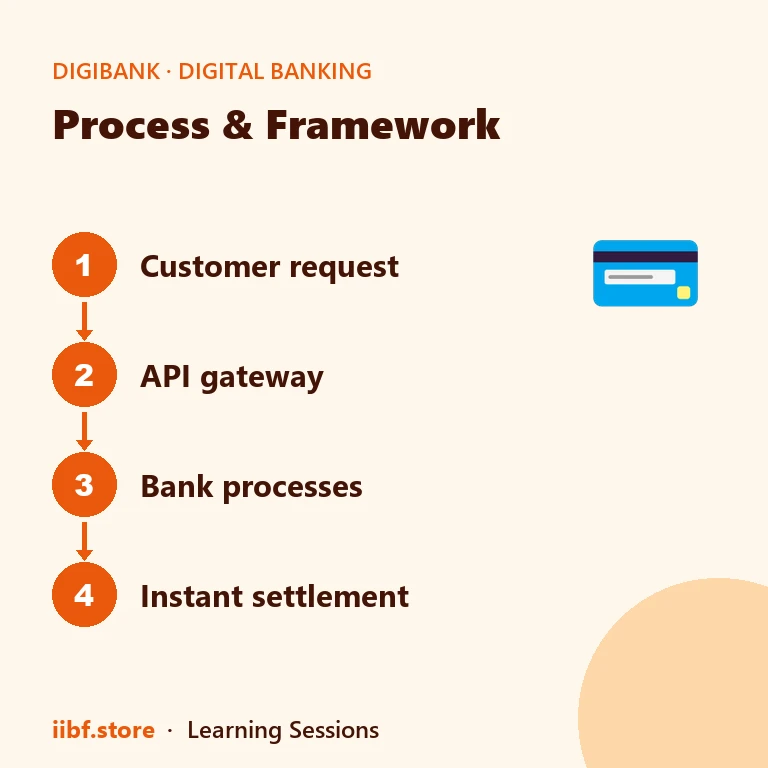
A bank integrating with ONDC typically builds three layers: a compliance layer mapping existing KYC and merchant-onboarding data to the ONDC participant schema, a transaction layer translating ONDC's search/select/init/confirm order flow into the bank's core banking and payment APIs, and a settlement layer reconciling network transactions against the bank's ledger. Most banks route through a Techno-Service Provider (TSP) empanelled by ONDC, which handles protocol versioning and gateway calls while the bank focuses on lending, escrow, and settlement guarantees. This layered approach mirrors the account-linking patterns candidates study under Mobile Banking, where a thin client talks to a thick backend through standardised APIs. Settlement finality is the exam-sensitive part: unlike a card network, ONDC does not itself guarantee settlement — that obligation sits with the bank or payment aggregator acting as network participant, which is why RBI's payment aggregator directions apply squarely to ONDC-linked banking flows.
🔗 ONDC vs UPI vs Account Aggregator: How They Differ
Exam setters love side-by-side comparisons because a single confused row can flip four MCQ options. ONDC solves discovery and commerce interoperability; UPI solves instant payment movement; the Account Aggregator framework solves consented data sharing. They frequently work together in one customer journey — a buyer discovers a seller via an ONDC-compliant app, pays via UPI, and a lender might pull bank-statement data via an AA-based flow to underwrite instant checkout credit. Candidates should also revisit Retail Banking - Digital Banking Class 12 for how these three rails are increasingly bundled into a single retail digital banking product suite.
| Feature | ONDC | UPI | Account Aggregator |
|---|---|---|---|
| Primary purpose | Commerce discovery & order flow | Instant payment settlement | Consented data sharing |
| Regulator/promoter | DPIIT-backed nonprofit (ONDC) | NPCI, RBI-regulated | RBI-licensed AA entities |
| Moves money directly? | ❌ No | ✅ Yes | ❌ No |
| Core building block | Beckn protocol APIs | UPI switch & PSP apps | Consent artefact + FIU/FIP |
| Bank's typical role | Network participant / TSP | Issuing/acquiring bank | Financial Information Provider |
⚠️ Common Mistake: Students often write that ONDC "processes payments" — it only orchestrates commerce; payment settlement is delegated to UPI or card rails.
📈 Financial Inclusion and Merchant Onboarding Impact
Because ONDC removes the discovery advantage large platforms hold, small kirana stores and rural sellers can be onboarded through the same catalogue infrastructure as national chains, provided a bank or business correspondent digitises their inventory once. This directly extends the Financial Inclusion agenda that IIBF papers test heavily: candidates should connect ONDC-enabled merchant onboarding to priority-sector lending data, since transaction history on the network can feed cash-flow-based underwriting for micro-merchants who previously had no credit file. Banks acting as SNPs for these merchants often bundle a current account, a QR code for UPI collection, and a small working-capital limit — a combination candidates should recognise as a converged digital banking product rather than three separate services.
📌 Remember: ONDC network participants must still complete standard merchant KYC and Ind-AS/GST compliance checks before onboarding — the protocol layers on top of, not instead of, existing due diligence.
🔒 Risks, RBI Oversight and Exam Pointers
Because ONDC is a multi-party network, dispute resolution, data protection, and settlement risk are shared across participants rather than owned by a single platform — banks must pre-agree who is liable if an order is confirmed but the seller cannot fulfil it, and who absorbs a failed settlement leg. RBI's payment aggregator and payment gateway guidelines apply to any bank or NBFC acting as a network participant that touches customer funds, and examiners expect candidates to cite this regulatory overlay rather than treat ONDC as unregulated. For the primary source, see the Reserve Bank of India's payment systems guidance at rbi.org.in. Candidates should also revisit the POS (Point of Sale) chapter, since merchant-side settlement risk overlaps closely with ONDC seller-side flows.
Outside the digital banking paper, this shared-liability model resembles risk-sharing questions tested under stressed asset resolution framework in the CCP syllabus, where multiple lenders must agree on loss allocation — a useful cross-subject anchor if you are attempting both exams. It is also worth comparing ONDC's account-linking assumptions with UPI ecosystem in India architecture and with open banking in India principles, since all three rely on standardised, consent-driven APIs rather than bilateral bank agreements.
🧠 Practice MCQs: ONDC Banking Integration
Q1. What is the primary function of ONDC in the digital commerce ecosystem? (a) It processes card payments directly (b) It is an open protocol enabling interoperable buyer-seller discovery and ordering (c) It is a private e-commerce marketplace (d) It replaces UPI for payment settlement
Answer: (b) — ONDC standardises discovery and order flow between independent buyer and seller apps; it does not move money itself.
Q2. In ONDC terminology, a bank that operates a merchant-facing app on the network is typically called a: (a) Buyer Network Participant (b) Seller Network Participant (c) Payment Service Operator (d) Core Banking Aggregator
Answer: (b) — Banks or their fintech partners onboarding sellers act as Seller Network Participants (SNPs) on ONDC.
Q3. Who bears settlement risk in an ONDC-linked transaction? (a) ONDC itself as network guarantor (b) The bank or payment aggregator acting as network participant (c) NPCI exclusively (d) No one, since ONDC guarantees settlement
Answer: (b) — ONDC does not guarantee settlement; that obligation rests with the participating bank or licensed payment aggregator.
Q4. Which RBI-regulated framework is most commonly combined with ONDC to complete payment collection at checkout? (a) Account Aggregator (b) UPI (c) SWIFT (d) NEFT batch settlement
Answer: (b) — ONDC handles discovery and ordering while UPI executes the actual instant payment settlement.
Q5. How does ONDC most directly support the financial inclusion agenda tested in the Digital Banking syllabus? (a) By offering subsidised loans directly (b) By giving small merchants equal catalogue visibility, enabling onboarding and transaction-based credit data (c) By eliminating the need for merchant KYC (d) By restricting network access to large retail chains
Answer: (b) — Equal discovery access lets small and rural merchants build a digital transaction footprint that supports inclusion and underwriting.
Want chapter-wise mock tests with 100+ MCQs? Start practising free →
Frequently Asked Questions
Is ONDC a bank or a payment app?
No. ONDC is an open protocol that standardises how buyer apps, seller apps, and logistics providers discover and transact with each other; banks participate as network participants rather than owning the protocol.
Does ONDC replace UPI?
No. ONDC and UPI solve different problems — ONDC handles commerce discovery and ordering, while UPI remains the payment rail used to actually settle funds at checkout.
What role can a bank play on the ONDC network?
A bank can act as a Buyer Network Participant, a Seller Network Participant, or a technology/settlement partner to a Techno-Service Provider, depending on whether it is onboarding merchants, offering a shopping app, or handling settlement.
Why is ONDC relevant to the IIBF Digital Banking exam?
It tests candidates on open-protocol architecture, the distinction between commerce and payment rails, settlement liability, and how digital infrastructure supports financial inclusion — all core Digital Banking syllabus themes.
Ready to lock in these concepts? Attempt a full chapter-wise Digital Banking mock test on the JAIIB course page, or browse every Digital Banking article on the blog to keep your 2026 exam prep on track.
Quick quiz on this topic
5 exam-style questions from our free test bank — check yourself before you move on.
Practice this topic
Take a free mock test, download chapter PDFs, or watch a video class — all included on iibf.store.
Keep reading