Priority Sector Lending 2026: PSLC, On-Lending & RIDF for JAIIB PPB
If Part 5 of our priority sector lending series left you squinting at terms like PSLC, on-lending and RIDF, you are not alone. This is the exact corner of JAIIB PPB where candidates quietly bleed marks — not because the ideas are hard, but because nobody joins the dots between the 40% target and the penalty a bank pays when it falls short. Priority sector lending shows up in every single attempt, and the 2026 syllabus leans hard on the shortfall mechanism. Let us fix that in the next few minutes.
Priority Sector Lending 2026 (Part 5) · Watch on YouTube
What priority sector lending really means
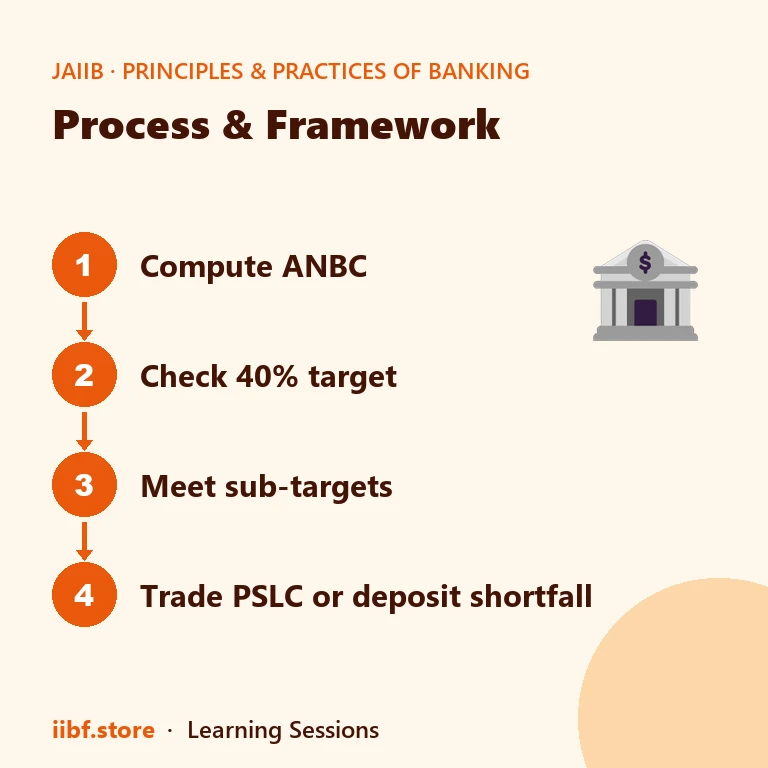
At its core, priority sector lending is a rule that forces banks to channel a slice of their credit toward parts of the economy that markets tend to ignore. For domestic scheduled commercial banks the headline target is 40% of Adjusted Net Bank Credit (ANBC) or the Credit Equivalent of Off-Balance-Sheet Exposure (CEOBE), whichever is higher. Inside that 40% sit the categories you must memorise: agriculture, MSME, export credit, education, housing, social infrastructure, renewable energy and the "others" bucket, plus a cross-cutting weaker-sections requirement.
The sub-targets are where MCQs live:
- Agriculture — 18% of ANBC, with a carve-out of 10% for small and marginal farmers.
- Micro enterprises — 7.5% of ANBC.
- Weaker sections — 12% of ANBC.
Miss any of these and the bank does not simply shrug — it pays, and that payment is the whole point of Part 5.
PSLC: trading achievement without trading the loan
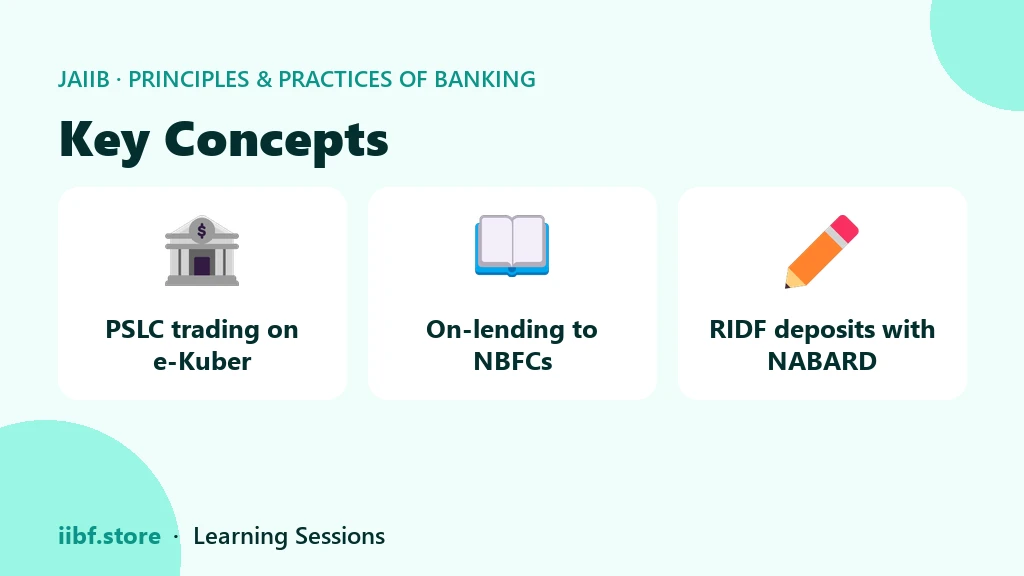
A Priority Sector Lending Certificate (PSLC) is the most elegant idea in this chapter. A bank that has over-achieved a category can sell its surplus to a bank that has fallen short — but only the priority-sector "achievement" changes hands, never the underlying loan or its credit risk. There are four flavours: PSLC-General, PSLC-Agriculture, PSLC-Small and Marginal Farmers, and PSLC-Micro Enterprises.
Three facts examiners love: PSLCs are traded on RBI's e-Kuber platform; they expire on 31 March regardless of when they were bought; and the net position (PSLC buy minus PSLC sell) is added to the bank's credit for ANBC computation. Because no loan moves, the selling bank keeps the asset on its books and the buying bank gets the compliance credit — a clean, risk-free market.
On-lending: reaching the last mile through NBFCs
Sometimes a bank cannot originate small rural or micro loans efficiently, so RBI lets it lend to a well-run NBFC, Housing Finance Company or Microfinance Institution that on-lends to the ultimate priority-sector borrower. Subject to prescribed caps and eligibility, that bank-to-NBFC exposure counts toward the bank's priority sector lending targets. It is a pragmatic bridge — the bank supplies scale and funding, the NBFC supplies last-mile reach.
RIDF and the real "shortfall penalty"
Here is the mechanism Part 5 is built around. When a bank still falls short after PSLCs and on-lending, it must park the shortfall in dedicated development funds — and these funds pay below-market interest. That opportunity cost is the penalty; there is no fine as such, but locking money into a low-yield deposit hurts.
| Shortfall in… | Deposited into | Maintained with |
|---|---|---|
| Agriculture / overall PSL | Rural Infrastructure Development Fund (RIDF) | NABARD |
| MSME | MSME development funds | SIDBI / MUDRA |
| Housing | Housing shortfall fund | NHB |
Per RBI's latest FAQs (updated January 2026), these outstanding deposits are reckoned toward the relevant sub-target and the overall priority sector lending target, and are added back to Net Bank Credit for ANBC computation. So the money is not lost — it just earns less until the bank organically catches up.
A 30-second worked example
Say a bank's ANBC is ₹1,00,000 crore. Its overall target is 40% = ₹40,000 crore; agriculture 18% = ₹18,000 crore; micro enterprises 7.5% = ₹7,500 crore; weaker sections 12% = ₹12,000 crore. If actual agriculture lending is only ₹16,000 crore, the ₹2,000 crore gap flows into RIDF with NABARD. Buy PSLC-Agriculture worth ₹2,000 crore before 31 March and the gap closes instead — no RIDF deposit needed. That single choice is a classic exam scenario.
Want the full JAIIB PPB syllabus mapped this way? Our JAIIB course walks through every module, and you can pressure-test yourself on the practice tests. Build a countdown with the study planner, and keep current numbers handy on our live RBI rates page. For the primary source, the RBI Master Directions on Priority Sector Lending are the last word.
Three traps that catch JAIIB candidates
The first trap is confusing the base for the percentage. Every priority sector lending target is measured against ANBC or CEOBE, whichever is higher — never against gross advances or total deposits. Candidates who anchor on "total loans" get every downstream calculation wrong, and examiners deliberately seed that error into the options.
The second trap is assuming a PSLC moves the loan. It does not. Only the achievement is traded, which is precisely why a bank can sell a certificate and still keep earning interest on the same asset. Examiners phrase this as "credit risk transfers to the buyer" — a false statement you should reject on sight.
The third trap is treating the RIDF deposit as a fine. It is not a punitive penalty; it is a low-yield parking of the shortfall with NABARD, SIDBI, MUDRA or NHB. The bank loses interest income, not the principal, and the deposit still counts toward the sub-target until organic lending catches up. Hold those three distinctions and priority sector lending stops being a guessing game — it becomes three clean rules you can apply in seconds.
Frequently asked questions
Is priority sector lending 40% of ANBC or of total advances?
It is 40% of ANBC or CEOBE, whichever is higher — not of gross advances. ANBC adjusts bank credit for certain exclusions and the net PSLC position, so always start your calculation from ANBC.
Does selling a PSLC transfer the loan to the buying bank?
No. A PSLC transfers only the priority-sector achievement. The loan, the borrower relationship and the credit risk all stay with the originating bank. That is why PSLC trading is treated as risk-free.
What exactly is the penalty for missing a priority sector lending target?
There is no monetary fine. The shortfall is parked in RIDF (with NABARD) and similar funds with SIDBI, MUDRA and NHB, which pay below-market interest. The lost yield is the effective penalty.
When do PSLCs expire?
All PSLCs expire on 31 March of the financial year, no matter when they were bought or sold. They are not valid beyond that reporting date, so timing your purchase before year-end matters.
Prefer revising from a printed book?
Chapter-wise books with MCQs after every chapter — minimal pages, complete coverage, delivered anywhere in India. Every book has a free sample to read first.



















Quick quiz on this topic
5 exam-style questions from our free test bank — check yourself before you move on.
Practice this topic
Take a free mock test, download chapter PDFs, or watch a video class — all included on iibf.store.