Banker Customer Relationship: Debtor, Creditor and Trustee Roles (JAIIB PPB)
Every deposit slip, every loan sanction and every locker agreement rests on one legal foundation that JAIIB candidates must master: the banker customer relationship. Far from being a single bond, it is a bundle of relationships that switch depending on what the customer is doing — depositing money, borrowing, keeping valuables in safe custody, or asking the bank to collect a cheque. Because the banker customer relationship decides who owns the money, who owes whom, and what duties each side carries, it is a favourite area for Principles and Practices of Banking questions. This guide breaks the relationship into its general and special forms, explains the rights and obligations that flow from each, and gives you exam-ready tables and MCQs to lock the concept in.
🏦 The General Relationship: Debtor and Creditor
The starting point of the banker–customer relationship is contractual. When you open a savings or current account and pay money in, you are lending that money to the bank. The bank becomes the debtor and you, the depositor, become the creditor. This principle was settled in the classic English case Foley v. Hill (1848), where the House of Lords held that money paid into a bank is not held in trust — it becomes the bank's property, and the bank owes the customer an equivalent sum.
Three consequences flow from this. First, the bank is free to use your deposit for lending and investment; it only has to repay on demand (for current/savings) or on maturity (for term deposits). Second, the debt is repayable at the branch where the account is kept, during business hours, and only on a proper demand such as a cheque or withdrawal instruction — the bank is a debtor whose obligation is to pay on demand, not automatically. Third, the customer ranks as an unsecured creditor, which is why deposit insurance and the bank's own solvency matter.
💡 Exam Tip: Remember the direction — for an ordinary deposit the customer is the CREDITOR and the banker is the DEBTOR. Examiners love to flip this to test whether you truly understand who owes whom.
🔄 When the Roles Reverse: Banker as Creditor
The moment a customer borrows — a term loan, overdraft, or cash credit — the relationship inverts. Now the bank is the creditor and the borrower is the debtor. Understanding this reversal is essential for grasping how banks classify and recover dues. If a borrower stops servicing the loan, the account slides toward becoming one of the bank's non-performing assets, triggering provisioning and recovery action.
The lending relationship also brings in the framework of types of borrowers and credit facilities — individuals, partnerships, companies, trusts and HUFs each carry different documentation and liability rules. When security is taken, a fresh sub-relationship is layered on top: for goods pledged the bank is a pawnee, for a mortgage it is a mortgagee, and for hypothecated stock it holds a floating charge. These are not separate from the debtor-creditor bond; they secure it.
⚠️ Common Mistake: Candidates assume the banker is always the debtor. In any borrowing, guarantee, or advance, the banker is the CREDITOR. The relationship is defined by the transaction, not by who the bank is.
🤝 Special Relationships: Trustee, Bailee, Agent and Lessor
Beyond the core debtor-creditor bond, banks step into several special relationships where they do not own the customer's money or property. Recognising these is a high-yield exam skill.
As a trustee, the bank holds money for a specific purpose — for example, funds received for a demand draft not yet issued, or money held under an escrow arrangement. Here the money does not become the bank's property; if the bank fails, such funds are not part of its general assets. As a bailee, the bank keeps sealed articles in safe custody; ownership stays with the customer and the bank owes a duty of reasonable care. (Note that renting a locker is technically a lessor–lessee relationship, closer to landlord and tenant, than a pure bailment.)
As an agent, the bank acts on the customer's mandate — collecting cheques, paying utility bills, buying securities, or acting under a power of attorney in banking. When it collects an instrument, the bank is an agent for collection until the proceeds are realised, which is why protection under Section 131 of the NI Act matters. These special roles matter for accounting too, since the treatment of trust and agency balances links to accounting standards for banks.
⚖️ Banker's Rights: Lien, Set-off and Appropriation
The banker customer relationship gives the bank three important self-protection rights. A general lien lets the bank retain securities and goods (other than those given for a specific purpose or in safe custody) until the customer clears general dues — recognised under Section 171 of the Indian Contract Act as an implied pledge. The right of set-off allows the bank to combine two or more accounts of the same customer, in the same capacity, to arrive at a net position — for instance, adjusting a credit balance in savings against a debit in an overdraft after due notice.
The right of appropriation decides which debt a payment reduces when a customer owes several. The rule in Clayton's Case (Devaynes v. Noble, 1816) applies to running accounts: the first item on the debit side is discharged by the first item on the credit side. If the customer does not specify and the bank does not appropriate, credits automatically wipe out the earliest debits.
📌 Remember: Right of set-off requires the debts to be in the SAME NAME and SAME RIGHT (capacity). A bank cannot set off a sole account against a joint account balance, or a personal balance against a trust account.
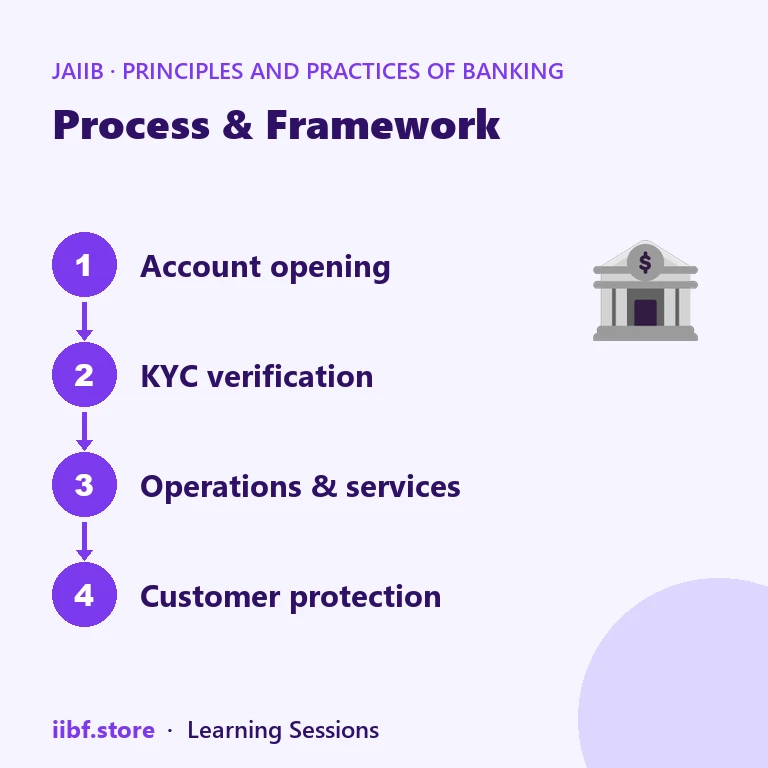
📋 Obligations of the Banker: Honour Cheques and Secrecy
Rights come paired with duties. The bank's first obligation is to honour its customer's cheques so long as the account has sufficient funds, the cheque is properly drawn, and there is no legal bar such as a stop-payment or a garnishee order. Wrongful dishonour exposes the bank to damages, and the smaller the amount wrongfully returned for a trader, the larger the presumed injury to reputation.
The second obligation is the duty of secrecy. The bank must not disclose the state of a customer's account except in the four recognised situations: under compulsion of law, where there is a duty to the public, in the bank's own interest, and with the customer's express or implied consent. This duty survives even after the account is closed. It sits alongside the customer's own transparency rights — for public-sector banks these interact with the Right to Information Act 2005.
The table below summarises how the relationship — and who owes whom — changes with the transaction.
| Transaction / Situation | Customer's Role | Banker's Role | Legal Nature | Bank owns the money? |
|---|---|---|---|---|
| Deposit in savings / current account | Creditor | Debtor | Contract (loan to bank) | ✔ Yes |
| Loan / overdraft / cash credit | Debtor | Creditor | Contract (advance) | ✘ No (it is repayable to bank) |
| Money for DD not yet issued / escrow | Beneficiary | Trustee | Trust | ✘ No |
| Sealed articles in safe custody | Bailor | Bailee | Bailment (duty of care) | ✘ No |
| Cheque sent for collection | Principal | Agent | Agency | ✘ No (until realised) |
| Safe deposit locker hired | Lessee | Lessor | Lease / tenancy | ✘ No |
Mastering how these roles interact with everyday operations — from types of cheque crossing to fund-transfer choices like RTGS vs NEFT vs IMPS — is what separates a pass from a strong score. Browse more topics in the Principles and Practices of Banking collection to build the full picture.
🧠 Practice MCQs: Banker Customer Relationship
Q1. When a customer deposits money in a savings account, the relationship between the banker and the customer is that of: (a) trustee and beneficiary (b) bailee and bailor (c) debtor and creditor (d) agent and principal
Answer: (c) — The deposited money becomes the bank's property; the bank is the debtor and the customer the creditor (Foley v. Hill).
Q2. In which case does the banker become the creditor? (a) Fixed deposit by the customer (b) Overdraft availed by the customer (c) Cheque given for collection (d) Articles kept in safe custody
Answer: (b) — When the customer borrows through an overdraft, loan or cash credit, the bank lends and becomes the creditor.
Q3. The rule in Clayton's Case relates to the banker's right of: (a) general lien (b) set-off (c) appropriation of payments (d) secrecy
Answer: (c) — Clayton's Case governs appropriation in running accounts: the first debit is cleared by the first credit.
Q4. For the right of set-off to be exercised, the accounts must be held in the: (a) same branch only (b) same name and same right (c) same currency (d) same financial year
Answer: (b) — Set-off requires the debts to be in the same name and same capacity; a sole account cannot be set off against a joint or trust account.
Q5. When a bank holds sealed articles in safe custody without charge, its relationship with the customer is that of: (a) trustee (b) bailee (c) mortgagee (d) pawnee
Answer: (b) — In safe custody the bank is a bailee, owing a duty of reasonable care while ownership stays with the customer.
Want chapter-wise mock tests with 100+ MCQs? Start practising free
❓ Frequently Asked Questions
Authoritative reference: see the latest guidelines on the Reserve Bank of India website and the IIBF syllabus portal.
Is the banker always the debtor in a banker customer relationship?
No. The banker is the debtor only for ordinary deposits. The moment the customer borrows — loan, overdraft or cash credit — the roles reverse and the banker becomes the creditor.
What is the difference between a general lien and a right of set-off?
A general lien lets the bank retain a customer's goods and securities until dues are cleared. A right of set-off combines the credit and debit balances of the same customer, in the same capacity, to reach a net position.
Under the duty of secrecy, when can a bank disclose account information?
In four situations: under compulsion of law, where there is a duty to the public, in the bank's own interest, and with the customer's express or implied consent.
Why is the relationship for a safe deposit locker not a bailment?
Because the bank does not take possession of the locker contents. Hiring a locker is a lessor–lessee (landlord–tenant) relationship, whereas sealed articles left in safe custody create a bailee–bailor bond.
The banker customer relationship is a scoring anchor across JAIIB PPB — get the debtor-creditor reversal and the special relationships right and several questions fall into place. Reinforce it with full-length practice on the JAIIB course and take a timed set on our free mock tests today.
Prefer revising from a printed book?
Chapter-wise books with MCQs after every chapter — minimal pages, complete coverage, delivered anywhere in India. Every book has a free sample to read first.



























Quick quiz on this topic
5 exam-style questions from our free test bank — check yourself before you move on.
Practice this topic
Take a free mock test, download chapter PDFs, or watch a video class — all included on iibf.store.