Regulation of Microfinance Institutions in Rural Banking (CAIIB)
The regulation of microfinance institutions is one of the most frequently tested areas in CAIIB Rural Banking, because it sits at the intersection of financial inclusion policy and prudential banking law. Every NBFC-MFI, and every bank running its own microfinance book, now operates under a single RBI rulebook — the Master Direction on Regulatory Framework for Microfinance Loans, 2022 — that replaced the older, fragmented margin-cap and pricing-cap regime. For an exam candidate, understanding this framework is not optional: questions test household income ceilings, the FOIR limit, board-approved pricing policy, and how the rules differ from the bank-led SHG/JLG channel discussed in the Issues Concerning Rural Areas chapter.
🏦 What Counts as a Microfinance Loan Today
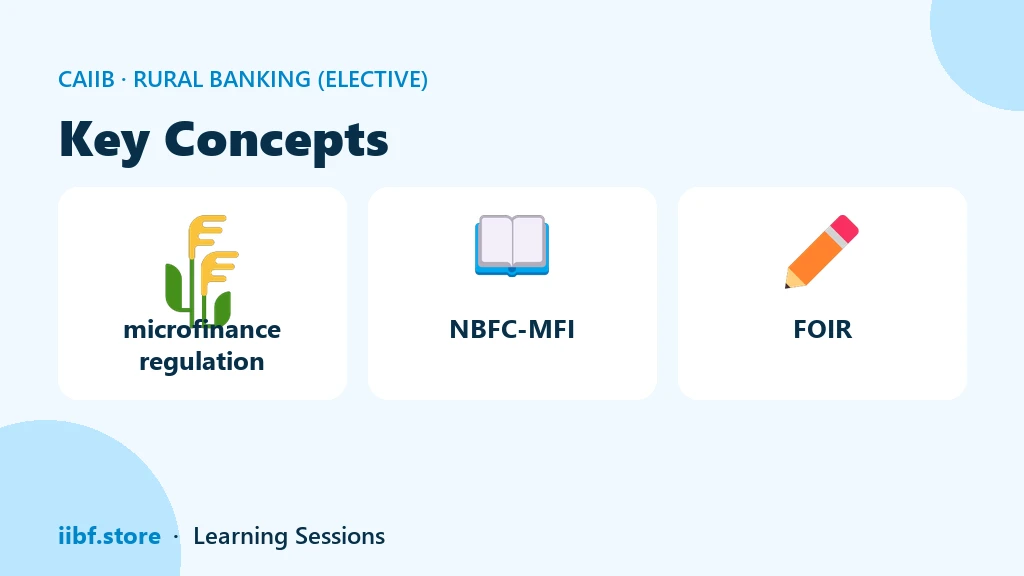
Before 2022, India ran three separate microfinance pricing regimes — one for NBFC-MFIs, a looser one for banks, and a third for other regulated entities. The RBI's harmonised Master Direction collapsed all three into one definition: a "microfinance loan" is a collateral-free loan given to a household with annual income up to ₹3 lakh, regardless of the end use or the location of the household. This single definition now applies uniformly to banks, NBFCs, NBFC-MFIs, and small finance banks, closing the arbitrage that let some lenders classify similar loans differently to escape stricter pricing rules.
The regulation also formally recognises that microfinance is delivered through more than one channel. A bank can lend directly to a Joint Liability Group, it can route credit through the SHG-bank linkage model, or an NBFC-MFI can originate the loan itself and carry it on its own book. Whichever channel is used, the household-income test and the pricing ceiling travel with the loan, not with the lender type. This is a subtle but exam-favourite point: two loans that look identical on paper can fall under different disclosure rules only if the borrowing household's declared income differs.
💡 Exam Tip: Memorise the ₹3 lakh household income ceiling exactly — questions frequently swap it with the older, retired ₹1.25 lakh (rural) / ₹2 lakh (urban) MFI-specific caps to test whether you know the 2022 harmonisation replaced them.
📋 Household Income Assessment and Qualifying Asset Rules
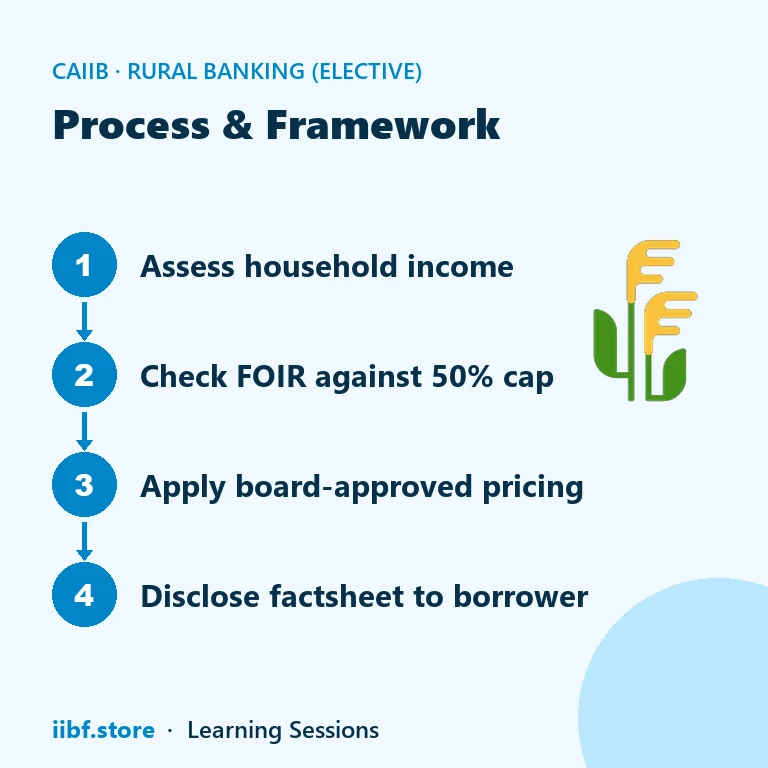
The Master Direction requires every regulated entity to put a board-approved methodology in place for assessing household income, and this methodology has to be applied consistently — not adjusted loan by loan to push a borrower under the ceiling. Lenders must also assess the household's total existing debt obligations, because the regulation caps total loan repayment outflow, not just the size of the new loan being sanctioned.
That cap is expressed through the FOIR — the Fixed Obligation to Income Ratio. Outflows on account of repayment of all microfinance loans, taken together, cannot exceed 50% of the household's monthly income. This is a hard ceiling, and it is meant to catch the exact problem examiners love to test: a household that is not formally over-indebted on any single loan but is stretched thin across three or four concurrent MFI loans from different lenders. Since qualifying-asset norms for NBFC-MFIs also require that at least 75% of total assets be in the nature of microfinance loans, the regulation simultaneously polices both the lender's balance sheet composition and the borrower's repayment capacity.
This dual focus — lender-side asset composition plus borrower-side FOIR — is what separates today's microfinance regulation from PSL agricultural lending norms, which cap exposure at the portfolio level rather than the household level. Candidates studying rural credit delivery alongside the broader Agriculture Economy chapter should keep this household-versus-portfolio distinction sharp, since mixing the two is a common paper-setter trap.
⚠️ Common Mistake: Candidates often confuse the FOIR ceiling (50% of household income across all microfinance loans) with per-loan EMI-to-income ratios used in retail lending. FOIR under this Direction is a household-level, all-lender aggregate — not a single-loan metric.
💰 Pricing Freedom, Interest Rate Disclosure and the Board Policy
The single biggest structural change in the 2022 Direction is pricing deregulation. RBI removed the hard interest-rate cap and the fixed margin cap that had governed NBFC-MFIs for a decade, and replaced it with a principles-based regime: every regulated entity must have a board-approved policy on interest rates, processing charges, and other fees, and this policy must be disclosed transparently to borrowers before disbursement. Pricing must not be "usurious," and RBI retains supervisory power to act against lenders whose rates are found excessive relative to their cost of funds.
In practice this means lenders must publish a standardised, easy-to-understand factsheet giving the borrower the effective annual interest rate, and they cannot levy a pre-payment penalty on floating-rate microfinance loans. Rate variation between individual borrowers of the same risk category is also restricted — a lender cannot arbitrarily price the same loan differently for two similar households without a documented risk basis. This transparency package is what makes the framework "regulation without a rate cap": freedom on pricing, but tight discipline on disclosure and governance.
For exam purposes, remember that this shift moved supervisory emphasis from RBI fixing a number to RBI auditing a process — the board policy itself, its periodic review, and the factsheet given to the borrower. This mirrors how Rural Development Policies generally lean on institution-level governance rather than blanket price controls to protect vulnerable borrowers, and it is a theme worth tracking across the whole Rural Banking elective.
📌 Remember: There is no RBI-fixed interest rate cap on microfinance loans post-2022 — pricing is board-governed and disclosure-driven, not centrally capped.
⚖️ NBFC-MFI Route vs Bank-Led SHG/JLG Route — How the Rules Differ
Although the income ceiling, FOIR limit, and disclosure norms apply uniformly, the delivery channel still changes a few operational details that examiners test as comparison questions. The table below sets out the practical differences a candidate needs to hold in memory going into the exam hall.
| Feature | NBFC-MFI Direct Lending | Bank-Led SHG/JLG Route |
|---|---|---|
| Household income ceiling | ₹3 lakh (uniform) | ₹3 lakh (uniform) |
| FOIR cap applies | ✅ Yes | ✅ Yes |
| RBI interest-rate cap | ❌ No — board policy governs | ❌ No — board policy governs |
| Collateral required | ❌ No (collateral-free) | ❌ No (group-guaranteed) |
| Counts toward PSL | ✅ Yes, as bank on-lending/assignment | ✅ Yes, direct agriculture/PSL |
| Qualifying-asset norm (75% microfinance assets) | ✅ Applies to the NBFC-MFI | ❌ Not applicable to the bank as a whole |
| Primary group liability model | Individual or JLG, lender-designed | Self-Help Group peer guarantee |
The practical exam takeaway is that the qualifying-asset test is what makes NBFC-MFIs a distinct regulatory category — a bank can run a large SHG book without ever being classified as an "MFI" because banks are not subject to the 75% asset-composition test. That single row in the table is the most commonly tested distinction between the two routes, more often than the pricing or FOIR rules, precisely because it explains why the same word "microfinance" describes two structurally different supervisory categories.
🧠 Practice MCQs: Regulation of Microfinance Institutions
Q1. Under the RBI Master Direction on Microfinance Loans, 2022, a household is eligible for a "microfinance loan" if its annual household income does not exceed: (a) ₹1.25 lakh (b) ₹2 lakh (c) ₹3 lakh (d) ₹5 lakh
Answer: (c) — The 2022 Direction harmonised the earlier rural/urban income caps into one uniform ₹3 lakh household income ceiling.
Q2. The Fixed Obligation to Income Ratio (FOIR) ceiling for microfinance loan repayment outflows is capped at what percentage of household monthly income? (a) 30% (b) 40% (c) 50% (d) 60%
Answer: (c) — Total repayment obligations on all microfinance loans of a household cannot exceed 50% of monthly household income.
Q3. Which of the following is TRUE about interest rate regulation on microfinance loans after the 2022 Master Direction? (a) RBI fixes a uniform interest rate cap (b) Rates are governed by a board-approved policy with mandatory disclosure (c) Only NBFC-MFIs may charge interest, banks must lend interest-free (d) Rates are fixed by NABARD annually
Answer: (b) — RBI removed the hard rate/margin cap and replaced it with a principles-based, board-approved and disclosed pricing regime.
Q4. For an NBFC to be classified as an NBFC-MFI, what minimum percentage of its total assets must be in the nature of qualifying microfinance loans? (a) 50% (b) 60% (c) 75% (d) 90%
Answer: (c) — The qualifying-asset norm requires at least 75% of an NBFC-MFI's total assets to be microfinance loans, a test that does not apply to banks.
Q5. A microfinance loan under the current RBI framework is best described as: (a) A secured loan against gold or property (b) A collateral-free loan to an eligible-income household (c) A term loan restricted to agricultural purposes only (d) A loan available only through SHGs
Answer: (b) — The Direction defines a microfinance loan as a collateral-free loan to a household meeting the income ceiling, regardless of end use or lending channel.
Want chapter-wise mock tests with 100+ MCQs? Start practising free →

❓ Frequently Asked Questions
What is the current RBI definition of a microfinance loan?
A collateral-free loan extended to a household with annual income up to ₹3 lakh, irrespective of the end use of the loan or which regulated entity extends it.
Is there still an RBI-mandated interest rate cap on microfinance loans?
No. Since the 2022 Master Direction, there is no centrally fixed rate cap; each lender must instead follow a board-approved, disclosed pricing policy that avoids usurious pricing.
How is FOIR different from a per-loan EMI-to-income ratio?
FOIR aggregates repayment obligations across all of a household's microfinance loans from every lender and caps that total at 50% of household income, rather than assessing a single loan in isolation.
Does the qualifying-asset norm apply to banks doing SHG lending?
No. The 75% qualifying-asset test applies only to NBFC-MFIs; banks running SHG or JLG microfinance books are not required to meet this asset-composition threshold.
Getting comfortable with the regulation of microfinance institutions means holding three numbers together — the ₹3 lakh income ceiling, the 50% FOIR cap, and the 75% qualifying-asset test — and knowing exactly which one applies to which lender. This framework connects directly to related delivery models covered in joint liability group financing, to secured rural products such as agricultural gold loans, and to the inclusion push behind Jan Dhan Yojana financial inclusion. On the monetary-policy side, candidates comparing how RBI balances market discipline against borrower protection will find a useful parallel in public debt management by RBI. Browse more coverage on the Rural Banking Elective tag hub, and read the source rules directly on the RBI Master Direction on Microfinance Loans, 2022. To lock in these numbers before exam day, work through full-length questions on the CAIIB course page →
Quick quiz on this topic
5 exam-style questions from our free test bank — check yourself before you move on.
Practice this topic
Take a free mock test, download chapter PDFs, or watch a video class — all included on iibf.store.
Keep reading