Regulatory Restrictions on Bank Loans: IIBF BCP Compliance Guide 2026
For a Banking Compliance Professional, no area triggers more supervisory scrutiny than lending, and the regulatory restrictions on bank loans sit right at the centre of it. These are not internal policy preferences a bank can waive at will — they flow from the Banking Regulation Act, 1949, and from RBI's Master Directions, and breaching them exposes the bank to penalties, wilful-default classification of borrowers, and adverse SPARC ratings. This IIBF BCP guide walks through the statutory ceilings (Sections 20, 19(2), 20A and 21), the RBI-imposed limits on advances against shares and sensitive commodities, and the directed-lending obligations that a compliance officer must monitor every single day. Master these and Module D of the exam becomes far more predictable.
Whether you are preparing for the BCP paper or already sitting in a compliance function, the principle is the same: every advance a bank sanctions must survive three tests — is it permitted by statute, is it within RBI's prudential ceilings, and is it consistent with the bank's board-approved loan policy? Get any one wrong and the exposure becomes a compliance breach, not merely a credit decision.
🔍 Why Lending Restrictions Are a Compliance Concern
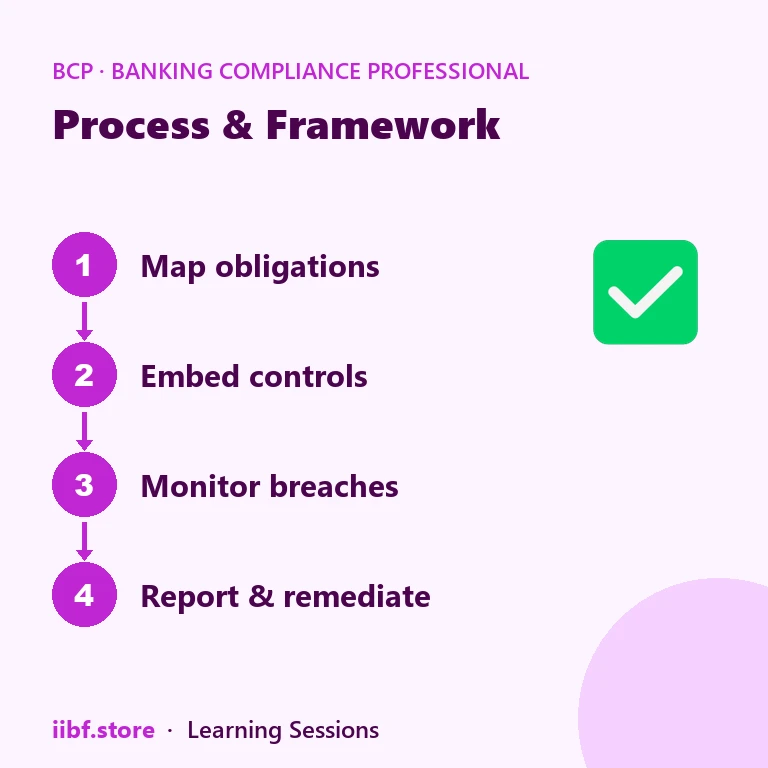
Compliance officers often assume that loan sanctioning is purely a credit function. In reality, a large share of RBI's monetary penalties on banks over the past decade have arisen from breaches of statutory and prudential lending norms — connected lending, advances against the bank's own shares, or exceeding single/group exposure ceilings. The compliance function owns the second line of defence here: it must map every applicable restriction to a control, test that control periodically, and escalate exceptions to the Chief Compliance Officer.
The restrictions fall into three buckets. First, statutory prohibitions under the Banking Regulation Act that no bank can override — for example, the outright ban on advances against its own shares under Section 20(1)(a). Second, prudential ceilings set by RBI directions, such as exposure limits and margins on advances against shares. Third, directed lending obligations like priority-sector targets, where under-achievement carries a financial consequence via RIDF-type deposits. A robust compliance calendar tracks all three. For the exam, remember that statutory restrictions bind absolutely, while prudential ceilings can be tightened by the board but never loosened below the RBI floor. This layered logic — statute, regulator, board — is the mental model examiners test repeatedly, and it is the same framework you will use in a live loans and advances regulatory restrictions review.
💡 Exam Tip: When a question asks whether a restriction can be relaxed, check the source. Statutory (BR Act) = never. RBI prudential = board may make it stricter, never softer.
🏦 Statutory Restrictions: Sections 20, 19(2), 20A and 21
Four sections of the Banking Regulation Act, 1949 form the statutory spine of lending restrictions, and BCP candidates should be able to recall each by number. Section 20 prohibits a banking company from granting any loans or advances on the security of its own shares, and restricts loans to its directors and to firms or companies in which a director is interested as partner, manager, guarantor, or holder of substantial interest. This is the classic "connected lending" bar, and it is the single most examined restriction in the paper.
Section 19(2) caps the shares a bank may hold — as pledgee, mortgagee, or absolute owner — in any company to an amount not exceeding 30% of the paid-up share capital of that company or 30% of the bank's own paid-up capital and reserves, whichever is less. Section 20A restricts a bank's power to remit debts due by a director without RBI's prior approval, closing a back-door route around Section 20. Section 21 empowers RBI to issue binding directions to control advances by banking companies — the legal hook for almost every RBI lending direction, including margins, ceilings, and sectoral caps.
For compliance testing, each section maps to a specific control: director-interest declarations (Section 20), a shareholding register with the 30% trigger (Section 19(2)), a remission-approval log (Section 20A), and a directions-tracker (Section 21). Candidates who confuse Section 20 (loans to directors) with Section 20A (remission of debts) lose easy marks, so anchor the numbers early. These statutory bars also interact with the large exposures and exposure norms that govern how much a bank may lend to a single counterparty or group.
📉 Advances Against Shares and Sensitive Commodities
Beyond outright prohibitions, RBI imposes quantitative ceilings and margins on certain advances. The most tested is lending against shares, debentures, and bonds to individuals. RBI caps such advances to an individual at ₹10 lakh where the securities are held in physical form and ₹20 lakh where they are dematerialised. A minimum margin of 50% applies to advances against shares/convertible debentures in physical form, and a minimum margin of 25% applies where they are in demat form. Banks may not extend finance to enable a borrower to acquire shares of the bank itself or to fund inter-corporate share purchases beyond permitted limits.
Sensitive commodities attract Selective Credit Control: when RBI activates it, banks must observe stipulated margins on advances against commodities such as certain foodgrains, oilseeds, and sugar to curb hoarding and speculative stockpiling. Advances against a bank's own certificates of deposit are prohibited, and finance against the security of another bank's fixed deposit receipts is discouraged and heavily conditioned. Bridge loans and interim finance are permitted only within specific guardrails.
The compliance takeaway is that these are dynamic controls — margins and ceilings change with RBI notifications — so the compliance function must maintain a live watch on circulars rather than relying on a static manual. The rate at which advances are priced also matters; a bank cannot recover interest beyond what its board-approved policy and RBI's external-benchmark regime permit, which ties directly into the interest rates on advances framework.
⚠️ Common Mistake: Candidates swap the physical (₹10 lakh) and demat (₹20 lakh) ceilings for advances against shares. Demat = higher limit, lower margin (25%). Physical = lower limit, higher margin (50%).
🌾 Priority Sector and Directed Lending Compliance
Directed lending is the third pillar of loan-related compliance. Under RBI's priority sector lending (PSL) guidelines, domestic commercial banks must deploy 40% of Adjusted Net Bank Credit (ANBC) or the credit-equivalent of off-balance-sheet exposure (CEOBE), whichever is higher, to priority sectors. Within that, agriculture carries an 18% sub-target, micro enterprises 7.5%, and weaker sections 12%. Shortfalls are not merely reported — they translate into mandatory contributions to funds such as the Rural Infrastructure Development Fund (RIDF), so a compliance officer treats PSL under-achievement as a quantifiable regulatory cost, not a soft target.
The compliance function verifies that classifications are genuine: an MSME loan tagged as priority sector must actually meet the definitional thresholds, and Priority Sector Lending Certificates (PSLCs) purchased to bridge a gap must be properly recorded. Misclassification to inflate PSL achievement is a serious supervisory red flag. Lead Bank Scheme obligations, government-sponsored schemes, and sub-target monitoring all sit inside this bucket and appear frequently in Module D questions.
For deeper coverage of the definitional thresholds, revisit priority sector, MSME and microfinance before the exam. A compliance officer who can connect the statutory bars, the prudential ceilings, and the directed-lending targets into one coherent monitoring calendar has essentially mastered the lending chapter — and that integration is exactly what separates a 70% score from a 90% score in the BCP paper.
📊 Section-wise Lending Restrictions at a Glance
| Provision / Norm | What it restricts | Key threshold | Can bank relax it? |
|---|---|---|---|
| Section 20(1)(a), BR Act | Advances against bank's own shares | Absolute prohibition | ❌ No |
| Section 20, BR Act | Loans to directors / interested concerns | Prohibited without safeguards | ❌ No |
| Section 19(2), BR Act | Shareholding in any company | ≤ 30% (lower of two bases) | ❌ No |
| Section 20A, BR Act | Remission of debt due by a director | Needs RBI prior approval | ❌ No |
| Advances against shares (demat) | Ceiling per individual | ₹20 lakh, 25% margin | ✅ Stricter only |
| Advances against shares (physical) | Ceiling per individual | ₹10 lakh, 50% margin | ✅ Stricter only |
| Priority Sector (overall) | Directed lending target | 40% of ANBC / CEOBE | ✅ Higher only |
📌 Remember: "❌ No" rows are statutory — a compliance breach the moment they are crossed. "✅" rows are floors the board may raise but never lower.
These lending controls do not sit in isolation. A weak control here usually surfaces first through the bank's compliance risk assessment, and repeat breaches feed into the RBI supervisory rating. Serious lapses — especially connected lending or evergreening — can lead to borrowers being tagged under the IRAC norms and wilful defaulters machinery. Where a single counterparty threatens to breach concentration limits, the large exposures framework becomes the binding constraint. Ethical conduct underpins all of it, so pair this with the code of conduct for bankers. You can browse every related note on the Banking Compliance Professional tag hub.

📚 Official reference: Always verify the latest rules, circulars and thresholds on the Reserve Bank of India (RBI) website before your exam — regulations change and only primary sources are authoritative.
🧠 Practice MCQs: Regulatory Restrictions on Bank Loans
Q1. Under which section of the Banking Regulation Act, 1949 is a bank prohibited from granting loans and advances to its own directors? (a) Section 19(2) (b) Section 20 (c) Section 21 (d) Section 20A
Answer: (b) — Section 20 bars loans to directors and to concerns in which a director is interested, and advances against the bank's own shares.
Q2. Section 19(2) restricts a bank from holding shares in any company (as pledgee, mortgagee or owner) beyond what ceiling? (a) 10% (b) 15% (c) 30% (d) 40%
Answer: (c) — The limit is 30% of the paid-up capital of that company or 30% of the bank's own paid-up capital and reserves, whichever is less.
Q3. What is the maximum advance a bank may grant to an individual against shares/debentures held in dematerialised form? (a) ₹5 lakh (b) ₹10 lakh (c) ₹20 lakh (d) ₹50 lakh
Answer: (c) — The demat ceiling is ₹20 lakh per individual with a minimum margin of 25%; the physical-form ceiling is ₹10 lakh with a 50% margin.
Q4. Which section empowers the RBI to issue binding directions to control advances by banking companies? (a) Section 21 (b) Section 35A (c) Section 36 (d) Section 22
Answer: (a) — Section 21 is the statutory hook under which RBI prescribes margins, ceilings and sectoral controls on advances.
Q5. The overall priority sector lending target for domestic commercial banks is what proportion of ANBC or CEOBE, whichever is higher? (a) 18% (b) 32% (c) 40% (d) 75%
Answer: (c) — The headline PSL target is 40%, within which agriculture is 18%, micro enterprises 7.5% and weaker sections 12%.
Want chapter-wise mock tests with 100+ MCQs? Start practising free →
Is lending compliance really examined in the BCP paper?
Yes. Module D of the Banking Compliance Professional syllabus is heavily weighted toward loans and advances, and statutory restrictions under Sections 20, 19(2) and 21 are among the most frequently tested items.
Can a bank's board relax a statutory lending restriction?
No. Restrictions rooted in the Banking Regulation Act cannot be softened by any bank. The board may only make RBI prudential ceilings stricter — for example, setting a lower internal exposure cap than the regulatory floor.
What is the difference between Section 20 and Section 20A?
Section 20 prohibits granting loans to directors and interested concerns, and advances against the bank's own shares. Section 20A restricts the bank's power to remit a debt due by a director without RBI's prior approval.
What happens if a bank misses its priority sector target?
The shortfall must be contributed to funds such as RIDF, making under-achievement a real regulatory cost. Compliance also watches for misclassification of loans as priority sector, which is a serious supervisory red flag.
🎯 Conclusion
The regulatory restrictions on bank loans are where compliance theory meets daily banking reality: a statutory bar under Section 20, a prudential margin on share-backed advances, and a directed-lending target all have to be monitored, tested, and escalated. For the IIBF BCP exam, anchor the section numbers, keep the physical-versus-demat ceilings straight, and remember that statutory bars are absolute while RBI ceilings are floors. Ready to test your recall under exam conditions? Take a free BCP mock test now → or explore the full structured course library to build your Module D mastery.
Practice this topic
Take a free mock test, download chapter PDFs, or watch a video class — all included on iibf.store.
Keep reading