Section 29A Eligibility for Resolution Applicants Under IBC 2016
For any banker preparing for the IIBF Insolvency and Bankruptcy Code 2016 course, understanding Section 29A eligibility for resolution applicants is one of the highest-yield topics you can master. Section 29A of the IBC decides who is allowed to submit a resolution plan for a company undergoing insolvency, and it is the single most litigated eligibility filter in the entire Code. This article walks through the origin of the provision, the categories of persons it disqualifies, the connected-person and relative test, the cure period for defaulters, and why the Committee of Creditors must scrutinise it before approving any plan. If you get comfortable with this clause, a whole cluster of exam questions on the Corporate Insolvency Resolution Process becomes easy marks.
Why Section 29A was introduced
When the Insolvency and Bankruptcy Code came into force in 2016, it did not originally contain any bar on who could bid for a stressed company. In practice this created a loophole: the very promoters whose mismanagement had driven a company into default could return through the resolution process and buy the business back at a steep discount, effectively erasing the debt they had caused. Parliament closed this door through the Insolvency and Bankruptcy Code (Amendment) Act, 2018, which inserted Section 29A with retrospective effect from 23 November 2017. The aim was to preserve the sanctity and credibility of the resolution mechanism.
The provision reflects a deliberate policy choice: the IBC is a creditor-driven, market-based framework, but the market must be honest. A defaulting promoter, a wilful defaulter flagged by the RBI, or a person convicted of a serious offence should not profit from the distress they helped create. The evolution of the Insolvency and Bankruptcy Code shows a steady tightening of eligibility rules as courts and the legislature responded to attempts to game the system. For the IIBF exam, remember that Section 29A is a disqualification clause, not a qualification clause — a person is presumed eligible unless they fall into one of its listed buckets. This framing matters because it shapes how the resolution professional and the Committee of Creditors apply the test.
Who is disqualified: the core categories
Section 29A lists several categories of persons who are ineligible to submit a resolution plan, either directly or through any person acting jointly or in concert with them. The most examinable disqualifications are: an undischarged insolvent; a wilful defaulter as classified under RBI guidelines; a person whose account is classified as a non-performing asset (NPA) for one year or more and who has not cleared the overdue amount with interest before submitting the plan; a person convicted of an offence carrying imprisonment of two years or more (for certain offences) or seven years or more; a person disqualified as a director under the Companies Act, 2013; a person barred by SEBI from trading in securities; and a person who has been a promoter or in management of a company where a preferential, undervalued, extortionate or fraudulent transaction occurred.
The clause also disqualifies any person who has executed a guarantee in favour of a creditor for a corporate debtor under insolvency, where that guarantee has been invoked and remains unpaid. Crucially, the bar extends to connected persons — so a promoter cannot simply route a bid through a relative, holding company or subsidiary to escape the disqualification. The IIBF course material on the initiation of the Corporate Insolvency Resolution Process ties this directly to how a resolution plan is evaluated before the CoC vote.
The NPA cure period and the connected-person test
Two sub-rules cause the most confusion in the exam, so learn them precisely. First, the NPA disqualification: a person is barred if they, or a company they promote or control, hold an account classified as a non-performing asset for a period of one year or more from the date of classification, up to the date of commencement of the corporate insolvency resolution process. However, the Code gives such a person a chance to cure the default — they can regain eligibility by paying all overdue amounts along with interest and charges relating to the NPA account before submitting the resolution plan. This cure right is a deliberate balance between deterrence and allowing genuine turnaround investors to participate.
Second, the connected-person and relative test. Section 29A(j) disqualifies not just the applicant but any person "connected" with them — including a person who is a promoter, in management or control of the applicant, the holding company, subsidiary, associate or related party. The definition of relative and connected person is drawn widely so that disqualified promoters cannot use proxies. A well-known carve-out exists for financial entities (such as scheduled banks, asset reconstruction companies and registered alternative investment funds) that are not related parties of the corporate debtor — they are not automatically tainted merely by holding an NPA in their books, because their business is lending, not defaulting. Understanding this financial-entity exception separates a strong answer from an average one on the IIBF paper.
Section 29A at a glance: disqualifications, cure and effect
The following table summarises the categories most tested in the IIBF Insolvency and Bankruptcy Code 2016 exam. Use it as a quick revision grid — the pattern of "disqualification, cure/exception, and practical effect" is exactly how examiners frame scenario questions on a resolution applicant's eligibility.
| Disqualification category | Cure / exception available? | Practical effect on the bid |
|---|---|---|
| Undischarged insolvent | No cure until discharged | Plan rejected outright |
| Wilful defaulter (RBI norms) | No statutory cure | Ineligible to submit a plan |
| Account classified as NPA for 1 year or more | Yes — clear overdue amount + interest before submitting plan | Eligible again once fully paid |
| Disqualified director (Companies Act, 2013) | Ends when disqualification period lapses | Barred during the disqualification window |
| Connected / related person of a disqualified applicant | Financial-entity exception if not a related party | Bid tainted unless exception applies |
| Guarantor with invoked, unpaid guarantee | No — must be honoured | Ineligible until guarantee settled |
Role of the CoC and resolution professional in applying Section 29A
Eligibility under Section 29A is not a one-time filing formality — it is a live gatekeeping duty. The resolution professional (RP) must confirm that every resolution plan received conforms to the requirements of the Code, and this expressly includes verifying that the applicant is not disqualified under Section 29A. The RP therefore collects affidavits and undertakings from each prospective applicant declaring their eligibility, and cross-checks them against RBI wilful-defaulter lists, SEBI orders and the corporate debtor's own records. The duties of the RP in this screening role are detailed in the IIBF study material on the roles and duties of the IRP and RP.
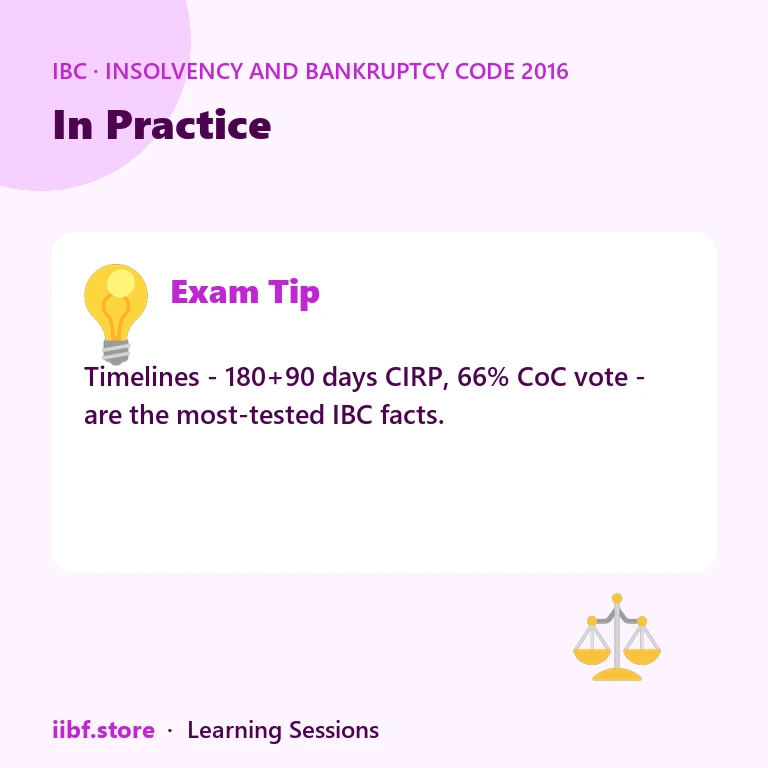
The Committee of Creditors (CoC) then approves a compliant resolution plan by a vote of not less than 66% of the voting share of financial creditors. But a plan approved by the CoC can still be struck down if the applicant turns out to be ineligible under Section 29A — the National Company Law Tribunal (NCLT) will not sanction a plan submitted by a disqualified person. This is why banks and their nominees on the CoC treat Section 29A verification as a threshold check, done before the commercial merits of a plan are even debated. For a broader refresher on how these credit-recovery mechanisms fit together, see the IIBF notes on credit recovery laws for banks. You can also read the official statutory text and amendment history on the Insolvency and Bankruptcy Board of India (IBBI) website, which is a *.gov.in primary source. For more exam-focused explainers, browse the full Insolvency and Bankruptcy Code 2016 tag hub and the wider iibf.store blog.
Frequently asked questions
What is Section 29A of the IBC 2016?
Section 29A is a disqualification clause that lists the categories of persons who are barred from submitting a resolution plan for a company under the Corporate Insolvency Resolution Process. It was inserted by the 2018 amendment (with effect from 23 November 2017) to stop defaulting promoters and other ineligible persons from regaining control of the distressed company through the back door.
Can a promoter whose account became an NPA still bid under Section 29A?
Yes, but only if they cure the default first. A person whose account has been classified as a non-performing asset for one year or more is disqualified, yet the Code lets them regain eligibility by paying all overdue amounts together with interest and related charges before submitting the resolution plan.
Does Section 29A apply to relatives and connected persons?
Yes. The bar extends to any person acting jointly or in concert with a disqualified applicant, and to connected persons such as promoters, holding companies, subsidiaries and related parties. This prevents a disqualified promoter from routing a bid through a proxy to escape the disqualification.
Who checks Section 29A eligibility during the CIRP?
The resolution professional verifies that each resolution plan is submitted by an eligible applicant, collecting affidavits and cross-checking regulatory lists. The Committee of Creditors then votes on compliant plans, but even a CoC-approved plan can be rejected by the NCLT if the applicant is later found ineligible under Section 29A.
Conclusion and next step
Section 29A eligibility for resolution applicants is where policy, banking regulation and insolvency law meet, which is exactly why the IIBF loves to test it. Master the disqualification buckets, the NPA cure right, the connected-person test and the financial-entity exception, and you will handle most scenario questions with confidence. Ready to test yourself under exam conditions? Take a timed IIBF mock on the IIBF practice tests, reinforce the concepts with a quick round on the match-the-concept game, and keep an eye on current banking developments through the latest IIBF news. Consistent practice on these high-yield clauses is what turns a pass into a distinction.
Quick quiz on this topic
5 exam-style questions from our free test bank — check yourself before you move on.
Practice this topic
Take a free mock test, download chapter PDFs, or watch a video class — all included on iibf.store.