Personal Guarantor Insolvency Under IBC 2016: CAIIB 2026 Guide
Bankers often forget that a guarantee does not vanish once the borrowing company enters resolution. Personal guarantor insolvency under IBC is the dedicated Part III track that lets creditors pursue the individual who stood surety, running parallel to (and often long after) the corporate debtor's own case. For JAIIB and CAIIB candidates, this is high-yield: it blends procedure, case law, and recovery strategy in one package.
📜 What Is Personal Guarantor Insolvency Under IBC?
The Insolvency and Bankruptcy Code, 2016 was drafted with three tracks: corporate insolvency (Part II), individual and partnership-firm insolvency (Part III), and cross-border insolvency (not yet notified). Within Part III, the government carved out personal guarantors to corporate debtors and notified this sub-category with effect from 1 December 2019, well ahead of the rest of individual insolvency. A promoter or director who has personally guaranteed a bank facility can thus be pulled into a formal insolvency process the moment the underlying loan turns bad, whether or not the corporate debtor is simultaneously undergoing CIRP.
The rationale: personal guarantees exist because the lender wants a second, independent pocket to recover from, and slow civil suits would defeat that purpose. The Part III framework — fresh start process, insolvency resolution process, and bankruptcy process — gives creditors a time-bound, tribunal-supervised route instead. This sits alongside the older credit recovery laws for banks such as SARFAESI, which remain available for the guarantor's non-corporate assets in parallel.
🏛️ NCLT Jurisdiction and the Section 95 Application
A distinctive feature of personal guarantor insolvency under IBC is that the adjudicating authority is the National Company Law Tribunal (NCLT) — the same forum handling the corporate debtor's CIRP — rather than the Debt Recovery Tribunal, which is designated for other categories of individuals once notified. This single-forum design lets one bench see both the company's resolution plan and the guarantor's exposure together, reducing conflicting orders.
The process is triggered under Section 95, which allows a creditor (or the guarantor personally) to file an application for initiating the insolvency resolution process, accompanied by particulars of the guarantee, the debt, and the default. This is distinct from the CIRP under IBC 2016 mechanism used against the company itself, though many facts overlap. Bankers should also revisit the structure of the IBC to see where Part III sits relative to the corporate provisions tested more heavily in JAIIB.
⏳ Interim Moratorium and the RP's Report
The moment a Section 95 application is filed, Section 96 kicks in an interim moratorium — automatically, without waiting for admission. During this window, all pending legal proceedings against the guarantor in respect of the debt stand stayed, and no fresh suit can be filed. This protects the guarantor from being simultaneously chased in multiple courts while the tribunal examines the application.
💡 Exam Tip: Do not confuse the Section 96 interim moratorium (automatic, on filing) with the Section 101 moratorium (post-admission) — examiners love testing this timing distinction.
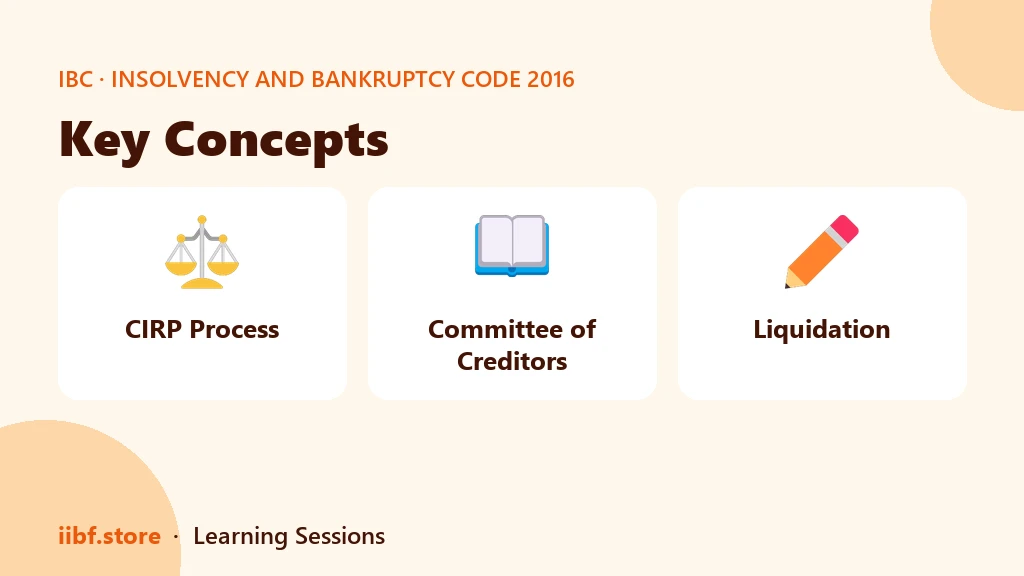
Within seven days of filing, the NCLT directs the Insolvency and Bankruptcy Board of India to nominate a resolution professional, who examines the application and recommends admission or rejection within ten days, under Section 99. Only after the NCLT admits the application does the full Section 101 moratorium and public notice process begin. The RP also compiles a list of claims and reports on the guarantor's assets, forming the factual foundation for the repayment plan that follows — a gatekeeping role that mirrors the roles and duties of IRP and RP in the corporate track.
🤝 Repayment Plan and Approval Process
Once admitted, the guarantor (with the RP's assistance) prepares a repayment plan under Sections 105-107, proposing how outstanding debts will be settled — through instalments, asset sales, or restructuring. A plan approved by a majority in value of creditors present and voting binds all creditors, including dissenters. The NCLT then confirms the plan, after which its terms supersede the original debt obligations.
⚠️ Common Mistake: Students often assume the repayment plan process is identical to a corporate resolution plan vote under the Committee of Creditors (CoC) mechanism — it is not; there is no formal CoC for guarantors, just a creditor meeting convened by the RP.
If no plan is approved, or the guarantor defaults, creditors can move to the bankruptcy process under Part III's later chapters, culminating in a discharge order once the estate is distributed. This sequence feeds directly into provisioning and recovery forecasting — the broader stressed asset resolution framework covered in CCP.
⚖️ Lalit Kumar Jain Verdict: Guarantee Survives Resolution
The single most exam-relevant judgment here is Lalit Kumar Jain v. Union of India (Supreme Court, 2021), which upheld the validity of notifying Part III provisions for personal guarantors ahead of other individuals. Crucially, the Court also settled a recovery question banks had litigated repeatedly: approval of a corporate debtor's resolution plan does not automatically discharge the personal guarantor's liability, even if the plan restructures the company's own debt, unless the guarantee deed or plan itself says so.
📌 Remember: "Approval of the resolution plan does not ipso facto discharge a personal guarantor" — this exact principle from Lalit Kumar Jain is a recurring MCQ stem.
The ruling closed a loophole where guarantors argued their liability should shrink whenever the company's debt was written down. The Court disagreed, holding a guarantee is a co-extensive but independent obligation. For bank credit officers, this is the legal backbone for pursuing a guarantor's Section 95 application even after the corporate CIRP concludes.
| Part III Process | Governing Sections | Adjudicating Authority | Notified for Personal Guarantors? |
|---|---|---|---|
| Fresh Start Process | Sections 80-93 | NCLT / DRT (category-based) | ❌ Not notified |
| Insolvency Resolution Process | Sections 94-120 | NCLT | ✅ Notified (1 Dec 2019) |
| Bankruptcy Process | Sections 121-148 | NCLT | ✅ Notified (1 Dec 2019) |
| Individual/Partnership (non-guarantor) Insolvency | Sections 78-187 (general) | DRT | ❌ Not notified |
🧠 Practice MCQs: Personal Guarantor Insolvency Under IBC
Q1. Which authority adjudicates an insolvency resolution process against a personal guarantor to a corporate debtor? (a) Debt Recovery Tribunal (b) High Court (c) National Company Law Tribunal (d) SEBI Tribunal
Answer: (c) — NCLT has jurisdiction over personal guarantors to corporate debtors, unlike other individual insolvency categories which route to the DRT.
Q2. An application to initiate the insolvency resolution process against a personal guarantor is filed under which section of the IBC? (a) Section 7 (b) Section 95 (c) Section 29A (d) Section 53
Answer: (b) — Section 95 governs applications by creditors or the guarantor to initiate the guarantor's insolvency resolution process.
Q3. When does the interim moratorium under Section 96 come into effect? (a) Only after NCLT admits the application (b) Automatically on filing the Section 95 application (c) Only after the repayment plan is approved (d) After the RP submits its report
Answer: (b) — The Section 96 interim moratorium is automatic upon filing, protecting the guarantor before admission is even decided.
Q4. As per Lalit Kumar Jain v. Union of India, approval of a corporate debtor's resolution plan: (a) Automatically discharges the personal guarantor (b) Does not automatically discharge the personal guarantor's liability (c) Cancels the guarantee deed (d) Transfers liability to the resolution professional
Answer: (b) — The Supreme Court held the guarantee is an independent, co-extensive obligation that survives the corporate resolution plan unless expressly extinguished.
Q5. A repayment plan for a personal guarantor under Part III of the IBC is approved by: (a) The Committee of Creditors by 66% voting share (b) A majority in value of creditors present and voting at the RP-convened meeting (c) The NCLAT directly (d) Unanimous consent of all creditors
Answer: (b) — Unlike the corporate CoC's 66% threshold, a guarantor's repayment plan needs only a majority in value of creditors present and voting, and it then binds all creditors.
Want chapter-wise mock tests with 100+ MCQs? Start practising free →
Is personal guarantor insolvency under IBC the same as corporate insolvency (CIRP)?
No. CIRP under Part II applies to the corporate debtor company, while personal guarantor insolvency is a separate Part III process against the individual who guaranteed the loan.
Which authority hears personal guarantor insolvency cases?
The National Company Law Tribunal (NCLT), unlike other individual insolvency categories which are designated to the Debt Recovery Tribunal.
Does a corporate debtor's approved resolution plan release the personal guarantor?
Not automatically. Lalit Kumar Jain v. Union of India held that guarantor liability survives the corporate resolution plan unless the guarantee deed or plan expressly says otherwise.
What happens if a guarantor's repayment plan is not approved?
Creditors can move the matter into the bankruptcy process under Part III's later chapters, leading to distribution of the guarantor's estate and a discharge order.
For bankers, mastering personal guarantor insolvency under IBC turns a guarantee clause from paperwork into a real, enforceable recovery lever. Reinforce this with the official Insolvency and Bankruptcy Board of India (IBBI) resources, then test your grasp with a full CAIIB course mock or browse more IBC 2016 study articles before exam day.
Quick quiz on this topic
5 exam-style questions from our free test bank — check yourself before you move on.
Practice this topic
Take a free mock test, download chapter PDFs, or watch a video class — all included on iibf.store.