Straight Through Processing in Treasury Dealing Rooms
Every bank treasury runs on speed and accuracy, and straight through processing in treasury is the engine that delivers both. Once a dealer strikes a forex or money market deal, straight through processing in treasury pushes that ticket from capture to settlement without a human retyping a single field — cutting the operational risk that plagued dealing rooms before core banking and treasury systems were integrated. For JAIIB, CAIIB and Treasury Management candidates, this is one of the most practical topics in the syllabus because it ties together dealing room technology, the money market, forex treasury and the treasury-ALM interface into a single exam-ready story. This article walks through how STP actually works inside a modern dealing room, why it matters for risk control, and where examiners typically test it.
🖥️ What Is Straight-Through Processing in a Treasury Dealing Room
Straight through processing, or STP, means a deal moves through capture, verification, confirmation, accounting and settlement electronically, with no manual re-keying at any stage. In the pre-STP era, a dealer would strike a deal on the telephone or a trading screen, write it on a deal slip, and a back-office clerk would key the same details into the accounting system hours later — a process ripe for transcription errors, delayed confirmations and fraud. Modern treasuries eliminate that gap by wiring the front-office dealing system directly into the mid-office risk engine and the back-office settlement platform, usually through a single integrated treasury solution. A dealer confirms a swap or a call money placement on screen, and the same electronic ticket automatically triggers limit checks, generates the accounting entries, and queues the payment instruction. Understanding this flow starts with the basic building blocks covered in the treasury chapter, which lays out how the front, mid and back office divide responsibility over a single deal. STP does not remove human judgment from dealing — it removes human handling from data that has already been agreed, which is exactly why regulators and auditors treat STP maturity as a proxy for how well a bank controls its treasury operations.
💱 STP Across the Forex, Money Market and Securities Desks
A dealing room is rarely a single desk — it typically has separate forex, money market and government securities desks, each dealing in a different instrument but feeding the same nostro, settlement and accounting infrastructure. On the forex side, an STP-enabled system captures a spot or forward deal, checks it against the counterparty limit and the net open position, and routes the settlement instruction to the correspondent bank without the dealer touching the payment leg. On the money market side, STP handles call money, term money, and collateralised borrowing and lending obligation (CBLO)-style transactions by linking the deal ticket straight to the current account and CRR/SLR computation. For candidates who want the instrument-level detail, the financial market chapter and the foreign exchange market chapter both build the product knowledge that STP workflows sit on top of. The efficiency gain compounds when volumes are high: a dealing room processing hundreds of forex and money market tickets a day simply cannot sustain manual entry without a proportional rise in operational error, so STP is less a convenience and more a structural necessity once a treasury crosses a certain deal volume.
💡 Exam Tip: If a question asks why STP reduces operational risk, the answer is elimination of manual re-keying between front, mid and back office — not elimination of market risk, which STP does not touch.
⚙️ The Deal Lifecycle: Capture, Verification, Settlement
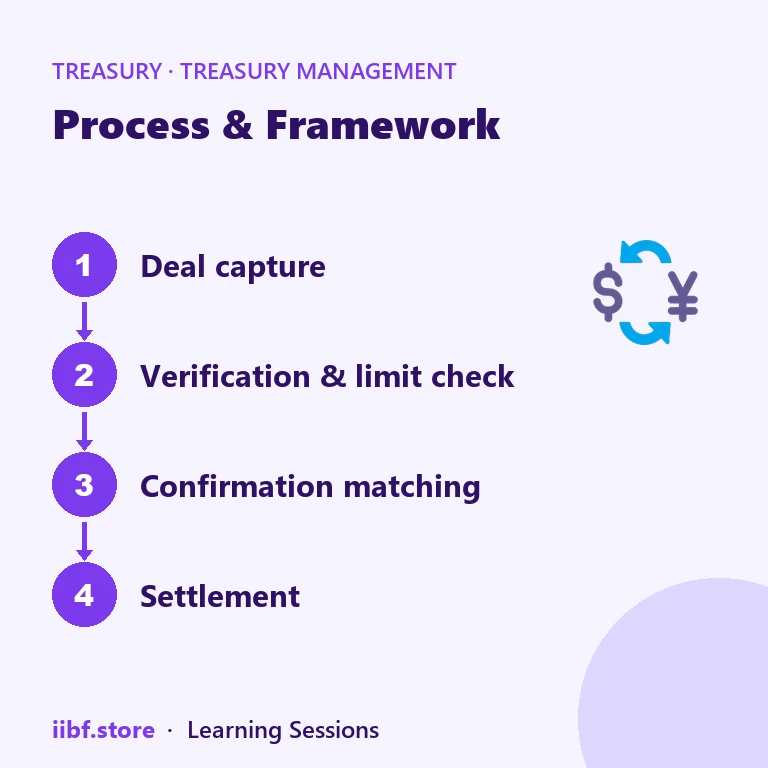
Every treasury deal, whether it is a forex swap or a government securities purchase, passes through the same broad lifecycle: deal capture by the dealer, independent verification by the mid office, confirmation exchange with the counterparty, accounting entry generation, and final settlement. In an STP environment, each of these steps is a system event rather than a manual task. Deal capture happens on the dealing platform itself; verification is an automated limit and rate-check against pre-set parameters; confirmation can flow through SWIFT messaging or a matching utility; and settlement for rupee securities routes through the Clearing Corporation of India's guaranteed settlement mechanism, while forex legs settle through correspondent nostro accounts or CLS. Because government securities and money market instruments settle on a delivery-versus-payment basis, timing discipline matters enormously — a delay anywhere in the chain can cause a settlement failure that shows up immediately in the bank's current account position with the RBI. The scope and function of treasury management chapter frames this lifecycle within the treasury's broader mandate of liquidity, funding and risk management, which is worth revisiting before attempting scenario-based exam questions on deal processing.
⚠️ Common Mistake: Candidates often assume STP means deals settle instantly. STP automates data flow between systems; actual settlement still follows the value date and settlement cycle applicable to that instrument.
🛡️ Risk Controls and the Treasury-ALM Interface in STP
An STP system is only as good as the controls wired into it. Every deal ticket that flows through the pipeline is checked in real time against dealer limits, counterparty exposure caps, and the bank's net open position limit before it is allowed to settle — a breach at capture stage triggers an automatic stop rather than waiting for a manual end-of-day reconciliation to catch it. This real-time control layer is also where the dealing room connects to the wider bank. Treasury does not operate in isolation; its funding, liquidity and interest-rate positions feed directly into the asset-liability management process, and a well-designed treasury and ALM interface ensures every STP-processed deal updates the bank's liquidity gap and duration reports without a separate manual feed. Forex dealing additionally operates under FEDAI-prescribed conventions for value dates, margins and cancellations, and an STP system that hard-codes the current FEDAI rules for forex dealings into its validation logic prevents a dealer from booking a deal that violates market convention. None of this replaces human oversight — mid-office risk officers still review exception reports daily — but it shifts the control point from "detect after the fact" to "prevent at entry," which is the core regulatory expectation behind treasury risk management today.
📊 Manual Deal Processing vs Straight-Through Processing
| Parameter | Manual / Semi-Manual Processing | Straight-Through Processing (STP) |
|---|---|---|
| Data re-keying between systems | Multiple times ❌ | None — single entry ✅ |
| Limit checks (counterparty, NOP) | End-of-day, batch ❌ | Real time, at deal capture ✅ |
| Settlement instruction generation | Manual back-office entry ❌ | Auto-generated from the deal ticket ✅ |
| Confirmation matching | Telephonic / fax follow-up ❌ | SWIFT or matching-utility based ✅ |
| Operational risk exposure | High (transcription errors) ❌ | Significantly lower ✅ |
| Reconciliation effort | Heavy, manual nostro tie-out ❌ | Largely automated ✅ |
📌 Remember: STP reduces operational risk, not market or credit risk — those still need active limit management and hedging, which is why dealing rooms keep their mid-office risk function even in a fully automated setup.
Beyond the core treasury desks, banks with large integrated treasuries also run bond portfolio and derivative activity through the same STP backbone. Understanding duration, convexity and portfolio strategy rounds out the picture of what a dealing room actually processes end to end, and candidates preparing this section should also glance at how para-banking entities are supervised — for context, the RBI's scale based regulation for NBFCs framework shows a parallel example of layered, risk-based oversight outside the banking dealing room itself. Within banks, however, the Reserve Bank of India's oversight of payment and settlement infrastructure — including RTGS and the securities settlement systems that STP tickets ultimately ride on — is documented on the Reserve Bank of India website, which remains the primary reference for any current rule on settlement timelines or system eligibility. For a browsable set of related notes, the treasury management tag page on iibf.store collects every article in this series.
🧠 Practice MCQs: Straight-Through Processing in Treasury
Q1. Straight through processing (STP) in a treasury dealing room primarily reduces which type of risk? (a) Market risk (b) Credit risk (c) Operational risk (d) Liquidity risk
Answer: (c) — STP eliminates manual re-keying between front, mid and back office, which directly cuts operational risk from transcription and delay errors.
Q2. In an STP-enabled dealing room, at what stage is a deal checked against the net open position limit? (a) Only at month-end audit (b) At deal capture, in real time (c) Only after settlement (d) It is never checked by the system
Answer: (b) — STP systems build limit checks into deal capture itself so a breach is stopped before settlement, not discovered afterward.
Q3. Government securities settled through the Clearing Corporation of India follow which settlement principle? (a) Payment only, no delivery link (b) Delivery versus payment (DvP) (c) Delivery with delayed payment (d) Cash-only settlement outside the banking system
Answer: (b) — Securities and funds legs are settled simultaneously under a delivery-versus-payment mechanism, guaranteed by the central counterparty.
Q4. The treasury-ALM interface in an STP environment mainly ensures that: (a) Dealers can bypass mid-office limits (b) Deal-level data automatically feeds liquidity gap and duration reports (c) Forex deals settle without a value date (d) FEDAI rules no longer apply to dealers
Answer: (b) — Because treasury deals affect the bank's funding and interest-rate position, an STP pipeline should feed processed deal data straight into ALM reporting without a separate manual step.
Q5. Which of the following is NOT a benefit of straight through processing? (a) Faster confirmation matching (b) Elimination of market risk on open positions (c) Reduced transcription errors (d) Lower manual reconciliation effort
Answer: (b) — STP is an operational and workflow control; it does not remove market risk, which must still be managed through limits, hedging and monitoring.
Want chapter-wise mock tests with 100+ MCQs? Start practising free →
❓ Frequently Asked Questions
What does STP stand for in bank treasury operations?
STP stands for straight through processing — the automated flow of a deal from capture through verification, accounting and settlement without manual re-entry of data at any stage.
Does STP eliminate the need for a mid-office risk function?
No. STP automates data flow and embeds real-time limit checks, but mid-office officers still monitor exception reports, review breaches and manage market and credit risk that STP does not address.
How does STP connect to the treasury-ALM interface?
Every STP-processed deal generates accounting and position data that feeds directly into the bank's asset-liability management reports, keeping liquidity gap and duration figures current without a separate manual data feed.
Why is STP important for IIBF Treasury Management exam preparation?
Examiners frequently test the deal lifecycle, the role of limit checks, and the distinction between operational risk and market risk — all of which are best understood through how STP actually processes a deal end to end.
Straight through processing in treasury is what allows a modern dealing room to handle forex, money market and securities volumes without operational risk scaling alongside them, while keeping the treasury-ALM interface fed with accurate, real-time data. Candidates who can walk through the full deal lifecycle — capture, verification, confirmation and settlement — and explain exactly where STP adds control will handle both conceptual and scenario-based questions confidently. Build on this with focused practice: attempt Treasury Management mock tests to see how these concepts appear in exam format.
Practice this topic
Take a free mock test, download chapter PDFs, or watch a video class — all included on iibf.store.