Job Evaluation Methods in Banks: CAIIB HRM Study Guide

Every CAIIB HRM candidate learns compensation structures, but few can explain what actually decides which grade a job sits in before a single rupee of pay is fixed. That groundwork is done through job evaluation methods in banks — the systematic techniques HR departments and the IBA use to rank, classify, or score jobs by their relative worth so that pay scales, promotion ladders, and bipartite settlements rest on something more defensible than guesswork. For exam purposes and for real branch and HR-department life, understanding these methods is what separates a candidate who can define "compensation" from one who can explain how a bank actually decides that a Scale III officer's role is worth more than a Scale I clerk's role. This guide walks through the four classical methods, where they show up in the CAIIB HRM syllabus, and how PSU and private banks apply them differently.
📊 What Is Job Evaluation and Why Banks Need It
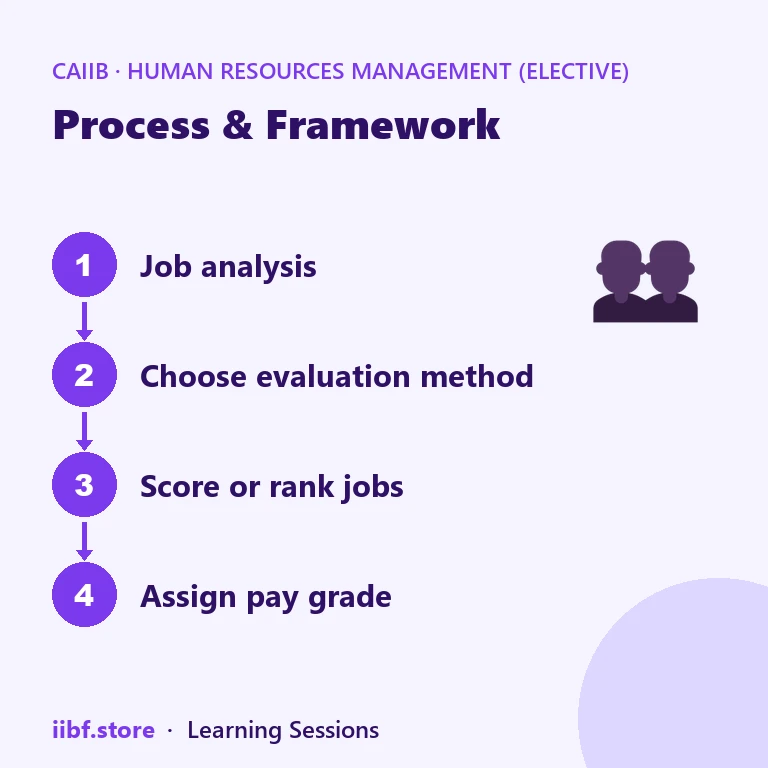
Job evaluation is a systematic process for determining the relative worth of different jobs within an organisation — not the worth of the person doing the job, but the job itself: its duties, responsibilities, required skills, working conditions, and accountability. It is distinct from performance appraisal, which measures how well an individual performs, and from job analysis, which simply documents what a job entails. Job evaluation takes that job analysis data and converts it into a ranking or score that HR can use to design pay grades, promotion hierarchies, and recruitment specifications.
In banks, this matters more than in most industries because compensation is heavily unionised and collectively bargained. Officer and clerical cadres are governed by industry-wide settlements negotiated by the Indian Banks' Association (IBA) with employee unions, and those settlements are built on grade structures that trace back to job evaluation exercises. A teller role, a credit-appraisal role, and a branch-manager role must be evaluated on a common yardstick before anyone can argue what each should be paid. You can read the foundational concepts in Fundamentals of Human Resource Management, which frames job evaluation as one of the core building blocks of the HR function before compensation, recruitment, or training decisions are layered on top.
💡 Exam Tip: If a CAIIB question asks you to distinguish job evaluation from performance appraisal, remember the anchor: job evaluation rates the job, performance appraisal rates the job-holder.
🧮 Ranking, Classification, and Point Rating Methods
Four classical methods dominate the syllabus and real HR practice. The ranking method is the simplest: a committee compares whole jobs against each other and arranges them from highest to lowest based on overall importance, without breaking them into separate factors. It works well for small organisations with few job titles but becomes unwieldy and subjective once the number of jobs runs into the hundreds — exactly the problem a large bank with dozens of officer and support-staff designations faces.
The job classification (or grading) method solves part of that scaling problem. HR first defines a set of grades or classes — say, Clerk, Officer Scale I through Scale VII — each with a written description of typical duties, skill levels, and decision-making authority. Individual jobs are then slotted into whichever grade description they best match. This is close to how banks structure their own cadre and scale system, which makes it intuitive for CAIIB candidates already familiar with Scale I–VII designations.
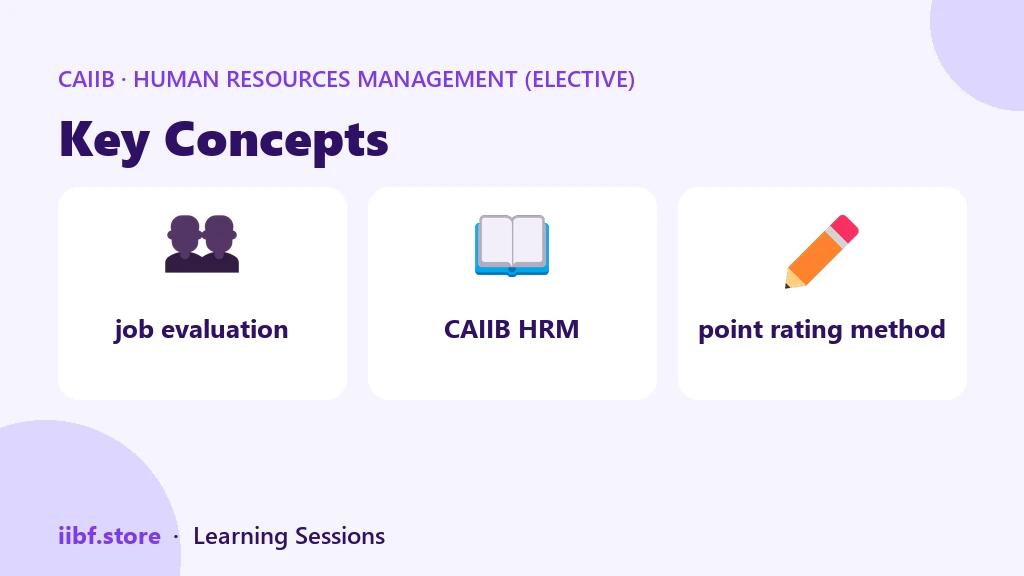
The point rating method is more analytical: jobs are broken into compensable factors — skill, effort, responsibility, and working conditions are the classic four — each factor is weighted, and points are assigned per factor. The sum of weighted points produces a numerical score that maps directly onto a pay grade, giving a more defensible, quantifiable basis than ranking or classification alone. The factor comparison method goes a step further, evaluating jobs factor by factor against a small set of already-priced "key jobs" and building a monetary scale directly from that comparison. Chapter-level detail on how these methods interact with grading structures is covered in HRM in Banks.
⚠️ Common Mistake: Candidates often confuse the point rating method with a performance scorecard. Point rating scores the job's demands, not an employee's output — the score never changes based on who fills the role.
⚖️ Job Evaluation vs Performance Appraisal in Bank HR
This distinction is tested repeatedly because the two processes sit next to each other in the syllabus and are easy to blur under exam pressure. Job evaluation is a one-time (or periodically revisited) structural exercise that fixes where a job sits in the hierarchy and what its pay band should be. Performance appraisal is a recurring, individual-level exercise that measures how a specific employee performed against targets, competencies, or behavioural indicators within a review cycle. A bank can leave its job evaluation structure untouched for years while running annual performance appraisals every single cycle.
The two do interact, though: performance appraisal outcomes can influence increments within a grade or eligibility for promotion into a higher grade, but they cannot retroactively change the evaluated worth of the job itself. A well-run HR function keeps these processes procedurally separate — job evaluation committees typically include HR specialists, department heads, and sometimes external consultants or union representation, while performance appraisal is run through the reporting-manager chain. Readers building out the broader HR systems context should also see Human Resource Development Strategies and Systems, which places job evaluation and appraisal within the wider HRD framework banks are expected to run end to end.
Related compensation mechanics — how evaluated grades translate into actual pay components — are covered in our CAIIB HRM guide to compensation management in banks, and the competency side of grading decisions is explored in our piece on competency mapping in banks.
🏦 How PSU and Private Banks Apply Job Evaluation
Public sector banks apply job evaluation within a heavily standardised, industry-wide framework. Because officer and award-staff compensation is fixed through IBA bipartite and joint-note settlements, individual PSU banks have limited freedom to redesign their own grade structures — the evaluation logic behind Scale I to Scale VII, and the clerical-to-officer progression, is effectively common across public sector banks. This gives PSU HR departments consistency and reduces disputes, but also reduces their flexibility to reward a genuinely scarce skill (say, a credit-risk modeller) outside the standard scale.
Private and foreign banks, by contrast, typically run their own internal job evaluation exercises, often using a licensed point-factor methodology from a global consulting firm, layered with market-pricing data. This lets them create narrower, more market-responsive bands — useful for retaining specialists in treasury, digital banking, or risk analytics where PSU-style uniform scales would badly underpay the role relative to the market. Both approaches ultimately serve the same purpose: converting a subjective sense of "this job matters more" into a defensible, auditable structure. See how core HR functions across bank types are organised in HRM in Indian Banks. For a look at how a specialised desk role is structured and evaluated on the BFM side of the CAIIB syllabus, see CAIIB BFM Treasury Management: Chapter 18, which shows how treasury roles carry distinct skill and risk-exposure weightings.
📌 Remember: PSU banks lean on IBA-negotiated uniform scales; private banks lean on internal point-factor systems benchmarked to the market. Both are still "job evaluation" — only the governance model differs.
| Feature | Ranking Method | Point Rating Method |
|---|---|---|
| Ease of use for small job sets | ✅ | ❌ |
| Scales well to hundreds of job titles | ❌ | ✅ |
| Produces a numerical, auditable score | ❌ | ✅ |
| Requires defined compensable factors | ❌ | ✅ |
| Common in large PSU-style bank structures | ❌ | ✅ |
| Vulnerable to committee subjectivity | ✅ | ❌ |
An under-graded role is a common driver of disengagement — see motivation theories in banks. More HR topics: Human Resources Management Elective tag.
🧠 Practice MCQs: Job Evaluation Methods in Banks
Q1. Which job evaluation method involves comparing whole jobs against each other without breaking them into separate factors? (a) Point rating method (b) Ranking method (c) Factor comparison method (d) Job classification method
Answer: (b) — Ranking compares entire jobs holistically rather than analysing individual compensable factors.
Q2. In the point rating method, a job's total score used to determine its pay grade is derived from: (a) Seniority of the employee currently holding it (b) The sum of weighted points assigned to compensable factors (c) Union negotiations alone (d) Market survey averages only
Answer: (b) — Points are assigned per weighted factor (skill, effort, responsibility, working conditions) and summed into a total score.
Q3. The job classification (grading) method evaluates jobs by: (a) Ranking jobs from highest to lowest importance (b) Slotting jobs into pre-defined grades based on written class descriptions (c) Assigning a monetary value factor by factor (d) Comparing pairs of jobs one at a time
Answer: (b) — Grades are defined first, then each job is matched to the grade description it fits best.
Q4. In Indian public sector banks, job evaluation outcomes typically feed into: (a) Individual performance bonuses only (b) Grade and scale structures negotiated through IBA bipartite settlements (c) Statutory bonus under the Payment of Bonus Act only (d) Branch-level profitability targets
Answer: (b) — PSU officer and award-staff pay scales trace back to grade structures fixed through IBA-led bipartite and joint-note settlements.
Q5. Which of the following is a recognised limitation of the ranking method of job evaluation? (a) It is too complex for small organisations (b) It becomes unwieldy and subjective as the number of jobs increases (c) It requires specialised HR software to operate (d) It cannot legally be used in the banking sector
Answer: (b) — Without defined factors, ranking large numbers of jobs relies heavily on committee judgement and loses consistency.
Want chapter-wise mock tests with 100+ MCQs? Start practising free →

❓ FAQs on Job Evaluation Methods in Banks
What is the main purpose of job evaluation in a bank?
It determines the relative worth of each job so that pay grades, promotion ladders, and recruitment specifications can be set on a consistent, defensible basis rather than ad hoc judgement.
Is job evaluation the same as performance appraisal?
No. Job evaluation assesses the job itself — its duties and demands — while performance appraisal assesses how well an individual employee performed in that job over a review period.
Which job evaluation method is considered most analytical?
The point rating method, because it breaks jobs into weighted compensable factors and produces a numerical score, is generally regarded as the most analytical and quantifiable of the classical methods.
How do PSU banks apply job evaluation differently from private banks?
PSU banks largely follow uniform grade structures fixed through IBA bipartite settlements, giving individual banks limited flexibility, while private banks more often run internal point-factor evaluations benchmarked against market pay data.
Job evaluation methods rarely get the spotlight compensation or recruitment topics get, but CAIIB HRM papers test them precisely because they sit underneath every pay and grading decision a bank makes. Know the four classical methods, be able to distinguish job evaluation from performance appraisal without hesitation, and understand why PSU and private banks apply the same theory through different governance models. For the official position on industry-wide compensation frameworks that job evaluation feeds into, see the Ministry of Labour and Employment, which oversees the statutory framework around job classification and wage structures in India. To lock in these concepts before exam day, work through structured chapter tests and revise the complete CAIIB course on iibf.store.
Quick quiz on this topic
5 exam-style questions from our free test bank — check yourself before you move on.
Practice this topic
Take a free mock test, download chapter PDFs, or watch a video class — all included on iibf.store.
Keep reading