Treasury Back Office Operations: Settlement and Controls (IIBF)
Every bank treasury runs on three legs: a dealer who quotes a price, a risk manager who checks limits, and a team that makes the trade actually settle. That third leg is treasury back office operations — the confirmation, settlement, reconciliation and accounting work that turns a verbal deal into a completed transaction. For JAIIB and CAIIB candidates, and for anyone attempting the IIBF Treasury Management certificate exam, this is a high-yield area: examiners repeatedly test segregation of duties, and the back office sits at the centre of that control structure. This article covers what the back office does, how deals get confirmed and settled, and where the reconciliation controls examiners test actually live.
🏦 Where the Back Office Sits in Treasury Structure
Every treasury desk splits into three functional tiers, and IIBF exams test the boundaries between them closely. The front office is the dealing room — the team that quotes prices, takes positions, and executes purchases and sales of forex, money market instruments, bonds and derivatives. The mid office measures and monitors risk: it tracks dealer limits, marks positions to market, and reports exposures to the treasury risk committee. The back office is neither a dealer nor a risk watchdog. It independently verifies that a deal struck by the front office actually exists on the counterparty's books, arranges settlement of funds and securities, passes the accounting entries, and generates the reports that feed both management and the regulator.
The single most exam-relevant fact about this structure is independence. RBI's internal control guidance for bank treasuries requires that the back office report through a separate reporting line from the dealing room — typically to operations or finance, never to the head of treasury. This is what prevents a dealer from booking a fictitious trade, confirming it himself, and hiding a loss until it grows too large to absorb. You can read the full functional breakdown in the Scope and Function of Treasury Management chapter, and the organisational detail in the Treasury chapter.
| Function | Primary Focus | Key Activity | Independent of Dealing Desk |
|---|---|---|---|
| Front office | Execution and pricing | Quoting rates, taking positions | ❌ |
| Mid office | Risk measurement | Limit monitoring, mark-to-market | ✅ |
| Back office | Confirmation and settlement | Deal verification, accounting, reporting | ✅ |
📝 Deal Confirmation, Matching and Settlement
Once a dealer strikes a trade, the deal slip moves to the back office, which independently confirms every term — amount, rate, value date, counterparty — before settlement begins. For rupee money market and government securities, confirmation and settlement largely run through CCIL and the Negotiated Dealing System-Order Matching (NDS-OM) platform, which auto-matches trades and settles them on a guaranteed, multilateral net basis. For forex deals, confirmations typically move by SWIFT message between the two banks' back offices, independent of any conversation the dealers had. This step exists precisely so that a mismatched or unauthorised deal surfaces before money moves, not after.
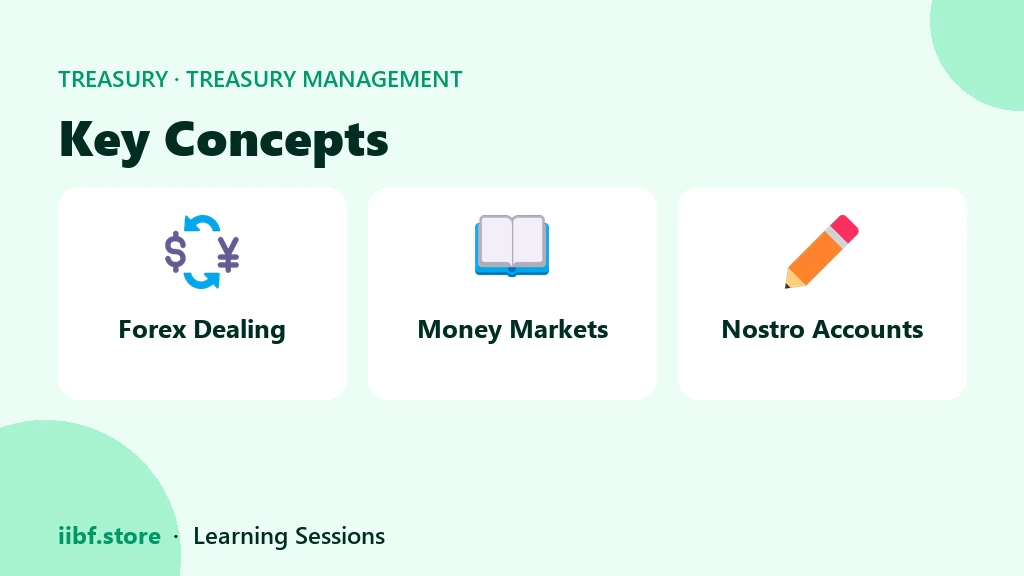
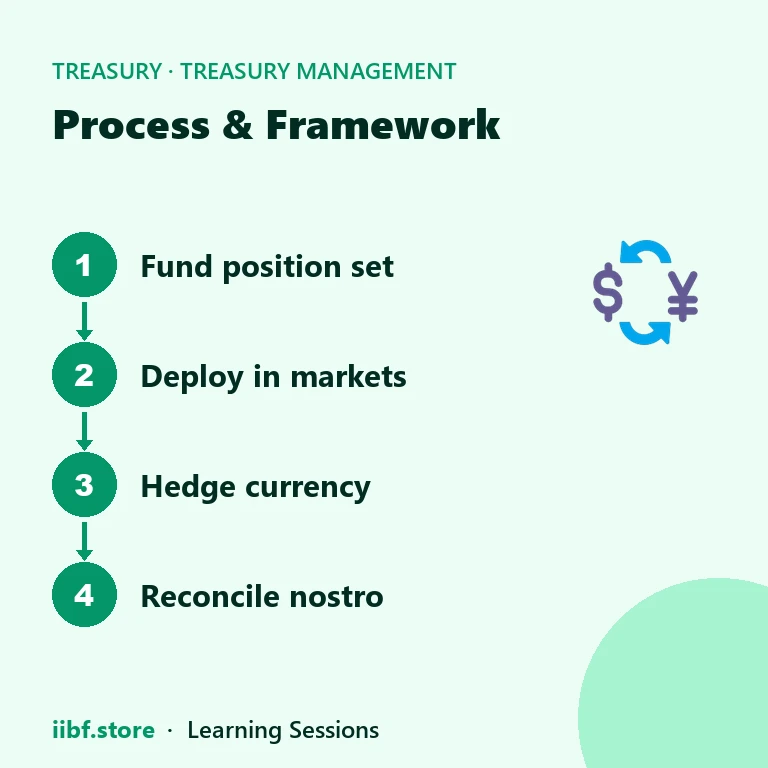
Settlement itself means the actual exchange of funds and securities on the contracted value date — rupee legs through RTGS, government securities through SGL/CSGL accounts at RBI, and forex legs through correspondent nostro and vostro accounts. When a counterparty fails to deliver funds or securities on the due date, that is called a "fail," and chasing fails through to resolution is a core back-office job, since an unresolved fail is effectively an unsecured exposure to the counterparty. Straight-through processing (STP) — where a deal flows from front-office capture to back-office settlement without manual re-keying — reduces these errors sharply and is now standard in most treasury systems. The Foreign Exchange Market chapter and the Integrated Treasury chapter both build directly on this settlement flow.
💡 Exam Tip: If a question describes a control that stops a dealer from confirming his own trade, the answer is almost always "back office," not "mid office" — mid office manages risk limits, it does not confirm settlement.
🔄 Reconciliation and Nostro Account Control
Reconciliation is where back-office discipline is tested every single day. Nostro accounts — a bank's foreign-currency accounts held with correspondent banks abroad — and vostro accounts — the rupee accounts correspondent banks hold with the bank at home — must be reconciled against the bank's own books daily, not weekly. Any mismatch between what the bank's ledger shows and what the correspondent statement shows is logged as a "break," aged, investigated, and closed out with an audit trail. A break that sits open for weeks is not a clerical nuisance; it can mask a duplicated payment, a missed receipt, or in the worst case, fraud.
The same discipline applies to SGL and CSGL holdings, which must reconcile against RBI and CCIL statements, and to suspense accounts, which should never carry an unexplained balance for long. This is also where the back office's role is easiest to confuse with the mid office's — reconciliation confirms that recorded transactions match external records, while the treasury middle office operations function separately confirms that recorded positions stay within approved risk limits. Both matter, but they answer different questions, and IIBF papers frequently set up a scenario to see whether a candidate can tell which control caught the problem.
⚠️ Common Mistake: Candidates often assume nostro reconciliation is a mid-office risk task. It is a back-office accounting and control function — risk monitoring is a separate, parallel activity.
📊 Accounting, Reporting and Regulatory Controls
Beyond settlement, the back office owns the treasury's books of account. It passes journal entries for every deal, computes realised and unrealised profit and loss, and feeds the treasury's numbers into the bank's general ledger. It also prepares the regulatory and management returns built on treasury data — structural liquidity statements, forex net open position reports, and investment portfolio disclosures — several of which trace back to guidance published by the Reserve Bank of India. Because these entries and reports touch statutory reporting, back-office work is subject to maker-checker discipline at every step: one person enters a payment instruction, a different person authorises its release, and a third, independent audit trail records both.
This is also where a back office's remit reaches into fixed-income settlement — for example, settling a fresh Treasury Bills in India auction allotment — and into portfolio-level accounting once an investment is booked under limits set out in a bank's investment policy of banks. A back office that cannot reconcile its books against those limits in real time cannot tell management, or the regulator, whether the bank is actually operating inside its approved boundaries.
📌 Remember: The back office never reports to the head of treasury. That single reporting-line rule is the foundation of every other control discussed in this article.
Read more on the broader function set under the treasury management tag, including how these controls plug into treasury products for corporate customers.
🧠 Practice MCQs: Treasury Back Office Operations
Q1. Which function is primarily responsible for the independent confirmation of a treasury deal? (a) Front office (b) Mid office (c) Back office (d) Compliance department
Answer: (c) — The back office independently confirms and settles deals, separate from the dealer who struck them.
Q2. Under sound treasury controls, deal confirmations to a counterparty should ideally be sent by: (a) The dealer who struck the trade (b) The back office, independent of the dealing desk (c) The head of treasury (d) The mid-office risk manager
Answer: (b) — Confirmation by the dealer defeats the purpose of independent verification; it must come from the back office.
Q3. A "fail" in treasury settlement refers to: (a) A loss-making trade (b) Non-delivery of funds or securities on the contracted value date (c) A breach of a dealer's limit (d) An unauthorised deal
Answer: (b) — A fail is a settlement-date non-delivery, which the back office must chase to resolution.
Q4. Daily nostro account reconciliation is primarily performed by: (a) Front-office dealers (b) The back office / reconciliation unit (c) External auditors only (d) The correspondent bank alone
Answer: (b) — Nostro reconciliation is a back-office accounting control, done daily, not an audit-only or risk-only activity.
Q5. Straight-through processing (STP) in treasury operations mainly aims to: (a) Increase manual intervention for accuracy (b) Eliminate manual re-keying of data between front, mid and back office systems (c) Replace the back office function entirely (d) Increase settlement time
Answer: (b) — STP passes deal data automatically across systems, cutting keying errors and speeding settlement.
Want chapter-wise mock tests with 100+ MCQs? Start practising free →
What is the main difference between mid office and back office in treasury?
The mid office monitors risk — dealer limits, mark-to-market valuation and exposure reporting. The back office confirms, settles, reconciles and accounts for deals already struck. They are parallel, independent functions that answer different questions.
Why must the back office be independent of the dealing desk?
If the back office reported to the treasury head or the dealers, a dealer could confirm and settle his own unauthorised or fictitious trade. Independent reporting lines are the primary control against this.
What documents does the back office use to confirm a treasury deal?
Typically a deal slip from the front office, a SWIFT or system-generated confirmation message exchanged with the counterparty, and, for rupee money market and G-Sec trades, matched records from CCIL or NDS-OM.
What happens if a nostro reconciliation break is not resolved quickly?
An open break can hide a duplicated payment, a missed receipt, or fraud, and it overstates or understates the bank's true cash position until it is investigated and closed.
Treasury back office operations rarely get the attention front-office dealing does, but exam papers reward candidates who know exactly which control — confirmation, settlement, reconciliation, or reporting — sits with which team. Revise the front-mid-back split until it is automatic, then work through mock tests on iibf.store to see how examiners frame these scenario-based questions.
Practice this topic
Take a free mock test, download chapter PDFs, or watch a video class — all included on iibf.store.