Warehouse Receipt Finance in India: A CAIIB Rural Banking Guide

Warehouse receipt finance in India lets a farmer, an FPO or a trader borrow against stored, quality-certified produce instead of dumping it on the market in distress right after harvest. For CAIIB Rural Banking candidates, understanding how banks lend against electronic Negotiable Warehouse Receipts (e-NWRs) issued under the Warehousing Development and Regulatory Authority framework is core exam ground, and it is equally central to how rural and agri branches actually structure post-harvest credit today. This article walks through the concept, the regulatory backbone, the loan mechanics, and the risks a banker must weigh before sanctioning a pledge loan.
📦 What Is Warehouse Receipt Finance in India?
Warehouse receipt finance is a pledge-based lending product under which a bank advances money against commodities deposited in an accredited warehouse, with the receipt for that stock serving as collateral. When a farmer harvests paddy, wheat, pulses, oilseeds, cotton or spices and has no immediate cash need for distress selling, they can deposit the produce with a warehouse registered under the Warehousing Development and Regulatory Authority (WDRA), get it graded and assayed, and receive a Negotiable Warehouse Receipt (NWR) — now almost universally issued in electronic form as an e-NWR. Because the e-NWR is a title document to specific, quality-certified stock, it is treated as movable property that can be pledged, transferred by electronic endorsement, or even traded, without the farmer physically moving the produce again.
The bank's exposure is therefore against a defined, insured, warehouse-held asset rather than a general-purpose crop loan against standing crop. This is a meaningfully different underwriting proposition, and CAIIB candidates should be able to distinguish it clearly from a standard Kisan Credit Card cash-credit limit. The broader demographic and structural backdrop of India's agriculture economy — fragmented landholdings, seasonal price crashes at harvest, and thin on-farm storage — is exactly why this instrument was designed and why examiners weight it heavily in the Rural Banking elective.
🏛️ Regulatory Framework and PSL Classification
The legal foundation is the Warehousing (Development and Regulation) Act, 2007, under which the Warehousing Development and Regulatory Authority was set up to register warehouses, accredit them for issuing negotiable receipts, and set standards for storage, insurance and grading. Electronic issuance of NWRs — the e-NWR — was made mandatory for WDRA-registered warehouses from 2017 onward, replacing paper receipts that were historically vulnerable to duplication and fraud. A registered repository maintains the electronic record, so a bank financing against an e-NWR can verify the underlying stock, its quality grade and its ownership chain directly through the repository rather than relying on physical inspection alone.
From a Priority Sector Lending standpoint, RBI's Master Direction treats loans against e-NWRs/NWRs issued by WDRA-registered warehouses, up to the ceiling specified in the direction, as qualifying under the Agriculture category — notably without the borrower needing to be a farmer or otherwise "engaged in agriculture," since the collateral itself is agricultural produce. This is a favourite twist in CAIIB questions: candidates often assume PSL agriculture credit always needs an agriculturist-borrower, and warehouse receipt finance is the standard counter-example. It sits alongside the wider Priority Sector Lending framework that rural bankers must map chapter by chapter.
💡 Exam Tip: Remember the WDRA Act year (2007) and the shift to mandatory e-NWRs; examiners frequently pair a "which year" question with a "who regulates it" question in the same set.
💰 How Banks Structure Warehouse Receipt Loans
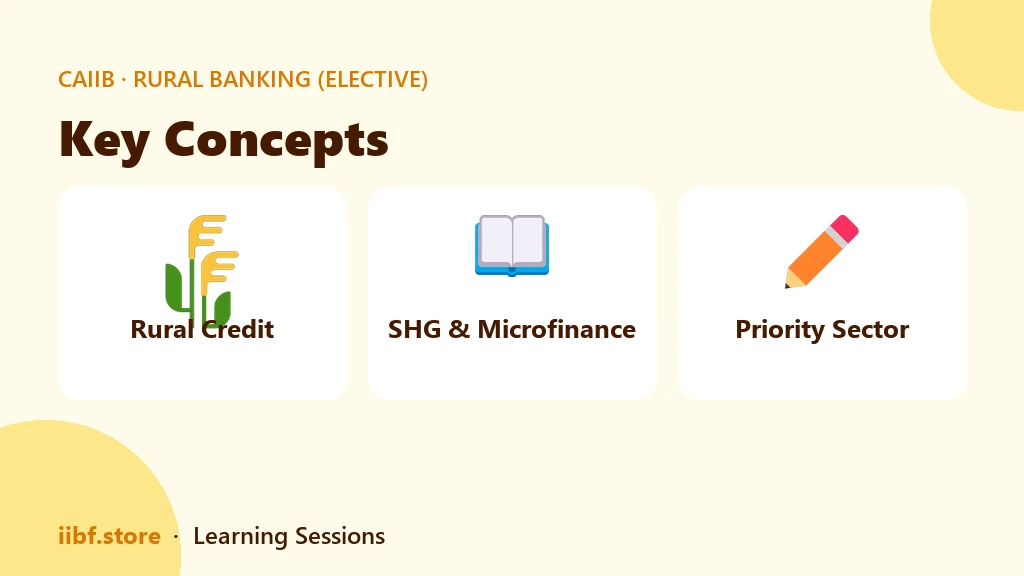
Operationally, the branch or agri-credit cell first confirms the warehouse is WDRA-registered and the e-NWR is genuine and lien-marked in the repository in the bank's favour. The loan is then sanctioned as a demand or cash-credit facility against the value of the pledged stock at prevailing market or MSP-linked prices, with the bank retaining a margin — commonly in the range banks fix internally, often 20-30% — to absorb price movement over the loan tenor. Drawing power is recalculated periodically against current market price, not the price on the day of pledge, so a falling market erodes the borrower's available limit even before the loan matures.
Insurance of the stored commodity against fire, flood and pest damage is mandatory and is usually bundled through the warehouse operator or WDRA-accredited insurance arrangements, with the bank named as loss payee. Tenor is typically short, six to twelve months, tied to the expected holding period before the farmer or trader releases stock for sale. On repayment, the lien on the e-NWR is lifted electronically through the repository, and the owner can then sell, transfer, or physically withdraw the commodity. Large agri-value-chain deals — where a processor, an FPO and a bank consortium jointly finance storage and offtake — sometimes borrow structuring ideas from consortium and multiple banking arrangements covered under CAIIB Advanced Bank Management.
⚠️ Common Mistake: Candidates often assume the loan amount is fixed for the full tenor. In practice, drawing power is marked to market, and banks can call for a top-up margin if prices fall sharply.
🌾 Risks, Challenges and the Way Forward
The product is not risk-free. Price risk is the most obvious — if commodity prices fall well below the value at which the receipt was pledged, the bank's cover thins and margin calls follow. Quality risk is next: grading disputes, moisture damage, or pest infestation discovered at withdrawal can reduce realisable value below the book figure, which is why WDRA's accreditation and periodic inspection of warehouses matter so much to a lending banker. India has also seen instances of warehouse-level fraud — inflated or duplicate paper receipts issued against stock that did not exist — which is the direct reason the sector pushed hard toward the repository-based e-NWR system.
Infrastructure gaps remain real: scientific storage capacity is unevenly distributed, and many smaller mandis and remote blocks still lack an accredited warehouse within practical reach, which ties directly into the state of rural infrastructure covered elsewhere in the elective. Farmer Producer Organisations are increasingly used as aggregation points — pooling small lots into warehouse-eligible quantities so smallholders who could never individually justify a pledge loan can still access this credit. Going forward, deeper e-NWR adoption, wider warehouse accreditation, and integration with e-NAM and commodity exchanges are the levers examiners and policymakers both point to.
Warehouse receipt finance rarely stands alone in a rural branch's book; it usually sits alongside other post-harvest and distress-linked products. Many of the same borrowers also carry crop insurance protection under the PMFBY crop insurance scheme, route deposits and short-term credit through the cooperative credit structure in India, or access it through a Small Finance Bank in Rural Banking channel where a scheduled commercial bank has no branch presence. CAIIB candidates should be comfortable relating warehouse receipt finance to each of these adjoining topics rather than studying it in isolation.
📌 Remember: Warehouse receipt finance converts a farmer's harvest-time liquidity problem into a financing decision — sell now at a low price, or pledge and hold for a better one.
| Basis | Traditional Crop Loan (KCC) | Warehouse Receipt Pledge Finance |
|---|---|---|
| Security offered | Standing/growing crop, land record-based | Stored, graded produce under e-NWR |
| Farmer pressured to sell immediately post-harvest | ✅ Yes, typically | ❌ No, can hold for a better price |
| Valuation basis | Scale of finance per crop/acre | Current market price of pledged stock, marked to market |
| Typical tenor | Crop season / renewed annually | 6-12 months, tied to holding period |
| PSL classification | Agriculture (direct) | Agriculture, up to RBI's specified ceiling, regardless of borrower's occupation |
🧠 Practice MCQs: Warehouse Receipt Finance
Q1. Which authority regulates the negotiable warehouse receipt system in India? (a) NABARD (b) SEBI (c) Warehousing Development and Regulatory Authority (d) Food Corporation of India
Answer: (c) — WDRA, set up under the Warehousing (Development and Regulation) Act, 2007, registers and accredits warehouses that issue negotiable receipts.
Q2. Electronic Negotiable Warehouse Receipts (e-NWRs) became mandatory for WDRA-registered warehouses from which year? (a) 2007 (b) 2011 (c) 2017 (d) 2020
Answer: (c) — e-NWR issuance through an approved repository was made mandatory from 2017, phasing out paper receipts prone to duplication.
Q3. Under RBI's Priority Sector Lending norms, loans against e-NWRs/NWRs of WDRA-registered warehouses, up to the specified ceiling, are classified under: (a) MSME (b) Agriculture (c) Export Credit (d) Housing
Answer: (b) — They qualify under Agriculture, irrespective of whether the borrower is personally engaged in farming, since the collateral itself is agricultural produce.
Q4. The margin retained by a bank on warehouse receipt pledge loans primarily protects against: (a) Credit risk of the warehouse operator (b) Price volatility of the pledged commodity (c) Foreign exchange risk (d) Core banking system risk
Answer: (b) — Margin absorbs a fall in the market price of the commodity between pledge and eventual sale/repayment.
Q5. Along with WDRA-accredited private warehouses, which public sector entities are traditional players in India's warehousing infrastructure? (a) NPCI and CCIL (b) Central Warehousing Corporation and State Warehousing Corporations (c) IRDAI and PFRDA (d) CERSAI and CIBIL
Answer: (b) — CWC and the various SWCs have long operated public warehousing capacity alongside newer WDRA-accredited private players.
Want chapter-wise mock tests with 100+ MCQs? Start practising free →

❓ Frequently Asked Questions
What is warehouse receipt finance?
It is a pledge loan a bank extends against commodities stored in an accredited warehouse, using the Negotiable Warehouse Receipt (or e-NWR) for that stock as collateral instead of the crop itself.
Is an e-NWR negotiable and transferable?
Yes. It is a title document that can be transferred electronically through the repository by endorsement, allowing ownership or a bank's lien to be recorded without moving the physical stock.
Does warehouse receipt finance count under Priority Sector Lending?
Loans against e-NWRs/NWRs issued by WDRA-registered warehouses, up to RBI's specified ceiling, are classified under the Agriculture category of Priority Sector Lending, regardless of the borrower's occupation.
What happens if the commodity's price falls below the loan amount?
Because drawing power is marked to current market price, a sharp fall triggers a margin call, and the bank may seek a top-up margin or partial repayment to restore cover.
✅ Conclusion: Key Takeaways for CAIIB Candidates
Warehouse receipt finance sits at the intersection of agri-infrastructure, PSL classification and practical rural credit delivery, which is exactly why it recurs across CAIIB Rural Banking papers. Bankers who understand the WDRA framework, the e-NWR mechanics, and the margin-and-drawing-power logic are better placed to structure sound post-harvest credit and to answer the case-study style questions this topic attracts. For a structured, chapter-linked run through this and the rest of the elective, work through the full CAIIB Rural Banking course, browse more Rural Banking Elective articles, and pair both with timed mock tests before your exam date.
Prefer revising from a printed book?
Chapter-wise books with MCQs after every chapter — minimal pages, complete coverage, delivered anywhere in India. Every book has a free sample to read first.













Quick quiz on this topic
5 exam-style questions from our free test bank — check yourself before you move on.
Practice this topic
Take a free mock test, download chapter PDFs, or watch a video class — all included on iibf.store.