Wealth Management for HNI Customers: JAIIB RBWM Guide
Banks do not serve every customer the same way, and nowhere is that clearer than in wealth management for HNI customers. A salaried depositor with a savings account and a business owner with a ₹5 crore portfolio need entirely different service models, product shelves and pricing — and JAIIB candidates are expected to know exactly where the line is drawn and why. This article breaks down how banks define a High Net-worth Individual (HNI), what wealth management for HNI customers actually includes, how the relationship-manager model differs from mass retail banking, and the regulatory guardrails RBI and SEBI place around suitability and mis-selling. It is written directly off the Retail Banking and Wealth Management syllabus so you can map every concept back to your exam.
🏦 Who Qualifies as an HNI Customer?
Indian banks do not use one universal cut-off for a High Net-worth Individual, but most private and foreign banks anchor their internal segmentation around investable surplus rather than income alone. A customer holding investable assets — deposits, mutual funds, bonds and equity excluding the primary residence — typically above ₹2 crore is classified HNI, while ₹25 lakh to ₹2 crore is often labelled "affluent" or "preferred," and anything above ₹25-30 crore usually gets pushed into a separate Ultra-HNI or private-banking-plus tier. These thresholds are internal policy, not RBI-mandated numbers, so every bank sets its own bands and reviews them periodically.
Segmentation exists because service cost and revenue potential differ sharply across the customer base. A mass-retail customer is served through standard branch processes, IVR, and digital self-service, while an HNI customer expects a single point of contact, faster turnaround on documentation, and access to products that never appear on a public rate card — structured deposits, portfolio management services, and pre-IPO or alternative investment fund allocations. Understanding this segmentation logic is foundational before you can classify why the service model in the next section looks so different.
For the exam, remember that HNI classification sits on top of, not instead of, the retail banking framework covered under the introduction to retail banking chapter — an HNI account is still a retail relationship, just priced and staffed differently.
💼 What Wealth Management for HNI Customers Actually Covers
Once a customer crosses the HNI threshold, the bank's offering shifts from selling individual products to managing an entire balance sheet. Wealth management for HNI customers typically spans four buckets: investment advisory (mutual funds, PMS, AIFs, direct equity), banking and lending (overdrafts against securities, structured loans), insurance and protection planning, and increasingly, non-financial services such as art advisory, real estate referrals, and family-office coordination for business-owning families. The dedicated Relationship Manager (RM) is the single thread that stitches these together, replacing the multiple, disconnected touchpoints a mass-retail customer deals with.
A distinctive feature of this segment is the shift from transaction-led to advice-led engagement. Where a branch teller processes a fixed deposit request, an HNI RM is expected to review the client's full portfolio periodically, rebalance across asset classes, and flag concentration risk — for instance, an entrepreneur holding excess wealth in their own company's unlisted shares. Banks increasingly formalise this through quarterly portfolio reviews and Investment Policy Statements signed off by the client, which also serve as the audit trail regulators look for during suitability checks.
Fee structures also diverge from mass retail: instead of flat transaction charges, HNI wealth management often runs on an Assets Under Management (AUM)-linked advisory fee, trail commissions on mutual funds, or a hybrid model. Candidates should note this distinction carefully, since exam questions frequently test whether a fee is transaction-based or AUM-based.
🎯 Private Banking vs Mass Retail: The Relationship Model
The operational difference between a mass-retail branch and a private banking desk is best understood through staffing ratios and channel design. A retail branch RM may service several hundred to a few thousand accounts through a mix of digital nudges and periodic calls; an HNI or private banking RM typically manages a book of 50-150 relationships, enabling proactive, personalised contact. This lower ratio is the single biggest cost driver behind why HNI wealth management for HNI customers is priced at a premium — and why banks protect it fiercely once a customer crosses the AUM threshold.
Digital channels have not eliminated this human layer; they have supplemented it. HNI clients still get app-based portfolio dashboards and instant fund transfers, but the differentiator remains the RM's ability to originate bespoke solutions — a structured note tailored to a client's tax position, or a bridge loan against a maturing FD portfolio, arranged within hours rather than through standard branch queues. This mirrors the broader theme of how retail banking concepts scale differently once ticket sizes and service expectations rise.
Cross-selling discipline also differs. Mass retail cross-sell is largely product-push (a credit card offer at account opening); HNI cross-sell is need-based and reviewed against the client's existing exposure, precisely because regulators penalise unsuitable product placement far more strictly once the ticket size and vulnerability of the customer segment increases.
💡 Exam Tip: If a question asks why HNI segments carry lower RM-to-client ratios than mass retail, the answer is service depth and revenue-per-client, not merely "richer customers get better treatment."
📌 Regulatory Guardrails: Suitability and Mis-Selling Risk
Because wealth management for HNI customers involves discretionary and non-vanilla products, it attracts the sharpest regulatory scrutiny in retail banking. RBI's fair-practice and outsourcing guidelines require banks to disclose fees transparently and prohibit misrepresenting a bank deposit as an investment product with equivalent safety. SEBI, in parallel, governs how banks acting as mutual fund or PMS distributors disclose commissions, and mandates a documented risk-profiling exercise before any recommendation is made — a step that must precede, not follow, product sale.
The most tested mis-selling failure pattern in this space is "reverse mis-selling": pushing a low-risk, low-fee product to a high-net-worth client who does not need liquidity, purely because it is easier to sell, versus true mis-selling, where a high-risk product is pushed to a conservative client chasing higher commission. Both are compliance failures, but examiners test candidates on distinguishing the direction of the mismatch between client risk appetite and product risk.
Banks manage this exposure through documented suitability assessments, cooling-off periods on complex products, and internal audit sign-off on any advisory recommendation above a defined ticket size. RBI's guidelines on outsourcing of financial services and the Reserve Bank of India's Master Directions remain the primary reference for how banks are expected to structure these controls — a link worth bookmarking directly for revision.
⚠️ Common Mistake: Students often assume wealth management for HNI customers is unregulated because it is "private." In reality, it sits under tighter suitability norms than standard retail product sales.
📈 Building the HNI Product Shelf: A Practical View
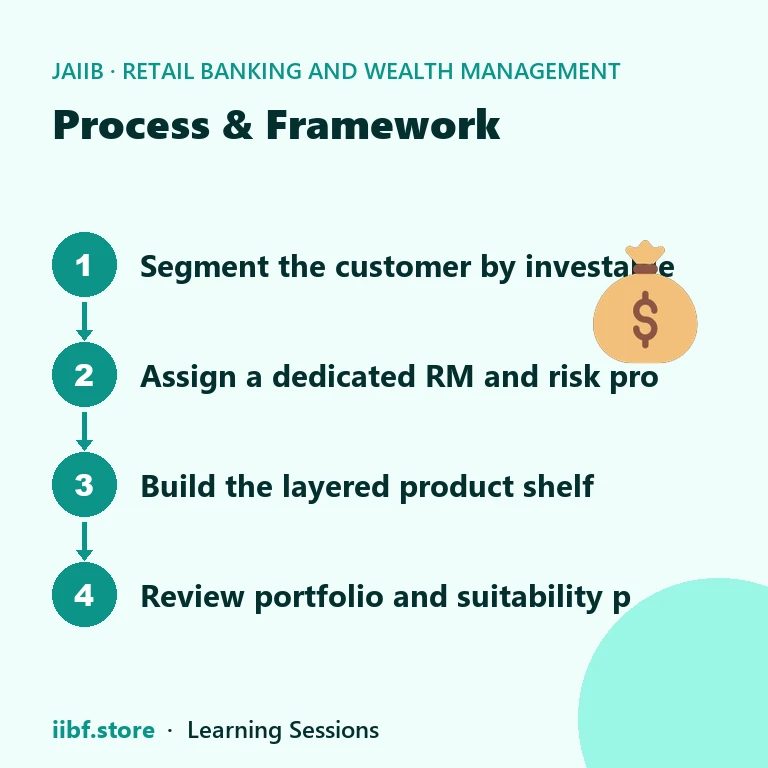
A well-designed HNI product shelf layers three tiers on top of standard retail banking. The base layer is banking convenience — priority servicing, doorstep banking, and preferential FD or lending rates. The middle layer is investment access — curated mutual fund and PMS panels, structured products, and access to Alternative Investment Funds (AIFs) that carry a regulatory minimum investment of ₹1 crore under SEBI norms, which itself acts as a natural HNI filter. The top layer is advisory and estate coordination — succession planning conversations, trust structuring referrals, and family-office style consolidated reporting across banks.
Banks also differentiate through "open architecture" versus "closed architecture" distribution: open-architecture desks offer mutual funds and insurance across multiple manufacturers, while closed-architecture desks push only in-house or group-company products. Regulators favour disclosure of this choice upfront, since it directly affects whether the client is getting the best-fit product or the bank's most profitable one. This ties back to how retail banking introduction frames the trade-off between product manufacturing and product distribution within a universal bank.
Candidates preparing for JAIIB should also connect this segment to the broader shifts in India's customer base — as India's working-age population and disposable income expand, discussed in detail under the demographic dividend in India theme, the affluent and HNI base is one of the fastest-growing retail segments banks are actively building capacity for.
📌 Remember: AIF investment minimums, SEBI risk-profiling mandates, and RBI fair-practice disclosure rules are the three regulatory pillars examiners repeatedly test in this topic.
| Feature | Mass Retail | Preferred / Affluent | HNI / Private Banking |
|---|---|---|---|
| Typical investable assets | Below ₹25 lakh | ₹25 lakh – ₹2 crore | Above ₹2 crore |
| Dedicated Relationship Manager | ❌ | ✅ (shared) | ✅ (dedicated) |
| RM-to-client ratio | 1:1000+ | 1:300-500 | 1:50-150 |
| Access to PMS / AIF | ❌ | Limited | ✅ |
| Fee model | Flat / transaction | Hybrid | AUM-linked advisory |
| Formal risk-profiling review | At onboarding only | Annual | Quarterly / event-based |

🔗 How This Topic Connects Across the RBWM Syllabus
This staged structure also explains why RBWM as a subject treats branch profitability and customer segmentation as linked ideas — a branch with a higher share of affluent and HNI accounts carries a fundamentally different cost-to-income profile than a pure mass-retail branch, even with similar footfall. Examiners frequently combine a segmentation question with a profitability-ratio question in the same case study, so treat the two topics as one revision unit rather than isolated chapters.
Two related retail products worth cross-referencing while you revise this chapter are how gold loans for retail customers are priced against a completely different, mass-market collateral model, and how personal loans in retail banking rely on credit scoring rather than relationship depth — both stand in direct contrast to the advisory-led, low-volume HNI model covered here. If you are also revising retirement-linked wealth products, the separate note on the National Pension System for retail customers is a useful adjacent read, since NPS often appears on the "banking convenience" layer of an HNI shelf even though it is a mass-market scheme. Building the habit of mapping every RBWM sub-topic back to a real product — instead of memorising definitions in isolation — is what separates candidates who clear the numerical and case-study sections from those who only clear the theory portion.
🧠 Practice MCQs: Wealth Management for HNI Customers
Q1. Under SEBI norms, what is the minimum investment amount generally required to invest in an Alternative Investment Fund (AIF)? (a) ₹10 lakh (b) ₹25 lakh (c) ₹1 crore (d) ₹5 crore
Answer: (c) — SEBI mandates a minimum investment of ₹1 crore in most AIF categories, which also acts as a natural HNI filter.
Q2. In HNI wealth management, which fee structure is most commonly used instead of flat transaction charges? (a) Fixed annual membership fee only (b) AUM-linked advisory fee (c) No fee, cross-subsidised by deposits (d) Per-branch-visit fee
Answer: (b) — HNI relationships are typically priced on an Assets Under Management (AUM)-linked advisory basis, often blended with trail commissions.
Q3. What must precede any investment product recommendation to an HNI client under SEBI-aligned practice? (a) Credit bureau check (b) Documented risk-profiling exercise (c) Branch manager sign-off only (d) KYC renewal
Answer: (b) — A documented risk-profiling exercise must be completed before a recommendation is made, forming the basis of suitability compliance.
Q4. "Reverse mis-selling" in wealth management refers to: (a) Selling a high-risk product to a conservative client (b) Selling a low-risk, low-fee product to a client who needed a different solution because it was easier to sell (c) Refusing to sell any product (d) Selling a product below its listed price
Answer: (b) — Reverse mis-selling is pushing an easy, low-fee product regardless of the client's actual need, distinct from classic mis-selling of unsuitable high-risk products.
Q5. Which distribution model offers mutual funds and insurance products from multiple manufacturers rather than only in-house products? (a) Closed architecture (b) Open architecture (c) Captive architecture (d) Single-manufacturer model
Answer: (b) — Open-architecture distribution gives clients access to products across multiple asset managers and insurers, improving fit over a purely in-house shelf.
Want chapter-wise mock tests with 100+ MCQs? Start practising free →
❓ Frequently Asked Questions
Is there an RBI-mandated minimum net worth to be classified as an HNI customer?
No. HNI classification is an internal bank policy based on investable assets, not a figure fixed by RBI; thresholds vary by bank and are reviewed periodically.
Can a mass-retail customer access products like PMS or AIFs?
Technically yes if they meet the regulatory minimum investment (for example ₹1 crore for most AIFs), but banks generally route such access only through their HNI or private banking desks due to the advisory and compliance overhead involved.
Why do banks assign lower client loads to HNI relationship managers?
Because the service model is advice-led rather than transaction-led — periodic portfolio reviews, bespoke structuring, and faster turnaround require significantly more RM time per client than standard retail servicing.
How is wealth management for HNI customers regulated differently from mass retail products?
It carries additional SEBI-aligned suitability and risk-profiling requirements before any recommendation, plus stricter fee-disclosure norms, since the products involved are typically non-vanilla and higher-ticket.
Segmentation, suitability and product-shelf design are recurring themes across the JAIIB Retail Banking and Wealth Management paper, and they connect directly to branch-level profitability metrics tested elsewhere in the syllabus. Revise the full topic list on the Retail Banking and Wealth Management tag page, then reinforce it with structured practice on the JAIIB course to lock in both the conceptual and numerical angles examiners favour.
Quick quiz on this topic
5 exam-style questions from our free test bank — check yourself before you move on.
Practice this topic
Take a free mock test, download chapter PDFs, or watch a video class — all included on iibf.store.
Keep reading