After NPA: Classification, Provisioning and Recovery Explained
Every banker has heard the sentence at least once: "account NPA ho gaya." And what follows is not comfortable for anyone — not for the borrower, not for the branch, not for the balance sheet. The short video below puts it in sixty seconds. This article puts it in the language your exam paper will use, because NPA classification and provisioning is not a single rule you memorise. It is a chain of consequences that begins on day 91 and does not end until the borrower clears every rupee of arrears, or the bank writes the account off entirely.
NPA ke baad jo hua wo theek nahi hua · Watch on YouTube
Day 91: the line that changes everything
An advance does not become non-performing because the branch manager decides it has. It happens automatically, by the calendar. Under the RBI prudential norms, a term loan turns NPA when interest and/or the instalment of principal remains overdue for more than 90 days. A cash credit or overdraft turns NPA when the account is "out of order" — the outstanding balance stays continuously above the sanctioned limit or drawing power for 90 days, or the balance is within the limit but there are no credits at all for 90 days. Bills purchased or discounted go the same way once they remain overdue beyond 90 days.
Agriculture gets its own clock, and this is where candidates lose marks. A short-duration crop loan turns NPA when the instalment of principal or interest stays overdue for two crop seasons. A long-duration crop loan turns NPA after one crop season. A crop season is decided by the state-level bankers committee for the area, not by a fixed number of months — so do not try to convert it into days.
One more thing the short does not have time to say: the classification is borrower-wise, not facility-wise. If one facility of a borrower goes bad, all facilities of that borrower are treated as NPA. A borrower cannot keep a clean term loan and a rotten cash credit in the same bank and hope the two stay separate.
The three buckets: sub-standard, doubtful, loss
Once an account is NPA, it does not sit in one place. It ages, and ageing is expensive.
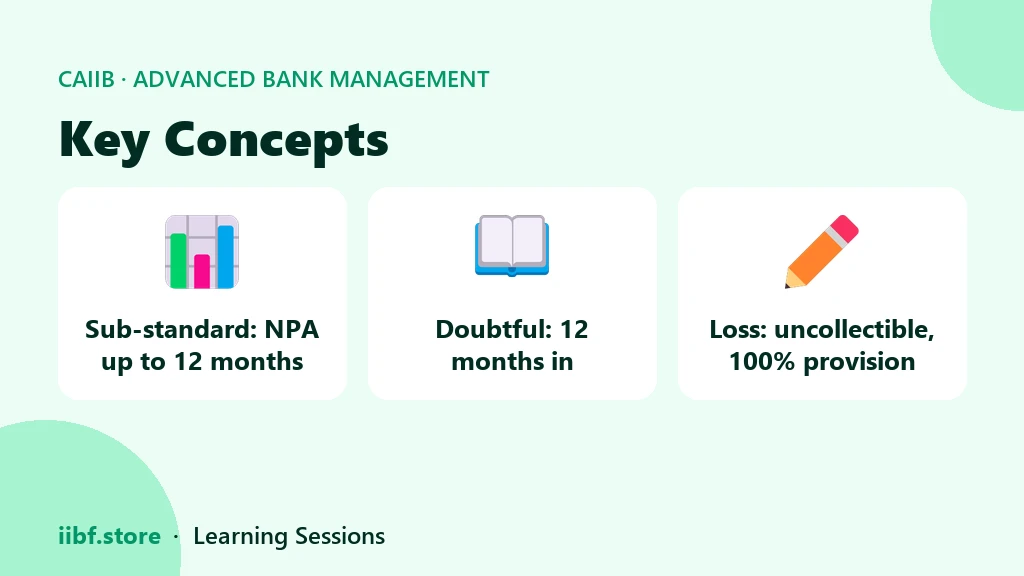
A sub-standard asset is one that has remained NPA for a period of 12 months or less. The security is still worth something, but the credit weakness is now on record.
A doubtful asset is one that has remained in the sub-standard category for 12 months. In other words, roughly two years after the first missed payment, the account moves here. Doubtful is further split by how long it has been doubtful — up to one year (D1), one to three years (D2), and more than three years (D3).
A loss asset is an account the bank, its internal or external auditors, or the RBI inspection has identified as uncollectible. Some salvage value may still exist; the point is that the loss has been recognised and the amount has not been written off.
Provisioning: what the bank quietly sets aside
This is the part borrowers never see and the part examiners always ask about. Every rupee of provision is a rupee taken out of profit. That is why one large slippage can visibly dent a bank quarterly result, and why recovery teams start calling on day 92.
| Category | Sub-category | Minimum provision |
|---|---|---|
| Standard | Farm credit to agricultural activities and SME | 0.25% |
| Standard | Commercial real estate (CRE) | 1.00% |
| Standard | CRE – residential housing | 0.75% |
| Standard | All other loans and advances | 0.40% |
| Sub-standard | Secured exposure | 15% |
| Sub-standard | Unsecured exposure | 25% |
| Doubtful | Unsecured portion (all D1/D2/D3) | 100% |
| Doubtful D1 | Secured portion, up to 1 year | 25% |
| Doubtful D2 | Secured portion, 1 to 3 years | 40% |
| Doubtful D3 | Secured portion, over 3 years | 100% |
| Loss | Entire outstanding | 100% |
Work through a number and the pattern sticks. Take a secured term loan of Rs 50 lakh where the EMI stops in January. By early April the account has crossed 90 days and is flagged NPA. It is sub-standard, so the bank provides 15 per cent — Rs 7.5 lakh gone from profit on one account. Twelve months later it becomes doubtful D1. If the realisable security is now valued at Rs 30 lakh, the unsecured portion of Rs 20 lakh attracts 100 per cent provision and the secured Rs 30 lakh attracts 25 per cent, so the total provision jumps to Rs 27.5 lakh. Nothing changed in the borrower behaviour. Only the calendar moved. That is the whole logic of NPA classification and provisioning: time itself is the risk factor.
Income recognition: the reversal nobody mentions
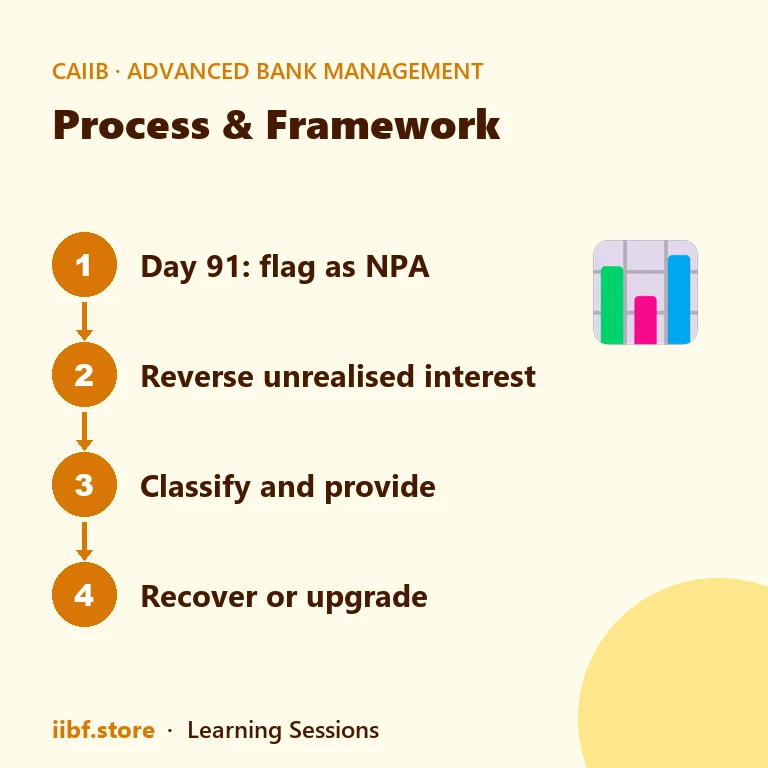
Banks work on accrual, but not on bad accounts. RBI is explicit that a bank should not charge and take to income account any interest on an NPA. Interest on such accounts can only be recognised when it is actually realised.
The consequence is uncomfortable. Interest already booked as income in earlier quarters, but still unrealised as on the date of slippage, has to be reversed. The branch that proudly showed that interest as income last quarter now watches it come off the books. There is a narrow exception: interest on advances against term deposits, NSCs, IVPs, KVPs and life policies may be taken to income on the due date provided adequate margin is available, because the security is liquid and self-liquidating.
Getting back to standard: the upgradation rule
Borrowers often assume that paying a couple of overdue instalments restores the account. It does not. RBI is unambiguous: loan accounts classified as NPA may be upgraded as standard only if the entire arrears of interest and principal are paid by the borrower. Part payment moves the recovery needle, not the classification.
This is also why "technical" slippage arguments rarely work. Temporary deficiencies — a stock statement not submitted, drawing power not updated, a limit awaiting renewal — are not by themselves grounds for classifying an account NPA. But once genuine overdues cross the threshold, no amount of paperwork undoes it. Only money does.
What it means for the borrower
Beyond the bank ledger, slippage follows the borrower around. The account status is reported to credit information companies, so the credit report carries the sub-standard or doubtful tag long after the crisis is over. Fresh credit gets harder and dearer. If the exposure is secured and above the statutory threshold, the bank can move under the SARFAESI Act, which begins with a 60-day notice demanding repayment before the secured creditor takes any enforcement action. Settlement or write-off closes the account for the bank but leaves a "settled" or "written off" marker that a future lender will read.
So when the video says what happened after NPA was not right, that is the honest version. The right time to act is the day the first EMI bounces, not the day the classification letter arrives. If you are preparing for the paper rather than living it, the CAIIB ABM credit management module covers this end to end, and the practice test bank is where you should be testing whether you can compute a doubtful-asset provision under time pressure. Build the revision around it with the study planner, and if you are still deciding your paper order, start from the CAIIB course page. More explainers like this one sit on the blog, and the underlying rules are worth reading once in the original at rbi.org.in.
Quick revision checklist
Before you close this page, make sure you can answer these without looking: the 90-day rule and the two "out of order" tests; two crop seasons versus one; 12 months to doubtful; the D1, D2 and D3 secured provisions of 25, 40 and 100 per cent; and the fact that upgradation needs the entire arrears. Get those six right and most NPA classification and provisioning questions in the paper become one-line answers rather than guesswork.
When exactly does a term loan become an NPA?
When interest and/or the instalment of principal remains overdue for more than 90 days. The count is by the calendar, not by branch discretion, and the classification then applies to all facilities of that borrower.
How much provision is needed on a sub-standard asset?
15 per cent of the total outstanding for the secured exposure, and 25 per cent where the exposure is unsecured. These are minimum requirements; a bank board may adopt higher rates and apply them consistently.
Can an NPA account go back to standard?
Yes, but only when the entire arrears of interest and principal are cleared. Paying one or two overdue instalments improves the recovery position but does not upgrade the classification.
Why does the bank reverse interest already booked?
Because interest on an NPA cannot be taken to the income account on accrual. Any interest booked in earlier periods but not actually realised as on the date of slippage has to be reversed, which is why NPA classification and provisioning hits reported profit twice over.
Prefer revising from a printed book?
Chapter-wise books with MCQs after every chapter — minimal pages, complete coverage, delivered anywhere in India. Every book has a free sample to read first.
























Quick quiz on this topic
5 exam-style questions from our free test bank — check yourself before you move on.
Practice this topic
Take a free mock test, download chapter PDFs, or watch a video class — all included on iibf.store.