CAIIB ABFM Exam Date December 2026: Complete Prep Guide
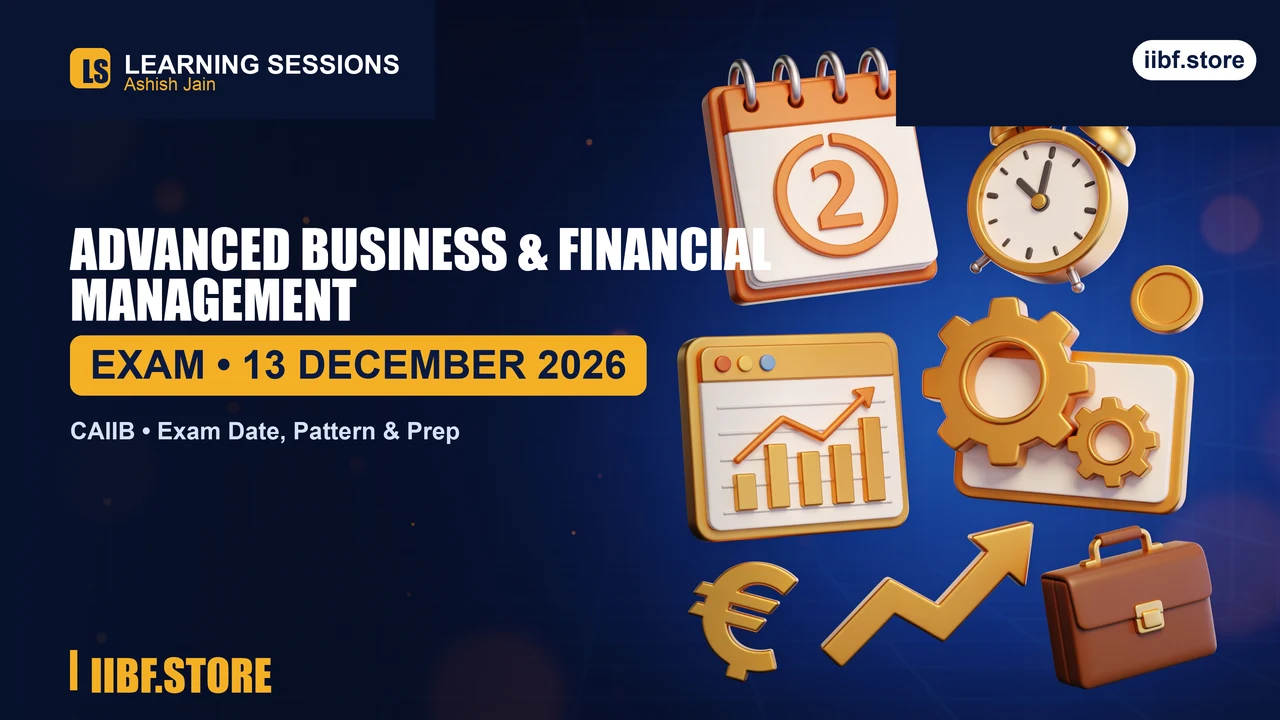
The CAIIB ABFM Exam Date is one calendar entry every banker chasing promotion this year should treat as non-negotiable: Advanced Business and Financial Management is scheduled for 13 December 2026 as per the latest released IIBF schedule — always confirm it on the official IIBF notification before you finalise your plan. Lock that single day into your head, because everything that follows in your preparation should be planned backwards from it.
ABFM is widely regarded as one of the most demanding electives in the CAIIB line-up, and that reputation is well earned. It is built on corporate finance and financial management studied at real depth, not surface-level definitions. The candidates who clear it in a single attempt are almost always the ones who started early, respected the numericals, and refused to leave the calculation-heavy chapters for the final week.
Key takeaways
- The CAIIB ABFM exam date is 13 December 2026 as per the latest released IIBF schedule — reconfirm on the official IIBF notification.
- Registration for the December cycle typically opens around September 2026; apply on day one because preferred centres fill fast.
- ABFM is an objective, multiple-choice paper that is heavily application and numerical based — not a theory test.
- Plan a 12-week study runway: build concepts first, drill numericals in the middle, and protect at least two weeks for full-length mocks.
- The biggest mistake is treating an elective as "easier" — ABFM deserves the same respect as any compulsory CAIIB paper.
When is the CAIIB ABFM exam date?
The Indian Institute of Banking and Finance (IIBF) has fixed the CAIIB ABFM exam date for 13 December 2026 in the December examination cycle. That date is your anchor — every revision block, every mock test, and every formula recap should be scheduled relative to it.
Because ABFM is an elective, it sits alongside the compulsory CAIIB papers within the same December window. If you are attempting more than one paper this cycle, map the individual dates carefully so two heavy papers do not land back-to-back with no recovery time in between.
Exact day-and-time details, reporting times, and the order of the remaining papers can shift slightly from one cycle to the next. Treat 13 December 2026 as fixed for ABFM, but verify the surrounding schedule on the official IIBF website the moment the notification is published.
Registration: do not miss the September window
Registration for the December cycle generally opens around September 2026. The window is short, and seats at popular examination centres go quickly, so treat the opening day as a mini-deadline of its own. A few practical reminders before you log in:
- You must be a CAIIB-eligible member of the Institute to apply, which means your membership and JAIIB completion should already be sorted.
- Apply on day one — preferred centres and convenient slots fill within hours in many cities.
- Keep your photograph, signature, and payment method ready to avoid last-minute upload errors.
- Confirm the precise open and close dates on the official notification, as they can move slightly each cycle.
If you want a head start while the window is still open, you can map the entire elective from the CAIIB ABFM subject page and line up your chapters before you even pay the fee.
What the ABFM paper actually tests
ABFM is an objective, multiple-choice paper — but do not let the format fool you into thinking it is light. It is one of the most application-heavy papers in the qualification, packed with numericals and case-based reasoning that demand genuine understanding of how a firm raises, deploys, and manages capital.
The syllabus is broad, but it clusters into a handful of big themes. Knowing these cold is what stops any module from ambushing you on exam day:
- The financial system and corporate finance: how firms raise and deploy capital, and the role of financial markets and intermediaries.
- Financial statements and analysis: reading, interpreting, and drawing conclusions from company accounts and ratios.
- Working capital and cost management: liquidity, the operating cycle, inventory, receivables, and cost-control decisions.
- Capital budgeting and capital structure: investment appraisal, cost of capital, leverage, and dividend policy.
- Risk and equity valuation: measuring risk and return, and valuing businesses and securities.
The exact number of questions, the duration, and the passing marks should always be read from the latest IIBF notification rather than assumed from a previous year. Never let last year's pattern lull you — confirm the current structure, and if you want a deeper dive into reading accounts, our Financial Statement Analysis for CAIIB ABFM guide walks through the toughest module in detail.
How ABFM modules map to your study effort
Not every theme carries the same weight or the same difficulty for a working banker. The table below is a planning aid — a way to decide where your hours should concentrate — rather than an official mark distribution. Always cross-check the precise syllabus split on the current IIBF notification.
| Module theme | Nature | Effort focus |
|---|---|---|
| Financial system & corporate finance | Conceptual | Build vocabulary first |
| Financial statement analysis | Mixed | Ratios & interpretation |
| Working capital & cost management | Numerical | Daily problem drills |
| Capital budgeting & structure | Heavily numerical | NPV, IRR, cost of capital |
| Risk & equity valuation | Mixed | Formulas + concepts |
The pattern is clear: the middle of the syllabus is where the marks are won or lost. Capital budgeting and working capital are calculation-dense, so they need repeated practice rather than a single read-through.
Why ABFM matters for your promotion plans
CAIIB is the qualification that moves you up the promotion ladder, and ABFM is one of its most respected electives precisely because it is demanding. The corporate-finance toolkit it builds — capital budgeting, valuation, working-capital strategy, and cost of capital — is exactly what a bank expects from an officer handling credit, treasury, or large advances.
Clear ABFM well and you are not merely adding a line to your CV. You are building the analytical muscle your next role will actually use, which is why so many candidates choose it as their flagship elective rather than an easy add-on.
Your week-by-week plan to 13 December 2026
Assuming you begin once registration opens in September, here is a realistic schedule that keeps the numericals from piling up at the end. Anchor every week to the CAIIB ABFM exam date and you will arrive calm rather than crammed.
- Weeks 1–3 (mid-September): Cover the financial system, corporate-finance basics, and financial-statement analysis. Build the vocabulary first so later chapters have a foundation to stand on.
- Weeks 4–6 (October): Move into working capital, cost management, and capital budgeting. This is the numerical heartland — practise problems daily, not just reading.
- Weeks 7–9 (early November): Tackle capital structure, leverage, dividend policy, risk, and valuation. Start one timed mock test every weekend.
- Weeks 10–12 (late November to early December): Pure revision and full-length mocks. Alternate tests with formula-sheet recaps, fix weak topics, and resist chasing new ones.
- Final week: Light revision, the formula compendium, and proper rest. No new chapters.
You can slot timed practice straight into this plan with our CAIIB chapter-wise mock tests, and reinforce formula recall between sessions using the CAIIB matching games. For broader strategy across the qualification, the CAIIB exam hub keeps every subject in one place.
Common mistakes that quietly cost ABFM marks
- Treating it like theory: ABFM rewards problem-solving. Reading a capital-budgeting chapter is not the same as solving ten NPV and IRR sums under time pressure.
- Ignoring the formula sheet: cost of capital, key ratios, and valuation formulas belong on one compact sheet you revise daily in the final month.
- Skipping numerical practice: the calculations decide this paper. Drill them until the steps are automatic and you are not thinking about the method, only the figures.
- Underestimating the elective: candidates assume electives are softer than compulsory papers. ABFM is not. Give it full respect from day one.
- Mismanaging exam-day time: one tricky sum can swallow ten minutes. Flag it, move on, and return only if time allows.
Pairing ABFM with another heavy elective in the same cycle multiplies these risks. If finance is newer territory for you, give ABFM the spotlight, protect your mock weeks, and consider adding a second elective in a later window. If you do pair, stagger revision so the calculation-heavy chapters of each paper never collide in the same week — a guide like our CAIIB BFM exam-date and prep walkthrough can help you sequence the two sensibly.
Exam-day checklist
- Carry your printed admit letter and a valid photo ID.
- Reach the centre early — aim for roughly 45 minutes before reporting time.
- Read each numerical fully; a single missed figure can change the entire answer.
- Attempt every question, and confirm the negative-marking rule on your admit letter before you begin.
- Watch the clock and avoid sinking too long into any one sum — flag it and return later.
Frequently Asked Questions
What is the CAIIB ABFM exam date in 2026?
As per the latest released IIBF schedule, the CAIIB ABFM (Advanced Business and Financial Management) paper is set for 13 December 2026. Because dates can shift slightly between cycles, always reconfirm it on the official IIBF notification before finalising your plan. Treat this single day as the anchor for your entire revision timeline.
When does registration for the December cycle open?
Registration for the December cycle generally opens around September 2026. The window is short and popular centres fill quickly, so it is wise to apply on the very first day it opens. Reconfirm the exact open and close dates on the official IIBF site, as they can move marginally each cycle.
Is ABFM harder than the other CAIIB papers?
ABFM is widely considered one of the more challenging electives because it is numerical and application-heavy rather than theory-based. That said, it is very much clearable on the first attempt with daily problem practice and timed mock tests. The key is to respect the calculations and start early rather than cramming them in the final week.
How many attempts do I get to clear CAIIB?
IIBF allows multiple attempts within a fixed time limit measured from your first registration. The exact number of attempts and the time limit should be confirmed on the current official notification, as these terms are periodically revised. Regardless of the limit, the smart strategy is to clear ABFM as early in your CAIIB journey as possible.
How should I prepare for the numerical questions?
Build a single compact formula sheet covering cost of capital, ratios, capital budgeting, and valuation, and revise it daily in the last month. Then drill problems — NPV, IRR, working-capital, and leverage sums — until the method is automatic. Finishing with full-length timed mocks trains you to solve accurately under exam pressure.
Where can I get the ABFM syllabus and study material?
You can download the official ABFM syllabus PDF to map every chapter, and pair it with free chapter-wise notes, one-liners, and formula sheets on Learning Sessions. Recorded and live classes by Ashish Jain cover each module, while the mock tests and matching games handle revision. Browse everything for this paper from the CAIIB guides hub.
Final word
13 December 2026 is closer than it looks once the September registration window opens. Lock the date, register on day one, and work a steady week-by-week plan instead of a last-month sprint. Start with the syllabus, drill the numericals until they are second nature, layer in full-length mocks, and fix your weak topics while there is still room to do so.
Do that, and you will not only clear CAIIB ABFM on your first attempt — you will walk into your next banking role carrying the corporate-finance confidence that real promotions are built on.
Related Guides
📚 Free Learning Sessions resources — connect & crack your exam
- 📝 Free mock tests — chapter-wise, exam-pattern, with instant solutions
- 🎮 Matching games — gamified revision of key terms & concepts
- 📄 Study notes & PDFs — downloadable chapter material
- 🎥 Video classes on YouTube — subscribe to @learningsessions
💬 Want the full course? WhatsApp your course name to 8360944207 and our team will set you up.
📱 Study on the go — get our iOS & Android app at iibf.store/app.
Quick quiz on this topic
5 exam-style questions from our free test bank — check yourself before you move on.
Practice this topic
Take a free mock test, download chapter PDFs, or watch a video class — all included on iibf.store.
Keep reading