Personal Guarantors Under IBC: Part III Process and Bank Recovery
When a corporate borrower defaults and the account is dragged into insolvency, the bank does not stop at the company. Personal guarantors under IBC face a separate, faster-moving process under Part III of the Insolvency and Bankruptcy Code, 2016 — notified specifically for individuals who have stood surety for corporate debtors. For JAIIB and CAIIB candidates handling recovery files, this is the mechanism that decides how much of a defaulted loan the bank can actually claw back from the promoter or director who signed the guarantee deed.
Part III was notified for personal guarantors to corporate debtors on 1 December 2019, well before the rest of the individual insolvency framework was activated. It runs largely through Sections 94 to 120 and is deliberately distinct from the Corporate Insolvency Resolution Process (CIRP) that governs the company itself.
📋 Part III and Why Personal Guarantors Are Treated Separately
The IBC splits individual insolvency into its own track precisely because a guarantor's liability is personal, not corporate. Only personal guarantors to corporate debtors were brought under Part III in the first phase — proprietors, partners and other individual debtors remain outside its notified scope for now. This narrow notification was itself challenged in court and upheld, which is why the process today runs on a settled footing.
The framework borrows CIRP's vocabulary — moratorium, resolution professional, committee of creditors-style voting — but reshapes each concept for an individual. There is no liquidation of a company; instead the guarantor gets a chance at a repayment plan before bankruptcy is even considered. Candidates should read this alongside the broader Structure of the IBC to see where Part III sits relative to Parts II and IV.
Crucially, the personal guarantor's process does not need the corporate debtor to be under CIRP at the same time. A bank can move against the guarantor even while recovery against the company is pending elsewhere, or after the company's resolution plan has already been approved — a point that becomes central once you get to the Lalit Kumar Jain ruling below.
⚖️ Why the Bank Invokes the Guarantee Before Filing Section 95
Before a bank can file an application against a personal guarantor, it must establish that a "default" has occurred qua the guarantor — not merely that the company has defaulted. This is why banks first formally invoke the guarantee: a written demand under the guarantee deed, calling upon the guarantor to pay the outstanding amount, creates the trigger event and the paper trail the NCLT will expect.
Under Section 128 of the Indian Contract Act, 1872, a guarantor's liability is coextensive with that of the principal debtor unless the contract says otherwise. Once invoked and unpaid, the bank — as a "creditor" under Section 95 — can file an application before the National Company Law Tribunal (NCLT) that has jurisdiction over the corporate debtor, seeking to initiate the insolvency resolution process against the guarantor personally.
This differs sharply from corporate recovery. Banks handling defaulted accounts often work this invocation step alongside their charge over collateral — pledged shares, hypothecated stock or goods held under bailment — and candidates studying recovery instruments should cross-reference bailment and pledge for bankers to see how these security interests interact with a guarantee claim. The Section 95 route is a parallel, personal remedy — it does not replace SARFAESI or DRT action, it adds a forum where the guarantor's own estate can be examined.
⚠️ Common Mistake: Candidates often assume Section 95 needs the corporate debtor to be under CIRP first. It does not — a bank can proceed against the guarantor independently, and even after the company's CIRP has concluded.
🧑⚖️ The Resolution Professional's Report and Interim Moratorium
The moment a Section 95 application is filed, Section 96 kicks in an interim moratorium that applies automatically to all debts of the guarantor — no separate order is needed. Pending legal proceedings on those debts stand stayed, and no new proceedings can be initiated, giving the guarantor immediate breathing room. This interim moratorium is narrower than the Section 14 moratorium in CIRP: it does not touch criminal proceedings, and certain protected assets — an unencumbered single dwelling unit, tools of the guarantor's trade and unencumbered personal effects within prescribed limits — stay outside its reach under the exempt-assets rule.
The NCLT directs the IBBI to nominate a resolution professional (RP) within seven days of the application. The RP examines the application, verifies the claimed default and the debts involved, and must submit a report to the NCLT under Section 99 recommending approval or rejection — typically within ten days of appointment. Unlike an IRP in corporate insolvency, this RP does not take over management of a business; the guarantor is an individual, and the RP's role is investigative and reporting in nature at this stage.
Once the NCLT admits the application under Section 100, based on the RP's report, the interim moratorium is replaced by a fuller moratorium and the process moves toward a repayment plan. Candidates comparing timelines should look at how Roles and Duties of IRP and RP differ between the corporate and personal-guarantor tracks — the title is the same, the job is not.
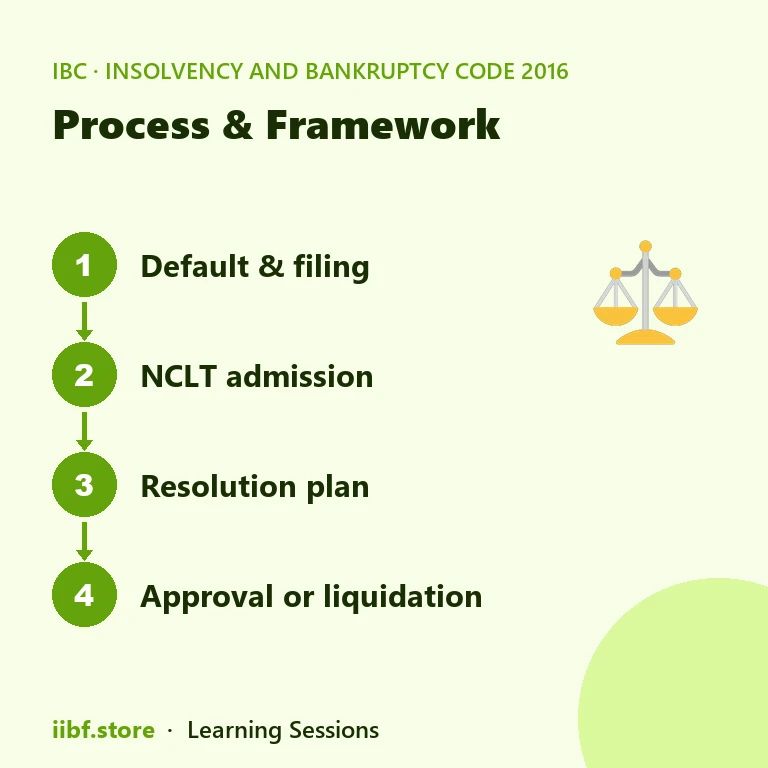
💡 Exam Tip: Remember the sequence — invocation of guarantee, then Section 95 filing, then automatic interim moratorium under Section 96, then RP report under Section 99, then NCLT admission/rejection under Section 100. Questions often test which step is automatic versus which needs a tribunal order.
📜 The Lalit Kumar Jain Ruling: Guarantor's Liability Survives
The Supreme Court's ruling in Lalit Kumar Jain v. Union of India (2021) settled two questions that used to trip up recovery officers. First, it upheld the validity of the notification bringing personal guarantors to corporate debtors under Part III. Second, and more consequentially for banks, it held that approval of a resolution plan for the corporate debtor does not automatically discharge the personal guarantor from liability for the remaining, unpaid portion of the debt.
The Court reasoned that a guarantee is a coextensive and independent contract under Section 128 of the Contract Act — the guarantor's obligation does not evaporate merely because the principal debtor's liability was restructured or written down through a CIRP resolution plan. Unless the guarantee deed itself, or the resolution plan, expressly says the guarantor stands released, the bank retains its claim against the guarantor for the shortfall between what was recovered from the company and what was actually owed.
This is precisely why banks pursue Section 95 proceedings even after a corporate debtor's resolution plan has been approved and the company has effectively been handed to a new promoter. The guarantee survives the corporate resolution — it is the guarantor's separate estate, not the company's, that is now in play.
📌 Remember: Discharge of the principal debtor's residual debt through a CIRP resolution plan does not discharge the surety — the Lalit Kumar Jain principle is one of the most frequently tested points on personal guarantors under IBC.
💰 Repayment Plan Versus Bankruptcy: What a Lender Actually Recovers
Once the NCLT admits the Section 95 application, the guarantor gets the first shot at a repayment plan under Sections 105 to 117 — a proposal to the creditors on how and when the outstanding debt will be paid, prepared with the RP's assistance and put to a meeting of creditors for approval. If creditors representing the requisite value approve it, the guarantor repays under supervision and, on satisfactory completion, is discharged from the debts covered by the plan.
If no repayment plan is proposed, or creditors reject it, or the guarantor fails to comply, the process moves to full bankruptcy under Sections 121 to 148. A bankruptcy trustee is appointed, the guarantor's estate (minus exempt assets) vests in the trustee for realisation and distribution among creditors, and the guarantor is eventually granted a discharge order — but only after the statutory period and after the estate has been administered.
| Aspect | Repayment Plan (Ss. 105-117) | Bankruptcy Process (Ss. 121-148) |
|---|---|---|
| Trigger | Guarantor proposes plan post-admission | Plan rejected, fails, or not proposed |
| Creditor vote needed | ✅ Yes, meeting of creditors | ❌ No vote — trustee-led realisation |
| Guarantor retains asset control | ✅ Yes, under supervision | ❌ No, estate vests in trustee |
| Typical lender recovery | Partial, per agreed schedule | Often lower, after exempt-asset carve-outs |
| End state for guarantor | Discharge on plan completion | Discharge order after estate administration |
In practice, lenders should calibrate expectations. The guarantor's single dwelling unit, tools of trade, and unencumbered personal effects up to prescribed thresholds are carved out of the estate in both routes, and the process through NCLT is neither quick nor guaranteed to yield full recovery. For most branch-level recovery teams, the Section 95 route is best treated as leverage alongside SARFAESI and civil suit action, not as a standalone silver bullet — the credit recovery toolkit covered in Credit Recovery Laws for Banks is still the fuller picture.
🎯 Conclusion: What This Means for Bank Recovery Teams
Personal guarantors under IBC give banks a structured, time-bound forum to pursue promoters and directors who signed guarantee deeds — but the process runs on its own rules, separate from the company's CIRP, with its own moratorium, its own RP report, and its own repayment-plan-before-bankruptcy sequence. The Lalit Kumar Jain ruling is the anchor fact: a resolution plan for the company does not wipe out the guarantor's exposure. For exam purposes, memorise the Section 95-96-99-100 sequence and the repayment-plan-versus-bankruptcy fork; for practical recovery work, treat this as one tool among several. For the corporate side of the same statute, revisit the CIRP timeline under IBC and how the IBBI as insolvency regulator oversees resolution professionals across both tracks. You can also verify current thresholds and forms on the official IBBI website before quoting figures in an answer sheet. Browse more topics on the IBC 2016 tag hub or start a timed mock at iibf.store/tests.
🧠 Practice MCQs: Personal Guarantors Under IBC
Q1. Part III of the IBC, insofar as it applies to personal guarantors to corporate debtors, was notified with effect from which date? (a) 1 December 2016 (b) 1 December 2019 (c) 1 April 2021 (d) 1 December 2021
Answer: (b) — Personal guarantors to corporate debtors were brought under Part III on 1 December 2019, ahead of the rest of the individual insolvency framework.
Q2. Under Section 96, the interim moratorium on filing a Section 95 application against a personal guarantor comes into effect: (a) only after NCLT passes a specific order (b) automatically on filing of the application (c) only after the RP submits its report (d) only after creditors vote in favour
Answer: (b) — The interim moratorium under Section 96 applies automatically the moment the application is filed, with no separate tribunal order required.
Q3. As per Lalit Kumar Jain v. Union of India, approval of a resolution plan for the corporate debtor: (a) automatically discharges the personal guarantor (b) discharges the guarantor only for secured debts (c) does not automatically discharge the personal guarantor's liability (d) converts the guarantee into a fresh loan
Answer: (c) — The Supreme Court held that a guarantor's coextensive liability under Section 128 of the Contract Act survives approval of the corporate debtor's resolution plan unless expressly released.
Q4. Who is required to submit a report to the NCLT recommending approval or rejection of a Section 95 application against a personal guarantor? (a) The committee of creditors (b) The resolution professional (c) The bankruptcy trustee (d) The corporate debtor's board
Answer: (b) — The resolution professional examines the application and debts, then submits a report under Section 99 recommending admission or rejection.
Q5. If a personal guarantor's repayment plan is rejected by creditors, the process moves next to: (a) automatic discharge (b) liquidation of the corporate debtor (c) the bankruptcy process under Part III (d) a fresh Section 95 application
Answer: (c) — Rejection or failure of the repayment plan pushes the matter into the bankruptcy process under Sections 121-148, where a trustee administers the guarantor's estate.
Want chapter-wise mock tests with 100+ MCQs? Start practising free →
Are all individual guarantors covered under Part III of the IBC right now?
No. Only personal guarantors to corporate debtors have been notified under Part III so far; other categories of individuals remain outside its current scope.
Does a bank need to wait for the corporate debtor's CIRP to finish before filing against the guarantor?
No. A Section 95 application against the personal guarantor can be filed independently of the corporate debtor's CIRP status, including after a resolution plan has already been approved.
What happens to the guarantor's assets during the interim moratorium?
Pending legal proceedings on the guarantor's debts are stayed and no new ones can begin, but the interim moratorium does not cover criminal proceedings, and certain assets like an unencumbered single dwelling and tools of trade remain exempt.
Is a repayment plan compulsory before a personal guarantor can be pushed into bankruptcy?
A repayment plan is the first stage the guarantor is given a chance to propose after admission of the application; bankruptcy proceedings follow only if no plan is proposed, or it is rejected, or the guarantor fails to comply.
Quick quiz on this topic
5 exam-style questions from our free test bank — check yourself before you move on.
Practice this topic
Take a free mock test, download chapter PDFs, or watch a video class — all included on iibf.store.