Advertising Compliance for Banks: RBI Rules on Ads and Claims
Ask a branch manager who signs off the hoarding outside the branch and you will usually get a shrug. That shrug is exactly why advertising compliance for banks shows up in the BCP paper year after year. A bank advertisement is not free commercial speech — it is a regulated communication, and every rate, every claim and every asterisk in it is enforceable against the bank.
The Reserve Bank's customer service and fair practices framework treats promotional literature as part of the customer relationship. If the creative misleads, the bank has mis-sold, whatever the fine print says. This article walks you through the rulebooks, the disclosure tests, the outsourced-channel trap and the internal control workflow an examiner expects you to describe.
📢 Why a Bank Advertisement Is a Regulated Communication
Start with the source of the obligation. Section 35A of the Banking Regulation Act, 1949 lets the Reserve Bank issue directions in the public interest, and the customer service and fair practices directions issued under it require that advertisements, brochures and promotional literature be clear, fair and not misleading. The RBI's Charter of Customer Rights spells out the same idea as a Right to Transparency, Fair and Honest Dealing — the customer must be able to understand the product from what the bank puts in front of them.
That standard has three practical limbs. First, accuracy: the headline number must be the number the customer actually gets. Second, completeness: material conditions cannot be pushed into fine print or a footnote nobody reads. Third, substantiation: a comparative claim such as "lowest rate in the market" must be backed by evidence the bank can produce on demand.
This is why advertising compliance for banks is treated as a conduct-risk topic rather than a marketing topic. A misleading advertisement creates a customer-service failure, a potential deficiency in service before a consumer forum, and a supervisory finding — all from one creative. The compliance function owns the test, even though the marketing department owns the campaign.
The same fair-dealing logic runs through pricing rules you will have studied in interest rates on advances, where the transparency of the rate is itself a regulatory requirement, not a courtesy.
💰 Interest Rate Ads: The Annualised Rate and All-In Cost Rule
The single most examinable rule is this: where an advertisement mentions an interest rate, it must state the annualised rate and disclose the fees and charges that go with it, so the customer sees the true cost rather than a decorative number.
The Reserve Bank hardwired this through the Key Facts Statement framework for retail and MSME loans, which requires the lender to disclose an all-inclusive Annual Percentage Rate — the rate plus processing fee, documentation charges, insurance premium recovered by the lender and every other cost embedded in the loan. A creative that shouts a flat rate or a monthly rate while the APR sits materially higher is misleading on its face. The Master Direction on credit and debit cards applies the same discipline to cards: the annualised percentage rate must be quoted for each situation, with the method of calculation illustrated.
💡 Exam Tip: If a question gives you a "flat rate" or "per month" figure in an ad, the answer almost always turns on converting to, or disclosing, the annualised rate — the regulator's test is the effective annual cost, not the headline.
Deposit advertising carries a mirror-image duty. A special-tenor or senior-citizen rate must show the tenor, the eligibility condition and the premature-withdrawal consequence in the same visual field as the rate. Strong advertising compliance for banks means a customer never discovers a condition only after signing.
Two claims fail almost automatically: unsubstantiated superlatives ("India's cheapest home loan") and suppressed material conditions ("zero processing fee" where the fee is merely deferred). Neither survives a fair-and-not-misleading test.
🧾 Insurance and Mutual Fund Creatives: IRDAI and SEBI Codes
The moment a bank distributes a third-party product, a second and sometimes a third rulebook attaches to the same piece of paper. As a corporate agent for insurance, the bank is bound by the IRDAI advertisement framework: the insurer must be named with its registration particulars, the intermediary must be identified as a distributor and not as the risk carrier, non-guaranteed benefits must be shown as non-guaranteed, and projected returns on unit-linked products cannot be dressed up as assured.
As a mutual fund distributor, the bank is bound by the SEBI advertisement code in the Sixth Schedule to the SEBI (Mutual Funds) Regulations, 1996. Past performance must be presented in the prescribed manner, no assured-return language is permitted unless the scheme is genuinely guaranteed and the guarantor named, and the standard risk warning — that mutual fund investments are subject to market risks and all scheme related documents should be read carefully — must be displayed legibly, with prescribed prominence and duration in audio-visual creatives.
⚠️ Common Mistake: Candidates assume RBI's rules alone govern a bancassurance leaflet. They do not. The bank must satisfy the RBI conduct standard and the IRDAI or SEBI code simultaneously — non-compliance with either is a breach for the bank.
There is also a suitability overlay. A creative that pushes an investment or insurance product to depositors without flagging risk feeds directly into mis-selling findings, which is why third-party distribution sits alongside loans and advances regulatory restrictions as a standing supervisory theme.
| Creative type | Primary rulebook | Mandatory disclosure | Compliance sign-off before release |
|---|---|---|---|
| Deposit rate ad | RBI interest-rate and customer-service directions | Tenor, eligibility, premature-withdrawal terms | ✅ |
| Loan / EMI ad | Fair Practices Code + Key Facts Statement framework | All-inclusive annual percentage rate and charges | ✅ |
| Credit card offer | Credit Card and Debit Card Directions, 2022 | APR per situation, free-credit-period conditions | ✅ |
| Insurance creative (corporate agent) | IRDAI advertisement regulations | Insurer identity, risk factors, non-guaranteed benefits | ✅ |
| Mutual fund creative (distributor) | SEBI (Mutual Funds) Regulations, Sixth Schedule | Standard market-risk warning, no assured returns | ✅ |
| LSP / DSA co-branded creative | RBI digital lending directions + outsourcing guidance | Bank named as the lender upfront | ✅ |
| Internal staff circular, no public solicitation | Internal policy only | Not a customer-facing communication | ❌ |
🤝 BCs, DSAs and Digital Lending Partners: The Bank Owns the Creative
Outsourcing an activity never outsources the accountability. RBI's outsourcing guidance is explicit that the bank remains responsible to its customers for the acts of its service providers, and the digital lending directions push that further: a lending service provider cannot present itself as the lender, the regulated entity's name must be disclosed upfront in the creative and on the app, and the key facts must reach the borrower from the bank, not from the intermediary's sales pitch.
In practice, this is where advertising compliance for banks breaks down most often. A DSA runs a WhatsApp campaign with an invented interest rate. A business correspondent prints a pamphlet promising guaranteed loan approval. A fintech partner buys search ads implying it is the lender. Each of these is the bank's breach, and each surfaces later as a complaint, an ombudsman case or a supervisory observation.
The control set an examiner wants to hear is specific: a contractual clause reserving prior written approval of every creative carrying the bank's name or logo, a mandatory creative library the partner must draw from, periodic mystery shopping and web sweeps of partner channels, and a right-to-audit clause with a takedown remedy and indemnity. Escalation of a partner breach should feed the same incident register as any other compliance failure.
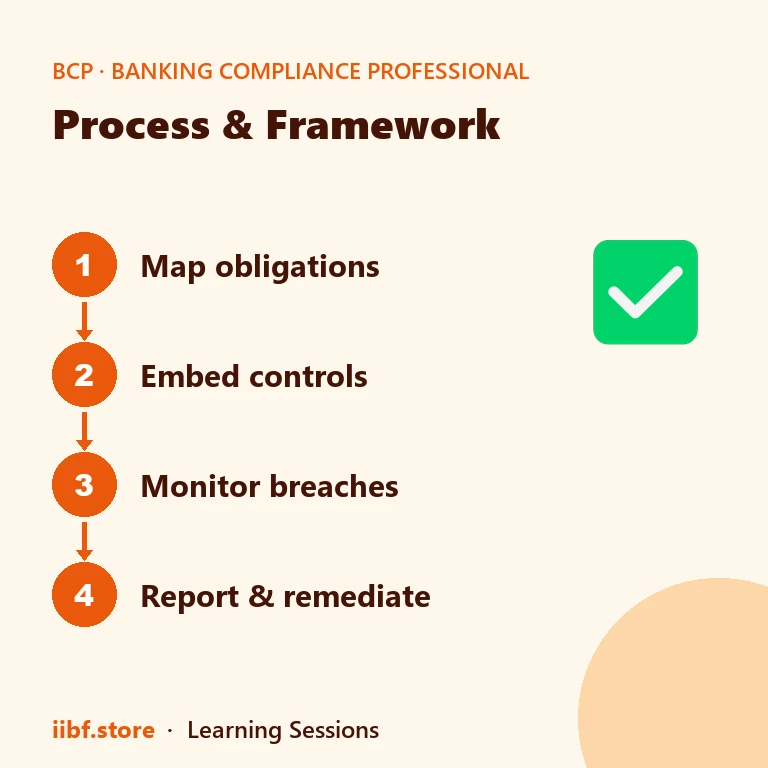
The governance parallel is worth noting for the exam: the same "responsibility does not travel with the outsourcing" principle you apply here is the one you apply in three lines of defence in bank compliance, where the first line owns the risk it creates through its channel partners.
⚖️ ASCI, the Consumer Protection Act 2019 and Endorser Liability
Beyond the financial regulators sit two more layers. The Advertising Standards Council of India code requires advertisements to be truthful and honest, non-offensive, and fair in competition, and its guidelines on influencer advertising in digital media require clear, upfront disclosure of a material connection between the advertiser and the influencer. Financial promotions attract heightened scrutiny because the audience is retail and the product is complex.
The statutory layer is the Consumer Protection Act, 2019. It defines a misleading advertisement to include one that falsely describes a service, gives a false guarantee, conveys an express or implied representation that would be an unfair trade practice, or deliberately conceals material information. The Central Consumer Protection Authority may order discontinuation or modification of such an advertisement and impose monetary penalties on the manufacturer, advertiser or endorser — up to ten lakh rupees, rising to fifty lakh rupees for subsequent contraventions — and may prohibit an endorser from endorsing any product or service for up to one year, extending to three years for a repeat contravention.
📌 Remember: Endorser liability is personal. A celebrity or influencer who fronts a bank's campaign has a due-diligence defence only if they verified the claim before endorsing it — which is why brand-ambassador contracts now carry claim-substantiation warranties.
Enforcement is real on both sides. The Reserve Bank has levied monetary penalties on banks under Section 47A read with Section 46 of the Banking Regulation Act, 1949 for customer-service and disclosure lapses, and the CCPA has issued directions against misleading financial promotions. Reputational cost usually exceeds the fine.
🗂️ Building the Control: Approval Workflow, Records and Social Media
An examiner rarely asks "is this ad wrong?" — they ask "what control would have stopped it?" The answer is a documented approval workflow with compliance sign-off before release, and it should be written into the bank's advertising and marketing communication policy approved by the board or a board committee.
The workflow runs: business brief, legal and product vetting of every claim, a substantiation file for any comparative or superlative statement, compliance sign-off, and only then release. Where a third-party regulator is involved, the IRDAI or SEBI-mandated disclosure is verified as a separate checkpoint. Nothing goes live on a verbal clearance.
Record retention matters as much as approval. The bank should retain every final creative, every version approved, the substantiation file and the media plan showing where and when the advertisement ran, for the period prescribed in its record-retention policy. When a complaint arrives eighteen months later, the media plan is what proves what the customer could actually have seen.
The hardest surface is digital. Social media posts, in-app banners, influencer reels and partner search ads change daily, so mature advertising compliance for banks includes scheduled sweeps of official handles and partner channels, a takedown protocol with defined turnaround, and a register of influencer engagements. Treat a new campaign format the way you would treat any new obligation under regulatory change management in banks — assess, assign an owner, embed a control, then test it. Where the campaign uses customer data for targeting, the consent and purpose-limitation rules from data protection compliance for banks apply to the campaign as well.
Board-level tone matters too: the honesty standard applied to promotions is the same standard the code of conduct for bank directors applies to the people approving them. Primary texts are on the Reserve Bank of India website, and you should read the operative direction rather than a summary before the exam.
🧠 Practice MCQs: Advertising Compliance for Banks
Q1. A bank's personal loan hoarding displays "8.5% interest" prominently while the processing fee appears in fine print. Under the RBI Key Facts Statement framework, what must the disclosure show? (a) The monthly rate (b) The flat rate (c) An all-inclusive annual percentage rate covering fees and charges (d) The bank's benchmark rate only
Answer: (c) — The KFS framework requires an all-inclusive APR so the borrower sees the true annualised cost, not a headline rate.
Q2. The standard market-risk warning on a mutual fund creative distributed by a bank branch is prescribed under which instrument? (a) Section 35A of the Banking Regulation Act, 1949 (b) The Sixth Schedule to the SEBI (Mutual Funds) Regulations, 1996 (c) The IRDAI advertisement regulations (d) The ASCI code alone
Answer: (b) — The mutual fund advertisement code, including the standard risk warning, sits in the Sixth Schedule to the SEBI (Mutual Funds) Regulations, 1996.
Q3. A lending service provider publishes a loan advertisement in its own name without naming the bank. Under RBI's digital lending framework, who is answerable to the regulator? (a) The lending service provider alone (b) The regulated entity, that is the bank (c) The Advertising Standards Council of India (d) The creative agency that produced the ad
Answer: (b) — Outsourcing does not dilute accountability; the regulated entity must be named upfront and remains responsible for the partner's creative.
Q4. Under the Consumer Protection Act, 2019, which authority may prohibit the endorser of a misleading advertisement from endorsing any product or service for up to one year? (a) The Reserve Bank of India (b) SEBI (c) The Central Consumer Protection Authority (d) The National Company Law Tribunal
Answer: (c) — The CCPA may order discontinuation, impose penalties and bar an endorser for up to one year, extending to three years for a repeat contravention.
Q5. Which of the following would most clearly fail the fair-and-not-misleading test in a bank advertisement? (a) Showing tenor conditions attached to a senior-citizen deposit rate (b) An unsubstantiated claim of "the lowest EMI in India" (c) Naming the bank as lender on a partner's creative (d) Displaying the prescribed mutual fund risk warning
Answer: (b) — Comparative and superlative claims must be capable of substantiation on demand; an unsupported superlative is misleading by itself.
Want chapter-wise mock tests with 100+ MCQs? Start practising free →
❓ Frequently Asked Questions
Does a bank need compliance sign-off for every single social media post?
For any post that promotes a product, quotes a rate or makes a claim, yes — the approval workflow applies regardless of the medium. Purely informational posts such as branch timings can follow a lighter pre-cleared template, but the policy must say so explicitly rather than leaving it to the social media team's judgement.
Is a disclaimer in fine print enough to cure a misleading headline claim?
No. The regulatory test looks at the overall impression the advertisement creates on an ordinary customer. Pushing a material condition into fine print is treated as suppression, not disclosure, under both the RBI fair-dealing standard and the Consumer Protection Act, 2019.
Who is liable if a DSA circulates an unapproved rate on WhatsApp?
The bank. The DSA relationship is an outsourcing arrangement, and the bank remains responsible to customers and to the regulator for the conduct of its agents. Contractual approval clauses, mystery shopping and a takedown protocol are the expected mitigants.
How long should advertising records be retained?
Retain the final creative, every approved version, the substantiation file and the media plan for the period set in the bank's record-retention policy, aligned to the limitation periods for consumer and ombudsman complaints. The media plan is the evidence of what the customer could actually have seen.
🎯 Conclusion: Turn the Rulebook Into a Checklist
For the BCP paper, compress advertising compliance for banks into five testable propositions: the advertisement must be clear, fair and not misleading; a rate must be shown annualised with all charges disclosed; comparative claims need substantiation on file; third-party products attract the IRDAI or SEBI code on top of RBI's standard; and the bank owns everything a BC, DSA or LSP publishes in its name. Add the control layer — documented approval with compliance sign-off, record retention, digital monitoring — and you can answer any variant the examiner writes.
Work through the linked chapters, then test yourself. Browse more compliance explainers on the Banking Compliance Professional tag hub, revise the priority-sector rules in priority sector, MSME and microfinance, and keep reading the daily updates on the iibf.store blog. Then take a full-length BCP mock test and see whether the rule survives contact with a question paper.
Practice this topic
Take a free mock test, download chapter PDFs, or watch a video class — all included on iibf.store.
Keep reading