Three Lines of Defence in Bank Compliance: BCP Exam Guide
The three lines of defence in bank compliance is the organising model that RBI expects every regulated entity to run — a structure that separates risk-taking, risk-oversight and risk-assurance into distinct reporting lines so that no single desk can hide a breach. For a Banking Compliance Professional (BCP) candidate, this model is not background theory; it is the map examiners use to test whether you understand who owns a control, who tests it, and who certifies that it actually works. Get the three lines confused in an exam answer and you will lose marks even when the substantive compliance point is correct.
📊 What Is the Three Lines of Defence Model?
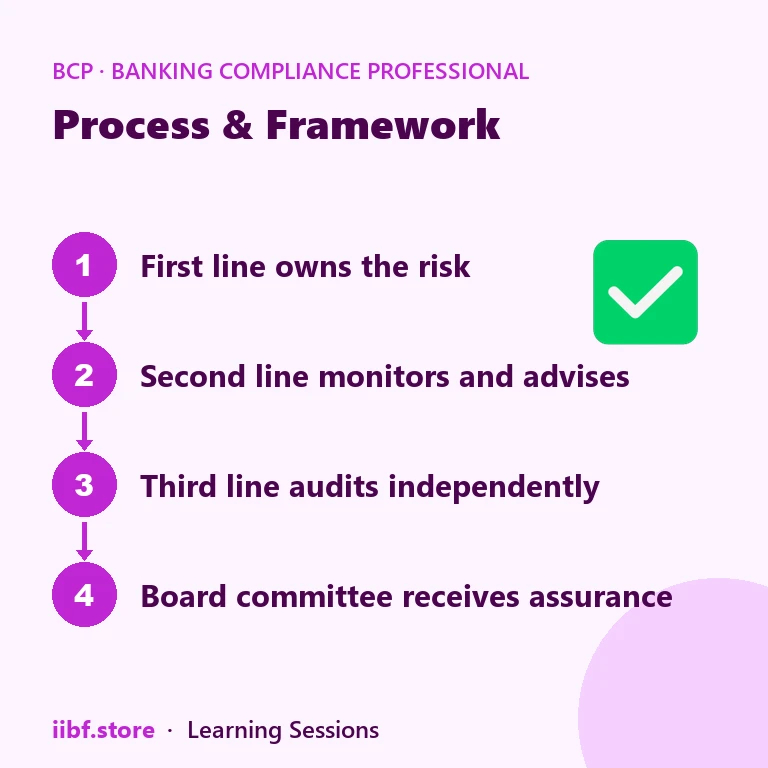
The three lines of defence framework divides a bank's risk and control responsibilities into three distinct groups. The first line is business and operations — branch managers, credit officers, treasury dealers — the people who own the risk because they originate the transaction. They are responsible for day-to-day adherence to policy, product terms and regulatory limits at the point of execution. The second line is the compliance function together with risk management — an independent group that sets policy, monitors adherence, tests controls and escalates breaches. The third line is internal audit, which independently assures the board that both the first and second lines are actually doing what they claim.
RBI's regulatory guidance on the compliance function builds directly on this model: compliance sits in the second line, must be functionally independent of business, and must have an unimpeded reporting line to the board or a board committee. The chief compliance officer is not meant to report through the business hierarchy precisely because that would collapse the second line into the first. When you see an exam scenario where a regional head instructs the compliance officer on how to treat a breach, the correct answer almost always turns on this independence principle.
The practical value of the model is that it prevents overlap and gaps. If the first line assumes compliance will catch every error and compliance assumes audit will catch every gap, control ownership evaporates. A well-run bank documents, line by line, who is accountable for which control — and that document is usually the first thing an RBI inspection team asks to see.
🛡️ Role of the Compliance Function as the Second Line
The compliance function's job in the second line is broader than most candidates expect. It is not just KYC checklists — it monitors adherence across every regulatory domain the bank operates in, including credit-side restrictions. Second-line testing routinely samples transactions against rules such as loans and advances regulatory restrictions and exposure ceilings covered under large exposures and exposure norms — both areas where a first-line lending officer might unintentionally breach a limit under commercial pressure.
Second-line compliance work has three recurring activities: advisory (helping business interpret a new circular before it acts), monitoring (periodic testing of samples against policy), and reporting (escalating findings to the CCO and board committee). None of these activities make compliance an approver of business decisions — it stays independent precisely so its findings are not compromised by co-ownership of the outcome. This is also why compliance officers are typically excluded from sitting on credit sanctioning committees in a voting capacity; participation there would blur the second line back into the first.
A bank that wants a defensible second line also needs a living process for absorbing new rules. That discipline connects directly with how a bank runs regulatory change management in banks — tracking each RBI circular from issue date to policy update to staff training, so the second line's monitoring checklist never lags behind what the regulator actually expects this month.
🔍 Where Internal Audit Fits as the Third Line
Internal audit's mandate is to independently assure the board that the first and second lines are functioning as designed — it is not a substitute for either. Where compliance tests adherence continuously, audit samples periodically and, critically, audits the compliance function itself: has the CCO's team actually tested what its monitoring plan says it tested, and were the findings escalated on time? This audit-of-the-auditor role is what makes the third line distinct rather than duplicative.
Audit scope typically extends well beyond compliance breaches into financial integrity questions — for instance, a parallel audit discipline covered under revenue audit in banks checks whether interest, fees and charges were correctly applied and recovered, which is a different lens from a compliance breach review but often surfaces the same root-cause control gaps. Candidates sometimes assume revenue leakage is purely a compliance matter; in the three-lines model it is squarely a first-line operational control that audit tests independently.
Reporting structure matters here too. Internal audit reports to the audit committee of the board, not to the CCO and not to business — a separate, parallel independent line from compliance's own board-committee reporting. Exam questions frequently probe whether a candidate can correctly place a given function (say, a loan review mechanism, or a post-sanction inspection team) into first, second or third line based on who it reports to and what it is testing.
⚖️ Common Failures and RBI Expectations
RBI's supervisory findings repeatedly cite the same failure pattern: a bank has all three lines on paper but they collapse into one in practice. Typical symptoms include a compliance officer who also signs off on the same product approvals they are meant to monitor, an audit function that reuses compliance's test results instead of independently verifying them, or a board committee that receives compliance MIS so late it cannot act before the next cycle. Each of these breaks the independence the model depends on.
Building an annual testing calendar is one practical fix — the same discipline explained under annual compliance programme in banks gives the second line a documented, board-approved schedule of what gets tested and when, so nothing depends on informal memory. Similarly, before a new product launches, the second line's sign-off — distinct from the business case the first line prepares — is what the process under new product approval compliance in banks is built to enforce.
Two further chapter areas illustrate how the model applies to specific regulatory domains. Guarantees issued on behalf of NBFCs, addressed under guarantees acceptances and finance to NBFCs, require first-line origination controls, second-line exposure monitoring and third-line periodic verification — the same three-tier logic applied to a narrow product line. Candidates who can map any scenario onto first, second or third line, rather than memorising the definitions in isolation, consistently score higher on applied BCP questions.
💡 Exam Tip: If a question asks "who is independent of business," the answer is the second line (compliance/risk) for ongoing monitoring and the third line (audit) for periodic assurance — business itself is never independent of business.
⚠️ Common Mistake: Candidates often place internal audit and compliance in the same line because both "find problems." Remember that compliance tests continuously and advises business, while audit tests periodically and assures the board — including auditing compliance's own work.
📌 How the Three Lines Compare
The table below summarises the model exam-style, contrasting reporting lines, frequency and independence across the three lines.
| Line | Who Sits Here | Primary Activity | Reports To | Independent of Business? |
|---|---|---|---|---|
| First line | Branches, credit, treasury, operations | Owns and manages risk at point of transaction | Business heads | ❌ |
| Second line | Compliance function, risk management | Sets policy, monitors, advises, escalates | CCO / board committee | ✅ |
| Third line | Internal audit | Independently assures lines one and two | Audit committee of the board | ✅ |
📌 Remember: The third line audits the second line too — a compliance monitoring plan is itself a live audit item, not just a checklist compliance runs unsupervised.
This structure also underpins how a bank handles sector-specific obligations. Priority sector targets, covered under priority sector MSME and microfinance norms, and government-linked lending under the lead bank scheme and government schemes chapter, both rely on first-line branches to originate correctly, second-line compliance to monitor shortfalls, and third-line audit to verify the numbers reported to RBI are real. Any customer data an officer touches while processing these accounts follows the identical three-line logic — first line handles it daily, second line sets access-control policy, and third line verifies the controls were actually enforced.

🧠 Practice MCQs: Three Lines of Defence in Bank Compliance
Q1. In the three lines of defence model, which line is responsible for day-to-day ownership of risk at the point a transaction is originated? (a) First line (b) Second line (c) Third line (d) External audit
Answer: (a) — Business and operations units originate and own the risk, making them the first line.
Q2. The compliance function is generally regarded as part of which line of defence? (a) First line (b) Second line (c) Third line (d) None — it is outside the model
Answer: (b) — Compliance, alongside risk management, forms the independent second line that monitors and advises business.
Q3. Internal audit's core distinguishing activity under the three lines model is: (a) Approving new products before launch (b) Independently assuring that the first and second lines function as designed (c) Signing loan sanctions (d) Setting compliance policy
Answer: (b) — Audit's mandate is independent assurance over both the first and second lines, including testing the compliance function's own work.
Q4. Why is a chief compliance officer typically kept out of a voting role on credit sanctioning committees? (a) CCOs lack credit knowledge (b) To preserve the second line's independence from first-line decisions (c) RBI has no rule on this (d) Sanctioning committees do not need compliance input
Answer: (b) — Voting on the decision being monitored would compromise the independence the second line is meant to provide.
Q5. Internal audit in the three lines model reports functionally to: (a) The chief compliance officer (b) The business head whose area is audited (c) The audit committee of the board (d) The branch manager
Answer: (c) — A reporting line to the audit committee, separate from compliance's own board-committee line, is what keeps the third line independent.
Want chapter-wise mock tests with 100+ MCQs? Start practising free →
❓ Frequently Asked Questions
What is the three lines of defence model in banking compliance?
It is a governance structure that separates risk ownership (first line: business), risk oversight (second line: compliance and risk management) and independent assurance (third line: internal audit) so that no single function both takes and checks the same risk.
Is the compliance function the same as internal audit?
No. Compliance is the second line — it sets policy, monitors adherence continuously and advises business. Internal audit is the third line — it periodically and independently verifies that both the first and second lines are working, including auditing compliance's own testing.
Why must the compliance function stay independent of business?
Independence ensures compliance findings and escalations are not diluted by co-ownership of business outcomes. RBI's compliance function guidance requires an unimpeded reporting line to the board or a board committee for exactly this reason.
How does the three lines model apply to a specific product like NBFC guarantees?
The first line originates the guarantee within sanctioned limits, the second line (compliance) monitors exposure and policy adherence on an ongoing basis, and the third line (audit) periodically verifies both the origination and the monitoring were done correctly.
For a BCP candidate, the three lines of defence in bank compliance is the lens that turns scattered rulebook knowledge into a coherent answer framework — every scenario question ultimately asks you to place a control in the right line. Read RBI's compliance function guidance on rbi.org.in alongside your study material, browse more subject notes on the Banking Compliance Professional tag hub, and lock in the model with timed practice — start a free BCP mock test today →.
Practice this topic
Take a free mock test, download chapter PDFs, or watch a video class — all included on iibf.store.
Keep reading