Code of Conduct for Bank Directors: What IIBF Ethics Covers
Every bank director in India signs a document most customers never see: a formal code of conduct for bank directors. It is not a ceremonial formality tucked away in a board file. It is the written line between prudent stewardship and the kind of governance failure that has, in recent years, forced the RBI to supersede entire boards. For JAIIB and CAIIB candidates, understanding what this code actually demands — and where it differs from the codes that govern ordinary bank staff — is a recurring exam theme under the Ethics in Banking paper, and a genuinely useful piece of professional knowledge for anyone who will one day sit in a boardroom or report to one.
This article breaks the topic down the way the IIBF syllabus expects: the legal basis, the core principles, the practical red flags examiners love to test, and how a director's code differs from a staff code of conduct or a customer-facing charter like the BCSBI code. Along the way we will lean on the same chapters your study plan already covers.
🏛️ Why Bank Directors Need a Formal Code of Conduct
A bank's board does not run day-to-day operations, but it carries ultimate responsibility for the institution's safety and soundness. Directors approve risk appetite, sanction large exposures, oversee the CEO, and sign off on the numbers that shareholders and depositors rely on. That concentration of authority is exactly why a written code of conduct for bank directors exists — to convert broad fiduciary expectations into specific, auditable behavioural standards: disclose related-party interests before a vote, recuse yourself from decisions where you have a personal stake, do not trade on price-sensitive information you receive as a director, and do not accept gifts or hospitality that could be seen as compromising independent judgement.
Without such a document, "good judgement" becomes a subjective defence after the fact. With it, a bank has an objective yardstick — and so does the RBI's supervisory team when it reviews board minutes during an inspection. The chapter on Building an Ethical Organization (Chapter 11) frames this well: ethics at the top of the house sets the tone that trickles down to every branch counter.
📜 What the RBI and Companies Act Require
The legal scaffolding behind a director's code of conduct comes from two directions. The Companies Act, 2013 requires listed and large unlisted companies — including most banks — to adopt a code of conduct for the board and senior management, disclosed in the annual report and affirmed annually by every director. Independent directors additionally follow the "Code for Independent Directors" set out in Schedule IV of the Act, covering duties like acting in good faith, exercising independent judgement, and not misusing confidential information.
Layered on top of this, the RBI applies its own "fit and proper" criteria before clearing directors of private banks, and expects boards to formally adopt conduct standards covering conflict of interest, confidentiality, and insider dealing as part of sound corporate governance. A director found in breach can be disqualified from holding the position again — a consequence with real teeth, unlike a purely symbolic pledge. Candidates preparing for the exam should read the RBI's published guidance directly rather than relying on secondary summaries; see the Reserve Bank of India's official site at rbi.org.in for the current master directions on directors and corporate governance in banks.
💡 Exam Tip: If a question asks who a director's code of conduct legally binds, the answer set usually includes "senior management" too — the Companies Act code extends beyond the boardroom to the leadership layer that executes board decisions.
⚖️ Core Principles Inside a Director's Code of Conduct
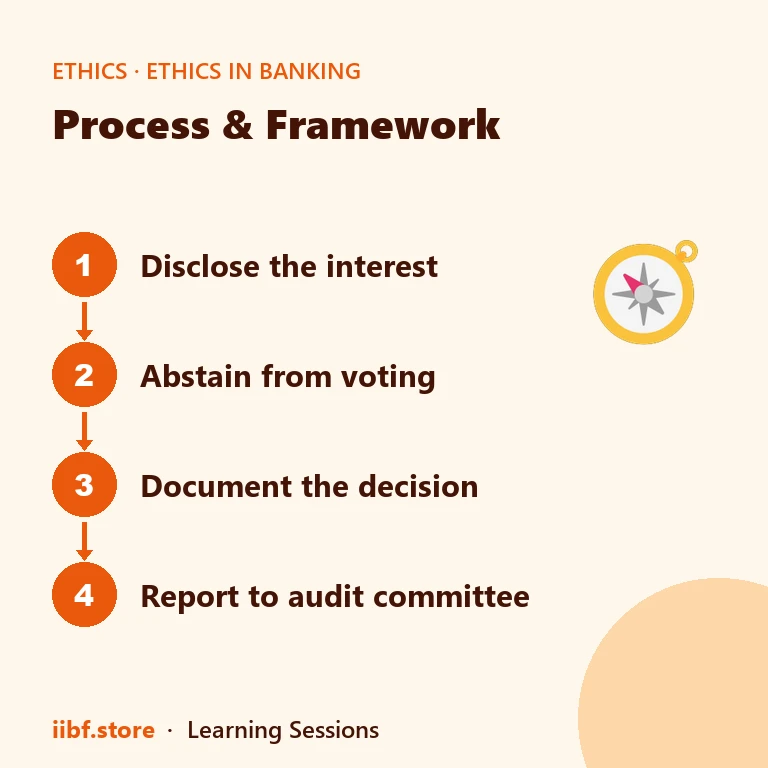
Strip away the legal drafting and most director codes converge on five recurring principles. First, fiduciary primacy: the bank's interest — and by extension depositors' and shareholders' interests — comes before the director's personal or business interest. Second, disclosure: any material interest in a matter before the board, whether financial, familial, or through a related entity, must be declared and the director must abstain from voting. Third, confidentiality: board papers, credit decisions, and unpublished price-sensitive information stay inside the boardroom until formally released. Fourth, independence of judgement: directors — particularly independent directors — must resist pressure from promoters, large shareholders, or management to rubber-stamp decisions. Fifth, accountability: directors are expected to actively question management, not passively approve whatever is placed before them, and to document dissent when they disagree with a board resolution.
These principles overlap with, but are distinct from, the workplace-level expectations covered in Work Ethics and the Workplace (Ethics in Banking, Chapter 10), which deals with day-to-day staff conduct rather than fiduciary board duties. A director's code sits one level higher: it governs strategic oversight, not operational execution.
⚠️ Common Mistake: Students often equate a director's code of conduct with a plain conflict-of-interest policy. The code is broader — it also covers confidentiality, independence, attendance discipline, and post-tenure restrictions like cooling-off periods before joining a competing institution.
🚫 Governance Failures: What Happens When the Code Is Ignored
Indian banking history offers several instructive, exam-relevant episodes where lapses in director conduct — undisclosed related-party lending, promoters exercising undue influence over supposedly independent boards, or directors staying silent on red flags raised by auditors — contributed to a bank's eventual reconstruction or moratorium. The regulatory response in such cases typically follows a pattern: the RBI supersedes the board, appoints an administrator, and in the aftermath tightens fit-and-proper norms for the next cohort of directors. This is precisely why questions on this topic often ask candidates to distinguish supervisory action from internal disciplinary action — the code of conduct enables both, but they are triggered differently and by different authorities.
A well-implemented code also has a preventive side that examiners test less often but that matters more in practice: a functioning whistle-blower channel that lets employees flag a director's suspected breach without fear of retaliation, an audit committee empowered to investigate related-party transactions independently, and periodic self-certification where each director confirms compliance with the code in writing. None of this works if the tone at the top treats the code as paperwork rather than policy.
📌 Remember: A code of conduct is only as strong as its enforcement mechanism — self-certification, audit committee oversight, and RBI supervisory review together, not the document alone.
📊 Director's Code vs Staff Code vs Customer Charter
One of the most common exam confusions is treating every "code" a bank publishes as the same instrument. They are not. The table below separates the three codes an IIBF candidate is expected to distinguish.
| Code Type | Who It Governs | Primary Focus | Legally Mandated |
|---|---|---|---|
| Code of Conduct for Directors | Board members, senior management | Fiduciary duty, conflict of interest, confidentiality | ✅ Yes — Companies Act, 2013 |
| Staff Code of Conduct | Officers and employees | Workplace behaviour, integrity, discipline | ✅ Yes — internal HR policy, RBI expectation |
| BCSBI Code of Commitment | The bank, towards customers | Fair treatment, disclosure, grievance redressal | ❌ Voluntary adoption by member banks |
Notice the direction each code points. A director's code and a staff code both regulate conduct inside the institution, while the BCSBI code regulates the bank's promises to the world outside it — a distinction examiners like to test by swapping the "who it governs" column in MCQ options. For a deeper look at how personal accountability plays out for individual bankers rather than the board collectively, the sibling article on fiduciary duty of bankers is a useful companion read, as is the piece on how disclosure obligations actually get enforced in practice, covered under conflict of interest in banking.
🌍 Governance Beyond the Boardroom
A director's code of conduct does not operate in isolation — it connects to the bank's wider ethical infrastructure. Independent verification of whether the code is actually being followed, rather than merely signed once a year, is the job of periodic reviews closely related to what you will study under ethical audit in banks. On the customer-protection side, directors are also expected to satisfy themselves that onboarding controls — including how the bank applies risk categorisation of customers under KYC/AML norms — are functioning, since a board that ignores compliance gaps in customer risk assessment is itself failing its oversight duty. Directors operating across borders, or on the boards of banks with international exposure, face an added layer of complexity covered in Ethics and Globalization, where conduct standards must reconcile with varying regulatory regimes.
For a full map of how these threads connect — corruption, bribery, and white-collar crime as they intersect with board-level failure — the chapter on Ethical Issues of Corruption, Bribery and White-Collar Crime is directly relevant and frequently cross-referenced in exam scenarios involving director liability.
🧠 Practice MCQs: Code of Conduct for Bank Directors
Q1. Under the Companies Act, 2013, which document specifically governs the conduct of independent directors? (a) BCSBI Code of Commitment (b) Schedule IV Code for Independent Directors (c) RBI Master Circular on KYC (d) Banking Ombudsman Scheme
Answer: (b) — Schedule IV of the Companies Act, 2013 lays down the specific code applicable to independent directors, including duties of independent judgement and confidentiality.
Q2. A director's code of conduct for banks primarily governs conduct at which level? (a) Front-line teller transactions (b) Board and senior management oversight (c) Customer complaint handling (d) ATM cash replenishment
Answer: (b) — The code applies to board members and senior management, distinct from staff-level or customer-facing codes.
Q3. When a director has a personal financial interest in a matter before the board, the code of conduct requires them to: (a) Vote in favour to avoid delay (b) Disclose the interest and abstain from voting (c) Delegate the vote to another director (d) Ignore it if the amount is small
Answer: (b) — Disclosure followed by abstention is the standard requirement to prevent conflict of interest from influencing board decisions.
Q4. Which body sets the "fit and proper" criteria that bank directors must satisfy in India? (a) SEBI (b) Reserve Bank of India (c) IRDAI (d) Ministry of Corporate Affairs alone
Answer: (b) — The RBI prescribes fit and proper criteria for directors of banks, particularly private sector banks, as part of its corporate governance oversight.
Q5. The BCSBI Code of Commitment to Customers differs from a director's code of conduct because it: (a) Is legally mandatory for every bank (b) Governs the bank's promises to customers rather than internal board behaviour (c) Applies only to public sector bank directors (d) Replaces the Companies Act code
Answer: (b) — The BCSBI code is an outward-facing, voluntarily adopted commitment to customers, unlike the internally focused, legally mandated director's code.
Want chapter-wise mock tests with 100+ MCQs? Start practising free →
Frequently Asked Questions
Is a code of conduct for bank directors legally mandatory in India?
Yes. The Companies Act, 2013 requires banks, as companies, to adopt a board-level code of conduct, and independent directors additionally follow the Schedule IV code. The RBI expects it as part of sound corporate governance for regulated entities.
What happens if a director violates the code of conduct?
Consequences range from internal censure and removal by the board to RBI supervisory action, disqualification from future directorships, and in serious cases, referral for investigation under company law or banking regulation.
How is a director's code different from an employee code of conduct?
A director's code governs fiduciary, oversight, and disclosure duties at board level, while an employee code governs day-to-day workplace behaviour, service standards, and operational discipline for staff.
Where can I read more chapters on this topic for JAIIB/CAIIB Ethics preparation?
Browse the full set of Ethics in Banking chapters and related articles on the Ethics in Banking tag hub, which links every chapter and blog post on this subject.
Conclusion: Governance Starts With a Signature
A code of conduct for bank directors is not a compliance formality to memorise for one exam question and forget. It is the working definition of what a bank considers acceptable behaviour at the highest level of decision-making — and every major governance failure in Indian banking traces back, in some part, to that definition being ignored rather than enforced. For your IIBF preparation, know the legal basis (Companies Act, Schedule IV, RBI fit-and-proper norms), the five core principles, and how this code differs from staff and customer-facing codes — that combination covers the large majority of exam angles on this topic.
Ready to test what you have just read? Attempt chapter-wise mock questions on Ethics in Banking and build exam speed with instant feedback at iibf.store/tests.
Quick quiz on this topic
5 exam-style questions from our free test bank — check yourself before you move on.
Practice this topic
Take a free mock test, download chapter PDFs, or watch a video class — all included on iibf.store.