PMLA Reporting Obligations for Bankers: CAIIB BRBL Guide
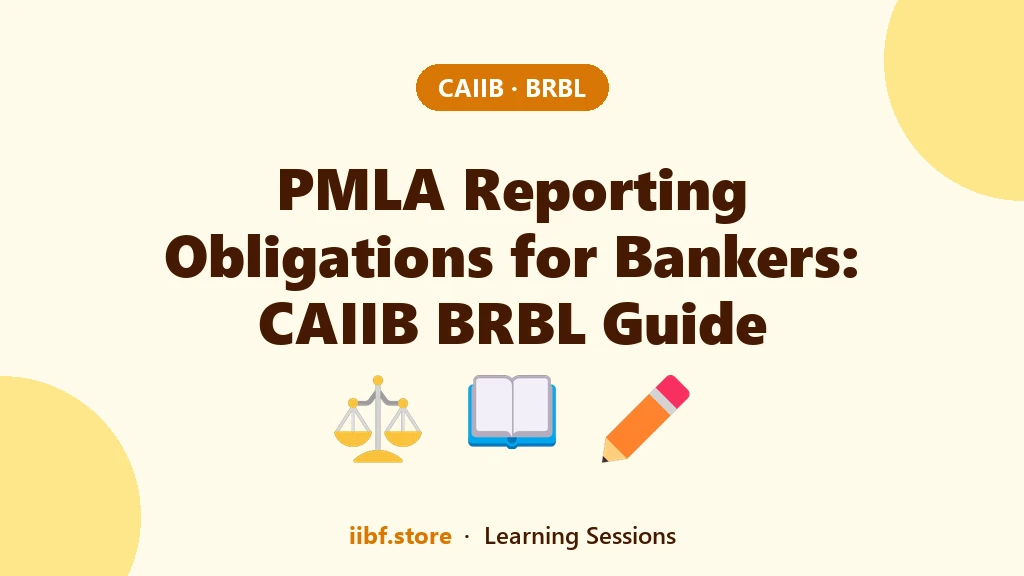
For CAIIB Banking Regulations and Business Laws candidates, the PMLA reporting obligations for bankers are one of the most exam-tested — and most misread — parts of the compliance syllabus. Every branch, every officer, and every transaction above a threshold sits inside a reporting chain that runs straight to the Financial Intelligence Unit-India (FIU-IND). Get the report types, the timelines, or the authority structure wrong on exam day and you lose marks on what is otherwise a scoring topic. This guide breaks the Prevention of Money Laundering Act, 2002 down the way CAIIB examiners actually test it: definitions, reporting formats, penalties, and the adjudication chain.
📜 What Is the Prevention of Money Laundering Act, 2002?
The Prevention of Money Laundering Act (PMLA), 2002 came into force on 1 July 2005 and is the primary criminal law dealing with money laundering in India. It defines the offence of money laundering under Section 3 as any process or activity connected with proceeds of crime, including concealment, possession, acquisition, use, or projecting/claiming it as untainted property. Section 4 prescribes rigorous imprisonment of three to seven years (up to ten years for offences under the NDPS Act), along with a fine.
Banks, financial institutions, and intermediaries are classified as "reporting entities" under Section 12 of the Act. This single classification is the hinge on which the entire compliance chapter turns — it is what obliges every bank to maintain records, verify client identity, and report specified transactions. The Act works alongside the wider legal framework of regulation of banks, and CAIIB candidates should read this topic together with the legal framework of regulation of banks chapter, since PMLA compliance sits inside the same supervisory architecture that governs licensing and conduct of banking business.
💡 Exam Tip: PMLA is a criminal statute enforced by the Enforcement Directorate (ED); it is distinct from the RBI's KYC/AML Master Direction, which is a regulatory instruction. Examiners frequently test this distinction with "which authority" questions.
🚨 Reporting Obligations: STR, CTR, CCR to FIU-IND
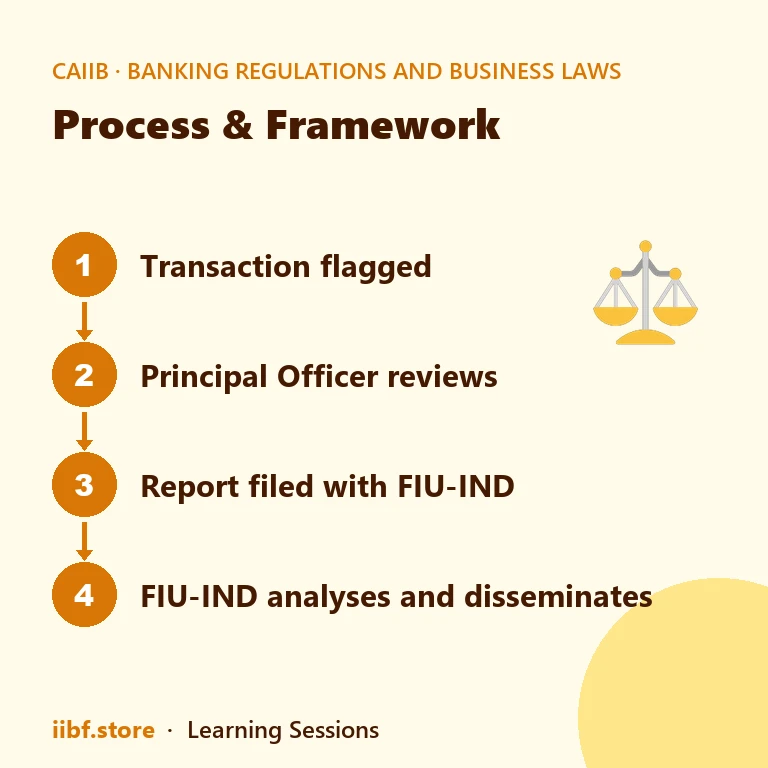
Section 12 of PMLA requires every reporting entity to maintain a record of prescribed transactions and to furnish information to the Director, FIU-IND, in the prescribed manner. In practice this obligation is discharged through three report types that CAIIB question papers return to repeatedly:
Cash Transaction Reports (CTR) cover all cash transactions of value more than ₹10 lakh, or a series of integrally connected cash transactions aggregating above that threshold in a month. Suspicious Transaction Reports (STR) must be filed irrespective of amount whenever a transaction appears to involve proceeds of crime, or is inconsistent with the customer's known profile, regardless of whether it is a single transaction or a series. Counterfeit Currency Reports (CCR) cover transactions involving counterfeit currency or bank notes used as genuine. There is also the Non-Profit Organisation Transaction Report (NTR) for transactions of NPO clients above ₹10 lakh.
Timelines matter for the exam: CTRs and CCRs are filed by the 15th of the succeeding month, while an STR must be filed within 7 working days of the branch or controlling office arriving at a conclusion that a transaction is suspicious — not from the date of the transaction itself. This "date of finding," not "date of transaction," distinction is a favourite trap in CAIIB objective papers. The same due-diligence discipline that produces clean STRs also underwrites broader regulation of banking business, a theme covered in the regulation of banking business chapter.
⚠️ Common Mistake: Students often assume STR thresholds mirror the ₹10 lakh CTR limit. STRs have no monetary threshold — suspicion alone triggers the obligation.
⚖️ Penalties, Adjudication and the Enforcement Directorate
PMLA gives investigative and attachment powers to the Directorate of Enforcement. Under Section 5, an authorised ED officer may provisionally attach property believed to be proceeds of crime for up to 180 days, subject to confirmation by the Adjudicating Authority within 180 days of the order. The Adjudicating Authority, constituted under Section 6, decides whether attached, seized, or frozen property is involved in money laundering; appeals against its orders lie to the Appellate Tribunal, and thereafter to the jurisdictional High Court.
For reporting entities themselves, Section 13 empowers the Director, FIU-IND to review compliance and — after giving a reasonable opportunity of being heard — issue a warning, direct compliance, or impose a monetary penalty which shall not be less than ₹10,000 but may extend to ₹1 lakh for each failure. Repeated or wilful non-compliance can also invite RBI supervisory action against the bank separately under the Banking Regulation Act framework, so a single lapse can trigger action from two different regulators. This dual-track exposure is exactly the kind of applied scenario CAIIB case-study questions build around, alongside adjacent topics such as legal risk in banking sources and controls.
📌 Remember: Provisional attachment = 180 days maximum, confirmed by the Adjudicating Authority within the same 180-day window. Two separate authorities, one continuous clock.
🏦 Record-Keeping, KYC Overlap and the Compliance Officer's Role
PMLA Rules require reporting entities to preserve records of transactions, and records evidencing customer identity, for at least five years from the date of transaction with the client and, separately, for five years after the business relationship ends. This dovetails with — but is legally separate from — the RBI's KYC direction, which prescribes how identity is verified in the first place. A bank's Principal Officer, appointed under the PMLA Rules, is personally responsible for ensuring STRs, CTRs, and CCRs reach FIU-IND on time, for maintaining an internal audit trail, and for coordinating with the board-approved AML policy. Governance of this function ultimately traces back to how banks are constituted and supervised, a theme candidates should map against the control over organisation of banks chapter, since the Principal Officer's reporting line and the board's oversight committee are both examined together in scenario-based questions. It also helps to place PMLA within the softer, behavioural side of compliance conversations with customers — the kind of structured, professional exchange discussed in transactional analysis in banking, which many CAIIB ABM candidates study alongside this BRBL topic for the integrated case studies.
Finally, do not confuse PMLA's FIU-IND reporting chain with the wholly separate institutional architecture built to monitor systemic risk, discussed in the financial stability and development council guide — one deals with individual suspicious transactions, the other with macro-prudential coordination across regulators.
| Report Type | Trigger / Threshold | Filing Timeline | Filed With | Monetary Threshold? |
|---|---|---|---|---|
| CTR (Cash Transaction Report) | Cash transactions > ₹10 lakh (single or connected series in a month) | By 15th of succeeding month | FIU-IND | ✅ Yes |
| STR (Suspicious Transaction Report) | Suspicion of proceeds of crime, irrespective of amount | Within 7 working days of forming suspicion | FIU-IND | ❌ No |
| CCR (Counterfeit Currency Report) | Use of counterfeit currency/notes as genuine | By 15th of succeeding month | FIU-IND | ❌ No |
| NTR (NPO Transaction Report) | NPO client transactions > ₹10 lakh | By 15th of succeeding month | FIU-IND | ✅ Yes |
Reading the table left to right is the fastest way to memorise this chapter: match trigger to timeline to authority, and the objective-type questions on PMLA stop being a guessing game. Combine it with the practice sets under the regulation of banking business imp ques chapter for repetition on threshold-based questions.
🧠 Practice MCQs: PMLA Reporting Obligations for Bankers
Q1. Under PMLA, 2002, a Suspicious Transaction Report (STR) must be filed within how many working days of the bank concluding that a transaction is suspicious? (a) 3 working days (b) 7 working days (c) 15 working days (d) 30 working days
Answer: (b) — STRs are filed within 7 working days from the date the branch/controlling office forms the opinion, not from the transaction date.
Q2. What is the maximum period for which the Enforcement Directorate can provisionally attach property under Section 5 of PMLA before Adjudicating Authority confirmation? (a) 90 days (b) 120 days (c) 180 days (d) 365 days
Answer: (c) — Provisional attachment under Section 5 is valid for up to 180 days, within which the Adjudicating Authority must confirm it.
Q3. A Cash Transaction Report (CTR) is required for cash transactions of value more than: (a) ₹2 lakh (b) ₹5 lakh (c) ₹10 lakh (d) ₹50 lakh
Answer: (c) — CTRs cover cash transactions exceeding ₹10 lakh, including integrally connected transactions aggregating above that limit in a month.
Q4. Who is designated under PMLA Rules as personally responsible for ensuring timely filing of STRs and CTRs by a bank? (a) Branch Manager (b) Principal Officer (c) Statutory Auditor (d) Company Secretary
Answer: (b) — The Principal Officer, appointed under the PMLA Rules, is responsible for reporting compliance and coordinating with FIU-IND.
Q5. Under Section 13 of PMLA, the minimum monetary penalty the Director, FIU-IND can impose on a reporting entity for non-compliance is: (a) ₹1,000 (b) ₹10,000 (c) ₹50,000 (d) ₹1,00,000
Answer: (b) — The penalty ranges from a minimum of ₹10,000 to a maximum of ₹1 lakh for each failure, after a hearing.
Want chapter-wise mock tests with 100+ MCQs? Start practising free →
Frequently Asked Questions
Is PMLA the same as the RBI's KYC/AML Master Direction?
No. PMLA, 2002 is a criminal statute enforced by the Enforcement Directorate that criminalises money laundering and mandates reporting to FIU-IND. The RBI's KYC direction is a regulatory instruction that tells banks how to verify identity and monitor accounts to meet those obligations.
Who receives STRs, CTRs and CCRs filed by banks?
All prescribed reports under PMLA are filed with the Financial Intelligence Unit-India (FIU-IND), which analyses the data and disseminates actionable intelligence to law enforcement and regulatory agencies.
How long must banks retain PMLA-related records?
Records of transactions must be preserved for at least five years from the date of the transaction, and records of customer identity must be preserved for five years from the end of the business relationship.
What happens if a bank fails to file a required report on time?
The Director, FIU-IND may, after hearing the reporting entity, issue a warning, direct compliance, or levy a monetary penalty between ₹10,000 and ₹1 lakh per failure, in addition to any separate supervisory action RBI may take.
Conclusion
PMLA reporting obligations for bankers sit at the intersection of criminal law, RBI supervision, and everyday branch operations — which is exactly why CAIIB BRBL papers keep returning to STR timelines, attachment periods, and the Principal Officer's role. Read the Act alongside the legal framework of regulation of banks chapter, drill the table above until the trigger-timeline pairs are automatic, and verify every figure against the official text on the Enforcement Directorate's PMLA page. For more BRBL topics, browse the Banking Regulations and Business Laws tag, and when you're ready to test yourself end to end, enrol in the CAIIB course for structured, chapter-wise practice.
Quick quiz on this topic
5 exam-style questions from our free test bank — check yourself before you move on.
Practice this topic
Take a free mock test, download chapter PDFs, or watch a video class — all included on iibf.store.
Keep reading