Lok Adalat for Loan Recovery: Powers, Limits, CAIIB BRBL
Almost every CAIIB candidate meets lok adalat for loan recovery in the Banking Regulations and Business Laws paper, usually as a two-marker on whether an award can be challenged in appeal. It is also the cheapest recovery route a branch has: no court fee on a fresh reference, no adjudication on merits, and a settlement that is enforceable exactly like a civil court decree. This guide covers the statutory basis, the monetary limits banks work with, the branch-level process, and the traps that quietly cost marks in BRBL.
⚖️ What a Lok Adalat Actually Is
A Lok Adalat is not a court. It is a conciliation forum constituted under the Legal Services Authorities Act, 1987, organised by the National, State, District or Taluk Legal Services Authority. A typical bench has a serving or retired judicial officer as chairman, with a member of the legal profession and a social worker.
The bench has no power to decide anything on merits. Its only lawful output is a compromise that the parties themselves reach. If the borrower and the bank do not agree, the bench cannot impose a figure — it simply returns the file. The Supreme Court underlined exactly this in State of Punjab v. Jalour Singh, holding that a Lok Adalat has no adjudicatory function and an award not founded on a genuine compromise cannot stand.
That limitation is precisely what makes the forum attractive for recovery. Because nothing is adjudicated, nothing is contested, and nothing gets appealed. A branch that walks in with a sanctioned compromise proposal walks out the same day with an enforceable instrument. Our chapter notes on Lok Adalats under the Legal Services Authorities Act set out the bench composition and referral routes that examiners keep returning to.
Two variants matter for the exam. National Lok Adalats are held on notified dates across every court and tribunal in the country, and banks pool their eligible NPA accounts for those sittings. Permanent Lok Adalats, set up under Section 22B for notified public utility services, are a different animal altogether — they can decide the dispute on merits if conciliation fails, which an ordinary Lok Adalat can never do.
📜 Sections 19 to 22: The Legal Backbone
The statutory case for lok adalat for loan recovery rests on four sections, and BRBL examiners test them by number. Learn them as a sequence rather than as isolated facts.
- Section 19 — organisation of Lok Adalats and their jurisdiction, which covers cases already pending before a court and matters not yet filed. That is the basis for pre-litigation references of NPA accounts.
- Section 20 — how a case reaches the bench: by consent of both parties, on the application of one party where the court sees a chance of settlement, or on the court's own satisfaction after hearing the parties. If no compromise results, the record goes back to the referring court.
- Section 21 — the money section. Every award of a Lok Adalat is deemed to be a decree of a civil court, it is final and binding on all parties, and no appeal lies against it to any court.
- Section 22 — the bench gets civil-court powers under the Code of Civil Procedure for summoning witnesses, discovery and receiving evidence, and its proceedings are deemed judicial proceedings.
💡 Exam Tip: "No appeal lies" is not the same as "no remedy exists". Fraud or the absence of a real compromise must be taken to the High Court in writ jurisdiction; there is no statutory appellate ladder. Options offering an appeal to the District Judge or the DRAT are always wrong.
Court fee already paid in a suit settled at a Lok Adalat is refunded in the manner provided by the Court Fees Act, 1870. Contrast that economy with the cost and calendar of a resolution route such as the corporate insolvency resolution process, which is designed for a very different class of exposure.
🏦 Running a Lok Adalat Settlement From the Branch
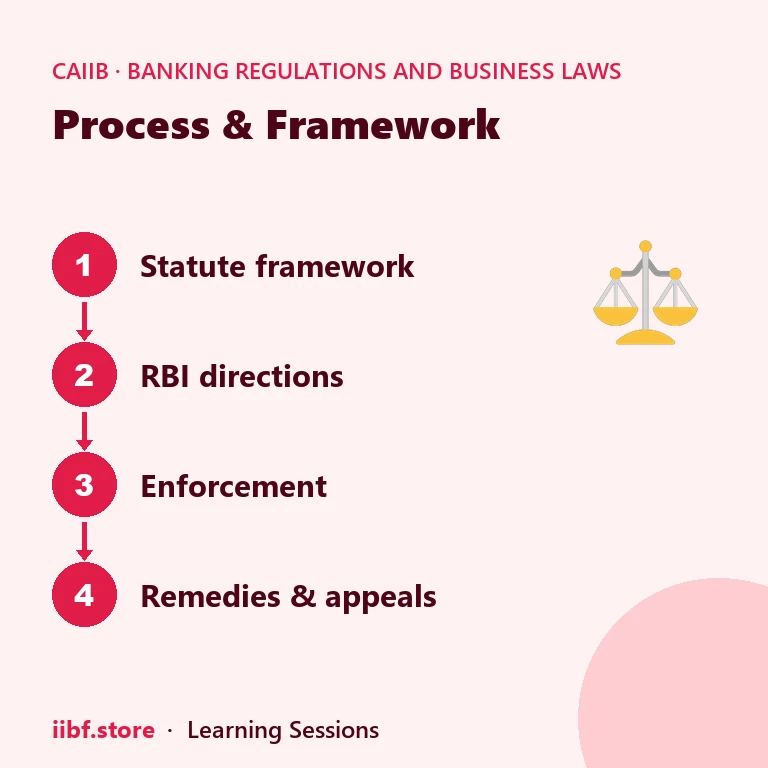
Using lok adalat for loan recovery is an operational drill, not a legal adventure. A well-run branch follows this sequence.
- Shortlist accounts. Small and mid-ticket NPAs where the borrower is traceable and willing, unexecuted decrees, and suits stuck in the civil court list. RBI has long encouraged banks to route small dues through this forum.
- Get the compromise sanctioned first. The officer attending must carry a sanction with a defined floor: minimum acceptable amount, payment schedule and default clause. A bench cannot wait while a branch calls its controlling office.
- Join every party liable. The principal borrower, all guarantors and any third-party mortgagor should be parties to the reference. A settlement that discharges the borrower while ignoring the surety can destroy the bank's claim against the surety — hence the contract of guarantee rules on discharge.
- Record the security position. Spell out what happens to the mortgaged property and to any goods held under a contract of pledge — release only on full receipt, never on the first instalment.
- Build in the default consequence. The award should state that on default the original dues revive, less amounts received, and become executable.
⚠️ Common Mistake: Treating the award as a mere agreement. It is a deemed decree — on default the bank files execution proceedings on the award itself. A fresh suit for the same debt would invite dismissal.
Small-ticket agricultural dues are natural candidates, particularly where crop failure rather than wilful default caused the slippage. Officers on that book should know how the interest subvention scheme for crop loans affects the amount actually recoverable before fixing a settlement floor. And a settled borrower can still complain about recovery conduct, so exposure under the Consumer Protection Act 2019 for banks does not vanish because an award was signed.
📊 Lok Adalat vs DRT, SARFAESI and a Civil Suit
BRBL loves the "which forum" question, and lok adalat for loan recovery is only one of four live answers. The comparison below is the one worth memorising, because every distractor in the paper is built out of these four rows.
| Route | Governing law | Money threshold | Decides on merits? |
|---|---|---|---|
| Lok Adalat | Legal Services Authorities Act, 1987 | No statutory ceiling; banks refer mainly small and mid-ticket dues | ❌ (compromise only) |
| Debt Recovery Tribunal | RDDB & FI Act, 1993 | Debt of ₹20 lakh and above | ✅ (recovery certificate) |
| SARFAESI enforcement | SARFAESI Act, 2002 | Excludes dues of ₹1 lakh or less, and cases where under 20% of principal and interest is outstanding | ❌ (no adjudication; recourse to DRT) |
| Civil suit | Code of Civil Procedure, 1908 | Any amount within the court's pecuniary jurisdiction | ✅ (decree after trial) |
Read the table with the exclusions in mind. The DRT floor of ₹20 lakh was raised from ₹10 lakh by a Central Government notification in 2018, so a ₹15 lakh NPA cannot be taken to a DRT at all — Lok Adalat, SARFAESI or a civil suit are the live options. Conversely, a bank that has already obtained a recovery certificate can still settle it at a Lok Adalat organised by the DRT itself.
Two forums can also run together. A bank may keep a SARFAESI notice alive while negotiating a compromise, because the statutory measures and the conciliation are not mutually exclusive. Where the lender itself changes identity, pending proceedings continue in the name of the transferee institution — the mechanics sit in our note on amalgamation of banking companies. More worked comparisons of this kind are collected under the Banking Regulations and Business Laws article hub.
📎 Always cross-check the current text of the governing circular on the Reserve Bank of India website before you rely on it in the exam hall or at your desk.
🧠 Practice MCQs: Lok Adalat for Loan Recovery
Q1. Under which section of the Legal Services Authorities Act, 1987 is an award of a Lok Adalat deemed to be a decree of a civil court and made final and binding? (a) Section 19 (b) Section 20 (c) Section 21 (d) Section 22
Answer: (c) — Section 21 deems the award a decree of a civil court, makes it final and binding, and bars any appeal against it.
Q2. A bank and a borrower fail to reach any compromise at a Lok Adalat sitting in a suit referred by a civil court. What happens next? (a) The Lok Adalat decides the case on merits (b) The record is returned to the referring court, which proceeds in accordance with law (c) The suit stands dismissed for want of settlement (d) The matter is transferred to the Debt Recovery Tribunal
Answer: (b) — An ordinary Lok Adalat has no adjudicatory power, so on failure of conciliation the record simply goes back to the court that referred it.
Q3. Which forum, unlike an ordinary Lok Adalat, may decide the dispute on merits when conciliation fails? (a) A National Lok Adalat (b) A Permanent Lok Adalat constituted under Section 22B (c) The Debts Recovery Appellate Tribunal (d) A Taluk Legal Services Committee
Answer: (b) — Permanent Lok Adalats for notified public utility services can proceed to decide the dispute on merits if the parties fail to settle.
Q4. A bank's NPA exposure to a borrower is ₹15 lakh. Which statement is correct? (a) It can be filed as an original application before a DRT (b) It is below the DRT threshold, so DRT is not available (c) SARFAESI cannot be used because the amount exceeds ₹1 lakh (d) Only a Lok Adalat reference is legally permissible
Answer: (b) — The DRT threshold is ₹20 lakh, so a ₹15 lakh claim must go to a civil court, SARFAESI enforcement or a Lok Adalat.
Q5. A suit pending in a civil court is settled at a Lok Adalat. What is the position of the court fee already paid by the bank? (a) It is forfeited to the State (b) It is refunded in the manner provided by the Court Fees Act, 1870 (c) It is adjusted against the settlement amount payable by the borrower (d) A further fee becomes payable on the award
Answer: (b) — Settlement before a Lok Adalat entitles the parties to refund of the court fee as provided in the Court Fees Act, 1870.
Want chapter-wise mock tests with 100+ MCQs? Start practising free →
❓ Frequently Asked Questions
Can a bank appeal against a Lok Adalat award it later regrets?
No. Section 21 of the Legal Services Authorities Act, 1987 makes the award final and binding and bars any appeal. The only recourse is writ jurisdiction of the High Court, and only on narrow grounds such as fraud or the absence of a genuine compromise.
Can an account be referred to a Lok Adalat before any suit is filed?
Yes. Section 19 gives Lok Adalats jurisdiction over matters falling within a court's jurisdiction that have not yet been brought before it, which is why banks routinely place pre-litigation NPAs at National Lok Adalat sittings.
What happens if the borrower defaults on the instalments fixed in the award?
The award is a deemed decree, so the bank files execution proceedings on the award itself. A well-drafted award also revives the original dues, less amounts received, on the first default.
Does a Lok Adalat settlement release the guarantor automatically?
Not unless the guarantor is a party to it and the award says so. A compromise that discharges the principal debtor without reserving rights can prejudice the bank's claim against the surety, so all sureties should be joined in the reference.
Treat this topic as two exam blocks: the four sections that create the forum, and the forum-selection table that separates it from DRT, SARFAESI and a civil suit. Get those right and the BRBL questions on lok adalat for loan recovery become free marks rather than guesswork. Work through the full syllabus with our CAIIB preparation course and lock the concepts in with timed chapter tests.
Quick quiz on this topic
5 exam-style questions from our free test bank — check yourself before you move on.
Practice this topic
Take a free mock test, download chapter PDFs, or watch a video class — all included on iibf.store.
Keep reading