Banker's General Lien under Section 171: JAIIB PPB Guide
A customer walks in to close a fixed deposit that you have been holding for a year. Meanwhile, his guarantor's loan in the same branch has gone bad. Can you hold back the deposit receipt? What if he has left share certificates with you for safe custody and now wants them back? These questions sit at the heart of the banker's general lien under Section 171 of the Indian Contract Act, 1872, and they appear in the JAIIB Principles and Practices of Banking paper in one form or another.
In this article we will explain the lien in plain words, separate it from pledge and set-off, walk through a branch case, and show the traps IIBF sets in MCQs. All statutory wording below has been checked against the text of the Act on the India Code PDF of the Indian Contract Act, 1872.
What is a lien? Start with the basic idea
A lien is the right to retain goods that belong to another person until a debt owed to you is paid. Note the word: retain, not sell. A lienholder keeps possession; he does not automatically get power to auction the goods. That single difference separates a lien from a pledge, and it is the most frequent exam trap.
The Indian Contract Act deals with two kinds of lien for bailees:
- Particular lien (Section 170): a bailee who has, as per the purpose of the bailment, done work involving labour or skill on the goods may retain them until he is paid for that work, unless there is a contract to the contrary. The Act's own illustration is a jeweller who cuts and polishes a diamond.
- General lien (Section 171): certain categories of persons may retain goods for the general balance of account, not only for the dues connected with those goods.
What Section 171 actually says
Section 171 is titled "General lien of bankers, factors, wharfingers, attorneys and policy-brokers". It says that bankers, factors, wharfingers, attorneys of a High Court and policy-brokers may, in the absence of a contract to the contrary, retain as a security for a general balance of account any goods bailed to them. No other person has this right unless there is an express contract to that effect. In short, the banker's general lien under Section 171 is a default right of the banker that the parties can switch off by agreement.
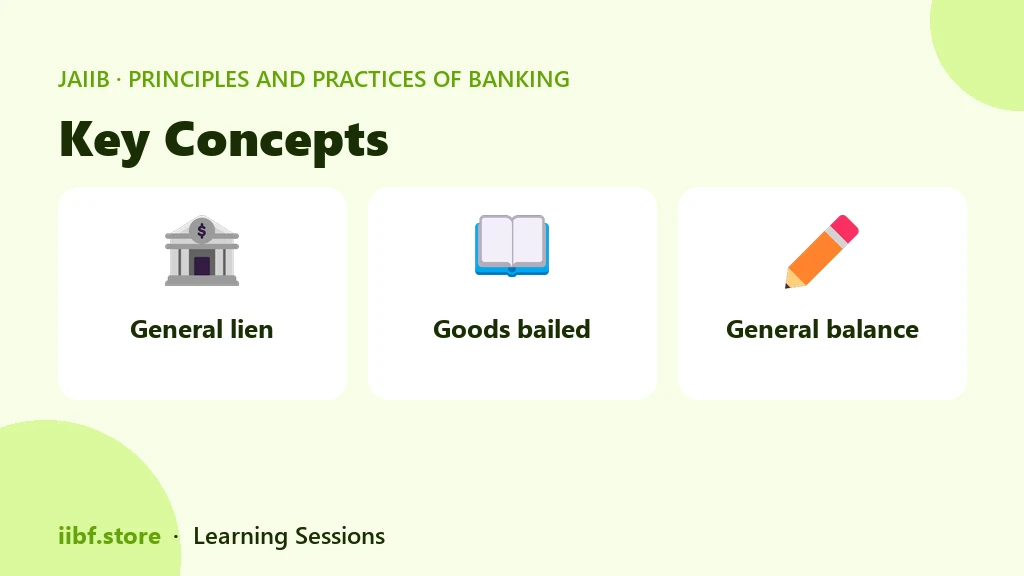
Three phrases carry the exam weight: "in the absence of a contract to the contrary", "general balance of account" and "goods bailed". Underline all three in your notes.
Key concepts behind the banker's general lien under Section 171
Let us unpack the section the way a lecturer would on the board.
Particular versus general lien
Under a particular lien the claim is limited to the charges for the very goods held. Under a general lien the banker may hold the customer's property for whatever net amount the customer owes him on the whole account. If a customer owes the bank on a cash credit account and also on a term loan, the banker can retain securities left with him for the combined balance, not only for the account for which those securities were first given.
Why bankers get this privilege
The bank lends on trust, receives papers and valuables in bulk from many customers, and works on running accounts where debits and credits keep changing. A general lien lets the banker protect himself on the net position of the account. The law treats this as a customary right of bankers, and Section 171 puts it in the statute.
What counts as "goods bailed"
Bailment means delivery of goods for some purpose on a contract that they will be returned. In banking practice, the things customarily held include bills, share and debenture certificates, bonds, title deeds, warehouse receipts and similar securities handed over to the banker in the course of banking business. Customers' money lying in a deposit account is a different matter, because the bank becomes a debtor to the depositor, not a bailee of specific notes. For deposits the banker relies on the right of set-off, which we compare below.
Lien is a right of retention only
The banker can keep possession until the debt is cleared. To sell the security, he needs more: either the customer's agreement (a pledge or a letter of authority to sell), a court decree, or a statutory route available to secured creditors. Exam questions often ask "can the banker sell goods held under a lien?" The safe answer is: lien by itself gives only the right to retain.
Where the banker's lien does not apply
The right is not unlimited. Courts have read Section 171 along with the principle that a lien cannot override the purpose for which the property was handed over. Remember these limits:
- A contract to the contrary. If the loan sanction letter, the pledge agreement or the deposit terms say that the security is held only for a specified liability, the general lien is excluded to that extent.
- Property held for a special purpose. A bill given only for collection and credit to a particular account, or an instrument entrusted for a specified use, should not be held back for an unrelated debt. An implied agreement can also be enough to exclude the lien.
- Property not belonging to the debtor. Goods that the customer holds as trustee or agent for someone else are not safely available for the customer's personal debt where the banker knows the real position.
- A different capacity. A lien works best when the same person is debtor and owner. A joint, trust or third-party capacity can break that match, so read the account and the document carefully.
When a question says "unless the contract provides otherwise", treat it as a signal that the answer turns on the contrary-contract clause.
Lien, pledge, set-off and hypothecation compared
Students lose marks by mixing these four. The table below is the revision card we use in class. For the pledge rules, remember that the Act defines pledge in Section 172 as the bailment of goods as security for payment of a debt or performance of a promise, and Section 176 gives the pawnee the right to sell after reasonable notice to the pawnor if there is default.
| Feature | General lien (S.171) | Pledge (S.172 onward) | Set-off | Hypothecation |
|---|---|---|---|---|
| Possession | With banker | With banker | Not applicable, it is a money claim | Stays with borrower |
| Arises by | Law, unless contract excludes | Agreement of the parties | Law and agreement, between mutual money debts | Agreement |
| Covers | General balance of account | The debt for which goods were pledged (S.174) | Debts of the same customer owed by and to the bank | The facility sanctioned |
| Power of sale | No, only retention | Yes, on reasonable notice (S.176) | Not a sale, it adjusts accounts | As per agreement and applicable law |
| Typical subject | Securities, bills, certificates left with bank | Gold, goods, shares, receipts under pledge | Credit balance against loan dues | Stock and book debts |
A neat memory hook: lien keeps, pledge sells, set-off adjusts, hypothecation leaves goods with the borrower.
Steps a banker follows before exercising the lien
The lien is a right, but branches should use it in a disciplined way. A wrongful retention exposes the bank to a claim for damages and to customer complaints. The banker's general lien under Section 171 is therefore exercised only after a few checks.
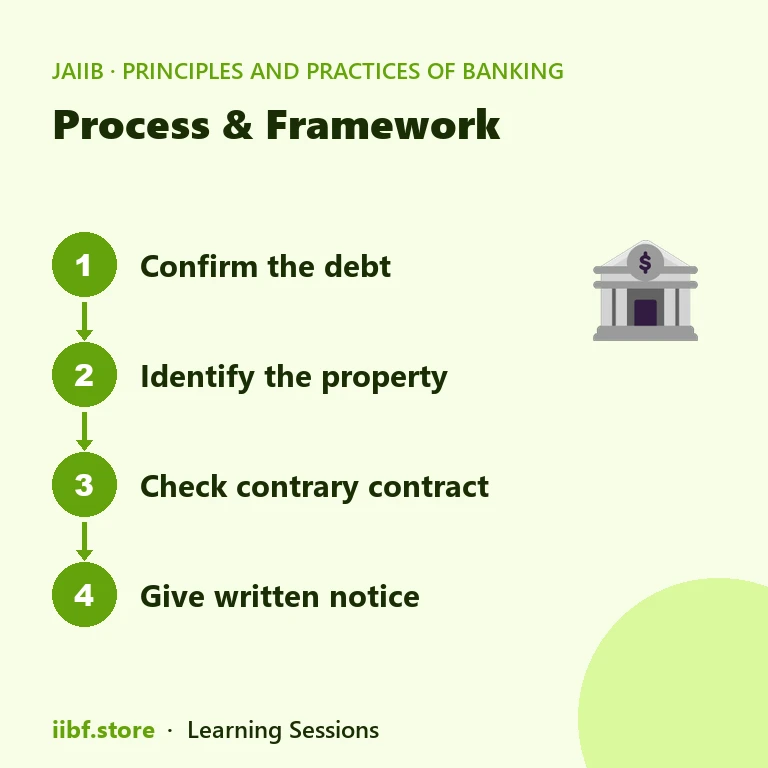
- Confirm the debt. The customer must actually owe a general balance that is due. A disputed or contingent claim needs caution.
- Identify the property. List what is held: nature, description, receipt number, and in what capacity it was received.
- Check for a contrary contract. Read the sanction terms, the letter of lien or pledge, and any special-purpose endorsement.
- Communicate in writing. Tell the customer which dues are pending and that the property will be retained until they are cleared. Obtain acknowledgement.
- Retain, and convert if needed. If the account stays unpaid, obtain a pledge or authority to sell, or take recovery action under the applicable law. Do not auction on the strength of a lien alone.
A worked branch example
Mr Verma, a customer of your branch, has a cash credit account that has gone into default with an outstanding balance. He had earlier handed over some debenture certificates for safe custody and a bill of exchange for collection and credit to his current account. He now asks for the certificates back.
How to think about it
- The debenture certificates were deposited in the ordinary course of banking business, with no contract excluding the lien. The branch may retain them as security for the general balance.
- The bill was sent only for collection and credit. It was entrusted for a special purpose, so the branch should collect it and credit the proceeds as agreed rather than hold the instrument for the cash credit dues. After credit, the balance in the account itself is open to adjustment by set-off as per the account terms.
- The branch cannot sell the debentures on the basis of the lien alone. It should seek a pledge letter or authority from Mr Verma, or follow the legal recovery route.
This is the pattern IIBF likes: two items, two different answers, because the purpose of the delivery is different.
How IIBF tests the banker's general lien under Section 171
Here are the usual question styles in the JAIIB PPB paper, and the traps behind them.
- Definition check: "A general lien allows a banker to retain goods for ..." Answer: the general balance of account.
- Who can claim: bankers, factors, wharfingers, High Court attorneys and policy-brokers. A common wrong option lists carriers or tailors, who only have a particular lien.
- Right to sell: options that say the lien lets the banker sell the goods are wrong.
- Exclusion: "The banker's lien does not apply when ..." Answer: there is a contract to the contrary or the property was received for a special purpose.
- Statement type: "Statement I: general lien is available to a banker without any agreement. Statement II: the lien can be excluded by contract." Both can be true together.
Practice MCQs
Q1. Under Section 171 of the Indian Contract Act, a banker may retain goods bailed to him as security for: (a) the specific loan only, (b) a general balance of account, (c) any debt of a third party, (d) the cost of safe custody only.
Answer: (b). That is the very meaning of a general lien. A lien limited to dues on the particular goods is the particular lien of Section 170.
Q2. A banker holding securities under his general lien wants to realise them. Which is correct? (a) He can sell at once, (b) He can only retain, and needs a pledge, authority or legal process to sell, (c) He must return them, (d) He may transfer them to any other bank.
Answer: (b). A lien gives retention. Sale needs additional authority, such as a pledge where Section 176 allows sale on reasonable notice.
Q3. A cheque is lodged with the bank only for collection and credit to a particular account. The customer owes the bank on an unrelated loan. Can the bank hold the cheque under general lien? (a) Yes always, (b) No, since it was received for a special purpose, (c) Yes, if the loan is large, (d) Only with RBI approval.
Answer: (b). Property received for a special purpose is outside the lien, because the purpose of delivery is inconsistent with a lien for unrelated dues.
Quick revision points
- Section 170 gives a bailee a particular lien for labour or skill; Section 171 gives bankers and four other classes a general lien.
- The banker's general lien under Section 171 covers the general balance of account.
- It operates on goods bailed, such as securities and documents, in the absence of a contract to the contrary.
- Lien means retain. It does not carry power of sale.
- Pledge is defined in Section 172, and the pawnee's sale right after reasonable notice is in Section 176.
- Special-purpose deliveries and trust property are generally outside the banker's lien.
- Money in a deposit account is a debt owed by the bank, so adjustment is by set-off, not lien.
Build the habit of reading every lien question against these lines before you pick an option. You can practise more of this theme in the full JAIIB PPB course, revise from the PPB printed book with chapter-wise MCQs, and test yourself with the JAIIB mock tests. The current JAIIB bundle is on the JAIIB offer page, and notes are in the free material library. For the official schedule of the upcoming exam cycle, always check iibf.org.in.
Frequently asked questions
What is the banker's general lien under Section 171?
It is the right of a banker, in the absence of a contract to the contrary, to retain goods bailed to him as security for the general balance of account owed by the customer.
What is the difference between particular lien and general lien?
A particular lien under Section 170 lets a bailee retain goods for payment of the labour or skill spent on those goods. A general lien under Section 171 lets certain persons, including bankers, retain goods for the whole balance of account.
Can a bank sell the securities it holds under lien?
Not on the strength of the lien alone. A lien is a right to retain. Sale requires a pledge or authority from the customer, a court order, or another legal route available to the bank.
Who else enjoys a general lien besides bankers?
Section 171 names factors, wharfingers, attorneys of a High Court and policy-brokers. Other persons need an express contract to claim a general lien.
When can the lien not be exercised?
When a contract excludes it, or where the property was handed over for a special purpose that is inconsistent with a lien, for example an instrument lodged only for collection.
Conclusion
The banker's general lien under Section 171 is a short provision with a long list of exam angles. Remember who may claim it, what it covers (general balance of account), what it attaches to (goods bailed), how it can be excluded (contract to the contrary or special purpose) and what it cannot do (sell). If you can recite those points and distinguish lien from pledge, set-off and hypothecation, you will pick up marks in this area comfortably. Revise it once a week alongside the rest of the paper, and keep applying it to real branch situations, because that is exactly how the questions are framed.
Prefer revising from a printed book?
Chapter-wise books with MCQs after every chapter — minimal pages, complete coverage, delivered anywhere in India. Every book has a free sample to read first.


















































Quick quiz on this topic
5 exam-style questions from our free test bank — check yourself before you move on.
Practice this topic
Take a free mock test, download chapter PDFs, or watch a video class — all included on iibf.store.