SFB Minimum Net Worth Requirement 2025: Capital, Promoter and Listing Rules
A colleague in your branch tells you that his cousin's microfinance company wants to become a bank, and asks, "How much money does it need to show?" You remember the old figure of Rs 200 crore, but then you recall that RBI has changed the licensing rules. This is exactly the kind of number-and-condition question that the Small Finance Banks paper loves, and the SFB minimum net worth requirement is the first thing a candidate must get right.
In this article we will walk through what the RBI's 2025 licensing guidelines say about entry capital, the separate routes for urban co-operative banks (UCBs) and NBFCs, capital adequacy, promoter holding, listing and the lending conditions that come with the licence. We will finish with a worked example, a comparison table, three practice MCQs and a quick revision list.
What are the 2025 licensing guidelines for small finance banks?
A small finance bank (SFB) is a private-sector bank licensed under the Banking Regulation Act, 1949, with a mandate of financial inclusion: serving small businesses, micro and small enterprises, farmers, and low-income households that bigger banks often under-serve. If you want the overall picture of the licence, you can first read our free study material; here we go deep on one theme, the capital and ownership conditions.
The current rulebook is the Reserve Bank of India (Small Finance Banks - Licensing) Guidelines, 2025, issued on 28 November 2025 (reference RBI/DOR/2025-26/175). Earlier, the on-tap guidelines of December 2019 set the entry capital at Rs 200 crore. In November 2020 an RBI Internal Working Group had recommended raising it to Rs 300 crore, and the 2025 guidelines adopt that higher figure. Always quote the 2025 position in the exam unless a question says otherwise.
Why does RBI insist on a capital floor?
A bank takes public deposits, so the owners must have real money at risk before the doors open. A higher floor also keeps out thin, speculative applicants and gives the bank a cushion for losses while it is still building its book of small loans. For a banker this is the same logic you see in every prudential rule: capital first, growth second.
Who can apply?
- Resident individuals with at least 10 years of senior-level experience in banking and finance.
- Resident-controlled companies and societies with a successful track record of at least 5 years.
- Existing UCBs, NBFCs, microfinance institutions, local area banks and payments banks that wish to convert.
- Not eligible: government or public sector entities, large industrial houses, alternative investment funds, charitable trusts and shell banks.
The SFB minimum net worth requirement for each type of applicant
This is the core of the topic. The figure depends on who is applying, and the exam usually tests whether you can match the applicant to the number.
- New (fresh) SFB: minimum paid-up voting equity capital or net worth of Rs 300 crore, which must be readily available when the banking licence is obtained.
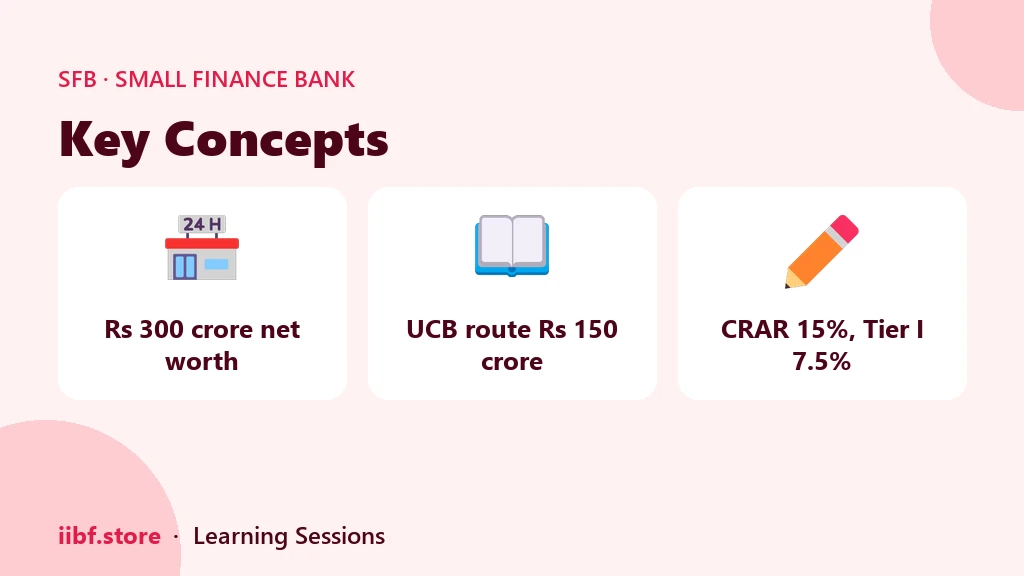
- UCB converting to an SFB: a net worth of Rs 150 crore from the commencement of business, which must rise to Rs 300 crore within five years.
- NBFC, MFI, local area bank or payments bank converting: net worth of Rs 300 crore; if it falls short, fresh equity must be brought in to reach this level within 18 months of the in-principle approval or the commencement of business, whichever is earlier.
Notice the pattern: the UCB route gets a head start because co-operative banks find it hard to raise equity quickly, and the converting NBFC gets a time window. The fresh applicant gets neither.
| Applicant | Net worth at start | Final level and timeline |
|---|---|---|
| New SFB (fresh licence) | Rs 300 crore, available at licence stage | Rs 300 crore from day one |
| UCB transition | Rs 150 crore from commencement | Rs 300 crore within 5 years |
| NBFC / MFI / LAB / PB conversion | Rs 300 crore, or infuse equity | Rs 300 crore within 18 months of in-principle approval or commencement, whichever is earlier |
Revision tip: remember the UCB figure as "half now, full in five years". The 2019 guidelines followed the same shape with Rs 100 crore rising to Rs 200 crore, so the logic did not change, only the numbers.
If you want a structured walk-through of the entire licensing and regulatory framework, with notes written for banking exams, see the Small Finance Bank course on iibf.store.
Capital adequacy: how much capital must the SFB keep afterwards?
Net worth at entry is only the starting point. The bank must then maintain a Capital to Risk-weighted Assets Ratio (CRAR) of at least 15 per cent of risk-weighted assets on a continuous basis. Within that, Tier I capital must be at least 7.5 per cent of risk-weighted assets, and Tier II capital is capped at 100 per cent of Tier I.
Many candidates mix this up with the entry capital. The difference is simple: the Rs 300 crore is an absolute rupee amount (a floor on size), while 15 per cent is a ratio (a measure of safety against the risks the bank is actually running). A bank can satisfy one and still fail the other.
Common trap
Do not state that Tier I must be 15 per cent. Fifteen per cent is the total CRAR; Tier I is only half of that, at 7.5 per cent.
Promoter shareholding and listing rules
RBI wants SFB promoters to have skin in the game at the start and then gradually broaden ownership, so that the bank does not remain a family or closely held business forever.
- Initial holding: promoters must hold at least 40 per cent of paid-up voting equity capital during the first five years from commencement of business.
- Dilution: the holding must then be brought down to 26 per cent within 15 years of commencement.
- UCB route: the minimum is 26 per cent during the first five years; anything above 26 per cent has to be reduced over 15 years, counted from the point the bank reaches the Rs 300 crore net worth.
- Listing: listing on a recognised stock exchange is mandatory within eight years of commencing operations.
Two small points that students miss: first, the UCB route starts the dilution clock from the date the net worth reaches Rs 300 crore and not from the date of conversion; second, the old 2019 text tied listing to a net worth milestone, whereas the 2025 text sets a plain eight-year limit from commencement of operations.
Lending conditions that come with the licence
Capital is the entry ticket, but the SFB must also honour its inclusion mandate. For the paper you should link the capital rules to these lending conditions.
- Small-borrower lending: at least 50 per cent of the loan portfolio must be loans and advances of up to Rs 25 lakh, tested borrower-wise on an ongoing basis.
- Priority sector lending: 60 per cent of Adjusted Net Bank Credit (ANBC) or Credit Equivalent of Off-Balance Sheet Exposure (CEOBE), whichever is higher, goes to priority sector. Of this, 40 per cent is spread across the PSL sub-sectors and the remaining 20 per cent can go to sub-sectors where the bank has a competitive advantage. This matches the 60 per cent target for SFBs under the PSL Master Directions 2025, and not the old 75 per cent.
- Connected lending: besides the limits in Section 20 of the Banking Regulation Act, the SFB cannot lend to its promoters, shareholders holding 10 per cent or more, their relatives, or entities they significantly influence or control.
- Branch footprint: general permission to open banking outlets from the start, provided at least 25 per cent of outlets are in unbanked rural centres (population up to 9,999) within one year.
Our Small Finance Banks printed book brings these items together with chapter-wise questions, which helps because the paper asks about the numbers in many different forms.
Step by step: from application to listing
Think of the life cycle of an SFB as a short checklist. The numbers change with the route, but the order does not.
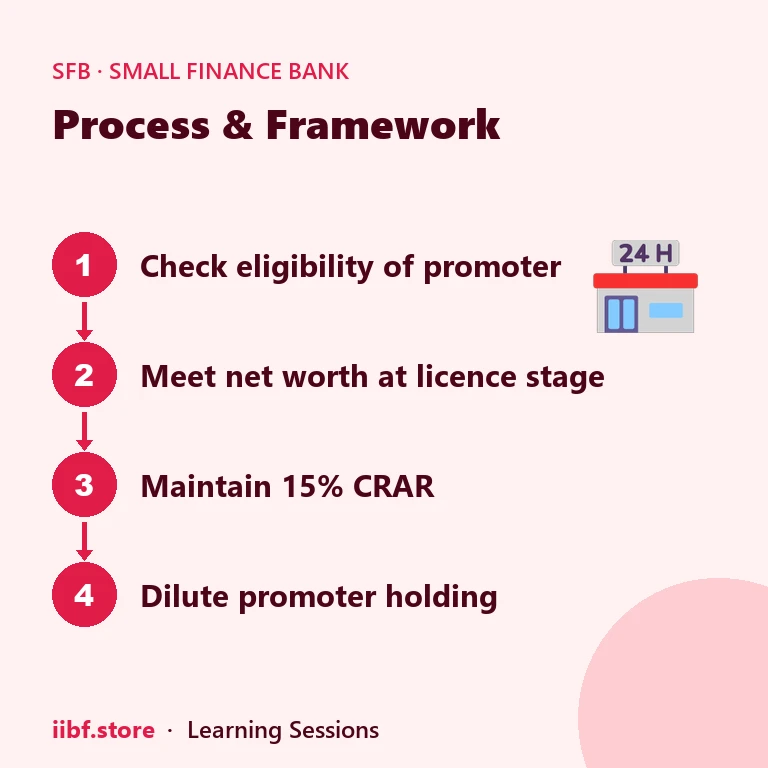
- Check eligibility. Promoter experience (10 years of senior banking or finance work for individuals, a 5-year track record for companies), residency and the exclusion list.
- Show the net worth. Rs 300 crore at licence stage for a fresh applicant; the UCB and NBFC routes follow their own timelines described above.
- Maintain CRAR. At least 15 per cent of risk-weighted assets, Tier I at least 7.5 per cent, at all times.
- Dilute promoter holding. From 40 per cent in the first five years to 26 per cent within 15 years.
- List the bank. Within eight years of commencing operations.
Worked example: a converting NBFC-MFI
Let us take an illustrative case with made-up numbers. Sunrise Microfinance is an NBFC-MFI with a net worth of Rs 220 crore. It receives the in-principle approval of RBI to become an SFB.
- Required net worth: Rs 300 crore.
- Shortfall: Rs 300 crore minus Rs 220 crore, that is Rs 80 crore.
- Deadline: it must infuse fresh equity of Rs 80 crore within 18 months of the in-principle approval or the date of commencing banking business, whichever is earlier.
Suppose the company starts banking operations in month 12 after approval. Then the earlier date is month 12, and the equity must be in by then, not month 18. This "whichever is earlier" wording is a favourite trap. Compare it with a UCB with Rs 150 crore at the start: that bank has five years to reach Rs 300 crore and so is not under the 18-month pressure at all.
How the exam tests the SFB minimum net worth requirement
In the IIBF paper the SFB minimum net worth requirement usually appears in three styles: a straight recall question ("What is the minimum net worth for a new SFB?"), a match-the-route question, or a statement-based question with a twist in the number or timeline. Always read the options for the 200 versus 300 crore trap, and for the 15 per cent versus 7.5 per cent trap.
Practice MCQ 1
Under the RBI Small Finance Banks (Licensing) Guidelines, 2025, what is the minimum paid-up voting equity capital or net worth of a new SFB? (a) Rs 100 crore (b) Rs 200 crore (c) Rs 300 crore (d) Rs 500 crore.
Answer: (c). Rs 200 crore was the 2019 figure and is a distractor; the 2025 guidelines require Rs 300 crore, readily available when the licence is obtained.
Practice MCQ 2
A UCB converts to an SFB. Its net worth at commencement and the level it must reach within five years are: (a) Rs 100 crore and Rs 200 crore (b) Rs 150 crore and Rs 300 crore (c) Rs 300 crore and Rs 300 crore (d) Rs 150 crore and Rs 200 crore.
Answer: (b). The UCB route is half the entry figure at the start, rising to the full Rs 300 crore within five years. Option (a) is the older 2019 pair.
Practice MCQ 3
Which of the following is correct about promoter shareholding of a new SFB? (a) 40 per cent for 5 years, then 26 per cent within 15 years (b) 51 per cent for 10 years (c) 26 per cent throughout (d) 40 per cent permanently.
Answer: (a). Promoters hold at least 40 per cent in the first five years and must reduce to 26 per cent within 15 years of commencement. Remember the 26 per cent starting floor applies to the UCB route.
To practise more of this pattern, attempt the Small Finance Banks mock tests after finishing this article.
Quick revision points
- 2025 guidelines dated 28 November 2025; entry capital for a new bank Rs 300 crore.
- UCB route Rs 150 crore, rising to Rs 300 crore in five years.
- NBFC/MFI/LAB/PB: Rs 300 crore or infusion within 18 months (whichever earlier).
- CRAR 15 per cent; Tier I 7.5 per cent; Tier II up to 100 per cent of Tier I.
- Promoters 40 per cent for five years, 26 per cent in 15 years; listing within eight years.
- 50 per cent of loans up to Rs 25 lakh; PSL at 60 per cent of ANBC or CEOBE.
Frequently asked questions
What is the SFB minimum net worth requirement for a new bank?
Under the RBI Small Finance Banks (Licensing) Guidelines, 2025, a new SFB needs minimum paid-up voting equity capital or net worth of Rs 300 crore, readily available at the time the banking licence is obtained.
How much net worth does a UCB need to become an SFB?
A UCB converting to an SFB needs a net worth of Rs 150 crore from the commencement of business, and must raise it to Rs 300 crore within five years.
Was the earlier SFB capital requirement Rs 200 crore?
Yes. The on-tap licensing guidelines of December 2019 required Rs 200 crore. The 2025 guidelines raised it to Rs 300 crore, so for current exams you should use the higher figure.
When must a small finance bank get listed?
The 2025 guidelines make listing mandatory within eight years of commencing operations.
What CRAR must an SFB maintain?
At least 15 per cent of risk-weighted assets on a continuous basis, with Tier I capital of at least 7.5 per cent and Tier II capped at 100 per cent of Tier I.
Conclusion
The SFB minimum net worth requirement is a numbers-driven topic, and numbers are easy marks if you build a clean memory frame: Rs 300 crore for new banks, half of it for UCBs with five years to catch up, 18 months for converting NBFCs, then 15 per cent CRAR, 40 to 26 per cent promoter dilution and listing in eight years. Pair this with the lending rules, and you can handle almost any statement-based question on SFB licensing.
For official updates and the exam schedule, keep checking the IIBF website, and revise from the RBI document itself at least once before the upcoming exam cycle.
Prefer revising from a printed book?
Chapter-wise books with MCQs after every chapter — minimal pages, complete coverage, delivered anywhere in India. Every book has a free sample to read first.


















































Practice this topic
Take a free mock test, download chapter PDFs, or watch a video class — all included on iibf.store.
Keep reading