Capital Conservation Buffer in Banks: CAIIB Risk Management Guide
Your bank has had a good year, profits are healthy, and the board wants to declare a handsome dividend and pay staff bonuses. Then the CFO points out that the CET1 ratio has slipped close to the regulatory band, and suddenly the payout is capped. That cap is not a penalty and not a Prompt Corrective Action trigger. It is the capital conservation buffer in banks doing exactly what it was designed to do: make banks keep earnings inside the business when capital gets thin.
For CAIIB Risk Management, this is a favourite area because it mixes definitions, a small table and simple arithmetic. In this guide we will build the concept from the ground up, walk through a worked example, and show you how IIBF tends to frame the questions.
What is the capital conservation buffer?
The capital conservation buffer (CCB) is an extra layer of capital that a bank must hold above its minimum regulatory capital requirement. It was introduced by the Basel Committee in Basel III after the 2008 crisis, when many banks kept paying dividends and bonuses even as their losses were eating into capital. The idea is simple: in good times, build a cushion; in stress, use the cushion to absorb losses without breaching the minimum.
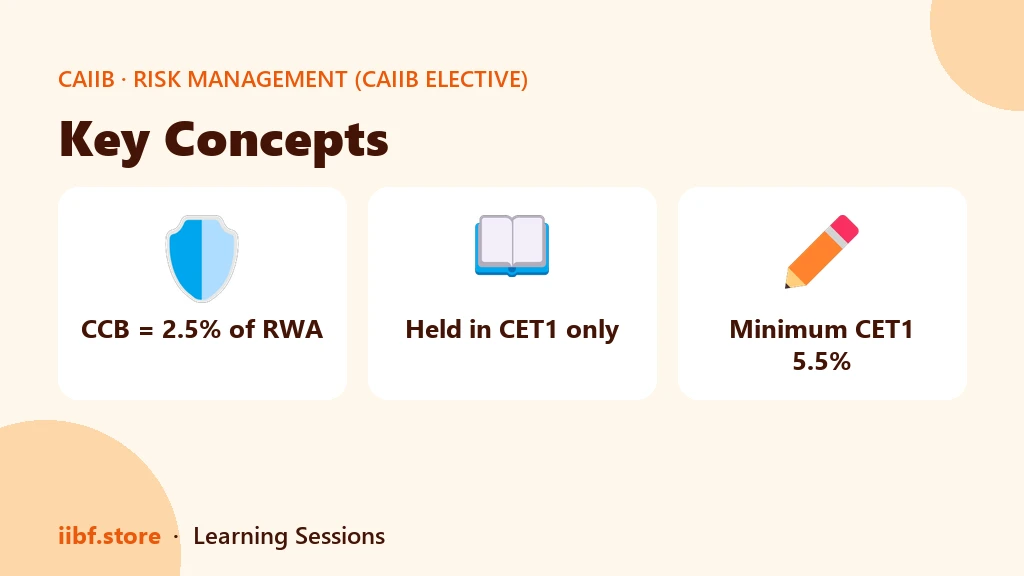
Under the RBI's capital adequacy framework for commercial banks, the buffer is 2.5% of risk-weighted assets (RWA) and must be held in the form of Common Equity Tier 1 (CET1) capital. The regulatory source is the RBI's Commercial Banks - Prudential Norms on Capital Adequacy Directions, 2025, which consolidates the earlier Basel III Master Circular (the older text is still available on the RBI's Master Circulars page). Always read the latest version of the Directions for your exam cycle, because the page carries an updated-on date.
Where the buffer sits in the capital stack
Under the RBI framework, banks must maintain a minimum CET1 ratio of 5.5% of RWA and a minimum total capital ratio (CRAR) of 9% of RWA. The CCB comes on top of these. So the effective CET1 requirement including the buffer is 5.5% + 2.5% = 8.0%, and the total capital requirement including the buffer is 9% + 2.5% = 11.5%. Remember this: the buffer is not an alternative to the minimum; it is layered over it.
The most important idea: a buffer is meant to be used
Students often think that dipping into the buffer means the bank has failed. That is wrong. The buffer is not part of the regulatory minimum, so a bank that eats into it has not breached the minimum capital requirement. The consequence is a restriction on discretionary distributions, not a regulatory default. The regulator is nudging the bank to rebuild capital, first by retaining earnings.
Why regulators created the buffer
Before Basel III, minimum capital was a hard floor, and banks in difficulty had every incentive to protect their dividends because cutting them sends a bad signal to markets. The result was capital leakage at exactly the wrong time. The capital conservation buffer in banks fixes this by hard-wiring the restraint into the rules: the closer the bank gets to the minimum, the less of its earnings it is allowed to distribute.
- Loss absorption: the buffer is a first line of defence that absorbs losses before the minimum is touched.
- Pro-cyclicality control: it forces banks to build capital while earnings are strong.
- Market discipline: payout limits are automatic, so management does not have to make a visible and awkward decision to cut a dividend.
If you want the surrounding framework (minimum ratios, deductions and the other buffers) explained chapter by chapter, the CAIIB Risk Management elective course covers it in classroom style.
How the buffer restricts payouts: step by step
The mechanism works through the bank's CET1 ratio. The CET1 range between the minimum and the minimum plus buffer is divided into four equal quartiles. The lower the CET1 ratio falls within the range, the higher the share of earnings the bank must conserve. The restriction applies to discretionary distributions, which the RBI describes as including dividend payments, share buybacks and staff bonus payments.
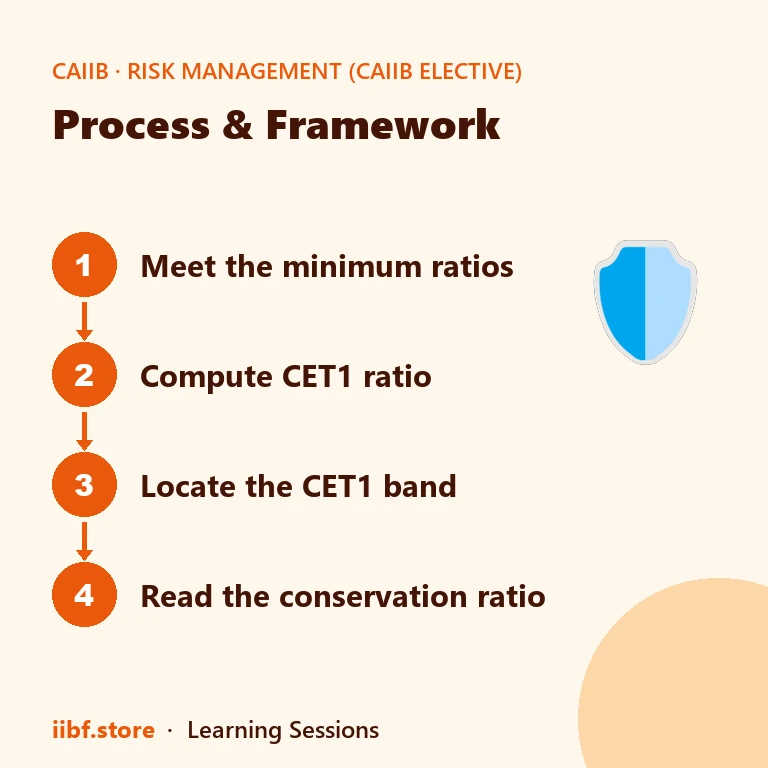
- Check the minimums. Confirm that the bank meets the 5.5% CET1 and 9% total capital minimums. The buffer only comes into play for the layer above the minimum.
- Compute the CET1 ratio. Divide CET1 capital by total RWA, after applying all regulatory deductions.
- Locate the CET1 band. Find which quartile of the buffer range the ratio falls in.
- Read the minimum capital conservation ratio. This is the percentage of earnings the bank must retain in the next payout period.
- Cap the distributions. Dividends, buybacks and bonuses must fit within the remaining share of earnings.
The conservation table
With a CCB of 2.5% and the CET1 minimum of 5.5%, each quartile of the buffer is 0.625 percentage points wide. The bands therefore run as follows.
| CET1 ratio (% of RWA) | Minimum capital conservation ratio (% of earnings) |
|---|---|
| 5.5% to 6.125% | 100% |
| Above 6.125% to 6.75% | 80% |
| Above 6.75% to 7.375% | 60% |
| Above 7.375% to 8.0% | 40% |
| Above 8.0% | 0% (no restriction) |
A conservation ratio of 100% means the bank must retain all earnings, so no dividend, no buyback and no discretionary bonus. At 0% there is no restriction from the buffer. Notice that the bank is fully free to distribute only once CET1 is above 8.0%, which is the minimum plus the whole buffer.
When the countercyclical buffer is also on
The RBI has also notified a countercyclical capital buffer (CCCB) framework, of up to 2.5% of RWA, to be activated when credit growth is excessive. When it is switched on, the conservation bands widen, because the quartiles are computed on the combined buffer. The RBI's own notification illustrates this assuming a CCB of 2.5% and a CCCB of 2.5%: the bands become above 5.5% to 6.75% (100%), above 6.75% to 8.0% (80%), above 8.0% to 9.25% (60%), above 9.25% to 10.50% (40%) and above 10.50% (0%). You can read the table on the RBI's countercyclical capital buffer notification. For the exam, the safest approach is to learn the CCB-only table and understand that a bigger combined buffer simply stretches each band.
Worked example: a branch-level feel for the numbers
Let us take a mid-sized bank with the following position at the end of a quarter.
- Total RWA: Rs 80,000 crore
- CET1 capital: Rs 5,600 crore
- Net profit for the period: Rs 1,000 crore
Step 1: CET1 ratio. 5,600 / 80,000 = 7.0%.
Step 2: Locate the band. 7.0% falls in the band above 6.75% and up to 7.375%, so the minimum capital conservation ratio is 60%.
Step 3: Payout cap. The bank must retain at least 60% of Rs 1,000 crore, that is Rs 600 crore. The maximum it can distribute through dividends, buybacks and discretionary bonuses is Rs 400 crore.
Step 4: Rebuilding. Retaining Rs 600 crore adds roughly 0.75 percentage points to the ratio (600 / 80,000), taking CET1 towards 7.75%, and into the 40% band. Retention itself helps the bank climb out of the restriction. That is the whole logic of the capital conservation buffer in banks.
| Item | Figure |
|---|---|
| CET1 ratio | 7.0% |
| Band | Above 6.75% to 7.375% |
| Conservation ratio | 60% |
| Minimum earnings retained | Rs 600 crore |
| Maximum distributable | Rs 400 crore |
The figures above are an illustration for learning, not any real bank's numbers.
CCB versus the other capital ideas students confuse it with
Many wrong answers in the exam come from mixing the buffer with similar terms. Keep these distinctions clear.
Buffer versus minimum requirement
The minimum CET1 (5.5%) and minimum total capital (9%) are mandatory floors. The CCB sits above them. Falling into the buffer triggers payout limits; falling below the minimum is a regulatory breach with far heavier consequences.
CCB versus countercyclical buffer
The CCB is permanent and fixed at 2.5%. The countercyclical buffer is variable and is switched on by the RBI only when systemic credit growth demands it. Both are met with CET1 in the framework the RBI has notified for the CCCB.
Buffer versus Prompt Corrective Action
The CCB restricts distributions through a pre-set table. Prompt Corrective Action is a separate supervisory framework with triggers based on capital, asset quality and profitability. The two operate independently, and a bank can face one without the other. If you are revising how risk-weighted assets feed the denominator of all these ratios, read our guide on risk weighted assets calculation.
How IIBF tests this topic
Questions on the buffer are rarely deep calculations. They test whether you remember the size, the form of capital and the consequence of a shortfall. Typical patterns include:
- Size and form: "The capital conservation buffer is ___ of RWA, maintained in the form of ___." Answer: 2.5%, CET1.
- Consequence: a restriction on dividends, buybacks and bonuses, not a licence cancellation.
- Table reading: given a CET1 ratio, identify the conservation ratio.
- Statement type: "Which of the following is correct about the buffer?" with one option claiming it is part of the regulatory minimum.
You can practise these under exam conditions with the CAIIB mock tests, and the chapter-wise question banks in the CAIIB Risk Management printed book reinforce the numeric detail.
Three practice MCQs
Q1. The capital conservation buffer under the RBI framework is maintained at ___ of RWA in the form of ___.
(a) 2.5%, Tier 2 capital (b) 2.5%, Common Equity Tier 1 (c) 1.5%, Additional Tier 1 (d) 5%, Common Equity Tier 1
Answer: (b). The buffer is 2.5% of RWA and must be met entirely from CET1. Options (a) and (c) name the wrong type of capital and size.
Q2. A bank has a CET1 ratio of 6.5% and only the CCB applies. What share of earnings must it conserve?
(a) 100% (b) 80% (c) 60% (d) 0%
Answer: (b). 6.5% lies above 6.125% and up to 6.75%, which is the second quartile, so 80% of earnings must be retained.
Q3. Which statement about the capital conservation buffer is correct?
(a) Breaching the buffer is a breach of the minimum capital requirement (b) The buffer restricts dividends and discretionary bonuses when it is used (c) The buffer can be met with Tier 2 bonds (d) It is switched on only in periods of excess credit growth
Answer: (b). The buffer is not part of the regulatory minimum, so using it is not a breach, but distributions get restricted. Option (c) is wrong because only CET1 counts, and option (d) describes the countercyclical buffer.
Common traps and mistakes
- Adding instead of layering. Candidates sometimes say the total requirement is 9% when the buffer is included. It is 11.5% for total capital and 8.0% for CET1.
- Treating the buffer as a minimum. It is not. Distribution limits, not a breach, follow its use.
- Using Tier 2 or AT1 to fill it. Only CET1 counts toward the buffer.
- Confusing quartiles. The bands are four equal slices of the range, so check whether the question assumes only the CCB or CCB plus CCCB.
- Ignoring bonuses. Restrictions cover buybacks and discretionary staff bonuses too, not only dividends.
Quick revision points
- CCB = 2.5% of RWA, held in CET1.
- Minimum CET1 is 5.5% and minimum total capital is 9%; with the buffer these become 8.0% and 11.5%.
- Using the buffer is not a breach; it limits dividends, buybacks and discretionary bonuses.
- The CET1 range is split into four equal bands; the bands give 100%, 80%, 60%, 40% and 0% conservation.
- A combined CCB and CCCB widens the bands; the CCCB is activated only by the RBI.
- Keep your notes in line with the latest RBI Directions, and use the free study material to revise the rest of the capital framework.
Frequently asked questions
What is the capital conservation buffer in banks?
It is an additional 2.5% of risk-weighted assets that a bank must hold in CET1 above its minimum capital requirement, so that it has a cushion to absorb losses in stress and retains earnings when capital is thin.
Is the capital conservation buffer part of the minimum capital requirement?
No. It sits above the minimum. A bank that dips into the buffer has not breached the minimum, but it faces limits on dividends, share buybacks and discretionary bonuses.
What type of capital can be used for the buffer?
Only Common Equity Tier 1 capital counts. Additional Tier 1 and Tier 2 instruments cannot be used to meet the buffer.
What happens if a bank's CET1 ratio falls into the buffer range?
The bank must conserve a minimum share of its earnings, from 40% to 100% depending on how deep into the range it falls. That reduces what it can pay out as dividends, buybacks and bonuses until the ratio recovers.
How is the capital conservation buffer different from the countercyclical buffer?
The capital conservation buffer is a fixed, permanent 2.5% of RWA. The countercyclical buffer is a variable add-on of up to 2.5% that the RBI activates only when credit growth is judged excessive.
Conclusion
The capital conservation buffer in banks is one of the neatest ideas in Basel III: rather than telling a bank to stop paying dividends when it is in trouble, the rules automatically scale payouts down as CET1 falls. For CAIIB Risk Management, hold on to four anchors: 2.5% of RWA, held in CET1, sits above the minimum, and it restricts distributions rather than triggering a breach. Add the quartile table and a clear head for the worked example, and this topic becomes a reliable scoring area.
For the upcoming exam cycle, check the official schedule on iibf.org.in. If you want structured support across the full capital adequacy chapter, see the CAIIB preparation offer and the CAIIB books for chapter-wise practice.
Prefer revising from a printed book?
Chapter-wise books with MCQs after every chapter — minimal pages, complete coverage, delivered anywhere in India. Every book has a free sample to read first.


















































Quick quiz on this topic
5 exam-style questions from our free test bank — check yourself before you move on.
Practice this topic
Take a free mock test, download chapter PDFs, or watch a video class — all included on iibf.store.