Market Stabilisation Scheme in India: How MSS Works
Imagine the RBI buying a large amount of dollars from the market to stop the rupee from appreciating too sharply. Every dollar it buys is paid for in rupees, and those rupees land in the banking system as fresh liquidity. If nothing is done, that liquidity can push up money supply and inflation. This is exactly the problem the market stabilisation scheme in india was designed to solve, and it is a favourite area in the CAIIB Central Banking elective.
In this article we will walk through why the scheme was created, the legal and contractual basis, how the ceiling and the MSS cash account work, how it differs from LAF and open market operations, and how IIBF frames questions on it. Read it like a conversation with a senior colleague who has already cleared the paper.
Why RBI needed a new sterilisation tool
When capital flows into India in large volumes, the RBI often buys foreign currency to contain excessive volatility in the exchange rate. The forex side is covered in the Central Banking elective course, but the liquidity side is what matters here.
Buying dollars means paying rupees. The rupees enter bank reserves and show up as surplus liquidity. To neutralise this effect, a central bank sterilises, that is, it takes the same amount of liquidity back out of the system. Sterilisation is the key word to remember.
What RBI was using before 2004
Sterilisation was possible through the RBI's own securities holdings and repo operations under the Liquidity Adjustment Facility. The limitation is simple: the RBI's own stock of securities is finite, so in years of heavy capital inflows the central bank can be left short of instruments to mop up liquidity.
An internal RBI working group looked at sterilisation instruments in December 2003, and the Market Stabilisation Scheme followed.
What the market stabilisation scheme in india actually is
The scheme is an arrangement between the Government of India and the RBI under which the Government issues Treasury Bills and/or dated securities over and above its normal borrowing needs, purely to absorb excess liquidity. The RBI conducts the auctions as the Government's debt manager.
Per the RBI press release on the scheme, the Memorandum of Understanding (MoU) between the Government and the RBI was signed on 25 March 2004, and the scheme took effect in April 2004. You can read the primary source on the RBI press release page on the Market Stabilisation Scheme.
Note the nature of the arrangement. It is not a separate statute. It rests on an MoU, which is why exam questions often ask about the "MoU between the Government and RBI".
Features you must remember
- Instruments: Treasury Bills and/or dated government securities. They carry the same features as existing securities, so they remain eligible for SLR, repo and the Liquidity Adjustment Facility.
- Purpose: to absorb liquidity that results from the RBI's foreign exchange market operations, not to finance the Government's deficit.
- Ceiling: the Government, in consultation with the RBI, fixes an annual aggregate ceiling. Outstanding MSS securities can never go above the ceiling at any time. For 2004-05 the initial ceiling was announced as Rs 60,000 crore.
- Separate account: the proceeds are kept in a separate MSS account with the RBI.
- Cost: the interest cost of the securities is borne by the Government.
If you want a fuller explanation of the other liquidity tools that sit beside this scheme, our free study material library has chapter notes you can browse.
The MSS cash account: why the money is parked
This is the part candidates most often get wrong. When the Government issues MSS securities, it receives cash. But that cash is not available for normal spending. It is credited to a separate, identifiable cash account maintained with the RBI, and the amount in that account can be used only to redeem or buy back MSS securities.
Why does this matter? If the Government could spend the money, the liquidity would flow right back into the banking system and the sterilisation would be defeated. The separate account keeps the liquidity locked away.
Treatment of interest cost
Interest and discount payments on MSS securities are not made out of the MSS account, and premium or accrued-interest receipts are not credited to it. These flows are shown under separate sub-heads in the Government's budget. The only marginal effect on the Government is therefore the interest cost, which it bears.
The 2009 amendment
The scheme was not frozen in form. A revised MoU signed on 26 February 2009 allows, by mutual agreement, part of the balance in the MSS cash account to be moved to the Government's normal cash account to help fund its market borrowing programme. An equivalent quantity of MSS securities then became part of the Government's normal market borrowing. The RBI Bulletin note on the scheme records this: see the RBI Bulletin page on the MSS.
This shows an important principle. The scheme is a tool of liquidity management and the Government and the RBI can recalibrate it when conditions change. When external conditions turn and forex operations start draining liquidity instead, the sterilised money can be released back into the system.
Step by step: how the scheme works in practice
Here is the sequence a banker should be able to explain in the exam hall.
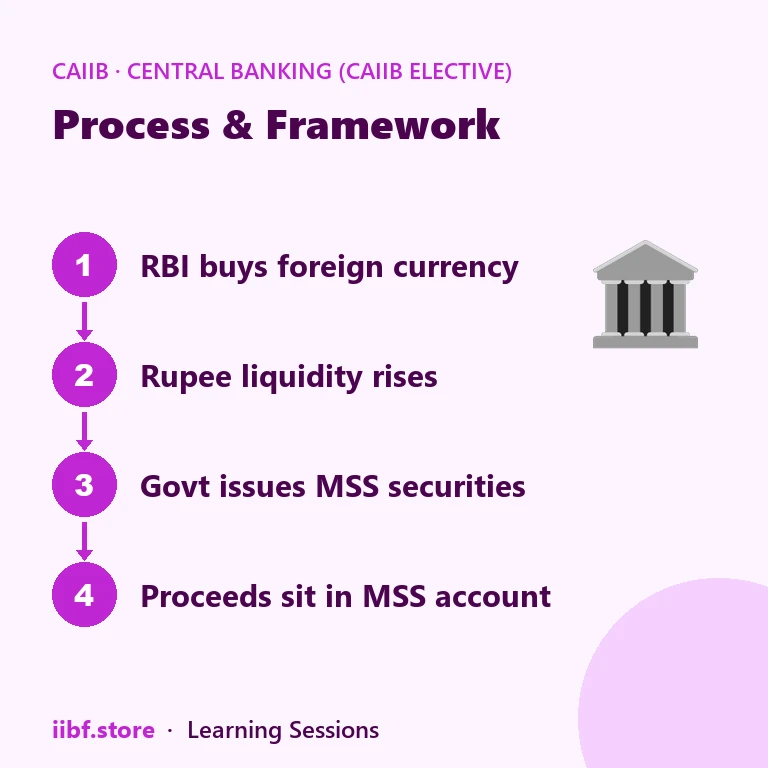
- RBI buys foreign currency from authorised dealers to curb sharp rupee appreciation.
- Rupee liquidity rises because the RBI pays in rupees, which end up as bank reserves.
- Government issues MSS securities (T-bills or dated securities) through RBI auctions, within the ceiling.
- Banks and investors pay for the securities, and rupees move out of bank reserves into the MSS account at RBI.
- The money stays parked and can be used only to redeem or buy back MSS securities.
A simple illustration
The numbers below are illustrative only, to show the direction of the flows; they are not actual data.
| Step | Action | Effect on banking-system liquidity |
|---|---|---|
| 1 | RBI buys forex worth Rs 10,000 crore | Rises by Rs 10,000 crore |
| 2 | Government issues MSS securities worth Rs 6,000 crore | Falls by Rs 6,000 crore |
| 3 | Net position | Rises by Rs 4,000 crore (partly sterilised) |
The point to take away: sterilisation can be full or partial. The RBI decides how much liquidity to absorb depending on the stance of monetary policy and the ceiling available.
MSS compared with LAF and open market operations
Students confuse the three because all of them move liquidity. The difference is in the nature of the instrument and who owns the securities. The Liquidity Adjustment Facility is a short-term tool under which the RBI injects or absorbs liquidity through repo and reverse repo. Open market operations are outright purchases and sales of government securities by the RBI from its own portfolio, usually for durable liquidity. The market stabilisation scheme in india is different: the securities are issued afresh by the Government, specifically for sterilisation, and the money is locked in a separate account.
| Feature | LAF | OMO | MSS |
|---|---|---|---|
| Who issues or owns the securities | Collateral from banks | RBI's own portfolio | Fresh issue by the Government |
| Typical tenor | Short term | Outright, durable | T-bills or dated securities |
| Main purpose | Day-to-day liquidity | Durable liquidity management | Absorb liquidity from forex operations |
| Cost borne by | RBI operations | RBI operations | Government (interest cost) |
For more detail on how the corridor and the rate tools sit together, you can study them chapter by chapter in the Central Banking printed book, which carries chapter-wise MCQs.
How IIBF tests this topic
IIBF usually asks the market stabilisation scheme in india as a factual or a conceptual statement question. Look out for these patterns.
- Match the purpose: the scheme is for sterilising liquidity from forex operations, not for funding the fiscal deficit.
- Who bears the cost: the Government bears the interest cost.
- Where the money sits: a separate account with the RBI, usable only for redemption or buyback of MSS securities, subject to the 2009 amendment.
- Who sets the ceiling: the Government in consultation with the RBI, not the RBI alone.
Practice question 1
The Market Stabilisation Scheme is primarily intended to: (a) finance the fiscal deficit, (b) sterilise excess liquidity arising from forex operations, (c) regulate bank lending rates, (d) support priority sector lending. The answer is (b). The scheme was set up to absorb liquidity created by the RBI's foreign exchange market intervention. Options (a), (c) and (d) have no link to it.
Practice question 2
Under the MSS, the ceiling on outstanding securities is fixed by: (a) RBI alone, (b) SEBI, (c) Government in consultation with RBI, (d) Finance Commission. The answer is (c). The MoU says the Government, in consultation with the RBI, sets an annual aggregate ceiling.
Practice question 3
Which statement about the MSS cash account is correct? (a) It can be used for any government expenditure, (b) It is used only to redeem or buy back MSS securities, subject to later MoU changes, (c) It is held with commercial banks, (d) It earns no role in sterilisation. The answer is (b). Under the original arrangement the balance could be used only for redemption or buyback; the 2009 amended MoU allowed a mutually agreed transfer to the normal cash account.
You can test yourself under exam conditions with the CAIIB mock tests, and if you are preparing for the whole exam, see the CAIIB offer page for the combined preparation options.
Common traps and revision points
- Do not call MSS a statutory scheme; it runs on an MoU between the Government and the RBI.
- MSS securities are government securities, so they remain SLR and repo eligible.
- Sterilisation means offsetting the liquidity effect of forex purchases; it does not mean cancelling the purchase.
- The ceiling is a limit on outstanding amounts at any time, not only on issuance in the year.
- The interest burden falls on the Government, which is why a larger MSS has a fiscal cost.
- The 2009 MoU amendment is the usual "exception" question: part of the cash account could be moved to the normal cash account.
Linking it with other chapters
Connect this topic to the foreign exchange reserves and exchange rate management chapters, and to the liquidity framework chapter. A question that asks about forex intervention, liquidity management and the cost to the Government together can often be answered from this one topic.
Frequently asked questions
What is the market stabilisation scheme in India?
It is an arrangement between the Government of India and the RBI, under which the Government issues Treasury Bills and dated securities to absorb excess liquidity that arises mainly from the RBI's forex operations. The proceeds are held in a separate account with the RBI.
When was the Market Stabilisation Scheme introduced?
The MoU between the Government and the RBI is dated 25 March 2004, and the scheme took effect in April 2004, as recorded in the RBI press release on the scheme.
Who bears the interest cost of MSS securities?
The Government bears the interest cost. The interest and discount payments are shown under separate budget sub-heads and are not paid from the MSS account.
How is MSS different from open market operations?
Under OMO the RBI sells or buys securities from its own portfolio. Under MSS, the Government issues fresh securities specifically to sterilise liquidity, and the proceeds are parked in a separate account.
Is the Market Stabilisation Scheme part of the CAIIB syllabus?
MSS comes under the liquidity management and forex operations discussion in the Central Banking elective. Check the official syllabus on the IIBF website for the current cycle.
Conclusion
The market stabilisation scheme in india is a neat example of how the Government and the central bank cooperate: the RBI manages the exchange rate, the Government issues securities, and the proceeds are locked away so that liquidity stays sterilised. Remember the MoU of 2004, the ceiling set by the Government in consultation with the RBI, the separate MSS account, the cost borne by the Government and the 2009 amendment. Revise these five points and you can handle almost any question on this topic. For the official exam schedule and syllabus, always refer to the IIBF website.
Prefer revising from a printed book?
Chapter-wise books with MCQs after every chapter — minimal pages, complete coverage, delivered anywhere in India. Every book has a free sample to read first.


















































Quick quiz on this topic
5 exam-style questions from our free test bank — check yourself before you move on.
Practice this topic
Take a free mock test, download chapter PDFs, or watch a video class — all included on iibf.store.