Section 7 Application by Financial Creditor: IBC Guide for Bankers
A borrower account has slipped into NPA, the restructuring talks have gone nowhere, and your branch head says the recovery cell is considering the NCLT. Sooner or later every banker hears the sentence, "We will file under Section 7." The section 7 application by financial creditor is the most common doorway into the Corporate Insolvency Resolution Process (CIRP), and it is also a favourite source of questions in the IBC paper. This article walks you through who can file, what must be proved, what the tribunal does within 14 days, and what changed in 2026.
What Section 7 of the IBC actually says
Section 7 of the Insolvency and Bankruptcy Code, 2016 lets a financial creditor approach the Adjudicating Authority (the National Company Law Tribunal, NCLT) to start CIRP against a corporate debtor once a default has occurred. The financial creditor may file alone, jointly with other financial creditors, or through a person the Central Government notifies on its behalf. A bank or NBFC that has lent money is the textbook financial creditor.
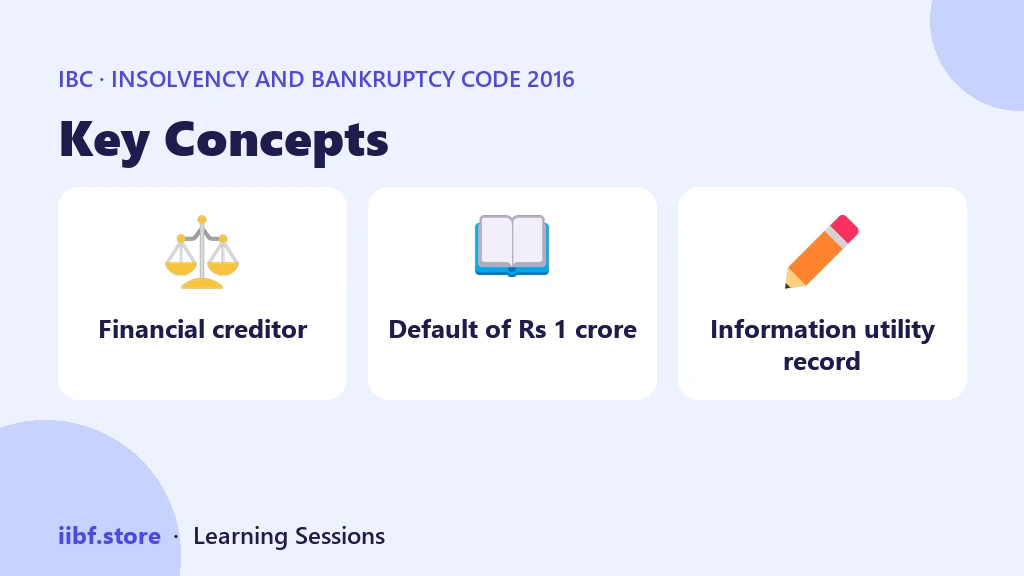
Three ideas carry the whole section, and you should be able to define each in one line in the exam:
- Financial creditor: a person to whom a financial debt is owed. Financial debt means a debt with interest, disbursed against the consideration for the time value of money, such as a term loan, cash credit or debentures.
- Default: non-payment of a debt when it has become due and payable and is not paid by the debtor.
- Adjudicating Authority: for companies, the NCLT bench having territorial jurisdiction over the registered office of the corporate debtor.
An important clarification sits in the Explanation to the section: the default may be a default on a financial debt owed to any financial creditor of the corporate debtor, not only to the creditor who is filing. So a small lender can file even if the default relates to another bank, provided the debtor has defaulted on a financial debt of the required size.
Who must file jointly
The section has provisos for creditors who are many in number. Financial creditors who are debenture holders, deposit holders and similar classes in Section 21(6A), and allottees under a real estate project, cannot file singly. They must file jointly, with at least 100 creditors of the class or 10 per cent of the class, whichever is less. A single homebuyer therefore cannot trigger a Section 7 application; a bank, however, can always file on its own.
The minimum default: Rs 1 crore
Section 4 of the Code says Part II (corporate insolvency) applies where the default is of at least Rs 1 lakh, and lets the Central Government raise that figure up to Rs 1 crore. By notification S.O. 1205(E) dated 24 March 2020, the Ministry of Corporate Affairs fixed the minimum amount of default at Rs 1 crore. You can read the notification on the IBC law notification page. For a bank this seldom matters, because a corporate NPA is usually far above the threshold, but exam questions like to test it.
What the bank must file with the application
A section 7 application by financial creditor is not just a letter to the tribunal. It is made in the prescribed form, in the prescribed manner and with the prescribed fee, and it must carry the following:
- A record of the default recorded with an information utility (in India, the National e-Governance Services Ltd, NeSL), or other evidence of default as specified by the Insolvency and Bankruptcy Board of India (IBBI).
- The name of the resolution professional proposed to act as Interim Resolution Professional (IRP).
- Any other information the Board specifies.
This is why banks now authenticate every loan record with NeSL at the time of sanction and disbursement. A default record that the borrower has already confirmed through the utility is the cleanest proof, and it makes admission quick. If you want to see how the utilities and the regulator fit together, the IBC course lays out the whole institutional framework in the IBC 2016 course.
Key concepts a banker must have clear
Before the process, fix the vocabulary. Most wrong answers in IBC papers come from mixing these terms.
Financial creditor versus operational creditor
A bank that lends money is a financial creditor and uses Section 7. A supplier of goods or services, or an employee owed wages, is an operational creditor and uses a different route, Section 9, which begins with a demand notice. A Section 7 filing has no pre-filing demand notice to the debtor; the filing rests on the proof of default.
Date of default and date of commencement
The date of default is when the debt fell due and was not paid. It matters for limitation. The insolvency commencement date is different: under Section 7(6), CIRP commences on the date the Adjudicating Authority admits the application. Mixing up these two dates is a classic trap.
Limitation
Section 238A applies the Limitation Act, 1963 to IBC proceedings, so a time-barred debt cannot ordinarily be recovered through Section 7. Banks therefore keep acknowledgments, balance confirmations and part-payments on record, because a valid acknowledgment in writing can extend the limitation period.
Step by step: how a Section 7 case moves
Here is the sequence of a section 7 application by financial creditor, from the branch desk to the tribunal order.
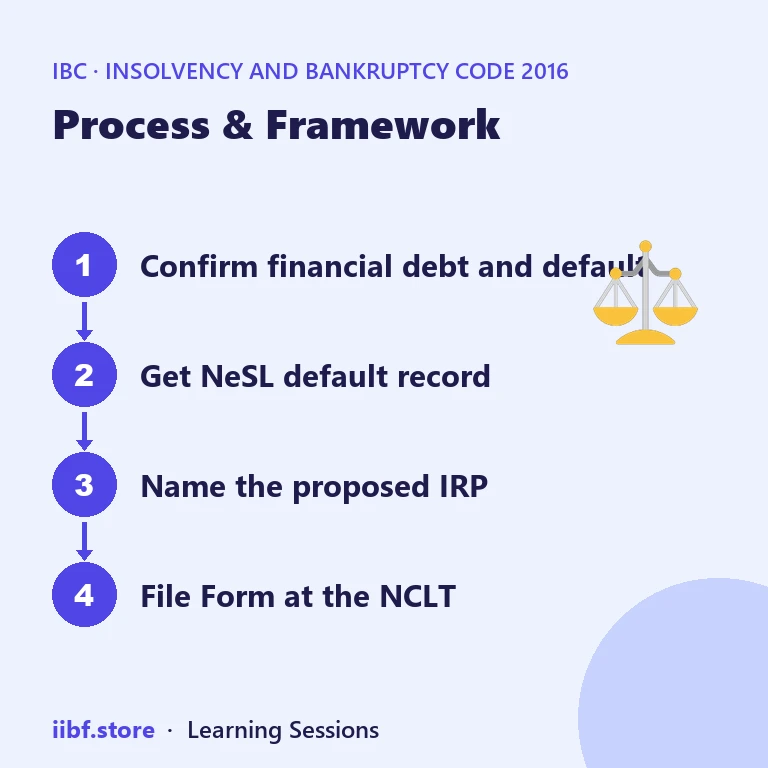
- Confirm financial debt and default. The recovery team checks that the facility is a financial debt, that the amount is due, and that the default is at least Rs 1 crore.
- Get the default record. Obtain the NeSL record, or other prescribed evidence such as the loan agreement, statements of account and the NPA classification trail.
- Choose the proposed IRP. The bank names a resolution professional and attaches the written consent. The professional should not face a pending disciplinary proceeding.
- File at the NCLT. The application goes to the bench with jurisdiction over the debtor's registered office, with the prescribed fee.
- Admission or rejection within 14 days. The tribunal decides under Section 7(5), described below.
- Communication and commencement. The order must be communicated within seven days. On admission, CIRP starts, the moratorium under Section 14 begins, and the IRP takes over the management of the company.
The 14-day rule and the 2026 amendment
This is the part that changed recently, so read it carefully. The Insolvency and Bankruptcy Code (Amendment) Act, 2026 (Act 6 of 2026) received assent on 6 April 2026. It substituted Section 7(5). The substituted text, as published in the Gazette, says the Adjudicating Authority shall, within 14 days of receiving the application, by order:
- admit the application if it is satisfied that a default has occurred, the application is complete, and no disciplinary proceeding is pending against the proposed resolution professional; or
- reject the application if a default has not occurred, or the application is incomplete, or a disciplinary proceeding is pending against the proposed resolution professional.
Before rejecting an application, the tribunal must give notice so the applicant can rectify the defect within seven days of receiving the notice. If the tribunal has not passed its order within 14 days, it must record the reasons for the delay in writing. Two new Explanations were added. Explanation I says that where the requirements for admission are met, no other ground can be considered to reject the application. Explanation II says that where a financial institution files a record of default recorded with an information utility along with its application, that record is sufficient for the tribunal to ascertain default.
The Ministry of Corporate Affairs brought these provisions into force from 26 May 2026 through notification S.O. 2625(E) dated 22 May 2026, which covers sections 2 to 6 of the Amendment Act, the section that amends Section 7 of the Code. You can read the amending text on the IBBI-hosted Amendment Act. For the exam cycle, assume the amended Section 7(5) is the law, and watch the IIBF and IBBI websites for any further notification.
What this means for a bank
The direction is clear: once default and completeness are shown, admission should follow. The tribunal's role at the admission stage is narrow. It does not weigh the borrower's commercial hardships or the prospects of revival at that stage; those belong to the resolution process itself. This is also why a clean, utility-backed record, a complete application and a clean proposed IRP matter so much.
Worked example from a branch
Take an illustrative case. A manufacturing company has a term loan and a cash credit limit with your bank. The term loan instalments have been unpaid for many months, the account is classified NPA, and the outstanding is well above Rs 1 crore. NeSL holds the authenticated record of the loan and the default. The recovery department chooses a resolution professional, files the application with the NCLT bench at the company's registered office, and attaches the NeSL record, the sanction letter and account statements.
| Item | What the tribunal checks | Banker's evidence |
|---|---|---|
| Financial debt | Is it a debt disbursed against time value of money? | Sanction letter, loan agreement |
| Default | Is the debt due and unpaid, at least Rs 1 crore? | NeSL record, statements, NPA trail |
| Completeness | Is the application in the prescribed form with the required particulars? | Filled form, fee, annexures |
| Proposed IRP | Is there a named professional with no pending disciplinary proceeding? | Consent and eligibility details |
| Limitation | Is the application within the limitation period? | Default date, acknowledgments |
If everything is in order, the bench admits the application within 14 days. From the date of admission, the moratorium bars suits and enforcement against the company, the board stops functioning and the IRP takes control. Within the statutory time, the IRP then makes the public announcement and invites claims, and a Committee of Creditors (CoC) is formed. Our posts on the free study material page include notes on the later stages of CIRP.
Why a section 7 application by financial creditor gets rejected
- Debt is not a financial debt. A trade payable or a guarantee that has not been invoked may not qualify. Check the nature of the facility first.
- No default or default below the threshold. Reconcile the account, including recoveries and interest, before filing.
- Incomplete application. Missing annexures, an unsigned authorisation or a missing IRP consent can lead to a notice and, if not cured within seven days, rejection.
- Disciplinary proceeding against the proposed IRP. Always confirm the status of the professional with IBBI before naming him.
- Time barred claim. Keep acknowledgments and security-related correspondence in the file.
How IIBF tests this topic
IIBF questions on a Section 7 application by financial creditor are usually direct statements or case-based facts. Expect questions on who can file, the Rs 1 crore threshold, the 14-day period, the date from which CIRP commences, and the difference from Section 9. Read every option for a hidden swap between Section 7 (financial creditor) and Section 9 (operational creditor).
Practice question 1
Which provision of the IBC lets a financial creditor initiate CIRP against a corporate debtor? Options: Section 7, Section 9, Section 10, Section 54A. The answer is Section 7. Section 9 is for operational creditors, and Section 10 is for the corporate debtor's own application.
Practice question 2
From which date does CIRP commence on a financial creditor's application? Options: date of default, date of filing, date of admission, date of the first CoC meeting. The answer is the date of admission, as Section 7(6) says. The filing date and the default date do not start CIRP.
Practice question 3
Real estate allottees wish to file under Section 7. What is the requirement? They must file jointly, with at least 100 allottees of the same project or 10 per cent of the allottees, whichever is less. A single allottee cannot file alone.
To practise this with timed questions, try the chapter-wise IBC mock tests, and revise the full statute from the IBC printed book with chapter-wise MCQs.
Quick revision points
- Section 7 is the financial creditor's route; Section 9 is the operational creditor's route; Section 10 is the corporate applicant's route.
- The minimum default is Rs 1 crore, fixed by MCA notification S.O. 1205(E) of 24 March 2020.
- Application needs a default record from an information utility, the proposed IRP's name and the prescribed particulars.
- After the 2026 amendment, the tribunal admits or rejects within 14 days under Section 7(5), with a seven-day window to cure defects before rejection.
- If admission requirements are met, no other ground can be used to reject.
- CIRP starts on the date of admission, and the moratorium follows.
- The Limitation Act applies through Section 238A.
Frequently asked questions
Who can file a Section 7 application?
A financial creditor, alone or jointly with other financial creditors, or a person the Central Government notifies on its behalf. Debenture holders, deposit holders and real estate allottees must file jointly, in the numbers the Code prescribes.
What is the minimum default for a Section 7 application?
The minimum amount of default is Rs 1 crore, as fixed by the MCA notification S.O. 1205(E) dated 24 March 2020 under the proviso to Section 4.
How long does the NCLT take to admit a Section 7 application?
Section 7(5) requires the Adjudicating Authority to decide within 14 days of receiving the application. If it does not, it must record the reasons for the delay in writing.
Is an information utility record compulsory?
The application must furnish a record of default from an information utility or other evidence of default specified by the Board. For a financial institution, the amended Section 7(5) says a utility-recorded default record filed with the application is sufficient to ascertain default.
When does CIRP start under Section 7?
CIRP commences on the date the Adjudicating Authority admits the application, not on the date of default or of filing.
Conclusion
The Section 7 application by financial creditor is the bank's main weapon in the IBC and a high-yield exam topic. Remember the chain: financial debt, default of at least Rs 1 crore, utility record, proposed IRP, admission within 14 days, and commencement on the date of admission. Learn the 2026 change to Section 7(5) well, and check the official schedule and syllabus at iibf.org.in for the upcoming exam cycle. For complete preparation, combine the course, the book and the mock tests listed above.
Prefer revising from a printed book?
Chapter-wise books with MCQs after every chapter — minimal pages, complete coverage, delivered anywhere in India. Every book has a free sample to read first.


















































Quick quiz on this topic
5 exam-style questions from our free test bank — check yourself before you move on.
Practice this topic
Take a free mock test, download chapter PDFs, or watch a video class — all included on iibf.store.