Beneficial Ownership Identification: KYC-AML Exam Guide 2026
Beneficial ownership identification is one of the trickiest yet most heavily tested ideas in the KYC, AML and CFT syllabus, because it forces a banker to look past the account holder on paper and ask who actually owns or controls the money behind a legal entity. Under the PMLA Rules 2005 and RBI's Master Direction on KYC, banks must trace shell companies, trusts and partnership firms down to the real natural person who ultimately benefits. This article breaks the concept into thresholds, red flags and FATF alignment, exam-style.
📋 Who Counts as a "Beneficial Owner" Under PMLA Rules
The Prevention of Money Laundering (Maintenance of Records) Rules, 2005 define a beneficial owner as the natural person who ultimately owns, controls, or is entitled to benefit from a customer, or on whose behalf a transaction is conducted. The rule deliberately looks through nominee shareholders, holding structures and layered entities to find a flesh-and-blood person. Two tests run in parallel: an ownership test (a shareholding or capital/profit interest above a prescribed threshold) and a control test (the ability to direct management decisions even without meeting the ownership threshold, for example through voting rights, board appointment powers, or a shareholders' agreement). Where no natural person satisfies either test, the rules require the bank to identify the senior managing official as a fallback beneficial owner. This layered definition matters because launderers often deliberately fragment ownership below the numeric threshold across multiple nominees to stay invisible — which is exactly why RBI's legislation at the national level chapter pairs the PMLA Rules with the Companies Act's significant beneficial owner (SBO) reporting regime for cross-verification.
💡 Exam Tip: Remember the rule as "ownership OR control OR senior managing official" — a fallback chain, not three independent alternatives to choose freely.
🏢 Thresholds Across Companies, Partnerships and Trusts
The exact ownership threshold for beneficial ownership identification changes by entity type, and examiners love this variation. For a company, a natural person holding 25% or more of shares or capital or profits is a beneficial owner. For a partnership firm or unincorporated association, the bar drops to 15% of capital or profits. For a trust, it is again 15%, but applied to the trustee, settlor, protector, beneficiaries with 15%+ interest, and any other natural person exercising ultimate effective control through a chain of control or ownership. Trusts are treated more strictly because settlors can retain informal control while formally divesting ownership. Where the customer or the owner of the controlling interest is a company listed on a stock exchange, or is a subsidiary of such a company, the KYC rules exempt the bank from separately verifying the identity of shareholders and beneficial owners of that listed company, since exchange disclosure norms already provide transparency.
🔍 Why Getting This Right Matters for AML/CFT
Weak beneficial ownership identification is the single biggest structural gap that money launderers exploit, because a layered corporate or trust structure lets illicit funds move through the formal banking system while the true controller stays anonymous. Trade-based money laundering schemes routinely use shell entities with opaque ownership to justify inflated or under-invoiced trade transactions — a pattern covered in our companion piece on trade-based money laundering. Politically exposed persons (PEPs) also frequently hide behind family members or trusted associates as nominee beneficial owners, so enhanced due diligence requires banks to probe source-of-wealth questions whenever a beneficial owner's profile does not match the declared business activity. Getting this wrong undermines the entire customer due diligence architecture, since CDD and EDD are only as strong as the identity they verify — see our guide to customer due diligence for the full picture.
| Entity Type | Ownership Threshold | Control Test Also Applies | Listed-Company Exemption |
|---|---|---|---|
| Company | 25% of shares/capital/profits | ✅ Yes | ✅ Yes |
| Partnership firm | 15% of capital/profits | ✅ Yes | ❌ No |
| Unincorporated association | 15% of capital/profits | ✅ Yes | ❌ No |
| Trust | 15% beneficiary interest | ✅ Yes (settlor/protector/trustee) | ❌ No |
| Sole proprietorship | Not applicable | ❌ No (proprietor is the customer) | ❌ No |
🌐 FATF Recommendation 24/25 and Global Alignment
India's domestic rules on beneficial ownership identification are not designed in isolation — they map directly onto FATF Recommendation 24 (transparency of legal persons) and Recommendation 25 (transparency of legal arrangements such as trusts). FATF's mutual evaluation reports repeatedly flag beneficial ownership transparency as a weak spot across jurisdictions, precisely because registries can lag behind real ownership changes and nominee arrangements are hard to detect from documents alone. Our detailed breakdown of the FATF 40 Recommendations situates Recommendations 24 and 25 within the broader 40-point framework banks are tested on. For the exam, it helps to study international consistency and gap analysis directly against the international guidelines and standards chapter, which cross-references FATF's beneficial ownership expectations with India's PMLA Rules and Companies Act SBO disclosures side by side.
⚠️ Common Mistake: Candidates often assume the beneficial ownership threshold is uniform at 25% across all entity types — remember partnerships and trusts drop to 15%.
🏦 Bank Procedures: Verification, Red Flags and Monitoring
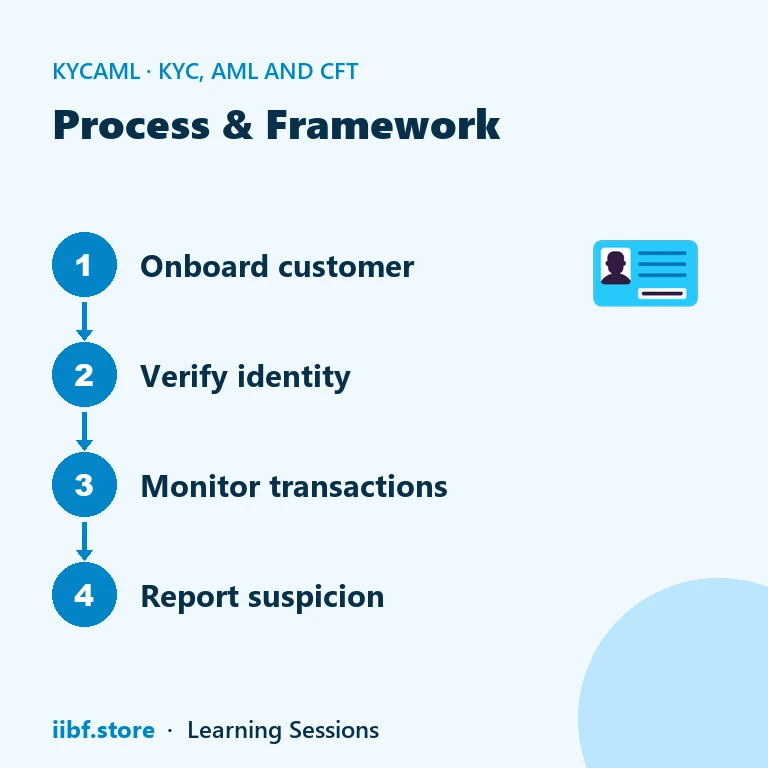
In practice, beneficial ownership identification is captured at account opening through a declaration form supported by identity and address proof, cross-checked against shareholding registers, partnership deeds, or trust deeds as applicable. Correspondent banking relationships raise the stakes further, since a respondent bank's own KYC failures on beneficial ownership can expose the correspondent to indirect risk across its underlying customers — explored in our correspondent banking chapter. Ongoing monitoring should flag a sudden shift in shareholding pattern, frequent changes of directors or trustees, or owners located in high-risk jurisdictions. FIU-India treats undisclosed or inconsistent beneficial ownership as a standalone red flag warranting an STR, independent of transaction value. Banks should also refresh declarations at periodic KYC updation, not just onboarding, since control structures evolve over an account's life.
📌 Remember: Beneficial ownership is refreshed at periodic KYC updation, not treated as a one-time onboarding checkbox.
🧠 Practice MCQs: Beneficial Ownership Identification
Q1. Under the PMLA Rules, 2005, what is the beneficial ownership threshold for a company customer? (a) 10% of shares (b) 15% of shares or capital (c) 25% of shares, capital or profits (d) 50% of voting rights
Answer: (c) — Companies use a 25% ownership threshold, higher than the 15% applied to partnerships and trusts.
Q2. For a trust, which of the following is NOT automatically treated as a potential beneficial owner? (a) Settlor (b) Trustee (c) Protector (d) External auditor of the trust
Answer: (d) — The external auditor plays no ownership or control role; settlor, trustee and protector are all explicitly covered.
Q3. When no natural person meets the ownership or control test, the KYC rules require identification of: (a) The bank's compliance officer (b) The senior managing official of the customer entity (c) The largest depositor (d) No one; the account cannot be opened
Answer: (b) — The senior managing official is the fallback beneficial owner when ownership and control tests both fail to identify a person.
Q4. Which FATF Recommendation deals specifically with transparency of legal arrangements such as trusts? (a) Recommendation 10 (b) Recommendation 16 (c) Recommendation 24 (d) Recommendation 25
Answer: (d) — Recommendation 25 covers legal arrangements like trusts; Recommendation 24 covers legal persons like companies.
Q5. A bank may skip separate beneficial owner verification when the customer is a subsidiary of a company that is: (a) Privately held (b) Listed on a recognised stock exchange (c) Registered under the Partnership Act (d) A trust with unnamed beneficiaries
Answer: (b) — Listed companies and their subsidiaries are exempt from separate beneficial owner verification due to exchange disclosure norms.
Want chapter-wise mock tests with 100+ MCQs? Start practising free →
❓ Frequently Asked Questions
What is beneficial ownership identification in KYC?
It is the process of tracing a legal entity customer, such as a company, partnership or trust, to the natural person who actually owns, controls or benefits from it, as required under the PMLA Rules, 2005.
What is the beneficial ownership threshold for companies versus trusts?
Companies use a 25% ownership or capital/profit threshold, while partnerships, unincorporated associations and trusts use a lower 15% threshold, reflecting their typically simpler ownership structures.
Is beneficial ownership verified only once at account opening?
No. Beneficial ownership declarations should be refreshed during periodic KYC updation because shareholding, control and trustee arrangements can change over the life of the relationship.
How does beneficial ownership relate to FATF standards?
India's PMLA Rules operationalise FATF Recommendations 24 and 25, which require countries to ensure adequate, accurate and timely beneficial ownership information on legal persons and arrangements.
Beneficial ownership identification sits at the intersection of company law, trust law and AML practice, which is exactly why IIBF exams probe it from multiple angles — much like tracing the true risk owner in a stressed asset resolution framework under the CCP syllabus. For a structured refresher on organisational responsibility for AML/CFT compliance, review the organization structure in India chapter, then reinforce the concept with the full KYC-AML topic hub and a timed mock test at iibf.store/tests before exam day.
Quick quiz on this topic
5 exam-style questions from our free test bank — check yourself before you move on.
Practice this topic
Take a free mock test, download chapter PDFs, or watch a video class — all included on iibf.store.
Keep reading