ROCE, ROE and ROA Explained in 5 Minutes (JAIIB AFM)
Three little ratios do a huge amount of heavy lifting in JAIIB AFM: ROCE, ROE and ROA. They all measure “how well is this business turning money into profit?” — but each looks at a different pool of money, and mixing them up is the classic way to drop an easy mark. The five-minute revision above gives you the shortcut; this guide gives you the understanding that makes the shortcut stick.
ROCE, ROE & ROA in 5 Minutes — JAIIB AFM Quick Revision #3 · Watch on YouTube
What each ratio really answers
The trick to remembering ROCE, ROE and ROA is to ask “return on what?” The answer changes the numerator and the denominator together.
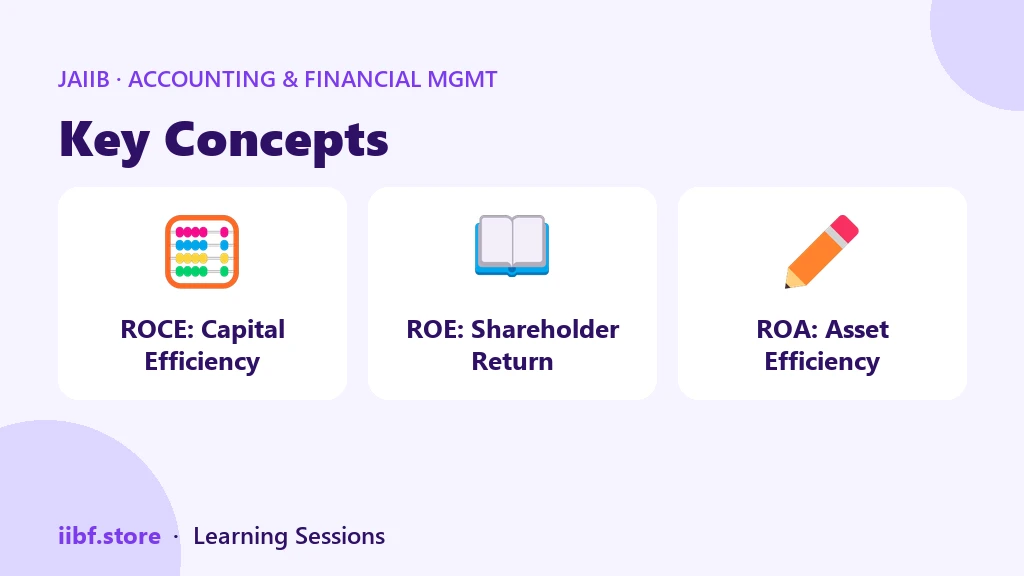
- ROCE (Return on Capital Employed) = EBIT ÷ Capital Employed. It measures how efficiently all long-term capital — equity plus debt — generates operating profit. Because it uses EBIT (before interest and tax), it ignores how the business is financed.
- ROE (Return on Equity) = Profit After Tax ÷ Shareholders’ Equity (net worth). It measures the return earned for the owners only, after interest and tax are paid.
- ROA (Return on Assets) = Net Profit ÷ Total Assets. It measures how efficiently the business uses its entire asset base to generate profit.
So ROCE looks at total capital, ROE looks at owners’ capital, and ROA looks at total assets. One idea, three lenses.
A worked example you can copy in the exam
Numbers make this concrete. Take a company with EBIT of ₹120, Profit After Tax of ₹70, Capital Employed of ₹600, Shareholders’ Equity of ₹400, and Total Assets of ₹1,000.
| Ratio | Formula | Calculation | Result |
|---|---|---|---|
| ROCE | EBIT / Capital Employed | 120 / 600 | 20% |
| ROE | PAT / Shareholders’ Equity | 70 / 400 | 17.5% |
| ROA | Net Profit / Total Assets | 70 / 1,000 | 7% |
Same company, three very different numbers — and each is “correct.” That is exactly why an MCQ can hand you EBIT and ask for ROE (a distractor) or hand you PAT and ask for ROCE (another distractor). Read which profit figure and which base the question wants, then pick the matching formula. Getting fluent with ROCE, ROE and ROA is really about getting fast at that matching step.
How to solve any return-ratio question
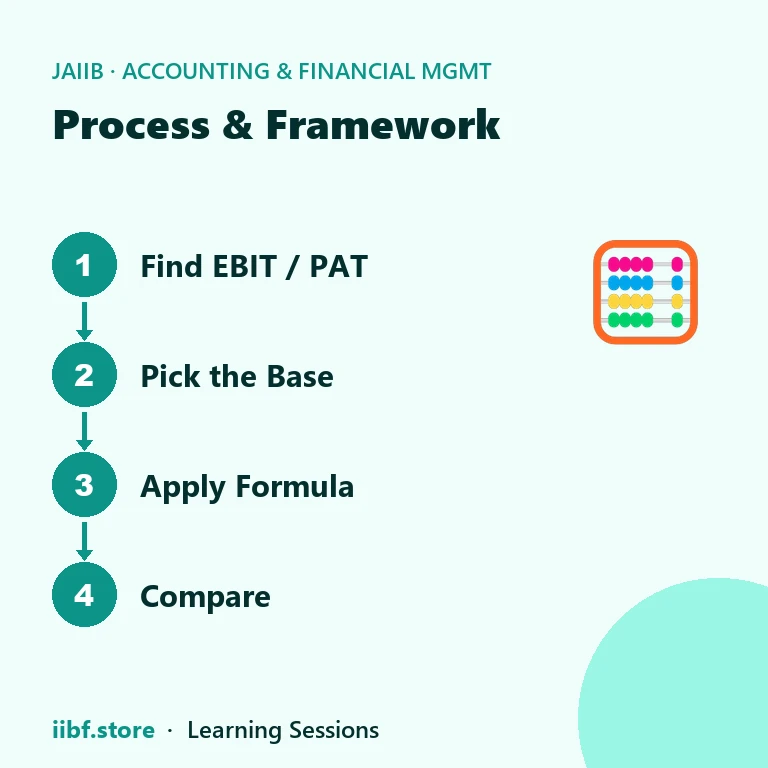
Whatever the wording, the method is the same four steps:
- Find the right profit figure. EBIT for ROCE; PAT (net profit) for ROE and ROA. Underline it in the question so you do not grab the wrong line.
- Pick the base. Capital Employed, Shareholders’ Equity, or Total Assets — this is where distractors live.
- Apply the formula and express as a percentage.
- Compare or interpret if the question asks which is more efficient or why ROE exceeds ROCE (a clue that debt is boosting owner returns — the leverage effect).
Drill this on a dozen sums and it becomes automatic. Our JAIIB mock tests serve up ratio questions in the exact one-mark format, the study planner can carve out a daily numerical slot, and the match game is a quick way to fix the formula pairings in memory. For the full paper, work through the JAIIB course so ratio analysis sits alongside the rest of AFM in order.
The insight examiners love
Once the arithmetic is easy, examiners test interpretation. If ROE is higher than ROCE, the company is using debt effectively — borrowed money is earning more than it costs, lifting the owners’ return. If ROA is very low while ROE looks healthy, the business is heavily leveraged. Being able to read the story behind ROCE, ROE and ROA, not just compute them, is what separates a 50 from a 65 in AFM. For the underlying accounting standards behind these figures, the regulator’s resources at rbi.org.in are a reliable reference.
Where these ratios show up beyond the exam
It is tempting to treat ROCE, ROE and ROA as three formulas to memorise and forget the day after the paper. Resist that. These are the exact numbers a credit officer scans when a company walks in for a loan, and understanding them now pays off long after JAIIB AFM is behind you. A lender reads ROCE to judge whether the business earns more on its capital than the bank would charge for it, ROE to see how the owners are being rewarded, and ROA to gauge how hard the asset base is working.
That practical lens also helps you answer trickier exam items. When a question compares two firms, it is really asking you to reason like an analyst: the company with steadier, higher ratios across cycles is usually the safer bet, even if a rival posts a flashier single-year figure. And when the numbers pull in different directions — strong ROE but weak ROA, say — the story is almost always leverage, and the “correct” option is the one that names it.
So drill the arithmetic until it is automatic, but keep asking what each result means. Candidates who can move fluently between computing ROCE, ROE and ROA and interpreting them are the ones who turn a nervous pass into a confident, high AFM score — and who carry a genuinely useful skill into their banking careers.
Frequently asked questions
What is the difference between ROCE and ROE?
ROCE uses EBIT over total capital employed (equity plus debt), while ROE uses profit after tax over shareholders’ equity only. ROCE ignores financing; ROE reflects it.
Why is ROA usually lower than ROE?
ROA divides profit by the entire asset base, which is larger than shareholders’ equity alone. When a company uses debt, ROE is magnified above ROA through the leverage effect.
Which profit figure do I use for each ratio?
Use EBIT for ROCE, and profit after tax (net profit) for both ROE and ROA. Picking the wrong profit line is the most common mistake in these questions.
Are ROCE, ROE and ROA important for JAIIB AFM?
Yes. Ratio analysis is a high-frequency scoring area in AFM, and these three return ratios appear regularly, often with distractor options built from the wrong base or profit figure.
Prefer revising from a printed book?
Chapter-wise books with MCQs after every chapter — minimal pages, complete coverage, delivered anywhere in India. Every book has a free sample to read first.
128 pages · 524 MCQs
Learning Sessions · Ashish Sir
131 pages · 672 MCQs
Learning Sessions · Ashish Sir
221 pages · 831 MCQs
Learning Sessions · Ashish Sir
107 pages · 445 MCQs
Learning Sessions · Ashish Sir
148 pages · 478 MCQs
Learning Sessions · Ashish Sir
151 pages · 465 MCQs
Learning Sessions · Ashish Sir
148 pages · 375 MCQs
Learning Sessions · Ashish Sir
216 pages · 895 MCQs
Learning Sessions · Ashish Sir
109 pages · 300 MCQs
Learning Sessions · Ashish Sir
104 pages · 360 MCQs
Learning Sessions · Ashish Sir
82 pages · 297 MCQs
Learning Sessions · Ashish Sir
151 pages · 600 MCQs
Learning Sessions · Ashish Sir
98 pages · 282 MCQs
Learning Sessions · Ashish Sir
132 pages · 225 MCQs
Learning Sessions · Ashish Sir
188 pages · 435 MCQs
Learning Sessions · Ashish Sir
117 pages · 236 MCQs
Learning Sessions · Ashish Sir
Learning Sessions · Ashish Sir
118 pages · 299 MCQs
Learning Sessions · Ashish Sir
Learning Sessions · Ashish Sir
Learning Sessions · Ashish Sir
Learning Sessions · Ashish Sir
115 pages · 255 MCQs
Learning Sessions · Ashish Sir
Learning Sessions · Ashish Sir
334 pages · 936 MCQs
Learning Sessions · Ashish Sir
Learning Sessions · Ashish Sir
115 pages · 344 MCQs
Learning Sessions · Ashish Sir
107 pages · 240 MCQs
Learning Sessions · Ashish Sir
90 pages · 150 MCQs
Learning Sessions · Ashish Sir
Learning Sessions · Ashish Sir
Quick quiz on this topic
5 exam-style questions from our free test bank — check yourself before you move on.
Practice this topic
Take a free mock test, download chapter PDFs, or watch a video class — all included on iibf.store.