FEMA Residential Status: NRI vs PIO vs OCI (CAIIB BFM)
One of the quietest ways to lose marks in CAIIB BFM is to assume that residence follows your passport. It does not. FEMA residential status is decided by where you actually live and intend to stay — not by your citizenship — and once you internalise that one idea, the whole NRI vs PIO vs OCI puzzle falls into place. The quick revision above sets it up; this guide locks it in.
FEMA Residential Status: NRI vs PIO vs OCI — CAIIB BFM Quick Revision · Watch on YouTube
What FEMA residential status actually measures
The Foreign Exchange Management Act draws a line between a “person resident in India” and a “person resident outside India.” The primary test is time: broadly, a person who has stayed in India for more than 182 days during the preceding financial year is treated as resident — subject to the purpose and intention of their stay or departure. In other words, FEMA residential status is about physical presence plus intent, and it can flip the moment someone leaves for employment, business or an uncertain-duration stay abroad. Citizenship never enters this test.
NRI vs PIO vs OCI — the clean distinction
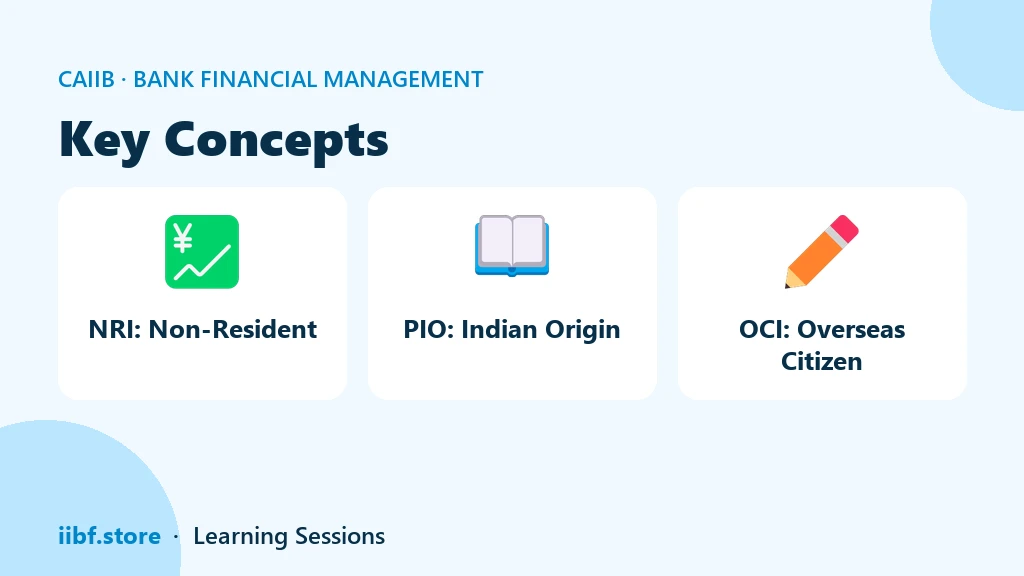
Here is the part that trips up candidates. NRI is a residence concept, while PIO and OCI are origin/citizenship concepts. They answer different questions, which is why a person can be more than one at once.
- NRI (Non-Resident Indian): an Indian citizen who is resident outside India as per the residence test above. This is a FEMA residence label.
- PIO (Person of Indian Origin): a foreign citizen (other than a citizen of certain specified countries) who, or whose ancestors, held an Indian passport or belonged to India. The separate PIO card scheme was merged into OCI in 2015, but the “Indian origin” concept still matters for account eligibility.
- OCI (Overseas Citizen of India): a foreign citizen registered as an Overseas Citizen of India, granting long-term visa and many resident-like rights — though it is not full dual citizenship.
For deposit accounts, banks treat NRIs and persons of Indian origin/OCIs alike — all three can maintain NRE, NRO and FCNR(B) accounts. The category matters most for which facilities and investments open up, and that is where BFM examiners like to probe.
Why this matters for account types
The whole reason FEMA residential status sits in the BFM syllabus is that it decides which rupee and foreign-currency accounts a person may operate. A quick comparison:
| Account | Currency | Who can hold it | Repatriable? |
|---|---|---|---|
| NRE | INR | NRIs / PIOs / OCIs | Yes (principal & interest) |
| NRO | INR | NRIs / PIOs / OCIs | Limited (within norms) |
| FCNR(B) | Foreign currency | NRIs / PIOs / OCIs | Yes |
| Resident savings | INR | Persons resident in India | Not applicable |
So the exam logic runs one way: establish residence → establish origin → map to the permitted account. Miss the first step and the rest collapses.
A four-step method for exam questions
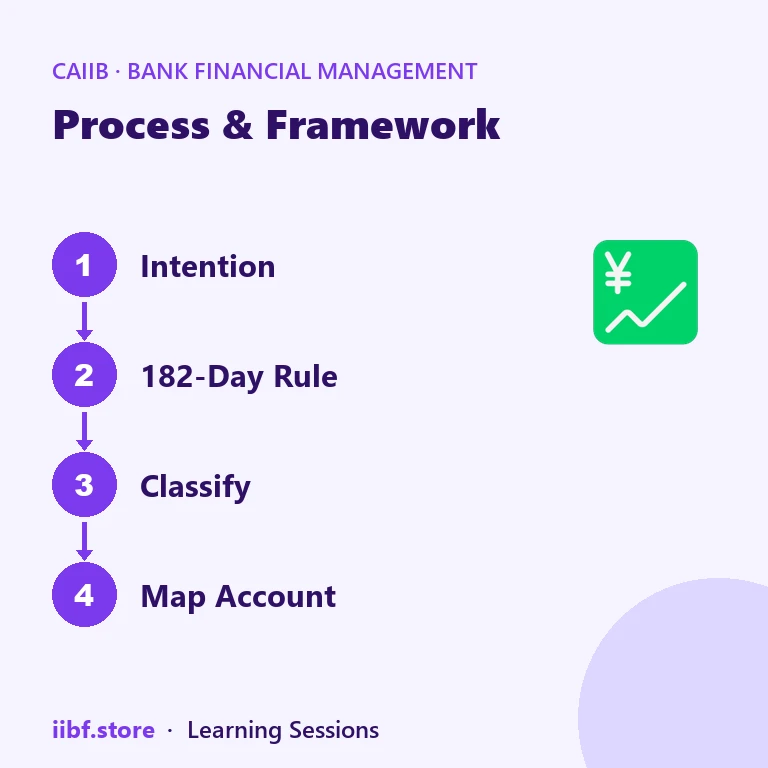
When a question describes someone flying out for a job or returning after years abroad, do not guess. Run these four steps:
- Read the intention. Is the person leaving for employment/business/uncertain stay, or coming back to settle? Intention can override a simple day-count on departure or arrival.
- Apply the 182-day rule to the preceding financial year as the baseline test.
- Classify as resident or non-resident, then layer on origin (Indian citizen → NRI; foreign citizen of Indian origin → PIO/OCI).
- Map the account or facility the person is now entitled to.
Practise this on ten varied scenarios and the pattern becomes reflex. You can drill exactly these on our CAIIB mock tests, keep the definitions sharp with the concept match game, and schedule your BFM revision through the study planner. For the full paper, the CAIIB course and dedicated BFM material walk through every forex sub-topic in order.
The traps that cost marks
Two errors show up again and again. The first is treating an OCI as an Indian citizen — OCI grants many rights but is not citizenship, so residence still governs the account. The second is forgetting that intention can flip status immediately on departure, so a person going abroad for employment becomes non-resident even before completing 182 days away. Keep those two straight and FEMA residential status questions become some of the most predictable marks in BFM. When in doubt, verify the current provisions with the regulator directly at rbi.org.in.
A quick worked scenario
Try this the way an exam would frame it. Suppose an Indian citizen leaves India in June to take up a two-year overseas contract, and the question is set in the following financial year. Do not reach for a calculator first — read the intention. Because the person left for employment for an uncertain, extended period, their FEMA residential status changes to non-resident from the date of departure, even though they had lived in India for most of the earlier year. That single clue — “left for employment” — is doing the real work in the question.
Now layer on origin. The person is an Indian citizen resident outside India, so they are an NRI, and they may open and operate NRE, NRO and FCNR(B) accounts. Had the question instead described a foreign national of Indian ancestry, you would classify them as a person of Indian origin or an OCI, with the same core account eligibility but different rules on certain investments. Run those two steps — residence, then origin — and you will answer correctly even when the numbers are deliberately noisy.
The lesson is that FEMA residential status questions reward careful reading far more than fast arithmetic. Spot the intention, apply the day-count only as a backstop, and map the account last.
Frequently asked questions
Does FEMA residential status depend on citizenship?
No. It depends on physical stay in India (broadly the 182-day rule for the preceding financial year) and the purpose/intention of the stay or departure. Citizenship is a separate question.
Can an NRI, PIO and OCI all open the same accounts?
For deposit purposes, yes — NRIs, PIOs and OCIs can all maintain NRE, NRO and FCNR(B) accounts. The category can affect certain investment and facility eligibilities.
Is OCI the same as dual citizenship?
No. Overseas Citizenship of India grants long-term visa and many resident-like rights but is not full dual citizenship, and it does not by itself make a person resident under FEMA.
What happened to the PIO card?
The separate PIO card scheme was merged into the OCI scheme in 2015. The “person of Indian origin” concept, however, still appears in banking eligibility rules.
Prefer revising from a printed book?
Chapter-wise books with MCQs after every chapter — minimal pages, complete coverage, delivered anywhere in India. Every book has a free sample to read first.
151 pages · 465 MCQs
Learning Sessions · Ashish Sir
148 pages · 478 MCQs
Learning Sessions · Ashish Sir
148 pages · 375 MCQs
Learning Sessions · Ashish Sir
216 pages · 895 MCQs
Learning Sessions · Ashish Sir
109 pages · 300 MCQs
Learning Sessions · Ashish Sir
104 pages · 360 MCQs
Learning Sessions · Ashish Sir
82 pages · 297 MCQs
Learning Sessions · Ashish Sir
151 pages · 600 MCQs
Learning Sessions · Ashish Sir
98 pages · 282 MCQs
Learning Sessions · Ashish Sir
131 pages · 672 MCQs
Learning Sessions · Ashish Sir
221 pages · 831 MCQs
Learning Sessions · Ashish Sir
128 pages · 524 MCQs
Learning Sessions · Ashish Sir
107 pages · 445 MCQs
Learning Sessions · Ashish Sir
132 pages · 225 MCQs
Learning Sessions · Ashish Sir
188 pages · 435 MCQs
Learning Sessions · Ashish Sir
117 pages · 236 MCQs
Learning Sessions · Ashish Sir
Learning Sessions · Ashish Sir
118 pages · 299 MCQs
Learning Sessions · Ashish Sir
Learning Sessions · Ashish Sir
Learning Sessions · Ashish Sir
Learning Sessions · Ashish Sir
115 pages · 255 MCQs
Learning Sessions · Ashish Sir
Learning Sessions · Ashish Sir
334 pages · 936 MCQs
Learning Sessions · Ashish Sir
Learning Sessions · Ashish Sir
115 pages · 344 MCQs
Learning Sessions · Ashish Sir
107 pages · 240 MCQs
Learning Sessions · Ashish Sir
90 pages · 150 MCQs
Learning Sessions · Ashish Sir
Learning Sessions · Ashish Sir
Quick quiz on this topic
5 exam-style questions from our free test bank — check yourself before you move on.
Practice this topic
Take a free mock test, download chapter PDFs, or watch a video class — all included on iibf.store.