CAIIB December 2026: How to Score 60+ (Strategy Guide)
Everyone wants to clear CAIIB. Fewer people aim to own it — to walk out of every paper with 60-plus instead of scraping the pass line. If you are sitting the CAIIB December 2026 attempt, that gap between “just passed” and “comfortably scored” is almost entirely about strategy, not raw hours. The video above breaks down what to focus on; this guide turns it into a plan you can actually follow.
CAIIB December 2026 — Exam Updates & How to Score 60+ · Watch on YouTube
The structure you are actually up against
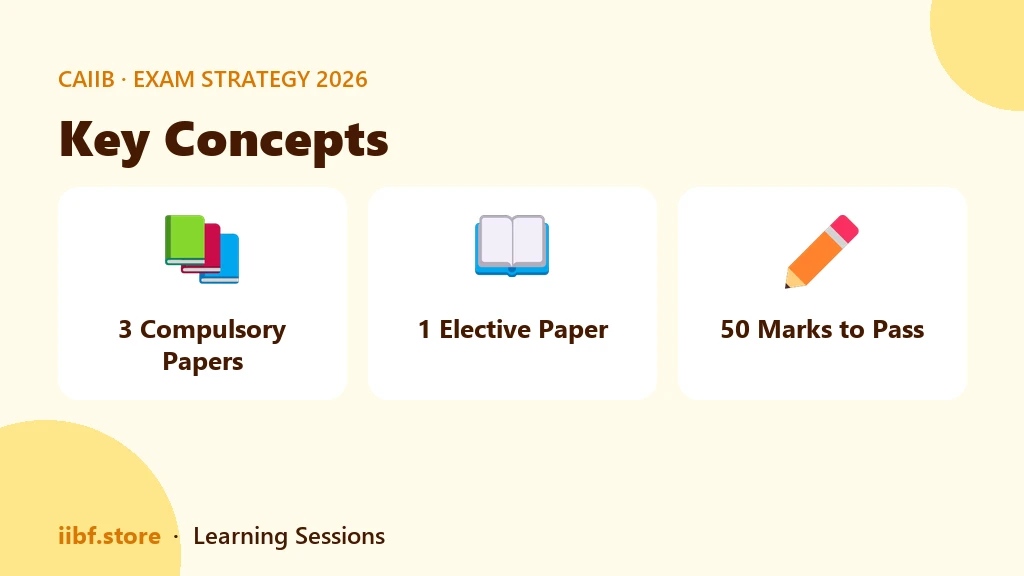
Before strategy, get the frame right. The CAIIB exam is built around three compulsory papers — Advanced Bank Management (ABM), Bank Financial Management (BFM) and Advanced Business & Financial Management (ABFM) — plus one elective, for which most candidates pick Banking Regulations & Business Laws (BRBL). Each paper is a 100-mark objective test of two hours, and the minimum for a pass is 50 marks in each subject. Those numbers are set by IIBF, so always confirm the current rules and dates for your CAIIB December 2026 attempt on the official IIBF website rather than relying on hearsay.
Why 60+ is a different game from 50
Passing CAIIB means clearing 50 in each paper. Scoring 60-plus means you have converted the “stretch” questions — the case-study and numerical items that separate a confident candidate from a lucky one. The good news: those marks live in predictable places. Duration and bond-pricing numericals in BFM, IRAC/NPA classification in ABM, valuation and capital-structure sums in ABFM, and section-number recall in BRBL. Master those clusters and 60 stops being a hope and becomes the floor.
| Paper | Where the 60+ marks hide | Effort profile |
|---|---|---|
| ABM | Statistics, IRAC/NPA, credit management | Formula drills + theory recall |
| BFM | ALM, bond pricing, forex, derivatives | Numerical practice heavy |
| ABFM | Valuation, capital structure, M&A | Concept + applied sums |
| BRBL (elective) | Section numbers, SARFAESI, IBC | Pure recall — high ROI |
A four-step plan for CAIIB December 2026
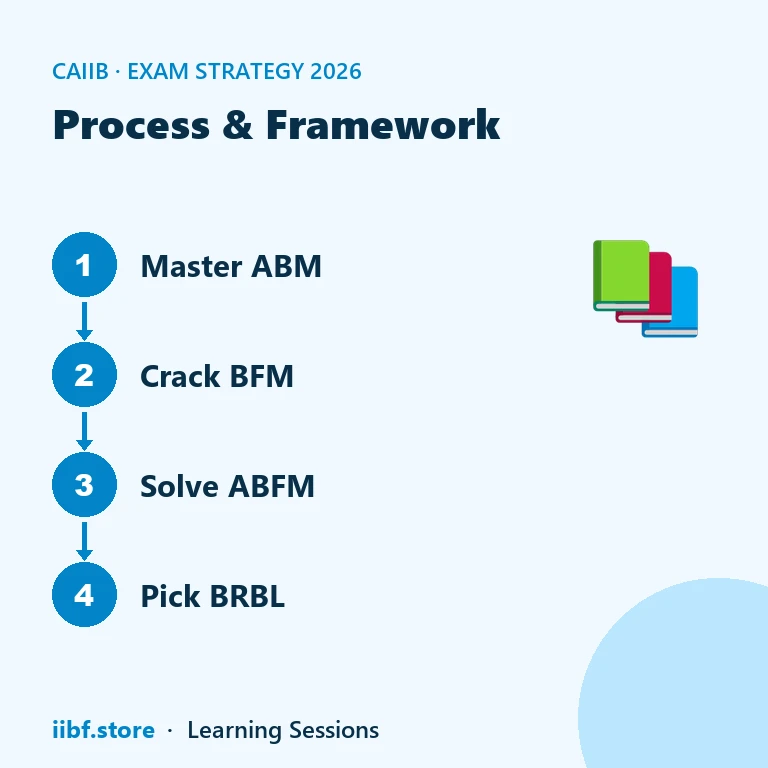
Do not spread yourself evenly across everything. Sequence the papers by how they reward effort:
- Master ABM early. Its statistics and NPA sections are formula-driven, so the earlier you drill them, the more they compound. Two or three numericals a day beats a weekend binge.
- Attack BFM with practice, not reading. BFM marks come from doing bond and duration sums until the variants feel automatic — reading the theory alone will not move your score.
- Layer ABFM on your ABM base. Valuation and capital-structure logic reuses accounting fundamentals, so it is efficient to study it after ABM rather than cold.
- Bank the elective (BRBL). It is largely recall — landmark section numbers such as Sec 13 of SARFAESI and Sec 35A of the BR Act — which makes it the single highest return-on-effort paper for a 60+ push.
Turning the plan into a routine
A plan you cannot sustain is just a wish. Break the months before CAIIB December 2026 into weekly blocks: one paper as the “main” focus, a second on maintenance revision, and a fixed daily slot for numericals. Our study planner can lay this out for you automatically and keep you honest with reminders, while full-length CAIIB mock tests rehearse the two-hour, 100-question pressure you will feel on the day. When your energy dips, ten minutes on the concept match game keeps definitions warm without feeling like grind. And build your foundation with the structured CAIIB course so you are not stitching notes together from ten sources.
Mistakes that quietly cap your score
The candidates who plateau at 52 usually make the same three errors: they treat BFM as a reading subject (it is a doing subject), they ignore the elective until the last week (it is the easiest 60+ paper), and they never sit a timed full mock (so exam-day pacing ambushes them). Fix those and the ceiling lifts on its own. Aim for 60 in your practice tests, and even a bad day on the real CAIIB December 2026 paper still lands you a comfortable pass.
Building the right mindset for CAIIB December 2026
Strategy and syllabus get most of the attention, but the candidates who clear CAIIB December 2026 with room to spare almost always share a certain temperament. They treat the exam as a project with a deadline, not a mountain to be climbed in one heroic weekend. That means small, repeatable habits: a fixed study slot most days, a running list of formulas that keep tripping you up, and a weekly review where you honestly grade your own progress instead of guessing at it.
It also means being ruthless about what you skip. You cannot master every line of every module, and trying to will only spread your attention too thin to score well anywhere. Identify the high-yield clusters in each paper — the numericals, the classification rules, the recurring section numbers — and pour your energy there first. The long tail of rare topics can wait until those anchors are solid.
Finally, protect your exam-day calm. Sit at least three full-length, timed mocks before the real CAIIB December 2026 papers so the clock stops being a threat and becomes just background noise. Candidates lose more marks to panic and poor pacing than to genuine gaps in knowledge. When you have rehearsed the pressure, you free up mental space to actually think — and that is where the difference between a pass and a strong 60-plus is quietly decided.
Frequently asked questions
What is the minimum passing mark for CAIIB?
The minimum for a pass is 50 marks out of 100 in each subject. Always reconfirm the current criteria on the official IIBF website before your attempt.
How many papers are there in CAIIB?
Three compulsory papers — ABM, BFM and ABFM — plus one elective, for which most candidates choose Banking Regulations & Business Laws (BRBL).
Which paper is easiest to score 60+ in?
The elective (typically BRBL) is largely recall-based, making it the highest return-on-effort paper. Memorising landmark section numbers can push your score well past the pass line.
How early should I start preparing for CAIIB December 2026?
Give yourself at least eight to ten weeks of consistent daily study. Numerical-heavy papers like BFM reward steady practice far more than last-minute cramming.
Prefer revising from a printed book?
Chapter-wise books with MCQs after every chapter — minimal pages, complete coverage, delivered anywhere in India. Every book has a free sample to read first.
148 pages · 478 MCQs
Learning Sessions · Ashish Sir
151 pages · 465 MCQs
Learning Sessions · Ashish Sir
148 pages · 375 MCQs
Learning Sessions · Ashish Sir
216 pages · 895 MCQs
Learning Sessions · Ashish Sir
109 pages · 300 MCQs
Learning Sessions · Ashish Sir
104 pages · 360 MCQs
Learning Sessions · Ashish Sir
82 pages · 297 MCQs
Learning Sessions · Ashish Sir
151 pages · 600 MCQs
Learning Sessions · Ashish Sir
98 pages · 282 MCQs
Learning Sessions · Ashish Sir
131 pages · 672 MCQs
Learning Sessions · Ashish Sir
221 pages · 831 MCQs
Learning Sessions · Ashish Sir
128 pages · 524 MCQs
Learning Sessions · Ashish Sir
107 pages · 445 MCQs
Learning Sessions · Ashish Sir
132 pages · 225 MCQs
Learning Sessions · Ashish Sir
188 pages · 435 MCQs
Learning Sessions · Ashish Sir
117 pages · 236 MCQs
Learning Sessions · Ashish Sir
Learning Sessions · Ashish Sir
118 pages · 299 MCQs
Learning Sessions · Ashish Sir
Learning Sessions · Ashish Sir
Learning Sessions · Ashish Sir
Learning Sessions · Ashish Sir
115 pages · 255 MCQs
Learning Sessions · Ashish Sir
Learning Sessions · Ashish Sir
334 pages · 936 MCQs
Learning Sessions · Ashish Sir
Learning Sessions · Ashish Sir
115 pages · 344 MCQs
Learning Sessions · Ashish Sir
107 pages · 240 MCQs
Learning Sessions · Ashish Sir
90 pages · 150 MCQs
Learning Sessions · Ashish Sir
Learning Sessions · Ashish Sir
Quick quiz on this topic
5 exam-style questions from our free test bank — check yourself before you move on.
Practice this topic
Take a free mock test, download chapter PDFs, or watch a video class — all included on iibf.store.