CAIIB BFM 2026: Most Important Topics to Target for 60+
Bank Financial Management is the CAIIB paper that sends most candidates into a panic, and the reason is simple: the syllabus is huge but the marks cluster around a handful of high-yield areas. If you are short on time, chasing every line of the book is the fastest way to fail. This revision guide maps the CAIIB BFM important topics that actually decide your score, so you can spend your last weeks where the marks live and walk into the exam targeting a comfortable 60+.
BFM Target 2026 - 100 Most Important Concepts · Watch on YouTube
Why a topic-first strategy beats reading cover to cover
BFM has four modules — International Banking, Risk Management, Treasury Management, and Balance Sheet Management — and they are not weighted equally in difficulty or in how predictably they are tested. Risk Management and Treasury together carry the numerical questions that repeat year after year, which is exactly why the CAIIB BFM important topics worth memorising sit largely in those two modules. Reading linearly spreads your effort evenly across content that is not tested evenly. A topic-first plan flips that: you front-load the concepts with the highest question frequency and lock in the easy, formula-driven marks first.
The high-yield concept list for 2026
Across thousands of past questions, the same themes keep reappearing. Treat the list below as your core revision map — these are the CAIIB BFM important topics to master before you touch anything peripheral. Under Risk Management, prioritise the three Basel III pillars, capital adequacy and the CRAR calculation, credit-risk approaches (standardised versus IRB), and operational-risk methods. Under Treasury and Balance Sheet Management, prioritise Asset-Liability Management (ALM), the liquidity ratios LCR and NSFR, duration and modified duration, convexity, and the interest-rate-risk measures in the banking book (IRRBB).
International Banking then adds the forex layer: FEDAI rules, nostro and vostro accounts, forward contracts and premium/discount calculation, FEMA residential status, and the mechanics of letters of credit. Get these anchored and you have covered the questions that show up almost every session.
| Module | Must-know concepts | Typical question type |
|---|---|---|
| Risk Management | Basel III, CRAR, PD/LGD/EAD, VaR | Numerical + theory |
| Treasury / BSM | ALM, duration, convexity, LCR, NSFR | Numerical (high repeat) |
| International Banking | Nostro/vostro, forward points, LC, FEMA | Applied theory |
| Balance Sheet Mgmt | Capital planning, RAROC, provisioning | Concept + calculation |
How to revise the CAIIB BFM important topics in five days
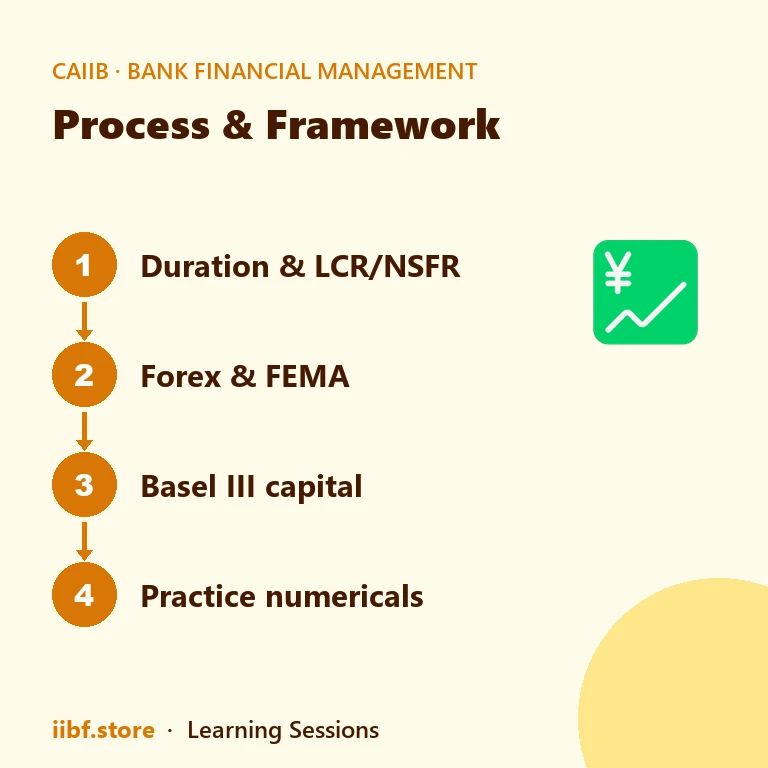
Time is the real constraint, so sequence matters. Spend day one on ALM, duration and the LCR/NSFR liquidity ratios — pure formula marks you cannot afford to miss. Day two, move to forex: forward contracts, FEMA status and nostro/vostro. Day three, consolidate Basel III capital, CRAR and credit-risk approaches. Day four, drill numericals under timed conditions, because BFM rewards speed as much as knowledge. Day five, revise your error log and attempt a full mock. Working through the CAIIB BFM important topics in this order means the highest-frequency areas get your freshest attention.
Turn revision into marks with practice
Reading the concept list is not the same as scoring on it. BFM is decided in the last ten minutes of the paper, when a duration or LCR sum either falls out cleanly or eats your time. The fix is volume: solve enough numericals that the standard formats become automatic. Pair this guide with the full CAIIB course, sharpen the analytics foundation via Advanced Bank Management, and grind chapter-wise mock tests until your accuracy holds under time pressure. Keep a study planner so the five-day sequence above actually happens instead of slipping.
Master these BFM important topics, practise them under exam conditions, and 60+ stops being a hope and becomes a plan.
Common mistakes that quietly sink BFM scores
Even candidates who know the CAIIB BFM important topics lose marks in avoidable ways, so it is worth naming the traps. The first is treating BFM like a theory paper and under-practising numericals; you may understand duration perfectly and still fumble the arithmetic under a ticking clock. The second is memorising formulas without understanding the inputs — knowing the LCR formula is useless if you cannot identify which assets count as high-quality liquid assets or how to apply the run-off factors. The third is ignoring International Banking because it feels peripheral; in reality forward-point and FEMA-status questions are among the most scoring in the paper because they follow fixed, learnable rules.
A fourth, subtler mistake is uneven revision. Candidates over-invest in one comfortable module and leave another almost blank, which caps their ceiling no matter how strong the favourite topic is. Because the paper draws from all four modules, a balanced pass across the high-frequency areas beats deep mastery of one. Finally, many aspirants skip the interest-rate-risk material — IRRBB, repricing gaps, and the impact of rate shocks on net interest income — assuming it is too advanced, when in fact the questions are formulaic once you have seen a few. Fold these fixes into your plan and the same CAIIB BFM important topics that intimidate most candidates become your most reliable source of marks. The difference between a 48 and a 62 is rarely intelligence; it is disciplined, numerical-first practice on the topics that actually repeat.
Frequently Asked Questions
Which BFM module is the most important for scoring?
Risk Management and Treasury/Balance Sheet Management carry the most repeatable numerical marks — ALM, duration, LCR/NSFR and Basel III capital appear almost every session, so prioritise them first.
How many days are enough to revise CAIIB BFM?
A focused five-day plan can cover the core CAIIB BFM important topics if you front-load formula-heavy areas (ALM, liquidity ratios, forex) and spend the final days on timed numerical practice and a full mock.
Is BFM more theory or numerical?
BFM is numerical-heavy compared with other CAIIB papers. Duration, convexity, CRAR, forward-point and LCR calculations recur, so speed with formulas often decides whether you clear 60.
What is the passing target for CAIIB BFM?
You need 50 in the paper (or 45 with an aggregate of 50 across papers). Aiming for 60+ by mastering the high-yield topics gives you a safety margin against a tough numerical set.
Focus your remaining prep on these high-yield BFM important topics, back them with relentless numerical practice, and give yourself the cushion that turns a nervous attempt into a confident pass. Begin with a free BFM mock test today.
Prefer revising from a printed book?
Chapter-wise books with MCQs after every chapter — minimal pages, complete coverage, delivered anywhere in India. Every book has a free sample to read first.











Quick quiz on this topic
5 exam-style questions from our free test bank — check yourself before you move on.
Practice this topic
Take a free mock test, download chapter PDFs, or watch a video class — all included on iibf.store.