Late Submission Fee (LSF) for FEMA Reporting: CAIIB BFM Guide
That 60-second reel throws a nasty little MCQ at you: under the current uniform framework, what is the maximum late submission fee an importer or exporter can be charged for reporting a foreign-exchange transaction late? Four tempting options, one correct answer — and if you have not drilled the rule, you will guess wrong. The late submission fee is a small topic with an outsized habit of appearing in CAIIB BFM, so let us lock it down properly.
CAIIB BFM: LSF for importers & exporters · Watch on YouTube
What the late submission fee actually is
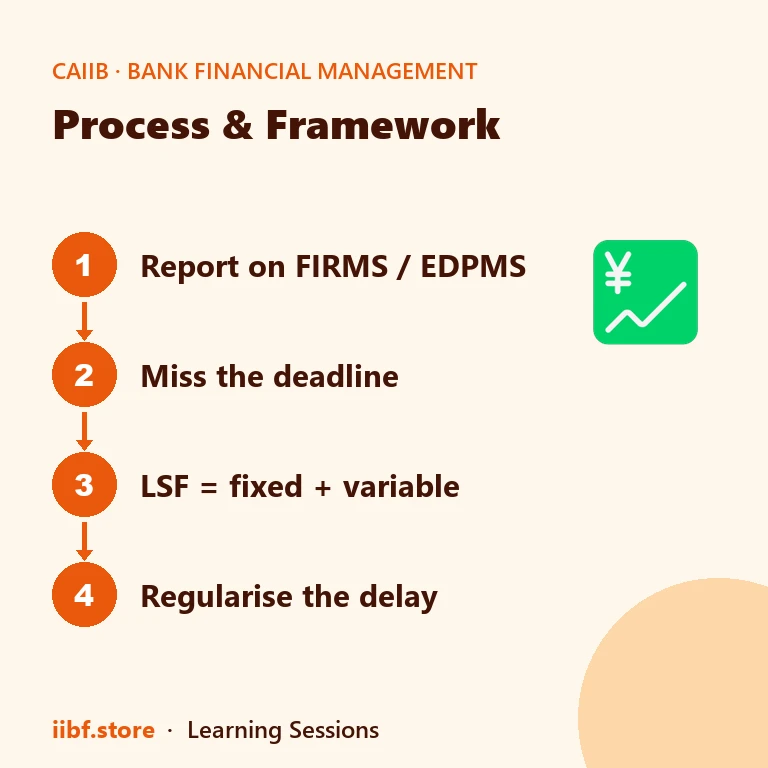
Every FEMA transaction carries a reporting deadline. When a bank or its customer files late — an FDI form, an ECB return, an overseas-investment filing, or an importer/exporter regularisation entry — RBI does not immediately treat it as a contravention to be compounded. Instead it offers a simpler off-ramp: pay a late submission fee (LSF) and the delay is regularised. It is a self-correcting mechanism that keeps minor, honest delays out of the heavier compounding process.
How the uniform LSF is calculated
RBI replaced a patchwork of penalties with a single uniform LSF matrix. The fee takes two shapes depending on what you reported late:
- For returns that do not capture a fund flow (for example an FLA return or an annual performance report), the LSF is a flat ₹7,500.
- For returns that do capture a flow (FC-GPR, FCTRS, Form ECB, ODI filings and similar), the LSF is ₹7,500 + [0.025% × A × n], where A is the amount involved and n is the number of years of delay.
And now the rule the reel is testing — the ceiling:
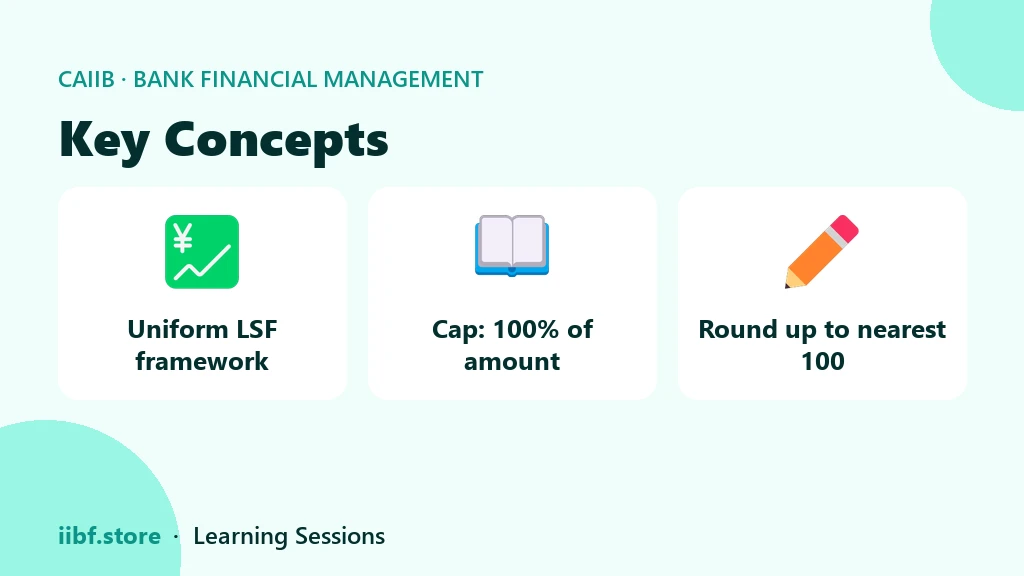
The maximum late submission fee is limited to 100% of "A" (the amount involved in the delayed reporting) and is rounded upward to the nearest ₹100.
The reel's MCQ, solved
The options were: (A) max ₹1 lakh rounded to nearest ₹1,000; (B) max 100% of the amount involved, rounded upward to the nearest ₹100; (C) max 300% capped at ₹1 lakh; (D) max ₹1 crore, no rounding. The correct answer is B. Take the video's example: if the amount involved is ₹1,001, the ceiling is 100% of ₹1,001 = ₹1,001, which rounds up to the nearest hundred — so the maximum late submission fee is ₹1,100. Upward rounding is the trap: it never rounds down, even by a rupee.
| Type of delayed reporting | LSF formula |
|---|---|
| Non-flow returns (FLA, APR, etc.) | Flat ₹7,500 |
| Flow returns (FC-GPR, FCTRS, ECB, ODI, etc.) | ₹7,500 + (0.025% × A × n) |
| Overall ceiling | 100% of A, rounded up to nearest ₹100 |
Why importers and exporters must care
Importers and exporters live inside FEMA's reporting machinery. Export proceeds are tracked on EDPMS and import payments on IDPMS, and delays in closing or regularising these entries are exactly the kind of lapse the late submission fee is designed to settle. Rather than escalating a delayed bill to compounding, an authorised dealer bank can regularise it by collecting the LSF — faster for the customer and cleaner for the bank. For CAIIB BFM you rarely need the portal minutiae; you need the cap rule and the two-part formula cold.
How to remember it on exam day
Compress the whole topic to three hooks: 7,500 is the base, 0.025% × A × n is the variable add-on for flow returns, and 100% of A rounded up to the nearest ₹100 is the hard ceiling. If an option offers any other cap — ₹1 lakh, 300%, or "no rounding" — it is a distractor. Nail those three numbers and every late submission fee question becomes a ten-second answer.
Ready to turn BFM theory into marks? Our CAIIB course covers the entire international-banking module, and the practice tests mirror the real pattern. Keep momentum with the study planner, and confirm the rule at the source in RBI's A.P. (DIR Series) circular on the uniform LSF.
LSF versus compounding: know the fork
The single most useful distinction in this topic is the fork between the late submission fee and compounding. A late submission fee settles a pure delay — you had every right to do the transaction, you simply reported it after the deadline. Compounding, by contrast, deals with a substantive contravention of FEMA, where the act itself needed permission you did not have. Paying the LSF regularises the delay administratively and usually stops it escalating; compounding is a formal, adjudicated process with its own fee schedule.
For importers and exporters this fork matters daily. A delayed EDPMS or IDPMS closure is almost always a timing lapse, so it is settled with the late submission fee rather than dragged into compounding. That is why the cap rule — 100% of the amount, rounded up to the nearest hundred — is worth memorising: it is the number that actually gets applied at the branch counter, not a theoretical maximum you will never meet. Get comfortable with it and this becomes one of the easiest marks in the whole BFM paper.
Frequently asked questions
Is the late submission fee the same as compounding under FEMA?
No. The late submission fee is a lighter, self-service route to regularise a simple reporting delay. Compounding is a separate, formal process for actual contraventions. Paying the LSF usually keeps a delay out of compounding altogether.
What is the maximum late submission fee that can be charged?
The ceiling is 100% of the amount involved in the delayed reporting, rounded upward to the nearest ₹100. It never exceeds the amount itself and never rounds down.
How is the variable part of the LSF computed?
For returns that capture a fund flow, it is ₹7,500 plus 0.025% of the amount involved multiplied by the number of years of delay. Non-flow returns attract only the flat ₹7,500.
Do importers and exporters pay the LSF directly to RBI?
Typically the authorised dealer bank collects the late submission fee while regularising the delayed FEMA reporting, then reflects it to RBI. The customer deals with their bank, not RBI directly.
Prefer revising from a printed book?
Chapter-wise books with MCQs after every chapter — minimal pages, complete coverage, delivered anywhere in India. Every book has a free sample to read first.










Quick quiz on this topic
5 exam-style questions from our free test bank — check yourself before you move on.
Practice this topic
Take a free mock test, download chapter PDFs, or watch a video class — all included on iibf.store.