JAIIB PPB Module B: Functions of Banks (High-Scoring Guide)
If Module A of Principles & Practices of Banking is where you learn the rules of the branch, JAIIB PPB Module B is where you learn what a bank actually does for a living. That is exactly why the new reel series above kicks off with it — and why toppers treat it as the heart of the paper. Get comfortable here and you have already locked up a big slice of your PPB marks.
JAIIB PPB — Module B Reel Series #1 · Watch on YouTube
Why JAIIB PPB Module B carries so many marks
The Principles & Practices of Banking paper has 100 questions, one mark each, no negative marking, in a two-hour window. It is split across four modules: General Banking Operations (A), Functions of Banks (B), Banking Technology (C) and Ethics in Banking (D). Between them, Modules A and B alone typically account for around 60% of the paper — and of the two, JAIIB PPB Module B is the one examiners lean on hardest for application-style questions. So this is not a section you skim the night before; it is the one you build your revision around.
The core functions you must know cold
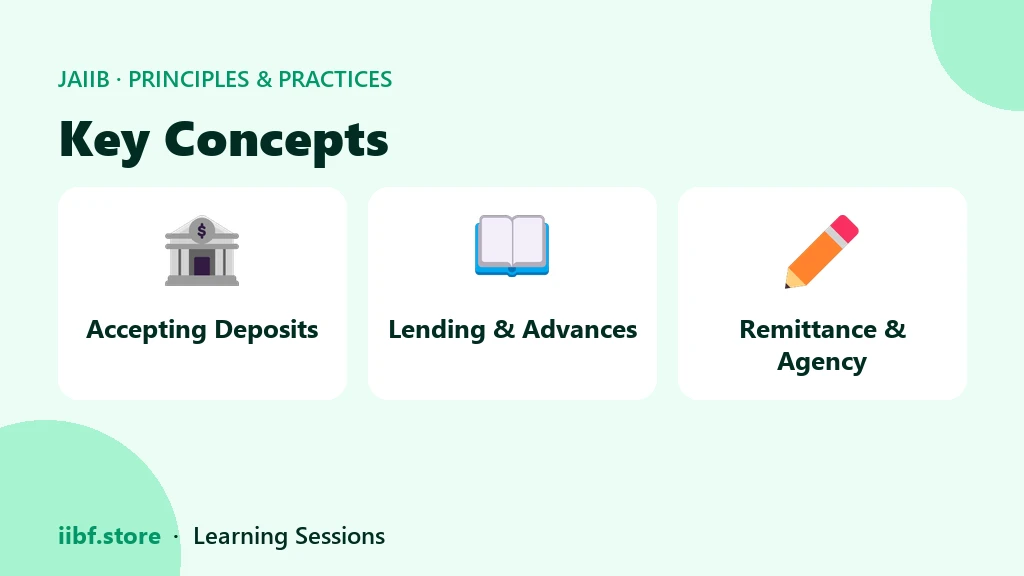
Strip away the jargon and a commercial bank does four things. Module B walks you through each one in operational detail — not the theory of why banks exist, but the day-to-day mechanics an officer is expected to handle.
- Accepting deposits. Savings, current, recurring and fixed deposits — who can open each, how they operate, nomination, and what happens on death or dispute of the account holder.
- Lending and advances. The principles of sound lending (safety, liquidity, profitability, diversification), types of facilities such as cash credit, overdraft, demand and term loans, and how securities are charged — pledge, hypothecation, mortgage, lien and assignment.
- Remittances and payment services. Collection and payment of cheques and other negotiable instruments, crossing, endorsement, and the banker’s protection under the Negotiable Instruments Act.
- Agency and general utility services. Standing instructions, locker facilities, government business, and the banker as an agent of the customer.
Running underneath all of this is the banker–customer relationship, which changes shape depending on the transaction — debtor/creditor for a deposit, creditor/debtor for a loan, bailee/bailor for a locker, and agent/principal for a collection. Questions that ask “what is the relationship when…” are practically free marks once you have this straight.
How the sub-topics map to marks
Here is a realistic sense of where the questions tend to cluster, so you can weight your revision instead of reading everything at the same intensity.
| Sub-topic in Module B | Typical exam weight | Question style |
|---|---|---|
| Banker–customer relationship | High | Scenario → identify relationship |
| Deposit accounts & operations | High | Who can open / nomination rules |
| Loans, advances & charging of securities | High | Match facility to security type |
| Negotiable instruments & cheque collection | Medium | Crossing / endorsement / protection |
| Ancillary & agency services | Medium | Direct recall |
Notice the pattern: the heavy-weight topics are all relationship and matching questions. That is good news, because those are memorisable with a single well-made table rather than pages of prose. This is why strong candidates spend more of their JAIIB PPB Module B time building comparison charts than re-reading paragraphs.
A study plan that actually fits JAIIB PPB Module B
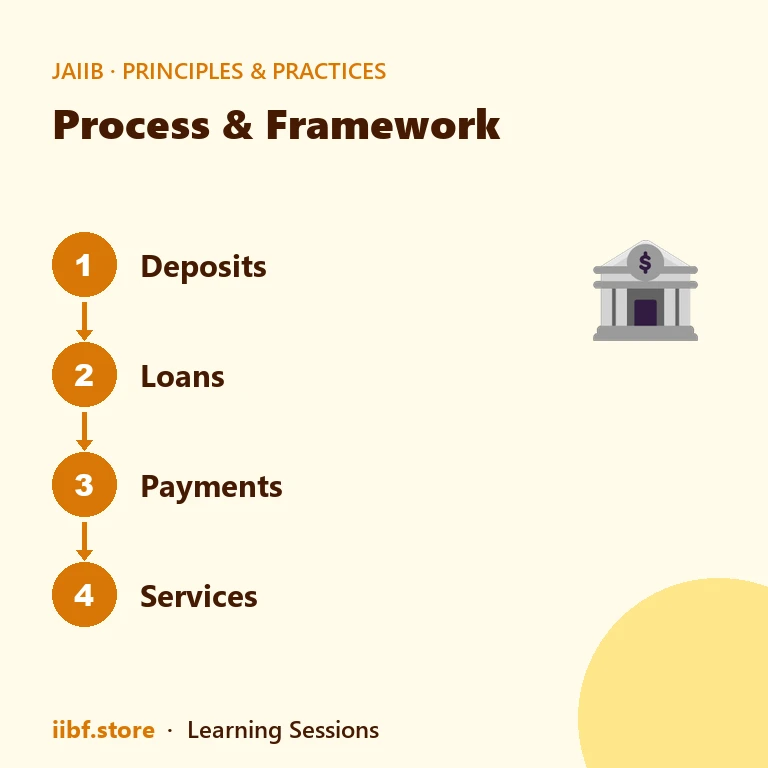
Do not read Module B front to back once and hope. Work it in four short passes, one function at a time:
- Deposits first — because it is the most self-contained and builds confidence. Nail nomination and account-operation rules.
- Loans and securities next — make one master table mapping each mode of charging security (pledge/hypothecation/mortgage) to the asset it suits.
- Negotiable instruments — focus on crossings, endorsements and when the collecting/paying banker is protected.
- Ancillary services — a quick recall list; low effort, easy marks.
After each pass, take a short topic quiz the same day. Spaced recall is what moves this from “I read it” to “I can answer it under time pressure.” Our JAIIB study planner can slot these four passes across your week automatically, and the JAIIB mock tests give you the exact one-mark, no-negative format you will face on exam day. If you prefer to revise while commuting, the flashcard-style match game is a painless way to drill the relationship pairings.
Common traps in Module B
Three mistakes cost candidates marks every cycle. First, confusing hypothecation (goods stay with the borrower) with pledge (goods move to the bank) — read the possession clue in the question. Second, assuming nomination overrides a will or survivorship; it does not, the nominee is only a trustee. Third, mixing up the collecting banker’s protection with the paying banker’s — know which statute section shields which. If you can dodge those three, JAIIB PPB Module B becomes one of the most reliable scoring zones in the whole paper.
Want the full syllabus structure straight from the source before you plan your attempt? The official rules are on the IIBF website, and you can build your complete prep around our JAIIB course. Do the four passes, quiz after each, and Module B stops being a worry and starts being points in the bank.
Frequently asked questions
How many questions come from JAIIB PPB Module B?
There is no fixed count published by IIBF, but Modules A and B together contribute roughly 60% of the 100-question PPB paper, and Module B is generally the heavier of the two for application-based questions.
Is there negative marking in the PPB paper?
No. The Principles & Practices of Banking paper has 100 one-mark questions over two hours with no negative marking, so you should attempt every question.
What is the single most important topic in Module B?
The banker–customer relationship, because it underpins deposit, loan, locker and collection scenarios — and questions that ask you to identify the relationship in a given situation appear almost every cycle.
Should I study Module A or Module B first?
Most toppers do Module A for the operational grounding, then Module B for the functions — but if you are short on time, prioritise Module B since it tends to carry more application-style marks.
Prefer revising from a printed book?
Chapter-wise books with MCQs after every chapter — minimal pages, complete coverage, delivered anywhere in India. Every book has a free sample to read first.
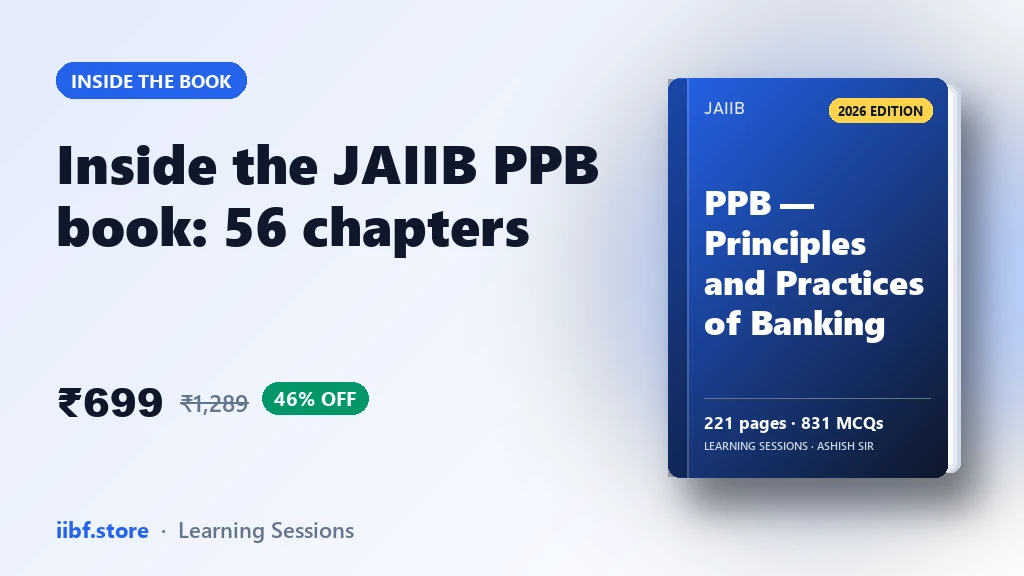
221 pages · 831 MCQs
Learning Sessions · Ashish Sir
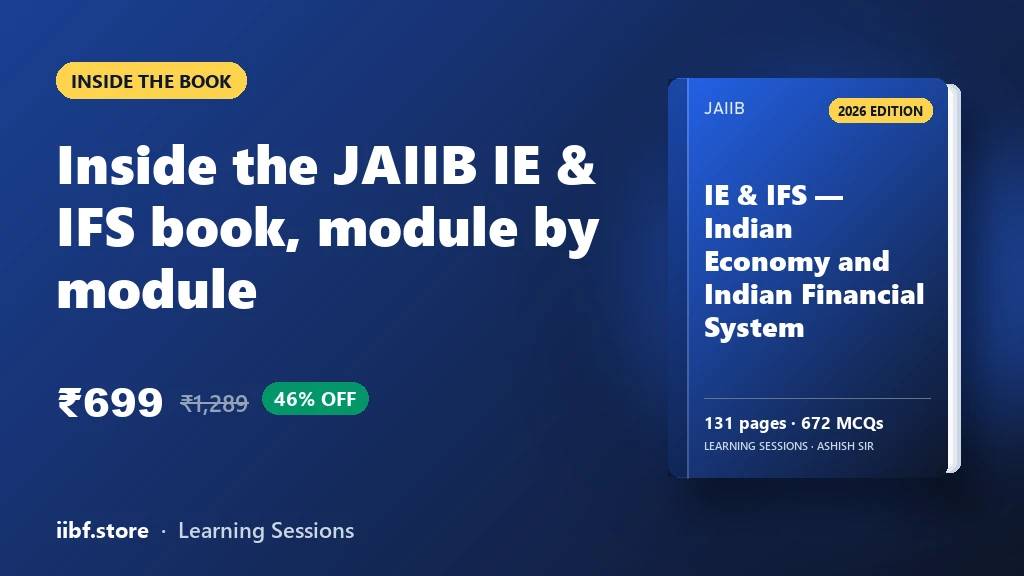
131 pages · 672 MCQs
Learning Sessions · Ashish Sir
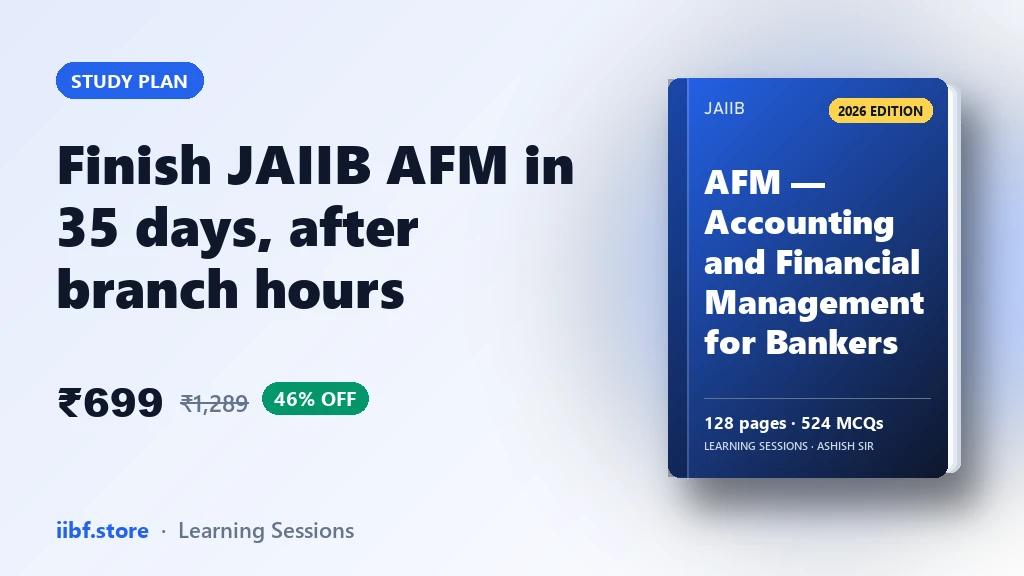
128 pages · 524 MCQs
Learning Sessions · Ashish Sir
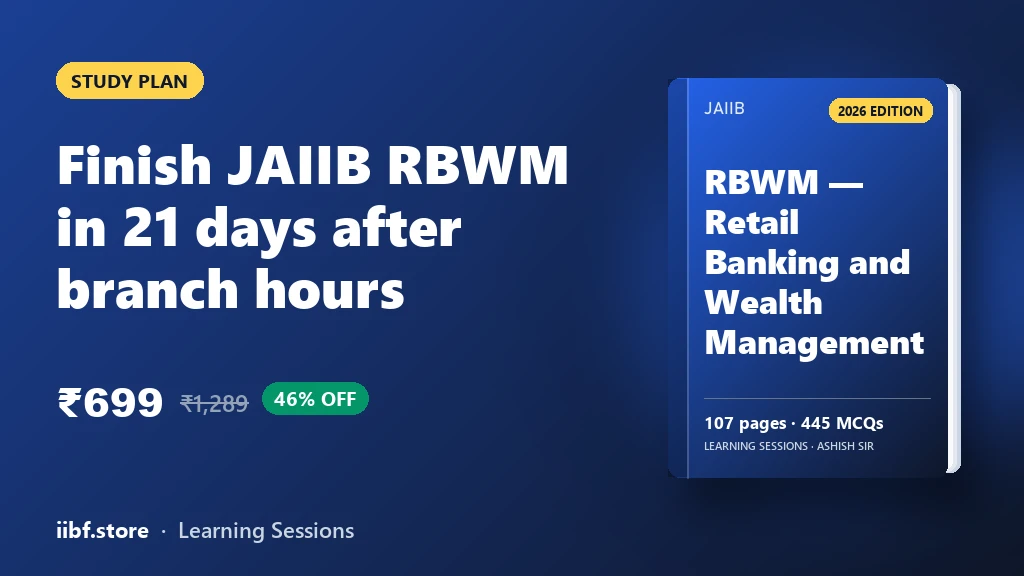
107 pages · 445 MCQs
Learning Sessions · Ashish Sir
148 pages · 478 MCQs
Learning Sessions · Ashish Sir
151 pages · 465 MCQs
Learning Sessions · Ashish Sir
148 pages · 375 MCQs
Learning Sessions · Ashish Sir
216 pages · 895 MCQs
Learning Sessions · Ashish Sir
109 pages · 300 MCQs
Learning Sessions · Ashish Sir
104 pages · 360 MCQs
Learning Sessions · Ashish Sir
82 pages · 297 MCQs
Learning Sessions · Ashish Sir
151 pages · 600 MCQs
Learning Sessions · Ashish Sir
98 pages · 282 MCQs
Learning Sessions · Ashish Sir
132 pages · 225 MCQs
Learning Sessions · Ashish Sir
188 pages · 435 MCQs
Learning Sessions · Ashish Sir
117 pages · 236 MCQs
Learning Sessions · Ashish Sir
Learning Sessions · Ashish Sir
118 pages · 299 MCQs
Learning Sessions · Ashish Sir
Learning Sessions · Ashish Sir
Learning Sessions · Ashish Sir
Learning Sessions · Ashish Sir
115 pages · 255 MCQs
Learning Sessions · Ashish Sir
Learning Sessions · Ashish Sir
334 pages · 936 MCQs
Learning Sessions · Ashish Sir
Learning Sessions · Ashish Sir
115 pages · 344 MCQs
Learning Sessions · Ashish Sir
107 pages · 240 MCQs
Learning Sessions · Ashish Sir
90 pages · 150 MCQs
Learning Sessions · Ashish Sir
Learning Sessions · Ashish Sir
Quick quiz on this topic
5 exam-style questions from our free test bank — check yourself before you move on.
Practice this topic
Take a free mock test, download chapter PDFs, or watch a video class — all included on iibf.store.