Cash Reserve Ratio in India: CRR Rules for CAIIB Central Banking
Ask any CAIIB Central Banking candidate to name RBI's most direct liquidity lever and most will say the repo rate. But the cash reserve ratio in India is older, blunter, and still tested heavily in the elective paper because it touches every scheduled bank's balance sheet the moment it changes. CRR is the slice of a bank's net demand and time liabilities that must sit, un-invested and non-interest-bearing, with RBI. Unlike SLR holdings, this money cannot be parked in government securities — it simply disappears from the bank's lendable pool. For exam purposes, understanding CRR mechanics, exemptions, and how it interacts with RBI's other tools is non-negotiable. This guide walks through the calculation, the policy logic, and the traps examiners like to set around NDTL and incremental CRR.
📊 What CRR Is and Why RBI Uses It
The cash reserve ratio in India is prescribed under Section 42 of the Reserve Bank of India Act, 1934, which empowers RBI to require every scheduled commercial bank to maintain a minimum average daily balance with it, expressed as a percentage of Net Demand and Time Liabilities (NDTL). Unlike SLR, CRR balances earn no interest and cannot count toward any other regulatory ratio — the funds are effectively sterilised. This makes CRR the most powerful blunt instrument in RBI's monetary toolkit: a one-percentage-point CRR hike can lock away tens of thousands of crores of systemic liquidity almost overnight, which is why changes are infrequent and telegraphed carefully through Monetary Policy Committee statements. Historically CRR has ranged from as low as 3% during the 2020 pandemic relief phase to well above 6% in tighter liquidity years. RBI leans on CRR less often now than in the pre-LAF era, preferring repo-based tools for fine-tuning, but CRR remains the backstop for structural liquidity absorption when durable liquidity in the banking system runs persistently surplus. Students should read the rationale for central bank liquidity control alongside the Liquidity Management in the System chapter, which frames CRR as one leg of a three-legged liquidity stool alongside SLR and open market operations.
🧮 CRR Calculation, NDTL, and Exemptions
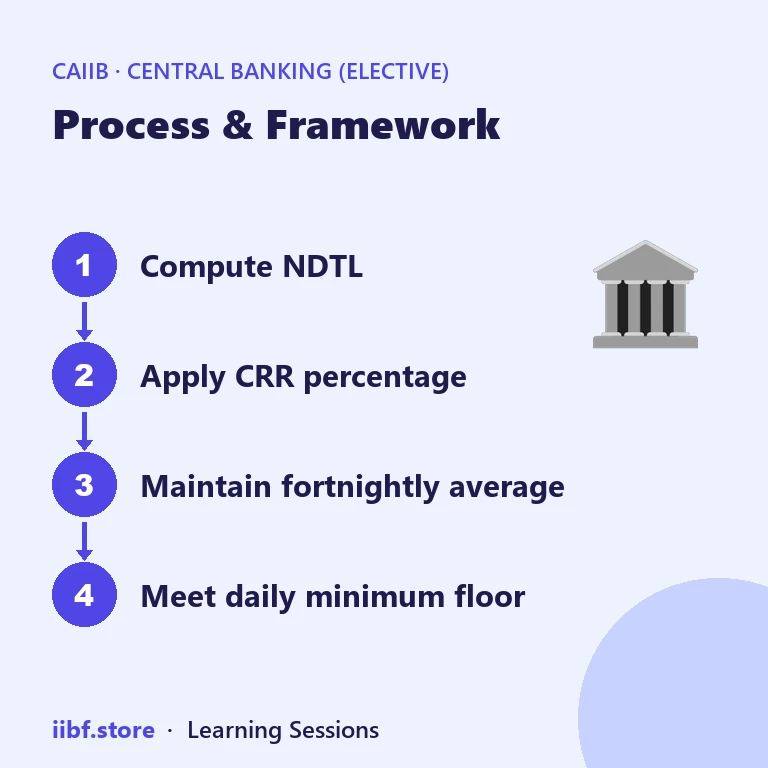
CRR is computed on NDTL as reported in a bank's fortnightly return, and banks must maintain the prescribed average over a 14-day reporting fortnight rather than hit the exact number every single day — RBI permits a daily minimum floor (typically 90% of the requirement) so a bank can dip slightly on any one day as long as the fortnightly average holds. Getting this averaging mechanic right is a favourite exam trap: candidates often assume CRR must be maintained daily at the full rate, which is incorrect. Certain liabilities are excluded from NDTL before the CRR percentage is applied — inter-bank liabilities, for instance, are netted off to avoid double-counting reserves across the banking system. Shortfalls attract penal interest, charged at Bank Rate plus 3 percentage points for the first default in a fortnight, rising further for repeated defaults in the same fortnight. This penal structure is deliberately punitive because CRR compliance underpins the credibility of RBI's liquidity math — a bank that quietly runs short distorts the very aggregate RBI is trying to manage. The Functions of Central Banks chapter covers this reserve-requirement function in the broader context of what central banks universally do, which is useful for comparing India's approach against other jurisdictions in the exam's theory questions.
⚖️ CRR vs SLR vs Repo Rate: Quick Comparison
Examiners frequently ask candidates to distinguish the three core liquidity tools by a single differentiating feature — interest earned, form of the asset held, or who controls the rate. The table below is the fastest revision aid for that exact question type. Note the interest-earning column carefully: it is the single most common one-mark trick in mock tests, since candidates conflate CRR (no interest) with SLR (interest-bearing securities) far too often. Also worth remembering: SLR assets remain on the bank's own books as an asset, while CRR balances are simply a liability reduction with RBI holding the cash. This structural difference is exactly why CRR hits bank profitability harder per percentage point than an equivalent SLR change — idle cash with zero yield costs more than a G-Sec earning coupon income. For a deeper dive into the SLR side of this comparison, see our companion piece on the statutory liquidity ratio in India, which walks through SLR-eligible securities and the HTM/AFS classification rules that CRR does not require at all.
| Feature | CRR | SLR | Repo Rate |
|---|---|---|---|
| Governing provision | RBI Act, 1934, Section 42 | Banking Regulation Act, 1949, Section 24 | LAF operating framework |
| Held as | Cash balance with RBI | Cash, gold, approved G-Secs | Not a reserve — a borrowing rate |
| Earns interest | ❌ | ✅ (on securities) | N/A |
| Maintenance cycle | Fortnightly average | Daily minimum | Overnight / variable tenor |
| Primary purpose | Structural liquidity absorption | Statutory solvency buffer | Day-to-day rate signalling |
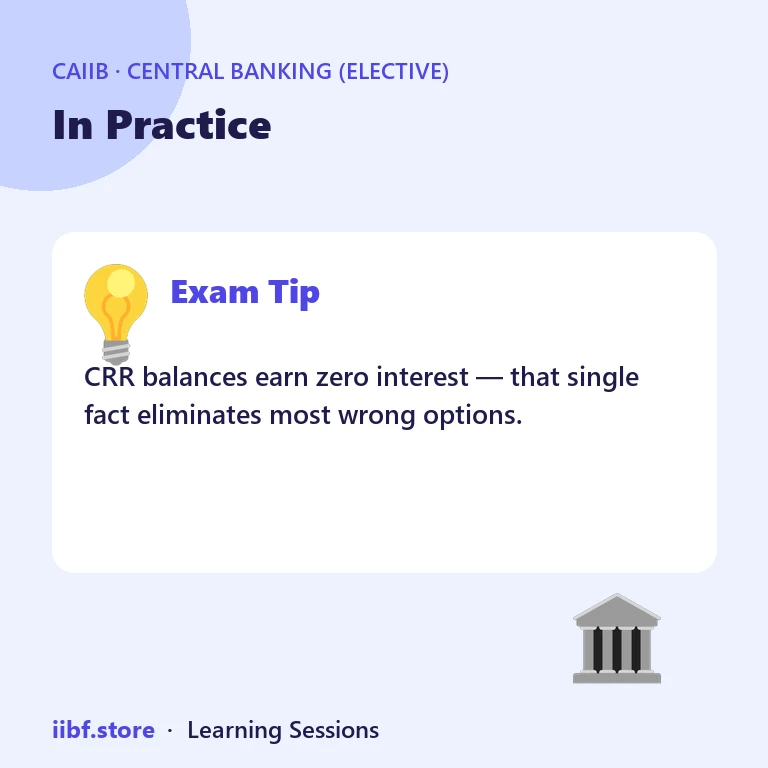
💡 Exam Tip: If a question says "non-interest-bearing statutory reserve," the answer is CRR, not SLR — this single phrase eliminates half the option set instantly.
🔁 How a CRR Change Ripples Through the Banking System
A CRR cut is one of the fastest ways RBI injects durable liquidity because it releases funds banks already hold — there is no auction, no counterparty bidding, no collateral to post. The moment the new ratio takes effect, every scheduled bank's lendable resources expand proportionally to its NDTL base, and the effect shows up in call money rates within the same reporting fortnight. A CRR hike works the same way in reverse: it is the fastest way to squeeze systemic liquidity without touching the repo rate at all, which matters when RBI wants to tighten conditions without sending a rate-hike signal to markets. This distinction — quantity tool versus price tool — is central to CAIIB theory questions that ask candidates to classify instruments. CRR changes also interact with the money multiplier: a lower CRR means each rupee of fresh reserves can support more deposit creation through the banking system, amplifying the impact of any simultaneous repo cut. Because the transmission is near-instant and system-wide, RBI reserves CRR moves for structural liquidity conditions rather than routine fine-tuning, leaving day-to-day management to repo, reverse repo, and variable rate operations under the liquidity corridor. Candidates should cross-check this with the Standing Deposit Facility and liquidity corridor article, which explains how CRR-released liquidity is subsequently absorbed or injected at the margin.
🧭 CRR in RBI's Policy Toolkit: Recent Trends
Over the past several policy cycles, RBI has used CRR sparingly compared to the repo rate, reserving it for episodes of genuinely surplus systemic liquidity rather than routine calibration. The 2020 pandemic-era cut to 3% was an emergency liquidity measure, unwound gradually as normalcy returned and durable liquidity surplus needed mopping up through other instruments first. This pattern reflects a broader shift in RBI's operating framework since the adoption of the flexible inflation-targeting regime: the repo rate under the Monetary Policy Committee now does the heavy lifting on the price side, while CRR is held in reserve as a quantity lever for structural, not cyclical, liquidity management. For CAIIB candidates, the practical takeaway is to track CRR as a slow-moving structural variable and the repo rate as the fast-moving cyclical one — conflating the two in a scenario-based question is a common scoring error. It also helps to connect CRR policy to the broader institutional architecture of Indian banking regulation, which the Evolution of Regulation and Supervision chapter traces from pre-1935 currency boards through to the present multi-tool RBI framework, and candidates preparing HRM alongside this elective may also want to revisit compensation management in banks for a change of pace between central-banking-heavy revision sessions.
⚠️ Common Mistake: Assuming CRR must be maintained at exactly the prescribed rate every single day. RBI only mandates a daily floor (typically 90% of the requirement) against a fortnightly average — a nuance examiners test directly.
📌 Remember: CRR balances earn zero interest and count toward no other ratio — treat any option claiming "CRR securities earn coupon income" as automatically wrong.
For the authoritative text on reserve requirements, the RBI's own explainer on the Cash Reserve Ratio and monetary policy instruments is available at rbi.org.in, and should be your reference point whenever a mock test figure looks unfamiliar — always verify against the current Monetary Policy Statement rather than memorising a fixed number, since CRR is revised periodically by the MPC.
🧠 Practice MCQs: Cash Reserve Ratio
Q1. Under which statute is the cash reserve ratio in India prescribed for scheduled commercial banks? (a) Banking Regulation Act, 1949, Section 24 (b) RBI Act, 1934, Section 42 (c) SARFAESI Act, 2002 (d) FEMA, 1999
Answer: (b) — CRR is a Section 42 requirement under the RBI Act, 1934; SLR is governed by Section 24 of the Banking Regulation Act.
Q2. CRR balances maintained with RBI: (a) Earn interest at the repo rate (b) Earn interest at the Bank Rate (c) Earn no interest (d) Earn interest only above the threshold NDTL
Answer: (c) — CRR balances are non-interest-bearing, unlike SLR holdings which can earn coupon income on eligible securities.
Q3. CRR is required to be maintained by banks as an average over which cycle? (a) Daily, with no flexibility (b) A fortnightly reporting period, subject to a daily minimum floor (c) Monthly, calculated on a calendar-month basis (d) Quarterly, aligned to the financial year
Answer: (b) — Banks must hold a daily minimum (commonly 90% of the requirement) while meeting the full prescribed ratio as a fortnightly average.
Q4. A cut in CRR primarily achieves which of the following? (a) Signals a change in the policy repo rate (b) Releases liquidity already held by banks, expanding lendable resources (c) Increases the statutory solvency buffer (d) Directly reduces the fiscal deficit
Answer: (b) — A CRR cut frees up funds banks already hold with RBI, unlike repo operations which require fresh borrowing or lending.
Q5. On which base is CRR computed for a scheduled commercial bank? (a) Gross Demand and Time Liabilities (b) Net Demand and Time Liabilities (NDTL) (c) Total risk-weighted assets (d) Tier-I capital
Answer: (b) — CRR (like SLR) is calculated as a percentage of NDTL, after netting off inter-bank liabilities.
Want chapter-wise mock tests with 100+ MCQs? Start practising free →
❓ Frequently Asked Questions
Is CRR the same as SLR?
No. CRR is a non-interest-bearing cash balance held with RBI under Section 42 of the RBI Act, while SLR is held by the bank itself in cash, gold, or approved securities under Section 24 of the Banking Regulation Act, and can earn interest.
Who decides changes to the cash reserve ratio in India?
The Reserve Bank of India sets CRR, and changes are typically announced alongside Monetary Policy Committee statements, though CRR itself is a tool RBI controls directly rather than an MPC-voted rate.
What happens if a bank fails to maintain the required CRR?
RBI levies penal interest at the Bank Rate plus 3 percentage points on the shortfall for the first default in a reporting fortnight, with a steeper penalty for repeated defaults in the same fortnight.
Does CRR apply to all liabilities equally?
No. CRR is computed on Net Demand and Time Liabilities after excluding certain items such as inter-bank liabilities, so gross liabilities are not the base figure used.
CRR is one of those CAIIB Central Banking topics that rewards precision over generalities — know the section number, the averaging rule, and the interest treatment cold, and you will clear most scenario-based questions on this ratio. Revisit the broader Theory and Practice of Central Banking chapter to place CRR alongside RBI's full toolkit, browse more topics under the Central Banking Elective tag, and when you are ready to test yourself against exam-pattern questions, head to the CAIIB course page to start structured practice today.
Quick quiz on this topic
5 exam-style questions from our free test bank — check yourself before you move on.
Practice this topic
Take a free mock test, download chapter PDFs, or watch a video class — all included on iibf.store.
Keep reading