Standing Deposit Facility and liquidity corridor: CAIIB guide
The Standing Deposit Facility and liquidity corridor together decide the floor, the ceiling and the centre of overnight money market rates in India, and CAIIB Central Banking examiners keep coming back to this trio. The Standing Deposit Facility (SDF) is the rate at which the Reserve Bank absorbs surplus funds from banks without giving any securities in exchange; the Marginal Standing Facility (MSF) is the rate at which banks can borrow against permitted collateral; and the policy repo rate sits between the two. Understand how these three rates fence in the Weighted Average Call Rate (WACR) and most numerical and conceptual questions on the Liquidity Adjustment Facility become straightforward.
🏦 What the Standing Deposit Facility and liquidity corridor actually mean
A liquidity corridor is simply a band of interest rates within which the central bank wants the overnight money market to trade. The lower edge is the rate at which a bank can always park surplus rupees with the Reserve Bank; the upper edge is the rate at which a bank can always borrow from the Reserve Bank. No rational bank lends in the call market below the floor (it can earn more risk-free from RBI) and no rational bank borrows above the ceiling (it can borrow cheaper from RBI). The market rate is therefore squeezed into the band.
In the Indian framework the floor is the SDF rate, the ceiling is the MSF rate, and the policy repo rate sits in the middle as the rate the Monetary Policy Committee actually votes on. Both SDF and MSF are standing facilities: they are available on demand at the counterparty bank's initiative, overnight, on all working days, without any auction and without any notified amount. That is the key distinction from the auction-based operations RBI conducts at its own initiative. The chapter on liquidity management in the system develops this architecture in detail, and the broader role of these tools appears again in functions of central banks.
📌 Remember: "Standing" means bank-initiated and always available. "Auction" means RBI-initiated, notified amount, variable rate. Every LAF question turns on this difference.
📉 Why SDF replaced the fixed-rate reverse repo as the floor
Before April 2022, the floor of the corridor was the fixed-rate reverse repo. It worked, but it carried a structural handicap: a reverse repo is a collateralised transaction, so the Reserve Bank had to deliver government securities from its own portfolio to the absorbing bank. The quantum of liquidity RBI could suck out was therefore capped by the stock of eligible securities on its balance sheet. During the surplus-liquidity years that followed the pandemic response, this ceiling on absorption capacity became a genuine operational worry.
The Standing Deposit Facility solves that problem because it is uncollateralised. RBI simply accepts the deposit and pays interest on it; no securities move. Absorption capacity becomes effectively unlimited, which matters enormously when the banking system is flush. The legal enabling provision came through an amendment to the Reserve Bank of India Act, 1934 (Section 17(12AB), inserted by the Finance Act, 2018), which permitted the Bank to accept deposits from banks without offering collateral. The facility was finally operationalised in April 2022, when the MPC placed the SDF rate 25 basis points below the policy repo rate and restored a symmetric corridor.
The fixed-rate reverse repo was not abolished. It remains on the books as an instrument the Reserve Bank may deploy at its discretion for specific purposes, but it is no longer the standing floor. In exam language: SDF is the floor of the corridor; the fixed reverse repo is a discretionary instrument. If you want to see how this fits the wider policy stance, read our companion piece on the inflation targeting framework in India.
📊 Corridor architecture: MSF ceiling, repo centre, SDF floor
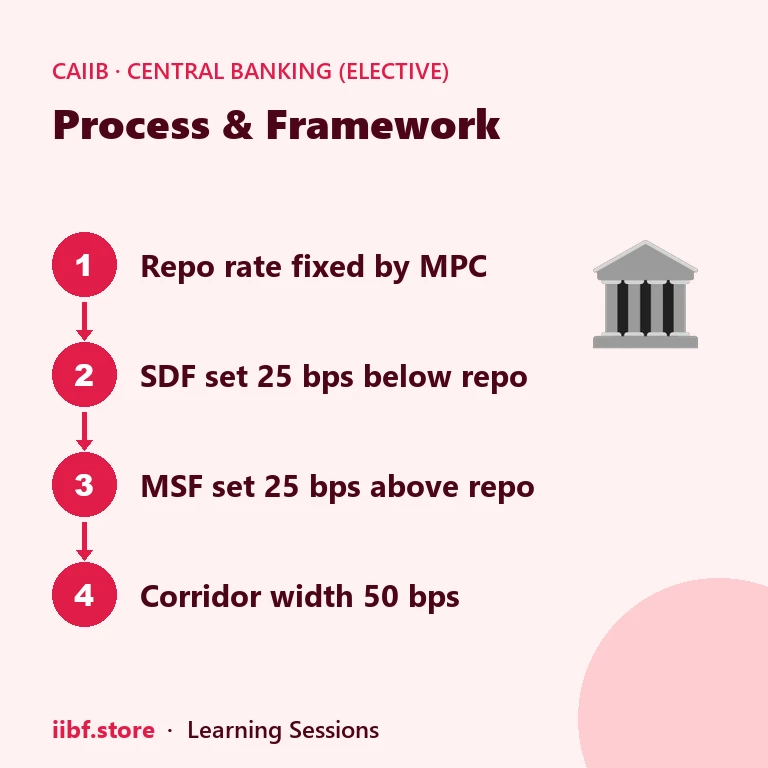
Since April 2022 the corridor has been symmetric, with the SDF 25 basis points below the repo rate and the MSF 25 basis points above it, giving a total corridor width of 50 basis points. During the pandemic the corridor had been widened asymmetrically, with the reverse repo pushed well below the repo rate to discourage banks from parking funds; the return to a symmetric 25/25 band in 2022 signalled normalisation. Because the MPC can and does revise these settings, always confirm the prevailing numbers from the latest policy statement or from our RBI rates page before an exam attempt.
| Facility | Direction | Rate vs repo | Collateral needed? | Standing or auction? |
|---|---|---|---|---|
| Standing Deposit Facility (SDF) | Absorbs liquidity | Below repo (25 bps, symmetric corridor) | ❌ No | Standing, bank-initiated |
| Marginal Standing Facility (MSF) | Injects liquidity | Above repo (25 bps, symmetric corridor) | ✅ Yes, eligible securities | Standing, bank-initiated |
| Fixed-rate reverse repo | Absorbs liquidity | At the rate RBI notifies | ✅ Yes, RBI delivers securities | Discretionary, no longer the floor |
| Variable Rate Reverse Repo (VRRR) | Absorbs liquidity | Cut-off discovered in auction, at or above SDF | ✅ Yes | Auction, RBI-initiated |
| Variable Rate Repo (VRR) | Injects liquidity | Cut-off discovered in auction, at or above repo | ✅ Yes | Auction, RBI-initiated |
MSF also allows a bank to dip into its Statutory Liquidity Ratio holdings up to a notified percentage of net demand and time liabilities, a limit RBI has changed more than once, so quote it only if you have checked the current circular. The theoretical logic behind ceilings and floors is covered in theory and practice of central banking.
⚠️ Common Mistake: Candidates write that SDF is "reverse repo renamed". It is not. Reverse repo is collateralised and the securities leave RBI's book; SDF is collateral-free and nothing moves except cash and interest.
🔁 VRR and VRRR: fine-tuning inside the corridor
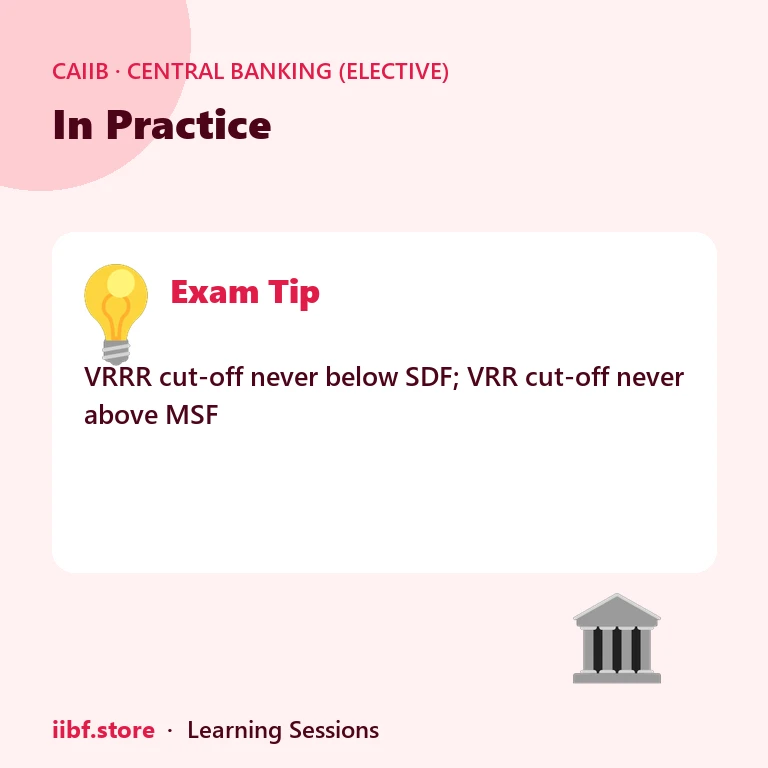
Standing facilities set the boundaries; auctions do the day-to-day steering. When the system is in surplus, the Reserve Bank conducts Variable Rate Reverse Repo auctions: it notifies an amount and a tenor, banks bid the rate at which they are willing to lend to RBI, and a cut-off emerges. Because a bank can always fall back on the SDF, no bank will bid below the SDF rate, so the VRRR cut-off is effectively bounded below by the floor. That is precisely how the floor does its work even on days when the standing facility itself sees little use.
When the system is in deficit, the mirror image applies. RBI runs Variable Rate Repo auctions, banks bid the rate at which they will borrow, and because MSF is always available as a fallback, no bank will bid above the MSF rate. The cut-off is bounded above by the ceiling. Main operations of longer tenor handle the durable component of the liquidity gap, while overnight or short fine-tuning operations mop up or supply the residual on a given day. Durable liquidity, as against frictional liquidity, is normally addressed through outright instruments and forex operations rather than through the corridor, which is why RBI intervention in the foreign exchange market and the corridor have to be studied together.
The Reserve Bank has revised the operating details of this framework more than once — the tenor of the main operation, the frequency of fine-tuning auctions and the reporting conventions have all changed over the years. For an exam answer, describe the mechanism and name the instruments; do not commit to a tenor unless the current framework statement supports it.
📈 How the corridor steers WACR and overnight rates
The operating target of monetary policy in India is the Weighted Average Call Rate, the average rate at which banks lend to each other overnight in the uncollateralised call money market, weighted by transaction volume. The whole point of the corridor is to keep the WACR aligned with the policy repo rate. When surplus liquidity is heavy, the WACR drifts down towards the SDF; when liquidity tightens, it climbs towards the MSF and can occasionally touch it. Reading the WACR against the corridor is the quickest way to judge the effective stance of liquidity policy, quite apart from what the stance is formally called.
This matters for transmission. The overnight rate feeds into treasury bill yields, certificate of deposit and commercial paper pricing, the external benchmark rates that price retail loans, and eventually deposit and lending rates across the banking system. A corridor that leaks — a WACR persistently stuck at the floor or repeatedly hitting the ceiling — signals that quantity management is not keeping pace with the announced rate stance. Bank treasuries watch this closely because it changes the carry on their portfolios and hence their valuation decisions, an issue treated in our note on trading book vs banking book.
Liquidity movements also change the money multiplier and the growth of broad money, so a question on the corridor can easily be paired with one on the money supply measures in India. More material on current debates in this area sits in the contemporary issues in central banking chapter and across the Central Banking elective tag hub.
💡 Exam Tip: If a question gives you the repo rate and asks for the corridor, apply the symmetric 25 bps rule: SDF = repo minus 25 bps, MSF = repo plus 25 bps, corridor width 50 bps — and add "unless revised by the MPC".
🧠 Practice MCQs: Standing Deposit Facility and the LAF corridor
Q1. Which single feature most clearly distinguishes the Standing Deposit Facility from the fixed-rate reverse repo? (a) It is available only to scheduled commercial banks (b) It absorbs liquidity without RBI providing collateral (c) It is conducted through a variable-rate auction (d) It carries a tenor of 14 days
Answer: (b) — SDF is an uncollateralised absorption window, so RBI's absorption capacity is not limited by its holdings of government securities.
Q2. In the current LAF architecture, which rate forms the ceiling of the liquidity corridor? (a) The SDF rate (b) The policy repo rate (c) The Marginal Standing Facility rate (d) The Bank Rate as separately notified by the MPC
Answer: (c) — MSF, being the standing borrowing window available on demand, caps how high the overnight rate can rationally go.
Q3. Since the corridor was restored to a symmetric width, the total spread between the SDF rate and the MSF rate is: (a) 50 basis points (b) 25 basis points (c) 65 basis points (d) 100 basis points
Answer: (a) — 25 bps below repo plus 25 bps above repo gives a 50 bps corridor, subject to any later revision by the MPC.
Q4. A Variable Rate Reverse Repo cut-off would not normally be discovered below which rate? (a) The MSF rate (b) The Bank Rate (c) The policy repo rate (d) The SDF rate
Answer: (d) — a bank can always park funds at the SDF, so it has no incentive to bid a VRRR rate below the floor.
Q5. The operating target that the liquidity corridor is designed to align with the policy repo rate is: (a) The 91-day treasury bill yield (b) The Weighted Average Call Rate (c) The 10-year G-sec yield (d) The one-year MCLR of scheduled commercial banks
Answer: (b) — WACR, the volume-weighted overnight uncollateralised call money rate, is the declared operating target.
Want chapter-wise mock tests with 100+ MCQs? Start practising free →
Is the fixed-rate reverse repo completely discontinued?
No. It has ceased to be the standing floor of the corridor, but it remains available as an instrument the Reserve Bank may use at its discretion for specific liquidity management purposes.
Why is the SDF called collateral-free?
Because RBI accepts the bank's surplus funds as a deposit and pays interest on it without delivering government securities in exchange, unlike a reverse repo where securities move from RBI to the bank.
Can the corridor be asymmetric again?
Yes. The corridor width is a policy choice. It was deliberately made asymmetric during the pandemic period and was restored to a symmetric 25 bps on either side in April 2022; the MPC can change it again.
What is the difference between VRR and VRRR?
A Variable Rate Repo auction injects liquidity into the banking system against collateral, while a Variable Rate Reverse Repo auction absorbs liquidity from it. Both are RBI-initiated, notified-amount auctions with market-discovered cut-offs.
🎯 Conclusion and study plan
For the CAIIB Central Banking elective, treat the Standing Deposit Facility and liquidity corridor as one integrated answer: SDF floor, repo centre, MSF ceiling, symmetric width, collateral-free absorption, auctions steering inside the band, and WACR as the operating target that everything is aimed at. Learn the rationale — why an uncollateralised floor was needed at all — because reason-based questions score better than rate-recall questions, and rates change. Pair this with the currency-side material in currency chest operations in India for a complete view of RBI's operating toolkit. Then test yourself: work through the elective chapter tests on the CAIIB course page and time yourself on a full mock before exam day.
Source and further reading: Reserve Bank of India and the Indian Institute of Banking & Finance.
Quick quiz on this topic
5 exam-style questions from our free test bank — check yourself before you move on.
Practice this topic
Take a free mock test, download chapter PDFs, or watch a video class — all included on iibf.store.
Keep reading