Is the CWMP Exam Preparation Book Right for You? An Honest Guide
It is 10 pm. You have cleared the day's branch work, the last customer is gone, and the syllabus of a wealth management certificate is sitting in front of you like a wall. Financial planning, taxation, investments, insurance, retirement, estate planning. Where do you even start? If that is you, this guide is for you, whether or not you ever buy anything from us.
We get one question again and again: "Is a CWMP exam preparation book enough, or do I need a classroom?" The honest answer is that it depends on who you are. So instead of selling you a dream, let us go through four kinds of candidates and tell you plainly where the printed set helps and where it does not.
First, what problem are you actually solving?
Most working bankers do not fail certificate exams because they are not smart enough. They fail because of three quiet problems.
- Scattered material. A PDF here, a class note there, an old forwarded file from a colleague. Half your time goes in finding what to read.
- Screen fatigue. After eight hours on a CBS screen, opening another screen to study is hard on the eyes and the mind.
- No practice loop. You read a chapter, feel good, and never find out whether you can answer a question from it.
A good CWMP exam preparation book should fix at least these three: one place for the syllabus, paper you can hold, and questions attached to what you just read. Keep that checklist in mind. We will test the book against it below.
What is inside the printed set
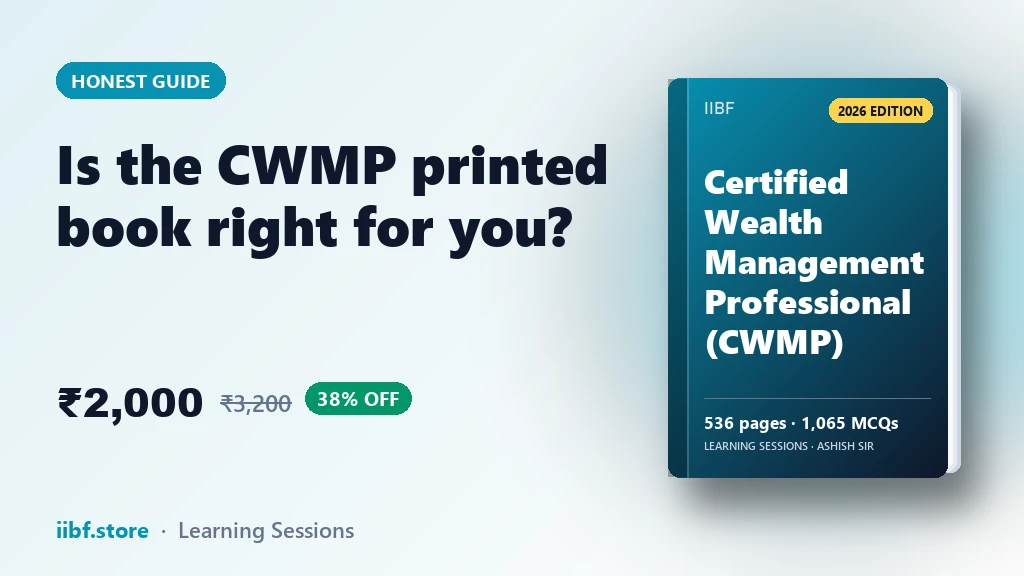
Let us be specific, because vague promises help nobody. The CWMP printed book (2026 edition) runs to 536 pages in three volumes, one each for Papers 1, 2 and 3. It has 71 chapters and 1,065 questions in all.
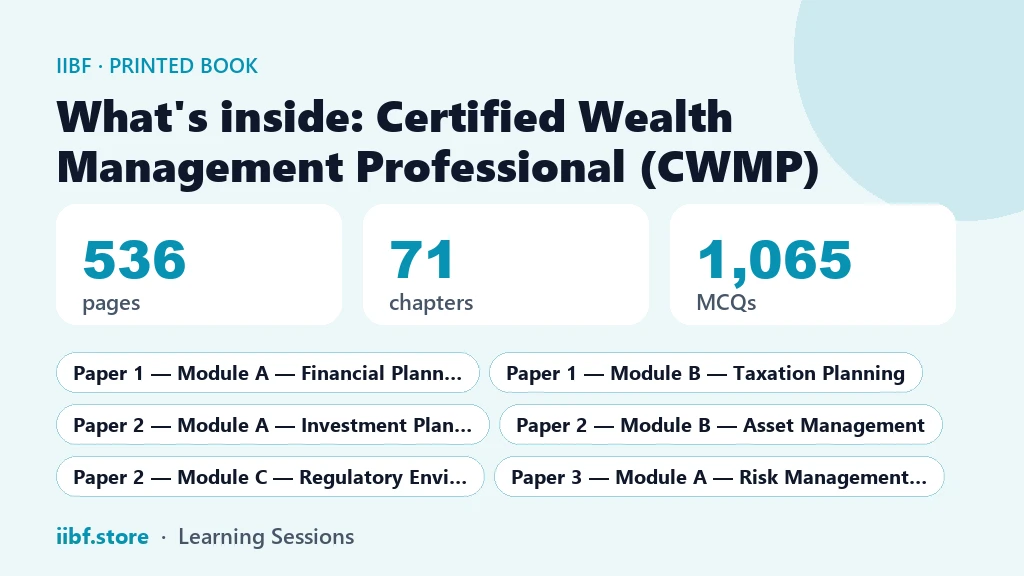
The chapters are grouped into modules, so you always know which part of the syllabus you are in:
- Paper 1: Module A (Financial Planning) and Module B (Taxation Planning).
- Paper 2: Module A (Investment Planning), Module B (Asset Management) and Module C (Regulatory Environment, Compliance and Law).
- Paper 3: Module A (Risk Management and Insurance), Module B (Retirement Planning) and Module C (Estate Planning).
On top of the chapters, the set carries 90 case studies (360 questions) and 15 mega tests (1,500 questions). The case studies matter because wealth management questions are rarely about definitions alone; they ask you to apply a rule to a client's situation.
Profile 1: You are attempting for the first time
You are new to this certificate, maybe new to taxation and insurance as well. Your biggest risk is not knowing where the finish line is.
How to use the book
Read in module order, not chapter-hopping. Finish one module, solve its questions the same week, then move on. Let the case studies come after you have read the related chapters, not before. In your first pass, do not try to memorise tax rates or limits; try to understand how a client's cash flow, insurance cover and retirement goal connect.
When it is not enough alone
A first-timer has no feel for the exam hall yet. The book teaches the content; it cannot teach you speed. Use the free mock tests on iibf.store early, even if your scores are poor. A bad score in week two is information. A bad score on exam day is a repeat attempt.
Profile 2: You have attempted before and want to fix the gaps
You know the syllabus. You have even cleared one or two papers. What you need is a ruthless way to find what went wrong.
How to use the book
Do not re-read everything. Start from the questions. Attempt the mega tests first, mark every wrong answer, and trace each one back to its chapter. This is the fastest use of a CWMP exam preparation book for a repeat candidate: questions first, chapters only where you bleed marks.
When it is not enough alone
If your earlier attempt failed on Module B (Taxation Planning) because of rules that change with each Finance Act, no printed book can promise to be current on the day you sit the exam. Check the official updates on the IIBF website for the upcoming exam cycle and the syllabus notices, and treat anything dated as something to verify.
Profile 3: You are short on time
Be honest with yourself here. If you have only a few weeks and a heavy branch, a 536-page set will not magically become a 100-page summary. What it can do is save you the hunt for material, so every hour you do have goes into learning, not searching.
How to use the book
Prioritise by marks per hour. Spend the first weekend on one quick skim of every module's chapter titles, then put your reading time into the modules where you are weakest. Skipping a whole paper to save time is a gamble; skipping a chapter you already know is not.
When it is not enough alone
If you have very little time, you also need a fixed daily slot, even thirty minutes, and mock tests to tell you where to spend it. The set on its own does not create discipline. If your calendar is the real problem, a book will not solve it. Our free study material section has short notes you can use on the commute while the printed volumes stay at home for deep sessions.
Profile 4: You simply learn better on paper
Some of us retain far more when we underline, scribble in the margin and flip back to an earlier page. If that is you, a printed set is not a luxury; it is the format that matches how your memory works.
How to use the book
Use the three-volume split to your advantage. Carry the volume for the paper you are currently studying, keep a pencil in it, and mark chapters with a simple code: green for confident, yellow for revisit, red for dangerous. Revise only yellow and red in the last fortnight.
When it is not enough alone
Paper does not give you instant feedback. If you study only from the book and never test yourself under a clock, you will feel prepared and still be surprised. Pair the printed set with timed practice.
A simple method that works with any CWMP exam preparation book
Whichever profile you matched, the method is the same four steps. It works with our book, and honestly it works with any decent one.
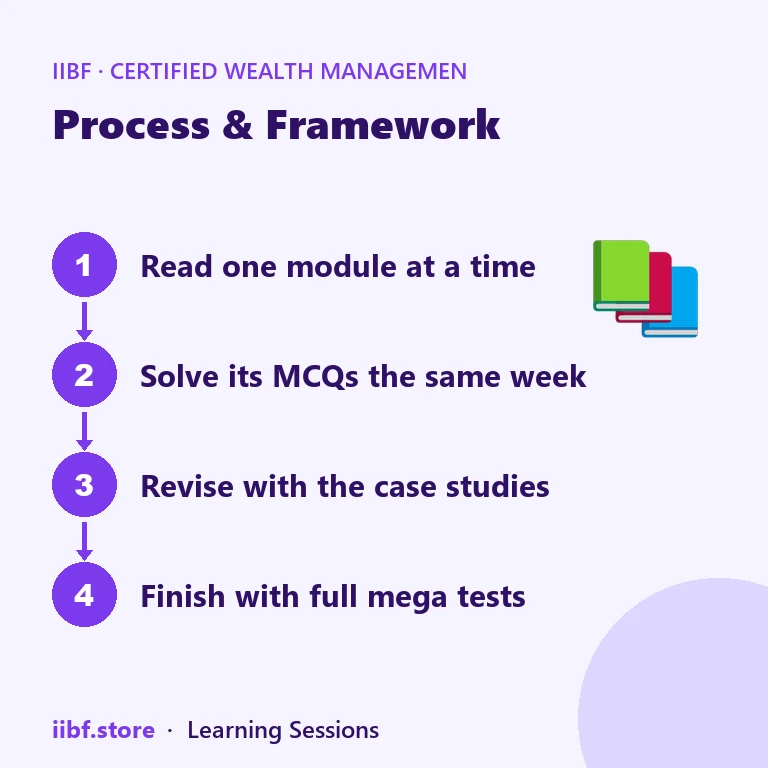
- Read one module at a time, never half a module.
- Solve that module's MCQs within the same week, while it is fresh.
- Use the case studies to practise applying rules to a client situation.
- Finish with full mega tests under a timer, then fix the wrong answers.
Here is how the four profiles compare at a glance.
| Your situation | Start with | Add alongside |
|---|---|---|
| First attempt | Modules in order, then each module's questions | Free mock tests from week two |
| Repeat attempt | Mega tests first, then weak chapters | Official updates for rule changes |
| Short on time | Weakest modules only, fixed daily slot | Short notes for the commute |
| Paper person | One volume at a time, colour-marked | Timed practice on a screen |
Price, and who should probably skip it
The set is listed at ₹2,000 against an MRP of ₹3,200 (38% off). Prices may change, so the CWMP book page is always the current word. There is also a free sample on that page. Read it before you decide; if the explanation style does not suit you, do not buy.
You should probably skip the book if you already have a trusted set of notes and only need practice, or if you never study from paper and will leave it on a shelf. In that case, our books page and free tests may be a better starting point. A book that sits unopened passes no exam.
Whatever you choose, remember the limit: a CWMP exam preparation book gives you content and questions. It does not give you exam-hall speed, and it does not read itself. That part is yours.
Final word
If you are a working banker with a tired mind and a stretched calendar, the right tool is the one you will actually open at 10 pm. For many of you that is paper, in modules, with questions attached. Pick your profile, follow the four steps, add mock tests, and check the official schedule at iibf.org.in. Do that, and you are already ahead of most candidates. You can also browse the iibf.store blog for more study plans.
Frequently asked questions
Is one book enough to clear CWMP?
A book gives you content and practice questions, but results depend on how you use it. Pair it with timed mock tests and check the official syllabus for the upcoming exam cycle.
How many questions does the printed set have?
The 2026 edition has 1,065 questions in total, plus 90 case studies (360 questions) and 15 mega tests (1,500 questions) listed as extras.
Can I read a sample before buying?
Yes. The book page has a free sample. Read it to check whether the explanation style suits you.
Does the book cover all three papers?
Yes. It comes in three volumes, one each for Papers 1, 2 and 3, across 71 chapters grouped into modules.
Prefer revising from a printed book?
Chapter-wise books with MCQs after every chapter — minimal pages, complete coverage, delivered anywhere in India. Every book has a free sample to read first.


















































Practice this topic
Take a free mock test, download chapter PDFs, or watch a video class — all included on iibf.store.
Keep reading