Claims Verification Under IBC: Forms, Timelines and Collation (2026)
When a corporate debtor enters the Corporate Insolvency Resolution Process (CIRP) under the IBC, one of the first tasks that decides whether a creditor is even counted in the resolution starts almost immediately: claims verification under IBC. Every creditor — secured or unsecured, financial or operational, a bank or a workman — must step forward within a strict window, using the correct prescribed form, or risk being left out of the process entirely. For CAIIB candidates and bank officers who deal with this process from the lender's side, knowing exactly how a claim moves from public announcement to a verified list of creditors is not exam trivia — it decides whether your bank's dues even reach the Committee of Creditors. This guide walks through the forms, the 14-day window, and why the Resolution Professional collates claims rather than adjudicates them.
📢 Public Announcement: Where the Clock Starts
Claims verification cannot begin until the world knows that a corporate debtor is under CIRP. Section 15 of the IBC, read with Regulation 6 of the IBBI (Insolvency Resolution Process for Corporate Persons) Regulations, 2016, requires the Interim Resolution Professional (IRP) to make a public announcement within three days of receiving the copy of the order admitting the application. This is the same order that fixes the commencement of CIRP, so the public announcement effectively starts the countdown for every stakeholder.
The announcement itself is made in Form A and is published in one English and one regional-language newspaper with wide circulation at the registered office and principal place of business, on the corporate debtor's website if any, and on the IBBI website. It must disclose the name and address of the corporate debtor, the last date for submission of claims, the relevant date for determining financial creditors in a class, and the details of the IRP including the address and email to which claims must be sent.
For banks, this is the trigger to pull together loan documents, sanction letters, and statements of account well before the deadline rather than scrambling once it is published. Missing the announcement is the single most common reason a bank's claim is filed late.
📝 Forms B, C, CA, D and F: Matching the Creditor to the Form
The CIRP Regulations prescribe a separate form for each category of creditor, and using the wrong one is a common exam trap as well as a real-world filing error. Form B is for financial creditors filing individually — banks, NBFCs, and bondholders with a direct financial debt. Form C is for operational creditors — suppliers, vendors, and service providers owed money for goods or services rendered. Form CA is specifically for financial creditors in a class, such as real estate allottees or fixed-deposit holders, who file through an Authorised Representative rather than individually. Form D covers workmen and employees, who may also be represented collectively. Form F is the residual category — creditors who do not fit financial, operational, or workmen classifications, such as statutory authorities claiming government dues.
Each form calls for particulars of the debt, the amount claimed as on the insolvency commencement date, and supporting documents. Banks typically attach the loan agreement, the account statement, and security documents; certified copies of ledger extracts admissible under the Bankers Books Evidence Act are commonly used to substantiate the outstanding balance without producing original registers. The full schedule of forms and the Regulations themselves are published by the Insolvency and Bankruptcy Board of India, which is the authority that frames and amends them.
| Form | Creditor Category | Typical Filer | Authorised Representative Mandatory? |
|---|---|---|---|
| Form B | Financial creditors (individual) | Banks, NBFCs, bondholders | ❌ No |
| Form C | Operational creditors | Suppliers, vendors | ❌ No |
| Form CA | Financial creditors in a class | Real estate allottees, FD holders | ✅ Yes |
| Form D | Workmen and employees | Individual or collective | ❌ Optional |
| Form F | Other creditors | Statutory authorities, others | ❌ No |
💡 Exam Tip: Remember the pattern — B for banks (financial), C for commercial supply (operational), CA for class, D for workers, F for the rest. Questions often swap Form C and Form F to test whether you know operational creditors do not use the residual form.
⏱️ The 14-Day Window and What Happens After
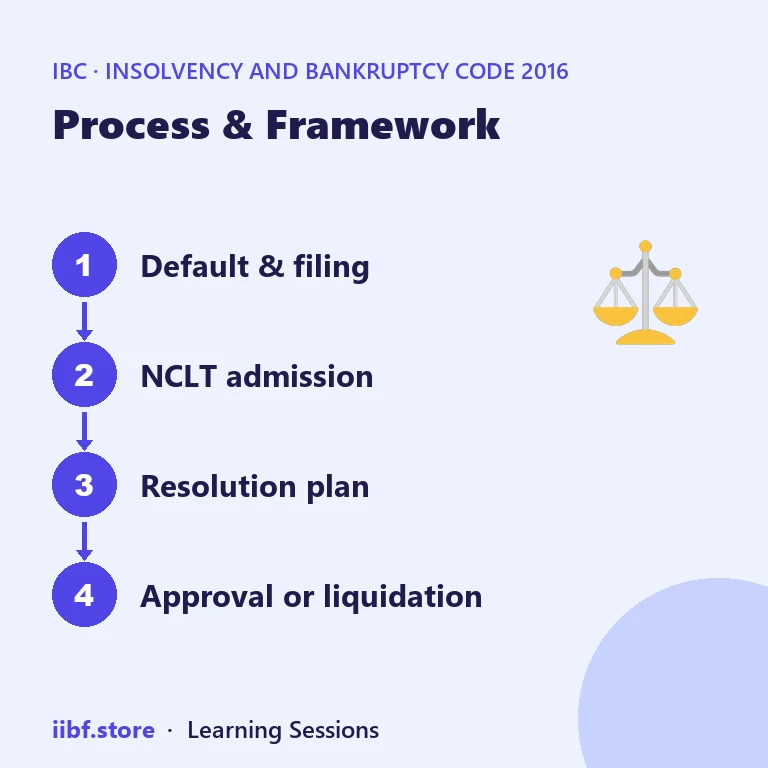
Regulation 12 of the CIRP Regulations gives every creditor 14 days from the insolvency commencement date to submit a claim to the IRP or RP in the prescribed form. This is the single most tested number in this topic, and candidates frequently confuse it with the 3-day announcement window or the 7-day verification window that follows — keep the three timelines separate.
Missing the 14-day window is not necessarily fatal. Regulation 12(2) permits a creditor to submit a claim after the 14 days but before the resolution plan is submitted to the Adjudicating Authority, provided the delay is explained and the claim is otherwise in order. In practice, though, a late claim risks being excluded from voting rounds of the Committee of Creditors that have already been completed by the time it is admitted, so the amount recovered can still be affected even if the claim is eventually accepted.
Banks should treat the public announcement date as an internal alert trigger, not the deadline itself, and build in a buffer for documentation to be assembled and signed off before the 14-day clock runs out. If CIRP is withdrawn part-way through — for instance under the settlement route covered in our note on withdrawal of CIRP under Section 12A — claims already collated simply lapse along with the process, and creditors revert to their original recovery remedies.
⚠️ Common Mistake: Candidates often assume the 14-day window is calculated from the date of public announcement. It is actually calculated from the insolvency commencement date, which is the date of admission of the CIRP application — the public announcement usually follows within three days of that date but the two are not the same reference point.
🔍 Collation, Not Adjudication: The RP's Real Role
Once claims start arriving, Regulation 13 requires the RP to verify every claim as on the insolvency commencement date within seven days of the last date fixed for receipt of claims, and to maintain a continuously updated list of creditors that is filed with the Adjudicating Authority and made available for inspection. This verification is deliberately narrow: the RP checks the claim against the corporate debtor's books of account and the supporting documents filed, and either admits it, admits it in part, or rejects it with reasons.
This is best understood as collation, not adjudication. The RP is not deciding a contested legal question the way a court or tribunal would; the RP is compiling and cross-checking figures to arrive at a working list of creditors so that the Committee of Creditors under IBC can be constituted and voting rights assigned. Where a claim is genuinely disputed — for example, a creditor claims an amount the corporate debtor's books do not reflect, or vice versa — the RP records it as disputed rather than trying to settle the dispute itself.
A creditor aggrieved by the RP's decision, whether the claim is rejected, admitted for a lower amount, or not decided within a reasonable time, may approach the Adjudicating Authority (the NCLT) under Section 42 of the IBC. This is the actual adjudicatory step in the process; everything the RP does before that is administrative collation meant to keep the resolution timeline moving.
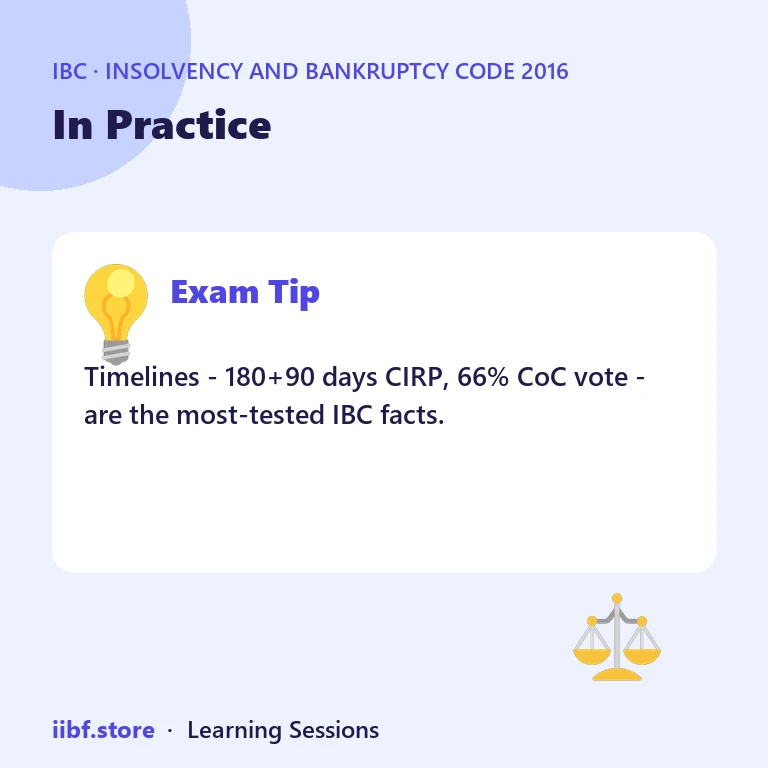
📌 Remember: Public announcement fixes the trigger, 14 days is the submission window, 7 days after that is the RP's verification window, and Section 42 is the only true adjudication route for a disputed claim.
🎯 Exam Takeaways and Next Steps
For CAIIB candidates, claims verification under IBC ties together several numbers and roles that examiners like to mix up: the 3-day public announcement, the 14-day submission window, the 7-day RP verification period, and the correct form for each creditor category. Keep the sequence straight — commencement, announcement, submission, collation, and only then adjudication if a dispute reaches the NCLT — and most questions on this topic become straightforward. For the wider statutory backdrop, revisit the Credit Recovery Laws for Banks chapter and browse more posts on the Insolvency and Bankruptcy Code tag hub.
Put this into practice before the exam floor rather than on it. Attempt chapter-wise mocks on iibf.store/tests and work through the full IBC module inside the CAIIB course to see how claims verification connects to the CIRP timeline as a whole.
🧠 Practice MCQs: Claims Verification Under IBC
Q1. Within how many days of receiving the copy of the admission order must the IRP make the public announcement under the CIRP Regulations? (a) 3 days (b) 7 days (c) 14 days (d) 30 days
Answer: (a) — Regulation 6 requires the public announcement in Form A within three days of the IRP receiving the order admitting the CIRP application.
Q2. Creditors must submit their claims to the IRP or RP within how many days of the insolvency commencement date? (a) 7 days (b) 14 days (c) 21 days (d) 30 days
Answer: (b) — Regulation 12(1) fixes 14 days from the insolvency commencement date as the standard submission window for claims.
Q3. Which form is prescribed for an operational creditor submitting a proof of claim in CIRP? (a) Form B (b) Form C (c) Form D (d) Form F
Answer: (b) — Form C is used by operational creditors; Form B is for financial creditors and Form D is for workmen and employees.
Q4. The Resolution Professional's verification of claims under Regulation 13 is best described as: (a) Judicial adjudication (b) Administrative collation (c) Binding arbitration (d) Final settlement of disputes
Answer: (b) — The RP compiles and cross-checks claims against the books of account to build a working list of creditors; it is not an adjudicatory function.
Q5. If the Resolution Professional rejects or partially admits a claim, the aggrieved creditor may approach: (a) RBI (b) IBBI (c) The Adjudicating Authority (NCLT) under Section 42 (d) A civil court only
Answer: (c) — Section 42 of the IBC allows a creditor aggrieved by the RP's decision on its claim to apply to the Adjudicating Authority for relief.
Want chapter-wise mock tests with 100+ MCQs? Start practising free →
What is claims verification under IBC?
It is the process by which the Interim Resolution Professional or Resolution Professional collects proof of claims from creditors after public announcement, checks them against the corporate debtor's books, and prepares a verified list of creditors used to constitute the Committee of Creditors.
What is the deadline for submitting a claim in CIRP?
Creditors must submit their claim within 14 days of the insolvency commencement date under Regulation 12 of the CIRP Regulations, though claims can still be considered later, before the resolution plan is submitted to the Adjudicating Authority, if the delay is explained.
Which form should a bank use to file its claim as a financial creditor?
A bank filing an individual financial claim uses Form B. Financial creditors in a class, such as real estate allottees, use Form CA instead and file through an Authorised Representative.
Can the Resolution Professional reject a creditor's claim permanently?
The RP can admit, partially admit, or reject a claim based on the books and documents available, but this is an administrative collation step, not a final adjudication. A creditor dissatisfied with the RP's decision can approach the Adjudicating Authority (NCLT) under Section 42 of the IBC.
Quick quiz on this topic
5 exam-style questions from our free test bank — check yourself before you move on.
Practice this topic
Take a free mock test, download chapter PDFs, or watch a video class — all included on iibf.store.