Understanding IBBI as Insolvency Regulator Under IBC

When bankers study the Insolvency and Bankruptcy Code, 2016, most attention goes to CIRP timelines and resolution plans — but understanding IBBI as insolvency regulator is just as critical for CAIIB and JAIIB exams. The Insolvency and Bankruptcy Board of India (IBBI) is the apex regulatory body created under the Code, and its powers touch every insolvency professional, information utility and resolution process in India. This article breaks down how IBBI as insolvency regulator functions, how it differs from adjudicating bodies like NCLT, and why bank officers dealing with stressed assets must know its role well.
Unlike a court or tribunal, IBBI does not decide individual insolvency cases. It writes the rules, licenses the intermediaries, and supervises the ecosystem within which the initiation of the Corporate Insolvency Resolution Process (CIRP) and later stages actually operate. Bankers who confuse IBBI's regulatory function with an adjudicating authority's judicial function frequently lose easy marks in exams — this piece is designed to close exactly that gap.
🏛️ Establishment and Structure of IBBI
The Insolvency and Bankruptcy Board of India was constituted on 1 October 2016 under the provisions of the Code, making it one of the youngest financial-sector regulators in the country — younger than SEBI, RBI or IRDAI. It is headquartered in New Delhi and functions as a body corporate with perpetual succession, meaning it can sue, be sued, hold property and enter contracts in its own name, independent of the government departments that created it.
IBBI is governed by a Governing Board rather than a single administrator. The Board includes a chairperson, whole-time members appointed by the Central Government, part-time members nominated by ministries such as Finance and Corporate Affairs, and — notably for bankers — one member nominated by the Reserve Bank of India, reflecting the close link between insolvency regulation and the banking sector's stressed-asset resolution needs. This composition ensures that monetary and credit-market perspectives feed directly into regulation-making.
Students often confuse this Board with the judicial bench structure of NCLT. IBBI's Board sets policy and regulations; it does not hear disputes between creditors and corporate debtors. That distinction is a recurring exam trap and is covered in more detail in the comparison table below.
⚙️ Core Functions and Regulatory Powers
IBBI's mandate under the Code is broad: it registers and regulates insolvency professionals (IPs), insolvency professional agencies (IPAs), insolvency professional entities (IPEs) and information utilities (IUs). Rather than licensing every individual IP directly, IBBI operates a two-tier structure — IPAs enrol and discipline their member professionals, while IBBI recognises, oversees and can inspect the IPAs themselves. This layered model is similar in spirit to how a self-regulatory organisation works, though the underlying legal architecture is distinct.
Beyond registration, IBBI issues detailed regulations covering nearly every procedural aspect of insolvency — forms for claims, timelines for the structure of the IBC process, the fee structure for professionals, and reporting formats for resolution plans. It also maintains a public repository of orders and data, runs a grievance and complaint-handling mechanism against errant professionals, and conducts research to recommend legislative amendments to the Central Government.
💡 Exam Tip: If a question asks "who frames regulations under the IBC," the answer is almost always IBBI, not NCLT. IBBI is the delegated legislation authority; NCLT and NCLAT apply the law to specific disputes.
Importantly, IBBI does not itself act as the resolution professional or liquidator in any case — its role stays firmly regulatory and supervisory, a separation of powers that keeps the insolvency market's referee distinct from its players.
📊 IBBI vs NCLT vs NCLAT vs DRT: Who Does What
One of the most commonly tested distinctions in JAIIB and CAIIB is telling apart the regulator from the adjudicating and appellate authorities. The table below lays out each institution's nature and primary role so the difference becomes impossible to forget.
| Institution | Nature | Governing Provision | Adjudicates Disputes? |
|---|---|---|---|
| IBBI | Statutory regulator (body corporate) | Section 188, IBC 2016 | ❌ No — regulation-making only |
| NCLT | Adjudicating Authority for corporate persons | Section 60, IBC 2016 | ✅ Yes — admits CIRP, approves resolution plans, orders liquidation |
| NCLAT | Appellate Authority over NCLT | Section 61, IBC 2016 | ✅ Yes — hears appeals against NCLT orders |
| DRT | Proposed Adjudicating Authority for individual (non-guarantor) insolvency | Part III, IBC 2016 (not yet fully notified) | ✅ Yes — for individuals once notified |
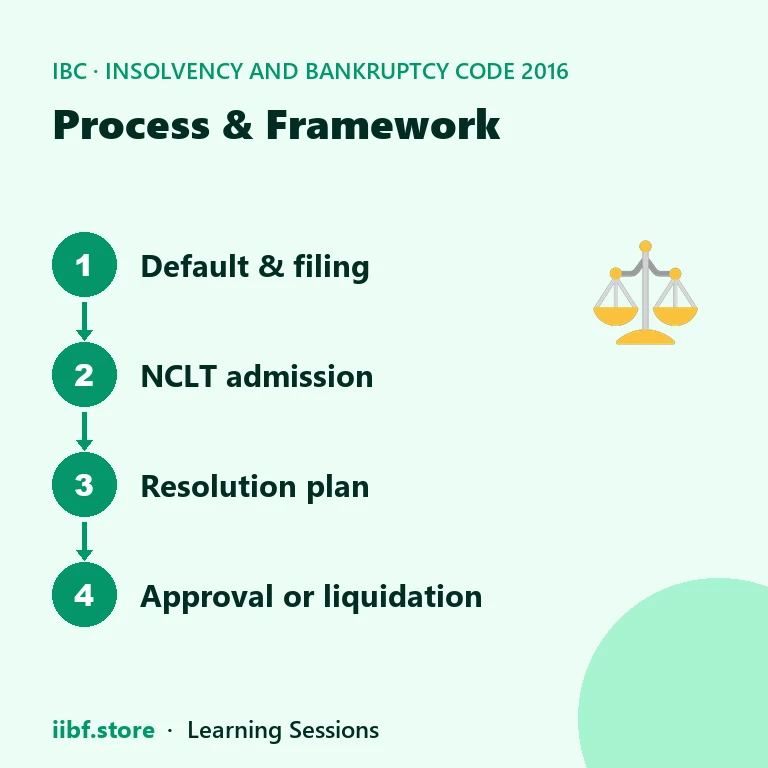
Notice that only IBBI has zero adjudicatory function — every other row in the table decides real cases. A bank officer preparing case studies on stressed-asset resolution should remember that filings, admissions and approvals always route through NCLT, with IBBI's rules operating quietly in the background as the procedural rulebook everyone must follow.
🔗 IBBI's Oversight Across the Insolvency Lifecycle
IBBI's footprint extends across the entire journey a stressed company travels, from the moment a creditor considers filing to the final distribution of proceeds. During the roles and duties of the IRP and RP, it is IBBI's Insolvency Resolution Process for Corporate Persons Regulations that dictate how claims must be invited, how the information memorandum is prepared, and how the resolution professional's fee is disclosed and approved by creditors.
Its oversight does not stop at the resolution stage. Liquidation regulations issued by IBBI govern how a liquidator realises assets and distributes proceeds once a resolution attempt fails, working alongside the statutory waterfall mechanism. Fast-track and pre-pack processes, where applicable, also run on procedural regulations that IBBI notifies and periodically updates — a reminder that even specialised, faster routes to resolution still answer to the same regulator.
For readers who want the full historical arc — why India moved from a fragmented recovery-law regime under SARFAESI and the DRT Act to a single unified code — the chapter on the evolution of the Insolvency and Bankruptcy Code traces that transition and explains why a dedicated regulator like IBBI was considered necessary in the first place.
⚠️ Common Mistake: Candidates often write that IBBI "approves" resolution plans. It does not — approval rests with the Committee of Creditors and, finally, NCLT. IBBI only prescribes the format and disclosure standards the plan must follow. For the full formation and voting mechanics, see our guide on the committee of creditors under IBC.
📜 Regulation-Making, Enforcement and Comparison with Other Regulators
IBBI's regulation-making power is exercised much like other financial-sector regulators exercise theirs — SEBI regulates market intermediaries and listed companies, RBI regulates banks and NBFCs, and IBBI regulates the insolvency profession and process. This comparative lens helps candidates who already understand SEBI's role in capital markets — for instance in the context of stock exchanges and depositories in India — quickly grasp what a "regulator" does versus what a "tribunal" does, since the same conceptual split repeats across the financial system.
On enforcement, IBBI can inspect and investigate insolvency professionals and IPAs, issue show-cause notices, and refer serious matters for disciplinary action, including suspension or cancellation of registration. It also has the power to call for records and conduct inspections of information utilities, since accurate default records feed directly into how quickly a case can be admitted. Separately, valuation of assets during a resolution process — a technical exercise governed by IBBI's own Registered Valuers framework — is covered in depth in our companion piece on valuation under IBC.
Candidates should also note that faster resolution routes, such as the one explained in our article on the fast track insolvency resolution process, still operate entirely within regulations that IBBI drafts and amends — reinforcing that no insolvency pathway in India sits outside IBBI's rule-making umbrella.
📌 Remember: IBBI = rule-maker and gatekeeper. NCLT/NCLAT = dispute-decider. CoC = commercial decision-maker. Keep these three roles separate and most "who does what" questions answer themselves.
For the official text of the provisions establishing and empowering IBBI, refer to the Insolvency and Bankruptcy Code, 2016 on India Code, and for how the banking regulator interacts with insolvency-linked stressed-asset resolution, see the Reserve Bank of India's prudential framework guidance.
🧠 Practice MCQs: IBBI as Insolvency Regulator
Q1. When was the Insolvency and Bankruptcy Board of India (IBBI) established? (a) 1 April 2016 (b) 1 October 2016 (c) 1 January 2017 (d) 1 December 2016
Answer: (b) — IBBI was constituted on 1 October 2016 under the Insolvency and Bankruptcy Code, 2016.
Q2. Which section of the IBC, 2016 provides for the establishment of IBBI? (a) Section 60 (b) Section 188 (c) Section 29A (d) Section 53
Answer: (b) — Section 188 of the Code establishes the Insolvency and Bankruptcy Board of India as a body corporate.
Q3. Which institution nominates a member to IBBI's Governing Board, reflecting close ties between insolvency regulation and banking? (a) SEBI (b) Reserve Bank of India (c) IRDAI (d) PFRDA
Answer: (b) — The Reserve Bank of India nominates a member to IBBI's Governing Board.
Q4. Who is the Adjudicating Authority for corporate insolvency cases, as distinct from IBBI's regulatory role? (a) IBBI itself (b) National Company Law Tribunal (NCLT) (c) Debts Recovery Tribunal (DRT) (d) SEBI
Answer: (b) — NCLT is the Adjudicating Authority under Section 60 for corporate insolvency; IBBI only regulates and frames rules.
Q5. How does IBBI primarily regulate individual insolvency professionals? (a) By directly issuing licenses to every professional (b) Through recognised Insolvency Professional Agencies (IPAs) that enrol members (c) Through NCLT registration (d) It does not regulate insolvency professionals at all
Answer: (b) — IBBI operates a two-tier model where IPAs enrol and discipline member professionals, while IBBI recognises and oversees the IPAs.
Want chapter-wise mock tests with 100+ MCQs? Start practising free →
Is IBBI a court or tribunal that decides insolvency cases?
No. IBBI is a regulatory body that frames rules and licenses professionals; disputes and approvals are decided by NCLT and, on appeal, by NCLAT.
What does IBBI stand for and when was it set up?
IBBI stands for the Insolvency and Bankruptcy Board of India. It was established on 1 October 2016 under Section 188 of the Insolvency and Bankruptcy Code, 2016.
Does IBBI directly license every insolvency professional?
No. IBBI recognises and supervises Insolvency Professional Agencies (IPAs), which in turn enrol, train and discipline individual insolvency professionals.
Can IBBI approve or reject a resolution plan?
No. A resolution plan is approved by the Committee of Creditors and then by NCLT. IBBI only prescribes the regulations governing the plan's format and disclosures.
For bank officers and CAIIB/JAIIB candidates, keeping IBBI as insolvency regulator conceptually separate from NCLT's adjudicating role and the Committee of Creditors' commercial decisions is the single highest-leverage distinction to master in this subject. Once that separation is clear, questions on registration of professionals, regulation-making, and enforcement powers become straightforward rather than confusing. Reinforce this with structured chapter-wise practice on iibf.store's CAIIB course or browse more insolvency topics on the IBC 2016 blog archive to keep building exam-ready command over this subject.
Quick quiz on this topic
5 exam-style questions from our free test bank — check yourself before you move on.
Practice this topic
Take a free mock test, download chapter PDFs, or watch a video class — all included on iibf.store.