Insolvency Commencement Date Under IBC: Full CAIIB Guide
Ask any recovery officer what the single most important date in a corporate insolvency file is, and most will point straight to the insolvency commencement date. Every clock in the process — the moratorium, the 330-day outer limit, even the look-back window for suspicious transactions — starts ticking from this one day, yet candidates routinely confuse it with the date a bank first files its application.
This guide sets the record straight on what that date actually is, how the National Company Law Tribunal (NCLT) fixes it, and why getting this single fact wrong can cost you marks in both the CAIIB and JAIIB papers that touch the Insolvency and Bankruptcy Code 2016. We will also look at where it sits inside the wider CIRP framework and the traps examiners like to set around it.
📅 What Exactly Is the Insolvency Commencement Date?
Under Section 5(12) of the Code, the insolvency commencement date (often shortened to ICD in study notes) is the date on which the Adjudicating Authority — the NCLT — passes an order admitting an application to initiate the corporate insolvency resolution process. It is not the date the creditor filed the application, and it is not the date of default. It is the date of the admission order itself.
This distinction matters because a company can face financial trouble for months before any petition is even filed, and the petition itself can sit before the NCLT for weeks or longer before a bench actually rules on it. Only the order date counts. Bankers preparing case studies around initiation of the corporate insolvency resolution process should treat this as the starting reference point for every subsequent calculation in the file.
⏱️ Why This Date Drives Every CIRP Deadline
Once the NCLT passes its admission order, the moratorium under Section 14 begins immediately from the ICD, freezing suits, asset transfers, and recovery actions against the corporate debtor. The interim resolution professional must also make a public announcement within three days of the ICD, inviting claims from creditors.
The outer boundary for completing the entire resolution process — 330 days including any extensions and litigation time — is likewise counted from the ICD, not from the filing date. Bankers who mix these two dates up tend to miscalculate how much runway a stressed account genuinely has left, which is exactly the kind of error a case-study question is designed to catch.
💡 Exam Tip: Whenever a question gives you both a filing date and an admission date, always anchor your timeline calculations to the admission date. That is the ICD, and it is the only one that matters for counting days.
🔍 The Look-Back Period for Avoidance Transactions
The ICD also serves as the reference point for spotting transactions the corporate debtor entered into before its collapse that unfairly favoured certain parties. The resolution professional must scan the company's books backward from this date to identify preferential, undervalued, and extortionate credit transactions.
This backward-looking review is one of the more technical duties assigned to the resolution professional, and it connects directly to the responsibilities covered under roles and duties of IRP and RP. Getting the look-back period wrong in an exam answer is a common and avoidable mistake.
⚠️ Common Mistake: Many candidates assume the insolvency commencement date is the date the creditor first noticed default, or the date the application was filed at NCLT. Both are wrong — it is strictly the date of the admission order passed by the Adjudicating Authority.
🏛️ How the NCLT Fixes the Date on Admission
When a financial creditor, operational creditor, or the corporate debtor itself files an application under Sections 7, 9, or 10, the NCLT first checks for completeness and the existence of a genuine default. If satisfied, it passes an admission order, and that order's date becomes the ICD recorded in the case file.
The distinction between who can file and what evidence is needed is covered in detail when comparing financial creditors vs operational creditors under IBC, since the two categories follow slightly different procedural routes to the same admission order. If the NCLT's order is later appealed, the appellate process itself is explained in the companion guide on NCLT and NCLAT under IBC.
📊 Timelines That Run From the ICD
The table below lines up the key events and deadlines that are all measured from the same starting point — the date the NCLT admits the case — so you can see at a glance how the entire CIRP calendar hangs off this single day.
| Event or Deadline | Counted From | Statutory Timeframe | Mandatory? |
|---|---|---|---|
| Public announcement of CIRP | ICD | Within 3 days | ✅ |
| Moratorium under Section 14 | ICD | Until CIRP concludes or liquidation order | ✅ |
| Preferential transaction look-back (related party) | ICD | 2 years prior | ✅ |
| Preferential transaction look-back (unrelated party) | ICD | 1 year prior | ✅ |
| Extortionate credit transaction review | ICD | 2 years prior | ✅ |
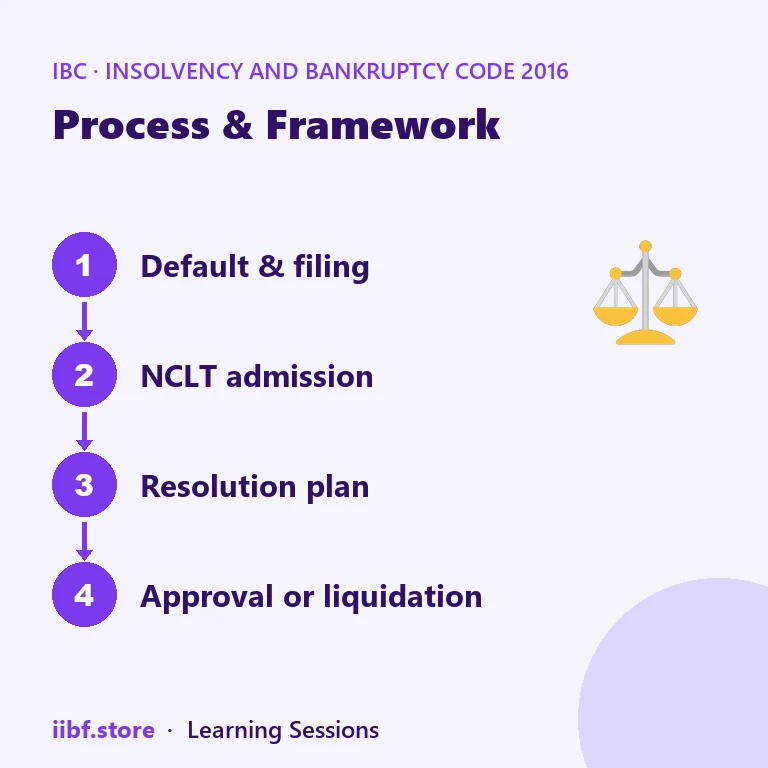
| Outer limit to complete CIRP | ICD | 330 days (including litigation) | ✅ |
Notice that the look-back periods differ for related and unrelated parties — a detail examiners like to test by swapping the two figures in a distractor option. If you want to see how these figures play out once a resolution attempt fails and the company moves to sale of assets, the liquidation process under IBC guide picks up exactly where this timeline ends.
📇 The Information Utility Trail Behind the Admission Order
Before the NCLT can be satisfied that a default genuinely occurred, it typically relies on authenticated records of default. This is where an information utility such as NeSL comes in, supplying a verified record that supports the creditor's application and speeds up the path to an admission order.
A stronger evidentiary trail before filing usually means a faster admission order, and therefore an earlier ICD, which is good for creditors who want the moratorium and the resolution clock to start sooner. The full mechanics of this evidence layer are explained in information utility NeSL IBC, a useful companion read before this one.
📌 Remember: The ICD equals the date of the NCLT's admission order under Section 7, 9, or 10 — never the filing date, never the default date.
Banks acting as financial creditors carry compliance obligations well beyond the insolvency file itself — for instance, the parallel disclosure duties discussed in RTI Act obligations for banks are worth knowing if you are studying BRBL alongside IBC. For the structural map of where this topic sits within the Code as a whole, revisit Chapter 4 — Structure of the IBC, and for the primary legal text and amendments, the Reserve Bank of India publishes circulars that reference how banks should treat accounts once this date is fixed. Every other article tagged under Insolvency and Bankruptcy Code 2016 on this blog builds on the same timeline logic explained here.
🧠 Practice MCQs: ICD Timelines
Q1. Under Section 5(12) of the IBC, the insolvency commencement date is: (a) The date the application is filed with NCLT (b) The date of first default by the corporate debtor (c) The date on which NCLT admits the CIRP application (d) The date the resolution professional is appointed
Answer: (c) — This date is fixed as the date on which the Adjudicating Authority passes the admission order, not the filing or default date.
Q2. Within how many days of the ICD must a public announcement of CIRP be made? (a) 1 day (b) 3 days (c) 7 days (d) 14 days
Answer: (b) — The public announcement inviting claims from creditors must be made within three days of admission.
Q3. The look-back period for reviewing preferential transactions with a related party is measured backward from the ICD as: (a) 6 months (b) 1 year (c) 2 years (d) 5 years
Answer: (c) — Transactions with related parties are scrutinised for up to 2 years before this date, compared with 1 year for unrelated parties.
Q4. The moratorium under Section 14 of the IBC comes into effect: (a) From the date of filing the application (b) From the ICD (c) Only after the resolution plan is approved (d) From the date the corporate debtor receives notice
Answer: (b) — The moratorium begins on admission and continues until the CIRP concludes or a liquidation order is passed.
Q5. The 330-day outer limit for completing CIRP, including time spent in litigation, is counted from: (a) The date of the first CoC meeting (b) The ICD (c) The date of public announcement (d) The date the resolution plan is submitted
Answer: (b) — The Supreme Court has upheld the 330-day outer limit measured from this date, including any time consumed in legal proceedings.
Want chapter-wise mock tests with 100+ MCQs? Start practising free →
❓ Frequently Asked Questions
What is the insolvency commencement date under IBC?
It is the date on which the NCLT passes an order admitting an application to begin the corporate insolvency resolution process against a corporate debtor, as defined under Section 5(12) of the Code.
Is this the same as the date of default?
No. The date of default is when the borrower first failed to pay, while the insolvency commencement date is the later date on which the NCLT formally admits the case — the two can be months or even years apart.
Why does this date matter for bank recovery teams?
It fixes the start of the moratorium that freezes recovery actions, sets the public announcement deadline, and determines the look-back window used to claw back preferential or undervalued transactions, so recovery teams need it recorded accurately from day one.
Does an appeal to NCLAT change this date?
No. Once the NCLT passes the admission order, the insolvency commencement date stands even if the order is later challenged before the NCLAT; only a reversal of admission itself would undo it.
The insolvency commencement date looks like a small definitional point, but it is the hinge every other IBC timeline swings on — get this one date right and the moratorium, look-back periods, and CIRP deadlines all fall into place logically. Sharpen your recall with full-length mock tests on the CAIIB course page before you sit for the exam.
Prefer revising from a printed book?
Chapter-wise books with MCQs after every chapter — minimal pages, complete coverage, delivered anywhere in India. Every book has a free sample to read first.


























Quick quiz on this topic
5 exam-style questions from our free test bank — check yourself before you move on.
Practice this topic
Take a free mock test, download chapter PDFs, or watch a video class — all included on iibf.store.